Bible Facts & Stats
Authors, Numbers, and Amazing Facts

Bible Books & Authors: The Divine-Human Authorship of Scripture
A comprehensive theological and historical exposition of how God inspired more than 40 human authors across 1,500 years to produce one unified divine revelation.
Read Full Study →
10 Longest Books in the Bible (By Word Count & Chapters)
What are the longest books in the Bible? An authoritative analysis ranking the top 10 books in Scripture by original Hebrew and English word counts and chapters.
Read Full Study →
10 Shortest Books in the Bible (By Word Count & Verses)
What is the shortest book in the Bible? An authoritative ranking of the top 10 shortest books in Scripture—from 3 John and 2 John to Philemon and Obadiah.
Read Full Study →
General Bible Statistics: The Master Numbers of the Biblical Canon
A comprehensive reference guide to the quantitative architecture of the Bible: chapter and verse counts, linguistic distribution, center chapters, and historical milestones.
Read Full Study →
Old Testament Statistics: The Hebrew Tanakh in Numbers
A quantitative and textual breakdown of the 39 Old Testament books, the Hebrew Tanakh divisions, scribal statistics, and textual transmission history.
Read Full Study →
New Testament Statistics: The Apostolic Canon in Numbers
A quantitative analysis of the 27 New Testament books: chapter divisions, apostolic author contributions, Greek manuscript evidence, and historical milestones.
Read Full Study →
Composition & History of the Bible: The Journey from Papyrus to Print
The historic chronicle of how the Holy Scriptures were inscribed, preserved through persecution, discovered in Qumran, translated into English and Tamil, and printed for the world.
Read Full Study →
The Extreme Verses & Chapters of the Bible: Shortest, Longest, and Center Points
An exhaustive scholarly analysis of the quantitative extremes of the biblical canon, investigating the shortest and longest verses across original Hebrew, Aramaic, and Greek manuscripts, the shortest and longest chapters, the mathematical center of Scripture, and the historical origin of chapter and verse divisions.
Read Full Study →
Biblical Currencies, Weights & Measures: Ancient Economics Converted to Modern Value
A comprehensive economic and archaeological guide converting biblical currencies, weights, and measurements—including the 30 pieces of silver paid to Judas, the unpayable 10,000 talents, the Roman denarius, the widow’s mites, and the sacred cubit—into modern purchasing power.
Read Full Study →
Animals, Birds & Mysterious Creatures of the Bible: Zoology, Symbolism, and Levitical Laws
An exhaustive biblical-zoological investigation examining over 130 species of animals and birds across Scripture, the enigmatic identity of Job's Behemoth and Leviathan, the dietary hygiene and spiritual rationale of Levitical clean and unclean taxonomy, and the profound messianic symbolism of the Lion of Judah and the Lamb of God.
Read Full Study →
Patriarchal Lifespans & Ages in the Bible: From Methuselah to Moses
An exhaustive demographic, scientific, and theological analysis of patriarchal longevity in Scripture, tracing the antediluvian pre-flood era where men lived over 900 years, the post-flood exponential decay curve, the significance of Methuselah's 969 years, Enoch's translation, and Moses' declaration of human lifespan in Psalm 90.
Read Full Study →
The 7 Feasts of Israel: Prophetic Shadows, Agricultural Cycles & Fulfillment
A comprehensive prophetic, agricultural, and theological analysis of the seven feasts of Yahweh in Leviticus 23 (Passover, Unleavened Bread, Firstfruits, Pentecost, Trumpets, Day of Atonement, and Tabernacles), examining how the Spring feasts were fulfilled at Christ's first coming and the Fall feasts prefigure His return and millennial reign.
Read Full Study →
Sacred Mountains of the Bible: Sinai, Moriah, Carmel, Hermon & Olives
An exhaustive geographic, archaeological, and theological exploration of the sacred peaks of Scripture—including Mount Ararat, Mount Moriah, Mount Sinai (Horeb), Mount Nebo, Mount Carmel, Mount Hermon, and the Mount of Olives—tracing where heaven touched earth and covenantal history was forged.
Read Full Study →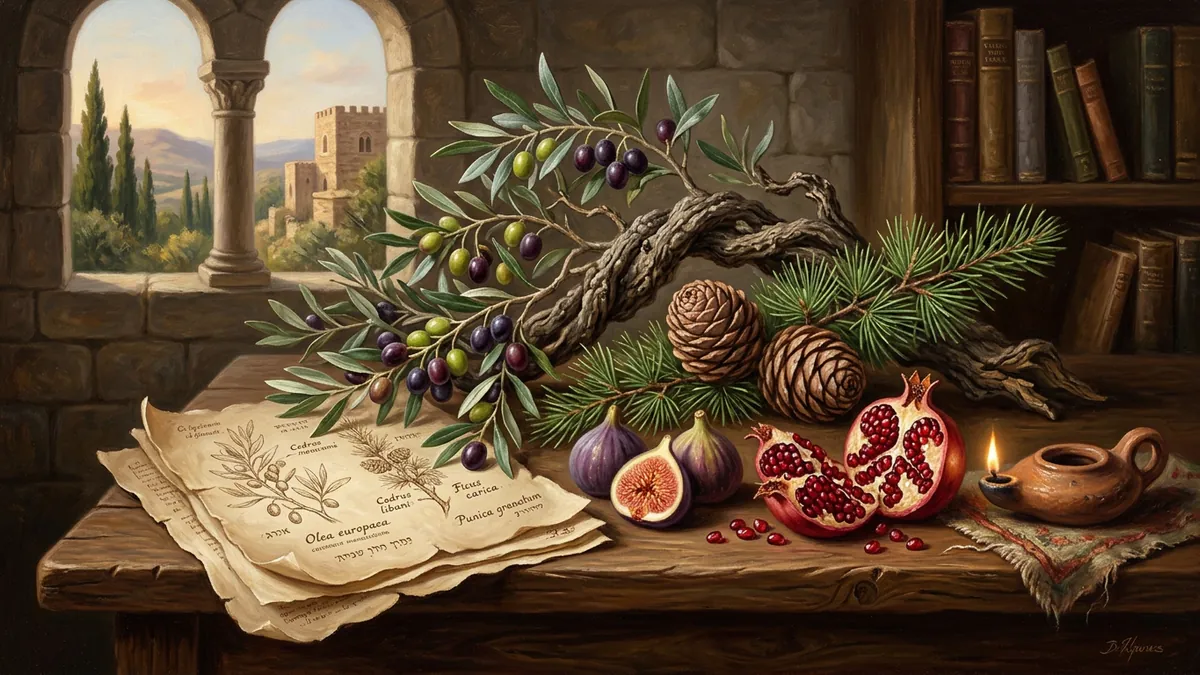
Trees, Plants & Sacred Botany of the Bible: From the Cedar of Lebanon to the Mustard Seed
An exhaustive botanical, agricultural, and theological study of over 120 plants, trees, and spices mentioned in Scripture—including the Olive tree, the Cedar of Lebanon, the Fig tree, the Pomegranate, the Mustard seed, Frankincense, Myrrh, and Hyssop—exploring their agronomic characteristics, cultural uses, and profound messianic symbolism from Eden's Tree of Life to the New Jerusalem.
Read Full Study →
Musical Instruments of the Bible: The Levite Orchestra & Temple Worship
An exhaustive musicological, archaeological, and theological exploration of the sacred musical instruments of Scripture—including David's Kinnor lyre, the Nevel harp, the ram's horn Shofar, silver trumpets (Chatzotzerot), bronze cymbals, timbrels, and flutes—tracing how King David organized the 4,000-man Levite temple orchestra, the acoustic architecture of the Temple, and the cosmic doxology of Psalm 150.
Read Full Study →Theological & Historical Study Guide
The Holy Bible is the most scrutinized, revered, and extraordinary literary work in human history. Comprising 66 individual books (39 in the Old Testament, 27 in the New Testament), written across 1,500 years by more than 40 human authors—ranging from kings and scholars to fishermen and shepherds—it exhibits an unbroken thematic unity that defies human explanation.
Statistical milestones reveal its sacred architecture: 1,189 chapters, 31,102 verses, with Psalm 117 as the shortest chapter, Psalm 119 as the longest, and John 11:35 ("Jesus wept") as the shortest verse. Furthermore, thousands of ancient manuscript witnesses—including the 2,000-year-old Dead Sea Scrolls and 5,800+ Greek New Testament manuscripts—demonstrate that the text has been preserved with unmatched textual purity.
The translation of the Scriptures is a global movement. Notably, Tamil holds the historic distinction of being the first Indian and Asian language to receive a printed translation of the New Testament (Tranquebar, 1714 AD). Bible Hunger celebrates this heritage, providing believers with factual, historical, and statistical evidence for the divine origin of the Scriptures.
Foundational Principles & Themes
The Architecture of the 66 Books
Written over 1,500 years across 3 continents in 3 languages by 40+ authors, the Bible tells one single cohesive story of redemption.
The Dead Sea Scrolls & Textual Integrity
Discovered in 1947 at Qumran, the scrolls confirmed that modern Old Testament translations are virtually identical to texts from 2,000 years ago.
Hebrew, Aramaic & Koine Greek Origins
Composed in ancient Hebrew (OT), Aramaic (Daniel & Ezra), and universal Koine Greek (NT), the Scriptures met humanity in precise cultural languages.
1714 AD: First Indian Bible Translation in Tamil
Bartholomäus Ziegenbalg printed the Tamil New Testament at Tranquebar in 1714, making Tamil the first language in Asia to receive the printed Word of God.
Biblical Questions & Exegetical Answers
Who divided the Bible into chapters and verses, and when?
Stephen Langton, Archbishop of Canterbury, divided the Bible into chapters around 1227 AD. Robert Estienne (Stephanus), a French printer, introduced the standard verse numbering in his 1551 Greek New Testament and 1553 French Bible.
What is the oldest complete manuscript of the Christian Bible in existence?
Codex Sinaiticus (dating to approximately 330–360 AD), preserved in Greek on animal parchment (vellum), contains the oldest complete New Testament and substantial portions of the Old Testament Septuagint.
How many languages have the Bible translated into today?
According to the United Bible Societies and Wycliffe Global Alliance, the complete Bible is available in over 736 languages, the New Testament in an additional 1,650+ languages, and portions in over 1,250 languages, reaching over 7 billion people.