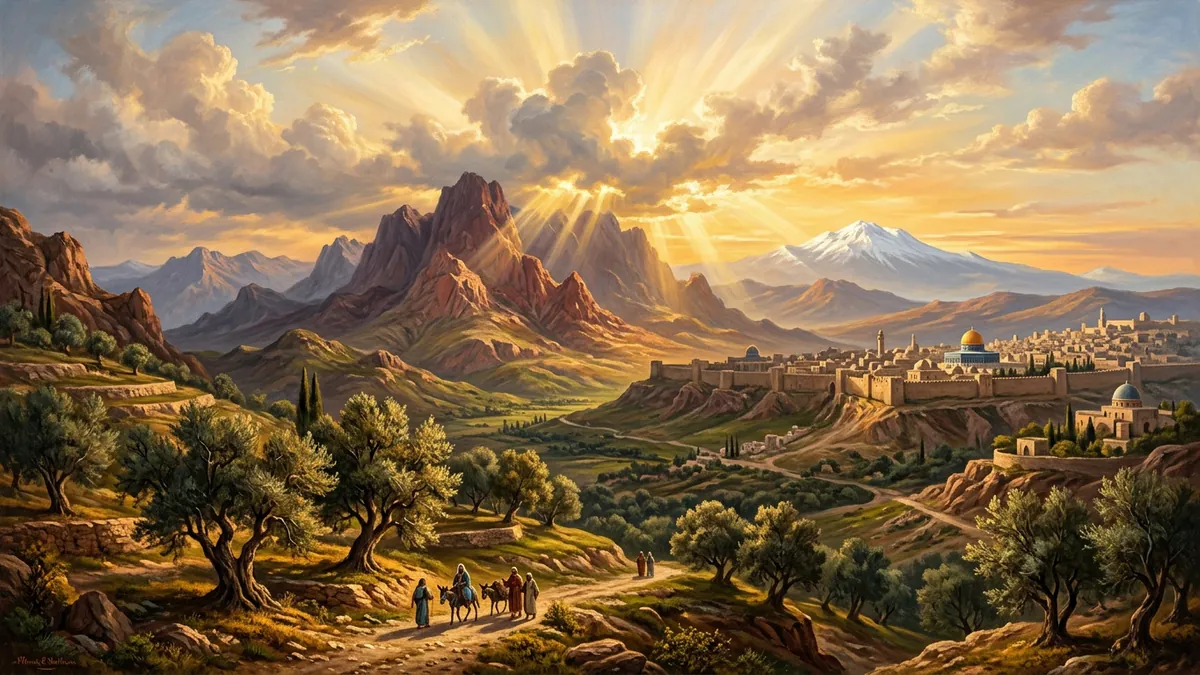
Throughout the redemptive drama of Holy Scripture, mountains serve far beyond mere dramatic physical landscapes. They are the supreme geographic altars of history—elevated terrestrial summits where the unapproachable holiness of Yahweh intersected mortal earth, where eternal covenants were cut in blood and stone, and where apocalyptic turning points were enacted. From the misty heights of Mount Ararat where Noah’s ark came to rest to the jagged granite crags of Mount Sinai where the Law thundered, and from the craggy ridge of Mount Moriah to the wind-swept summit of the Mount of Olives where Christ ascended and will return, mountains embody the majesty, stability, and transcendence of God.
Highest Biblical Peak
The Lawgiver's Summit
The Temple Ridge
The Prophetic Mountain
1. Master Comparison of the Major Biblical Mountains
The major sacred mountains of the Old and New Testaments each anchor a pivotal dispensation of covenant history:
2. Mount Sinai (Horeb): The Forge of the Covenant
Called the "Mountain of God" (Har HaElohim), Mount Sinai is the definitive summit of the Old Covenant. Here, Moses encountered the miraculous unconsumed Burning Bush (Exodus 3:1–6). Fifty days after the Exodus from Egypt, the entire nation of three million Israelites assembled at its base.
Exodus 19:16–18 describes an awesome theophany: the mountain was wrapped in dense smoke because Yahweh descended upon it in fire. Its smoke ascended like the smoke of an industrial furnace, thunder and lightning split the heavens, a celestial shofar blast grew louder and louder, and the entire granite massif shook violently. Here God gave the Ten Commandments (the Decalogue) and the architectural blueprints for the Tabernacle.
Centuries later, an exhausted, depressed Prophet Elijah fled 40 days through the desert back to this exact same mountain (1 Kings 19). Standing in a cave cleft on Mount Horeb, Elijah witnessed a hurricane wind that shattered rocks, an earthquake, and a roaring fire—yet God was not in the storm. Instead, Yahweh spoke in Qol Demamah Daqqah—a "still small voice" or gentle whisper, revealing that divine sovereignty operates not merely in terrifying cataclysms, but in quiet, persistent fidelity.
3. Mount Moriah: The Crimson Thread of Substitution
No single mountain ridge carries greater redemptive weight than Mount Moriah. In Genesis 22:2, God commanded Abraham: "Take now your son, your only son Isaac, whom you love, and go to the land of Moriah, and offer him there as a burnt offering upon one of the mountains which I will tell you of."
For three agonizing days, Abraham journeyed toward this specific summit. When Isaac asked the piercing question, "Behold the fire and the wood: but where is the lamb for a burnt offering?", Abraham uttered history’s greatest prophetic declaration: "God will provide Himself a lamb for a burnt offering, my son" (Genesis 22:8). As the sacrificial knife was raised, the Angel of the Lord halted him, providing a ram caught by its horns in a thicket. Abraham named the summit Yahweh-Yireh: "In the Mount of the Lord it shall be provided."
One thousand years later, King David purchased the threshing floor of Araunah the Jebusite on this exact Moriah ridge to halt a plague (2 Samuel 24). There, his son King Solomon constructed the glorious First Temple (2 Chronicles 3:1). And just outside the northern gate of that same Moriah limestone ridge, at a quarry knoll called Golgotha (Calvary), God fulfilled Abraham’s prophecy by offering His only Son, Jesus Christ, as the ultimate, unspared sacrificial Lamb!
4. Mount Carmel: The Showdown of Consuming Fire
Rising steeply above the Mediterranean Sea and the Jezreel Valley, Mount Carmel (meaning "Garden Land" or "Orchard") became the stage for ancient Israel's most dramatic theological confrontation. In 1 Kings 18, under the apostate reign of King Ahab and Queen Jezebel, the nation was ensnared in Baal worship.
Elijah challenged 450 prophets of Baal and 400 prophets of Asherah to a contest of fire: "The God who answers by fire, He is God." After pagan prophets danced, screamed, and lacerated themselves with lances from morning till evening without an answer, Elijah repaired the broken altar of Yahweh with twelve stones, dug a massive trench, and drenched the sacrifice three times with four barrels of water (twelve barrels total). At the time of the evening sacrifice, Elijah prayed a concise 63-word prayer. Instantly, the fire of Yahweh fell from heaven, consuming the sacrifice, the wood, the stones, the dust, and licking up all the water in the trench. Falling on their faces, the terrified populace cried: "Yahweh, He is God! Yahweh, He is God!" (1 Kings 18:39).
5. The Mount of Olives: From Gethsemane to the Second Coming
Directly east of Jerusalem, across the Kidron Valley, stands the two-mile limestone ridge of the Mount of Olives (Har HaZeitim). Standing 300 feet higher than the Temple Mount, it offers a breathtaking panoramic view of the Holy City.
No mountain is more intimately bound to Jesus Christ:
- The Olivet Discourse: Seated upon its western slope overlooking the Temple, Jesus delivered His monumental prophetic sermon concerning the end of the age and His return (Matthew 24–25).
- The Garden of Gethsemane: Nestled at its base amidst ancient olive trees, Jesus underwent the visceral agony of prayer, sweating great drops of blood as He accepted the cup of divine wrath (Luke 22:39–46).
- The Ascension: In Acts 1:9–12, following His resurrection, Jesus led His disciples out as far as Bethany on the eastern slope of the Mount of Olives. While blessing them, He ascended bodily into heaven in a cloud of Shekinah glory. Angels promised: "This same Jesus... will so come in like manner as you saw Him go into heaven."
- The Climax of History: Zechariah 14:4 prophesies that at the climax of the Battle of Armageddon, the physical feet of the returning Messiah will touch down upon this exact mountain: "And His feet will stand in that day on the Mount of Olives, which faces Jerusalem on the east. And the Mount of Olives shall be split in two from east to west, making a very large valley."
Biblical Keywords & Theological Roots
A mountain, hill range, or elevated peak; throughout biblical theology, the primary geographic meeting place between the transcendent Creator and mortal humanity.
Sinai; jagged thorn-bush summit; the rugged granite mountain in the wilderness where Yahweh descended in smoke and lightning to deliver the Torah.
Moriah; 'Chosen by Yahweh' or 'Provision of God'; the sacred Jerusalem ridge where Abraham bound Isaac and Solomon erected the Holy Temple.
Hermon; consecrated sanctuary, towering peak; northern snow-capped summit of the Anti-Lebanon range (9,232 ft) symbolizing abundant life-giving dew.
Support Independent Biblical Research
Did this study bless you? Help support our independent bilingual research and interactive visual Bible tools.
⚡ Fast Facts
- Mount Ararat is the highest mountain mentioned in the Bible (16,854 ft), where Noah's Ark rested after 150 days of the Deluge.
- Mount Moriah is the sacred Jerusalem ridge uniting Abraham's sacrifice of Isaac, Solomon's Temple, and Christ's crucifixion at Golgotha.
- On Mount Carmel, God answered Elijah's 63-word prayer by sending supernatural fire that consumed the water-soaked sacrifice and the stones.
- Zechariah 14:4 prophesies that at the Second Coming, Christ's feet will stand upon the Mount of Olives, splitting the mountain in two from east to west.
❓ Frequently Asked Questions (FAQs)
Why did God choose mountains as the primary location for covenants?
In biblical theology, mountains symbolize transcendence, sanctuary, and stability. Rising above the corruption of worldly plains, mountain summits provided quiet, solitary environments where God could reveal His glory without human distraction. From Sinai to Moriah, mountains visually illustrated the infinite chasm between holy heaven and fallen earth, demonstrating that true communion with God requires ascending into His consecrated presence.
Where is the true Mount Sinai located geographically?
Traditionally since the 4th century AD, Mount Sinai has been identified with Jebel Musa (7,497 ft) in the southern Sinai Peninsula of Egypt, where Saint Catherine's Monastery was built. However, several modern scholars and explorers argue for Jabal al-Lawz in ancient Midian (northwestern Saudi Arabia), based on Paul’s statement in Galatians 4:25 that 'Mount Sinai is in Arabia' and Moses’ historical connection to Midian (Exodus 3:1). Both sites preserve compelling geographical and archaeological arguments.
Why did Moses die on Mount Nebo without entering the Promised Land?
In Numbers 20, when Israel thirsted at Meribah, God commanded Moses to speak to the rock. In frustration and anger, Moses struck the rock twice and cried, 'Must we fetch you water out of this rock?', failing to sanctify God's holy name before the people. In biblical typology, the Rock represented Christ, who was to be struck only once (at Calvary) and thereafter spoken to in prayer. Moses dying on Mount Nebo illustrates that the Mosaic Law can bring believers to the edge of the promise, but only Joshua (Yeshua/Jesus) can lead them into the spiritual inheritance of grace.