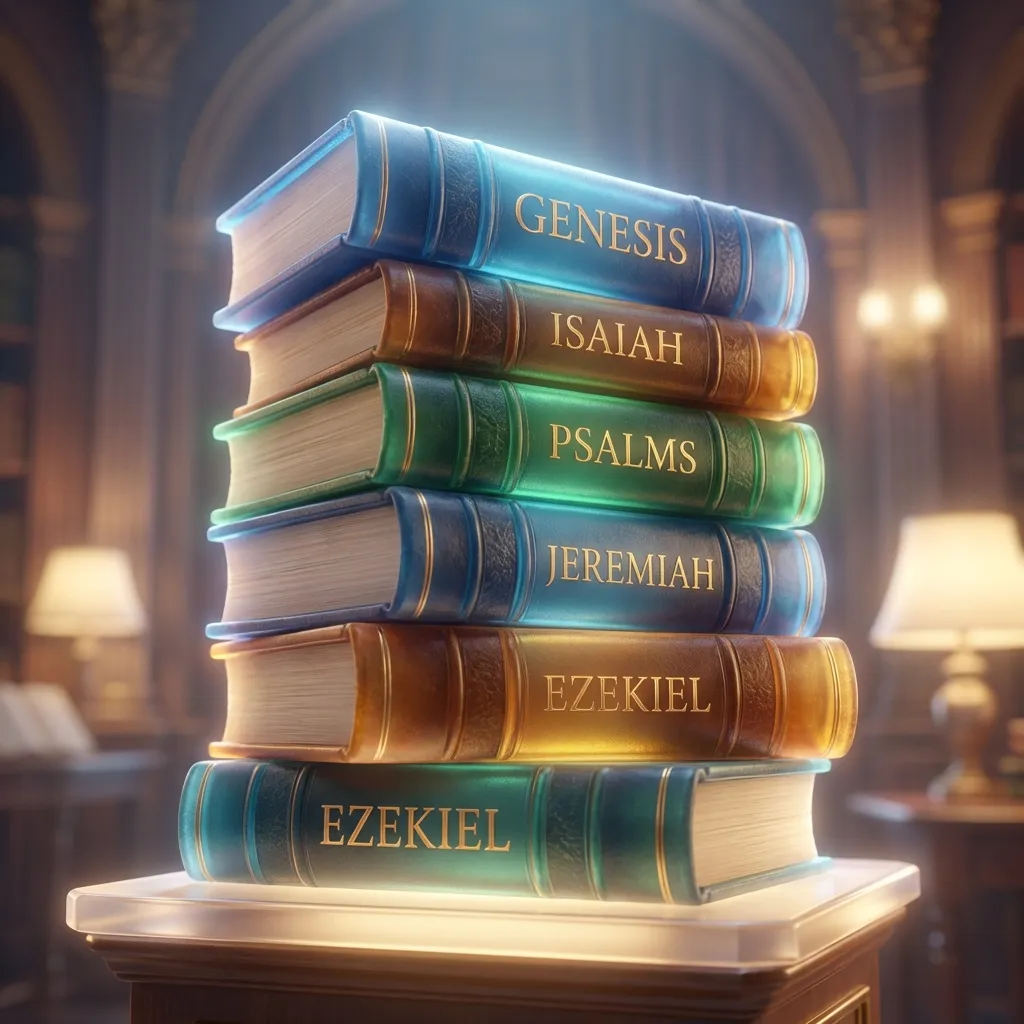
When determining the "longest" books in the Holy Bible, scholars distinguish between two different metrics: chapter count and raw word count in the original languages (Hebrew and Greek). While the Book of Psalms boasts the highest chapter count (150 chapters), the prophet Jeremiah actually contains the greatest number of words in the original Hebrew manuscript text. These monumental works stand as the theological pillars of Scripture, detailing God's majesty, covenant judgments, and redemption across generations.
1. The Top 10 Longest Books Ranked by Word Count
The following chart illustrates the ten largest books in the Protestant canon based on English word counts (KJV translation baseline) alongside their chapter dimensions:
2. Detailed Exegesis of the Top Literary Giants
1. Psalms (150 Chapters / ~43,743 words)
The Book of Psalms (Hebrew: Tehillim, "Praises") is the anatomy of the human soul. Composed over a thousand years by David, Asaph, Moses, the sons of Korah, and anonymous levitical singers, it is structured into Five Books mirroring the five books of the Torah (Book 1: Ps 1–41; Book 2: Ps 42–72; Book 3: Ps 73–89; Book 4: Ps 90–106; Book 5: Ps 107–150). Each subsection concludes with a doxology. It encompasses every human emotion—from the agonizing depths of messianic lament (Psalm 22) to ecstatic cosmic praise (Psalm 150).
2. Jeremiah (52 Chapters / ~42,659 words in English; #1 in Hebrew)
In the original Hebrew Bible, Jeremiah contains approximately 33,002 Hebrew words, making it longer than Psalms in the original language. Jeremiah ministered during the death throes of the Southern Kingdom of Judah, weeping over Jerusalem's impenitence. His scroll, written down by Baruch, contains blistering prophetic warnings of the Babylonian exile, personal confessions of despair, and the climactic jewel of Old Testament theology: the promise of the New Covenant (Jeremiah 31:31–34).
3. Ezekiel (48 Chapters / ~39,407 words)
Written by the priest Ezekiel while exiled by the River Chebar in Babylon, this book is an apocalyptic masterpiece. It opens with the chariot-throne vision of Yahweh's glory (Ezekiel 1), records the tragic departure of the Shekinah glory from Solomon's defiled temple (Ezekiel 10), proclaims the resurrection of Israel in the Valley of Dry Bones (Ezekiel 37), and concludes with an immense nine-chapter architectural blueprint of the restored cosmic Temple (Ezekiel 40–48).
4. Genesis (50 Chapters / ~38,267 words)
The seedbed of all biblical doctrine. Genesis spans more historical time (from Creation to the death of Joseph in Egypt) than all the remaining 65 books of the Bible combined. It transitions from primeval history (Creation, Fall, Flood, Babel) to patriarchal covenant history (Abraham, Isaac, Jacob, Joseph), demonstrating God's sovereign election of a chosen family through whom all nations would be blessed.
5. The Gospel of Luke (24 Chapters / ~25,944 words)
The only New Testament book among the top ten. Dr. Luke wrote the longest gospel, characterized by classical Greek historiography, exhaustive investigative research (Luke 1:1–4), and a passionate emphasis on the poor, outcasts, women, prayer, and the Holy Spirit. When combined with its companion volume, the Book of Acts (24,250 words), Luke’s two-volume work represents over 27% of the entire New Testament—surpassing the total volume of all thirteen Pauline epistles combined.
3. The Theological Purpose of Expansive Scripture
Why did the Holy Spirit inspire such massive literary works? Because God's redemptive plan is deep, multi-generational, and historically anchored. Redemption is not a simplistic slogan; it required detailed covenants, exhaustive moral instructions, historical chronicles, and expansive prophetic visions to prepare the human heart for the coming of Jesus Christ.
Biblical Keywords & Theological Roots
Psalm, sacred song, liturgical melody accompanied by stringed instruments; the descriptive title given to 57 individual psalms in the Psalter.
Scroll, roll of parchment; in antiquity, colossal books like Jeremiah or Ezekiel occupied an entire continuous leather scroll.
Book, document, scroll, historical register; authoritative written covenant record preserved for future generations.
Word, treatise, divine discourse; used by Luke to introduce his expansive two-volume historical work (Luke-Acts).
Support Independent Biblical Research
Did this study bless you? Help support our independent bilingual research and interactive visual Bible tools.
⚡ Fast Facts
- In the original Hebrew text, Jeremiah contains the most words of any biblical book (approx. 33,002 Hebrew words), slightly exceeding Psalms.
- The Book of Psalms has the highest chapter count in the entire Bible with 150 individual psalms, structured into five distinct books.
- The Gospel of Luke is the longest single book in the New Testament with 25,944 English words across 24 chapters.
- Combined, Luke's two volumes (Luke and Acts) make up more than 27% of the entire New Testament, more than all of the Apostle Paul's letters combined.
❓ Frequently Asked Questions (FAQs)
Why is Jeremiah longer than Psalms in Hebrew, but Psalms is longer in English?
Hebrew is an agglutinative Semitic language where prepositions, conjunctions, and pronominal suffixes attach directly to words. Because Jeremiah contains dense prose paragraphs, it contains more raw Hebrew words. In English translations, poetic formatting, chapter headers, and musical inscriptions (like 'Selah') cause Psalms to expand to more English words.
Why are 1 & 2 Kings and 1 & 2 Chronicles divided into two books each?
Originally in the Hebrew canon, Samuel, Kings, and Chronicles were each single, massive scrolls. When they were translated into Greek (the Septuagint) around 250 BC, Greek vowels required significantly more parchment space. A single leather scroll could no longer physically hold the entire text, so translators divided each work into two scrolls.
How long would it take to read the longest book of the Bible out loud?
Reading the Book of Psalms (150 chapters) at a normal speaking pace of approximately 130 to 150 words per minute takes between 4.5 to 5 hours. Reading Jeremiah takes approximately 4.5 hours, and reading the Gospel of Luke takes approximately 2.5 hours.