From the opening chapters of Genesis where God plants the Garden of Eden with "every tree that is pleasant to the sight and good for food" to the final vision of Revelation where the Tree of Life yields twelve manner of fruits whose leaves are for the healing of the nations, the Holy Bible is immersed in sacred botany. Scripture references more than 120 distinct plant species, ranging from majestic hundred-foot mountain cedars to tiny mustard seeds and fragile hyssop clinging to stone walls. Biblical authors employed the agronomy, botanical resilience, and physiological lifecycles of these flora to articulate profound theological truths concerning covenant blessings, spiritual fruitfulness, divine judgment, and messianic redemption.
Biblical Plant Species
The King of Trees
Smallest Parabolic Seed
The Seven Species
1. Master Taxonomy of the Most Important Biblical Trees & Plants
Ancient Israel's economy, religious ritual, and dietary sustenance rested upon a rich variety of native Levantine flora:
2. The Olive Tree: The King of the Forest
In Jotham’s ancient political fable (Judges 9:8–9), when the trees assembled to anoint a king over themselves, they immediately approached the olive tree. The olive tree declined, asking: "Should I leave my fatness, wherewith by me they honor God and man, and go to be promoted over the trees?"
The olive tree is virtually indestructible. Its roots penetrate deeply into barren limestone fractures, and when its trunk is cut down or burned by invading armies, new shoots (netzer) emerge vigorously from the root base. A single gnarled olive tree can live for more than two thousand years, as seen in the Garden of Gethsemane today.
In Scripture, olive oil was the essential fuel for the golden Menorah inside the Holy Place, requiring pure beaten oil from hand-crushed olives (Exodus 27:20). It formed the sacred base of the holy anointing oil poured over the heads of kings and priests (Exodus 30:23–25). In Romans 11:17–24, the Apostle Paul constructs his supreme ecclesiastical metaphor: Israel is the cultivated olive tree, while Gentile believers are wild olive shoots supernaturally grafted into the root and fatness of the rich covenant heritage.
3. The Cedar of Lebanon: Durability and Royal Splendor
Towering high in the snow-dusted mountains of Lebanon at elevations between 4,000 and 7,000 feet, the Cedar of Lebanon (Cedrus libani) was revered as the aristocrat of ancient Near Eastern timber. Growing up to one hundred feet tall with trunks exceeding forty feet in circumference, its fragrant, resin-rich wood is naturally resistant to fungal decay, moisture, and boring insects.
King Solomon entered a massive trade agreement with King Hiram of Tyre, sending 30,000 Israelite woodcutters and 80,000 stone hewers to float giant cedar logs down the Mediterranean coast to Joppa to construct the First Temple in Jerusalem (1 Kings 5). The entire interior of the Holy Place was paneled with cedar, carved with gourds and open flowers, and overlaid with pure gold: "there was no stone seen" (1 Kings 6:18).
The psalmist drew a direct spiritual parallel in Psalm 92:12: "The righteous shall flourish like the palm tree: he shall grow like a cedar in Lebanon." While weeds sprout overnight and wither in the summer drought, the cedar grows slowly across centuries, sending anchor roots deep into the mountain rock, standing tall against screaming blizzard winds—a vivid picture of mature, enduring, unshakeable faith.
4. Spices of Redemption: Frankincense, Myrrh, and Hyssop
The biblical narrative is suffused with aromatic resins and therapeutic spices that carry deep christological prophecies:
- Frankincense (Levonah): A white aromatic gum resin harvested by incising the bark of the Boswellia tree in Southern Arabia. Exclusively reserved for the golden Altar of Incense (Exodus 30:34) and presented by the Magi to the infant Christ (Matthew 2:11), it symbolizes the fragrance of acceptable prayer and Christ’s eternal High Priesthood.
- Myrrh (Mor): A bitter, fragrant gum resin gathered from the spiny Commiphora tree. Used in the sacred anointing oil (Exodus 30:23), as royal perfume (Psalm 45:8), and as a burial embalming spice. At Jesus' birth, the Magi presented myrrh, foretelling His death; on the Cross, He was offered wine mingled with myrrh to numb pain, which He refused (Mark 15:23); and at His burial, Nicodemus brought one hundred pounds of myrrh and aloes to wrap His body (John 19:39).
- Hyssop (Ezov): In Exodus 12:22, God commanded the Hebrews in Egypt to take a bunch of hyssop, dip it in the basin of sacrificial lamb's blood, and strike the lintel and two side doorposts. Centuries later, David wept in Psalm 51:7: "Purge me with hyssop, and I shall be clean: wash me, and I shall be whiter than snow." At Golgotha, when Christ cried "I thirst," soldiers put a sponge filled with sour wine on a stalk of hyssop and lifted it to His lips (John 19:29), completing the circle of blood and water.
5. The Tree of Life: From Genesis to Revelation
The overarching storyline of Holy Scripture is beautifully framed by two trees. In Genesis 2:9, the Tree of Life (Etz HaChayyim) stood at the center of Eden, offering immortality in unbroken fellowship with God. When humanity sinned, access to this tree was sovereignly barred by cherubim with a flaming sword to prevent fallen humans from living forever in a state of eternal corruption (Genesis 3:24).
The crimson bridge between these two paradises is the Cross of Calvary, which the New Testament authors repeatedly refer to as a "tree" (Greek: xylon; Acts 5:30; 1 Peter 2:24; Galatians 3:13). On the barren wooden tree of crucifixion, Christ took the curse of human sin upon Himself.
Finally, in Revelation 22:2, the Tree of Life reappears in the New Jerusalem, flourishing on both sides of the river of the water of life, bearing twelve manner of fruits every month: "and the leaves of the tree were for the healing of the nations." What was lost in the first garden through disobedience is eternally restored in the city of God through the Lamb!
Biblical Keywords & Theological Roots
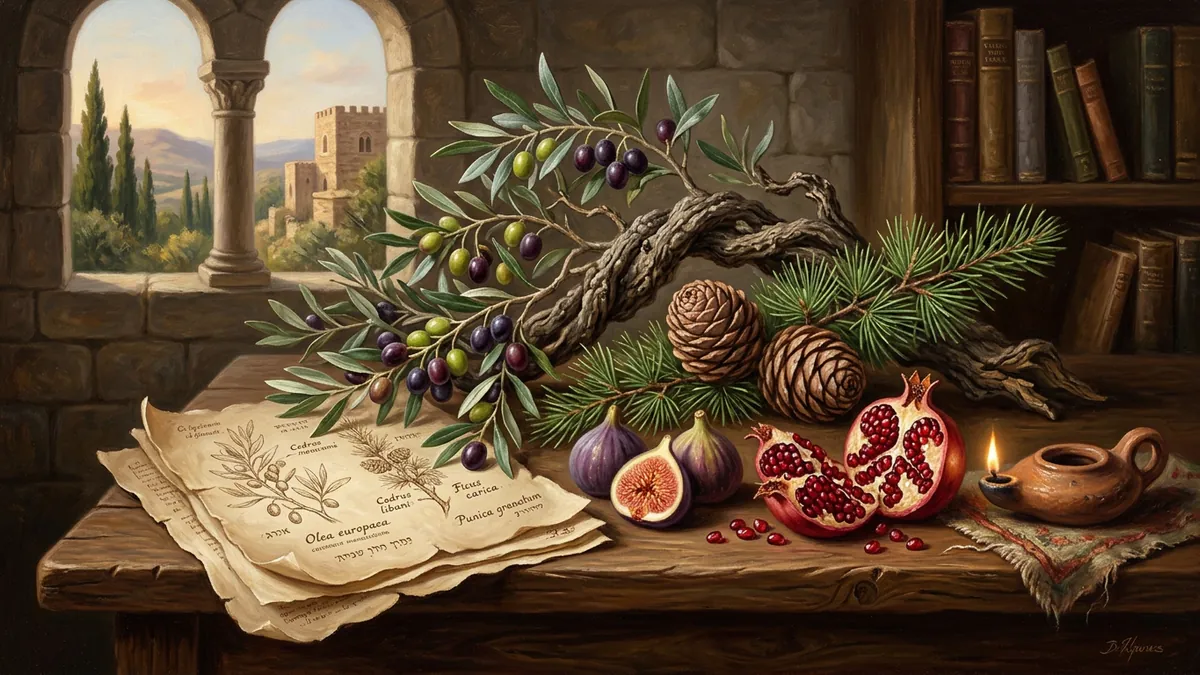
Olive tree, olive fruit; foundational plant of the Promised Land yielding pure golden oil for sanctuary lamps, royal anointing, and food.
Cedar (Cedrus libani); colossal, fragrant, rot-resistant evergreen wood used by Solomon to construct the Holy Temple and royal palaces.
Fig tree; broad-leafed Mediterranean fruit tree representing national prosperity, domestic tranquility ('under his own fig tree'), and spiritual fruitfulness.
Hyssop (Majorana syriaca); aromatic medicinal herb growing in rocky walls, mandated by Mosaic Law for sprinkling covenant blood and cleansing lepers.
Support Independent Biblical Research
Did this study bless you? Help support our independent bilingual research and interactive visual Bible tools.
⚡ Fast Facts
- The Bible mentions more than 120 plant species, with the olive tree referenced over 300 times as the symbol of peace, light, and anointing.
- Cedar of Lebanon trees can live for millennia; their insect-proof, aromatic wood was used by Solomon to construct the Holy Temple in Jerusalem.
- The microscopic mustard seed (1 mm) grows into an enormous 10-to-12-foot shrub, illustrating the exponential global expansion of God's Kingdom.
- Scripture is framed by the Tree of Life: introduced in Genesis 2, redeemed at the Cross ('tree'), and flourishing forever in Revelation 22.
❓ Frequently Asked Questions (FAQs)
Why did Jesus curse the barren fig tree in Matthew 21?
In the climate of Judea, fig trees produce small edible early buds (called *taqsh*) at the same time they sprout leaves. When Jesus approached the leafy fig tree during Passion Week, its abundant foliage falsely advertised fruit, but it yielded nothing. Prophetically, the fig tree was a symbol of the nation of Israel and the Jerusalem religious establishment—possessing all the outward foliage of hypocritical religious ritual, but lacking true spiritual repentance and justice. Cursing the tree was a prophetic act dramatizing the impending divine judgment on the unrepentant temple system.
What made the Cedar of Lebanon so uniquely prized in the ancient world?
The Cedar of Lebanon (*Cedrus libani*) possessed exceptional physical qualities unrivaled by other Mediterranean timber: it grew with massive straight trunks up to 100 feet tall, ideal for long structural temple beams; its dense heartwood was saturated with aromatic natural resins that repelled termites, wood-boring beetles, and fungal rot; and it emitted a permanent sacred fragrance. For these reasons, David and Solomon spared no expense in transporting cedar logs over 100 miles to build the House of God.
Why was Hyssop chosen for the Passover and cleansing rituals?
Hyssop (*Majorana syriaca*) was an unassuming, fragrant, mint-family shrub with tiny hairy leaves that formed natural absorbent brushes ideal for holding and sprinkling liquids without coagulation. Its humble growth habit—flourishing out of cracked stone walls and rocky soil (1 Kings 4:33)—symbolized that divine purification comes not through haughty human pride, but through humble submission to the blood of the covenant, culminating at Calvary where hyssop reached Christ's lips.