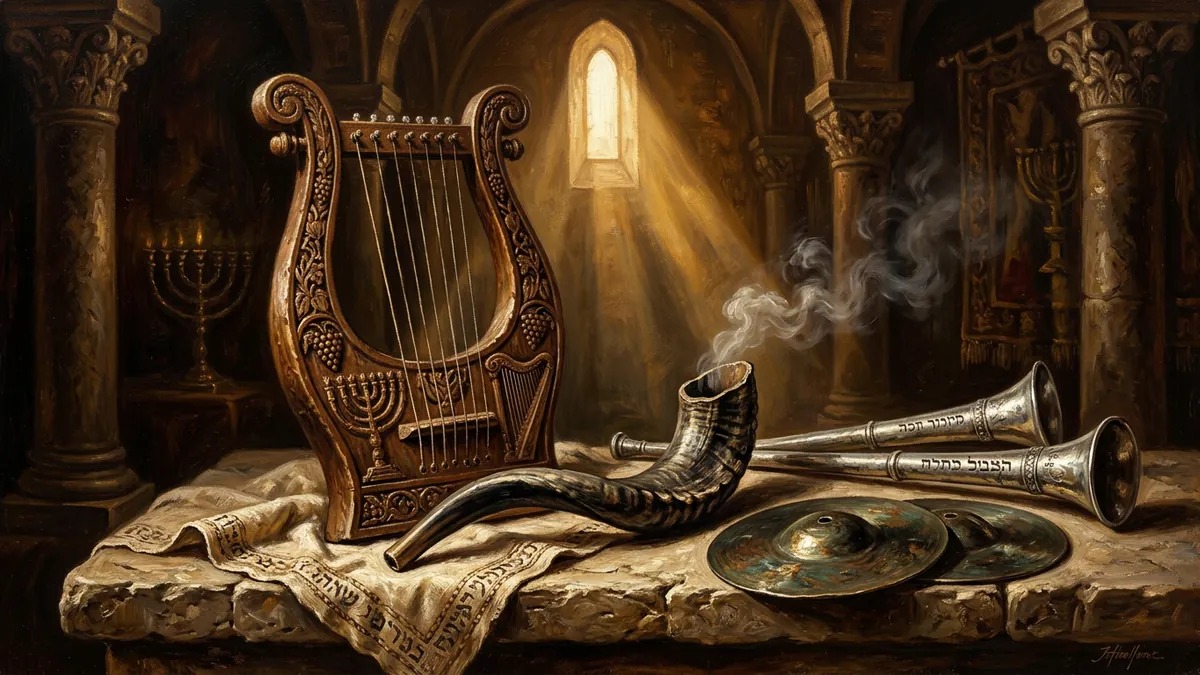
From Jubal in Genesis 4—the ancestral father of all who play the harp and flute—to the four and twenty elders in Revelation casting their golden harps before the glassy sea, the Holy Bible is resonant with sacred music. Worship in ancient Israel was not an austere, silent contemplation, but an exuberant, thunderous, multi-layered acoustic symphony. King David, the 'sweet psalmist of Israel,' revolutionized temple worship by commissioning an orchestra of 4,000 Levite musicians trained to minister before Yahweh night and day. Biblical instruments were divided into three classical organological families: stringed chordophones (Kinnor and Nevel), wind aerophones (Shofar, Chatzotzerah, and Ugav), and percussion idiophones (Metziltayim cymbals and Toph timbrels), culminating in the grand cosmic doxology of Psalm 150: "Let everything that hath breath praise the Lord!"
Levite Temple Orchestra
David's 120 Trumpeters
Oldest Instrument
The Supreme Doxology
1. Master Classification of Biblical Musical Instruments
Biblical musicology categorizes Israel’s sacred instruments into three functional families:
2. David's Kinnor: The Power of Anointed Melody
The Kinnor is the most renowned instrument in biblical history. First mentioned in Genesis 4:21, it became the inseparable companion of King David. When King Saul was tormented by a distressing spirit sent in judicial chastisement, his attendants advised him to seek a skillful player of the Kinnor.
1 Samuel 16:23 records one of the earliest documented accounts of musical spiritual warfare: "And so it was, whenever the spirit from God was upon Saul, that David took a harp and played it with his hand. Then Saul would become refreshed and well, and the distressing spirit would depart from him."
Why did David’s harp music drive away the demonic spirit? Jewish commentators and church fathers note that David did not merely play technical acoustic scales; as the anointed shepherd, his heart was in continuous communion with Yahweh, composing inspired psalms of praise. The demonic spirit could not endure the holy atmosphere created by an anointed worshiper magnifying the Creator. In the hands of a consecrated believer, music becomes a weapon of spiritual deliverance.
3. The Acoustic Symphony of Solomon's Temple
When King Solomon dedicated the First Temple in Jerusalem around 959 BC, the Bible records history’s most majestic liturgical orchestra performance. 2 Chronicles 5:12–14 describes the scene:
2 Chronicles 5:12–14: "And the Levites which were the singers, all of them of Asaph, of Heman, of Jeduthun, with their sons and their brethren, being arrayed in white linen, having cymbals and psalteries and harps, stood at the east end of the altar, and with them an hundred and twenty priests sounding with trumpets: It came even to pass, as the trumpeters and singers were as one, to make one sound to be heard in praising and thanking the Lord... that then the house was filled with a cloud, even the house of the Lord; so that the priests could not stand to minister by reason of the cloud: for the glory of the Lord had filled the house of God."
One hundred and twenty priests blew pure silver trumpets simultaneously, while thousands of Levites sang and played harps and cymbals in perfect unison (ke'echad—as one). When their praise coalesced into the timeless chorus, "For He is good; for His mercy endures forever," the physical Shekinah glory of God descended in a thick, luminous cloud so dense that priests could physically no longer stand! True unity in worship unlocks the manifest glory of God.
4. The Shofar: The Voice of God and the Cosmic Call
Unlike modern brass instruments that employ valves and fingerholes to change pitch, the Shofar is purely natural. Made from the hollowed horn of a kosher ram, it produces only two or three piercing natural overtone notes. Yet it carries the most profound eschatological and prophetic authority in Scripture:
- Mount Sinai: Exodus 19:16 describes the audible voice of God accompanied by an exceedingly loud heavenly shofar that caused all Israel to tremble.
- The Fall of Jericho: In Joshua 6, seven priests carrying seven shofars circled Jericho for seven days; on the seventh day, at the prolonged blast of the shofars and the shout of faith, the fortress walls collapsed flat!
- The Year of Jubilee: Leviticus 25:9 mandated that every 50th year, on the Day of Atonement, the shofar of Jubilee was blasted throughout all the land, canceling all debts, releasing all slaves, and restoring ancestral land.
- The Second Coming: 1 Thessalonians 4:16 and 1 Corinthians 15:52 declare that the resurrection of the dead and the rapture of the Church will be triggered by "the trumpet of God"—the ultimate cosmic shofar sounding the resurrection morning!
5. Psalm 150: The Climax of the Psalter
The entire 150-chapter Book of Psalms culminates in an explosive crescendo of instrumental praise in Psalm 150. In six short verses, the psalmist uses the imperative "Praise Him!" thirteen times, commanding every class of instrument to unite:
- "Praise Him with the sound of the trumpet (Shofar)!" (Wind power)
- "Praise Him with the psaltery (Nevel) and harp (Kinnor)!" (Stringed melody)
- "Praise Him with the timbrel (Toph) and dance!" (Rhythm and joyous movement)
- "Praise Him with stringed instruments and organs (Ugav)!" (Orchestral breadth)
- "Praise Him upon the loud cymbals: praise Him upon the high sounding cymbals!" (Crashing percussive majesty)
The psalm concludes with universal, all-encompassing breadth: "Let everything that hath breath praise the Lord. Praise ye the Lord!" (Psalm 150:6). Every breath granted to mortal man is a divine gift designed to return to the Creator in consecrated adoration.
Biblical Keywords & Theological Roots
Shofar; curved ram's horn; ancient wind instrument blown to announce holy convocations, awaken hearts on Yom Teruah, and proclaim Jubilee liberation.
Kinnor; Davidic lyre, sweet-toned wooden stringed instrument with 10 strings; the primary instrument of joyful worship and emotional deliverance in Israel.
Nevel; harp, psaltery, leather-soundbox chordophone producing resonant bass tones; played alongside the Kinnor by Levite choirs during sacrifices.
Silver trumpet; straight, hammered trumpet beaten from pure silver; blown exclusively by consecrated sons of Aaron to direct the marching camps and summon assembly.
Support Independent Biblical Research
Did this study bless you? Help support our independent bilingual research and interactive visual Bible tools.
⚡ Fast Facts
- King David established a professional 4,000-man Levite orchestra and choir that ministered before the Lord in continuous rotating shifts.
- When David played his 10-stringed Kinnor harp, the distressing demonic spirit departed from King Saul (1 Samuel 16:23).
- At the dedication of Solomon's Temple, 120 priests blew silver trumpets in unison until the Shekinah glory filled the House of God.
- The Book of Psalms concludes in Psalm 150 with a sweeping call for 8 distinct musical instruments and all breathing creation to praise Yahweh.
❓ Frequently Asked Questions (FAQs)
What is the difference between a Shofar and a Chatzotzerah?
The Shofar is a natural, curved horn of a kosher ram or wild mountain ibex with no metal parts, producing raw, primal, piercing harmonics. It was used primarily for spiritual calls to repentance, the Jubilee, and psychological warfare. In contrast, the Chatzotzerah was a straight, flared trumpet hammered from pure silver by royal metalworkers and was blown exclusively by consecrated Aaronic priests to signal the movement of the desert camp and proclaim feast days.
Why did music have the power to cast out demonic oppression in 1 Samuel 16?
Music itself is an acoustic medium, but in the hands of David—who was anointed by the Holy Spirit (1 Samuel 16:13)—his songs were theological declarations of praise to Yahweh. Demons are creatures of pride and spiritual darkness who abhor the magnifying of the true God. When David played the Kinnor, the manifest presence of God filled the chamber, creating a spiritual atmosphere in which demonic torment could not remain.
Did the early New Testament Church use musical instruments?
The early Christian Church met primarily in private homes under intense Roman and Jewish persecution where loud instruments were practically impossible. Furthermore, early Christians prioritized intelligible congregational singing of psalms, hymns, and spiritual songs (Ephesians 5:19; Colossians 3:16) with the heart as the primary instrument. However, Scripture does not prohibit instruments; rather, heavenly worship in Revelation depicts harps before the throne of God (Revelation 5:8; 14:2).