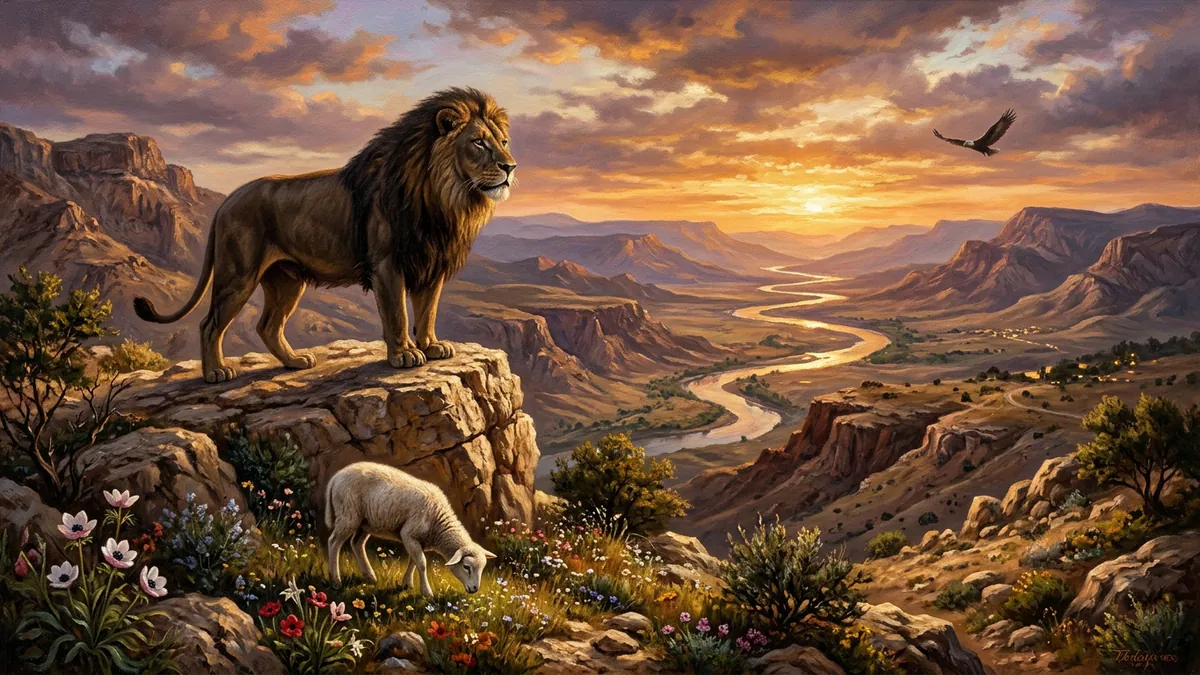
From the primeval dawn of Genesis where Adam was commissioned to name the living creatures (nephesh chayah) to the apocalyptic visions of Revelation where cosmic thrones are surrounded by four living beings, the Holy Bible is rich with zoological references. Biblical authors mention more than 130 distinct species of mammals, birds, reptiles, aquatic life, and insects. Scripture weaves animal behavior, physiological traits, and dietary classifications into profound theological lessons concerning creation, sacrifice, redemption, and divine sovereignty.
Animal Species
Most Mentioned
The Colossal Beasts
Talking Animals
1. The Most Frequently Mentioned Animals in Scripture
Ancient Israel was fundamentally a pastoral and agrarian culture. Consequently, domestic livestock and regional Levantine predators dominate the biblical narrative:
2. The Enigma of Job: Behemoth and Leviathan
In the climactic chapters of the Book of Job, God speaks out of the whirlwind to humble Job’s finite understanding of cosmic justice. Rather than offering abstract philosophical treatises on suffering, the Almighty presents two colossal, terrifying creatures that no human hunter can master:
Behemoth: The Chief of the Ways of God (Job 40:15–24)
God instructs Job to "Look now at Behemoth, which I made along with you." Notice the specific physiological descriptors provided by the text:
- Herbivorous Diet: "He eats grass like an ox" (v. 15).
- Muscular Anatomy: "See now, his strength is in his hips, and his power is in his stomach muscles" (v. 16).
- The Massive Tail: "He moves his tail like a cedar; the sinews of his thighs are tightly knit" (v. 17). Many modern commentators suggest a hippopotamus or elephant; however, both possess tiny, rope-like tails entirely unlike a towering cedar trunk! Creation paleontologists argue this description precisely matches a colossal sauropod dinosaur.
- Bones of Bronze and Iron: "His bones are like beams of bronze, his ribs like bars of iron. He is the first of the ways of God" (vv. 18–19).
- Hydraulic Immunity: "Indeed the river may rage, yet he is not alarmed; he is confident, though the Jordan gushes into his mouth" (v. 23).
Leviathan: The Fire-Breathing Monarch of the Deep (Job 41:1–34)
While Behemoth rules the marshy lowlands, Leviathan is the terrifying monarch of the oceanic deep:
- Impenetrable Armor: "His rows of scales are his pride, shut up tightly as with a seal; one is so near another that no air can come between them" (vv. 15–16). Harpoons, iron spears, and bronze darts bounce off him like straw (vv. 26–29).
- Bio-Illuminescence and Breath: "His sneezings flash forth light... Out of his mouth go burning lights; sparks of fire shoot out. Smoke goes out of his nostrils, as from a boiling pot and burning rushes" (vv. 18–20).
- Absolute Fearlessness: "On earth there is nothing like him, which is made without fear. He beholds every high thing; he is king over all the children of pride" (vv. 33–34).
3. Levitical Taxonomy: The Science and Theology of Clean and Unclean
In Leviticus 11 and Deuteronomy 14, God established a rigorous dietary boundary separating "clean" (tahor) animals from "unclean" (tamei) animals. While modern secularists dismiss these laws as primitive taboos, modern medical science and epidemiology confirm their remarkable hygienic foresight:
- Land Mammals: Must possess two simultaneous physiological criteria: split (cloven) hooves AND chew the cud (ruminants) (Leviticus 11:3). Cows, sheep, goats, and deer qualify. Swine (pigs) have split hooves but do not chew cud; in antiquity, uninspected pork harbored lethal trichinosis and parasitic worms. Camels and rabbits chew cud but lack split hooves. Ruminants process plant cellulose through multi-chambered stomachs, neutralizing environmental toxins.
- Aquatic Life: Must possess both fins AND scales (Leviticus 11:9). Bony fish (like tilapia and salmon) swim in open water. Shellfish, crabs, lobsters, shrimp, and catfish lack scales; they are benthic bottom-feeders and scavengers that bioaccumulate heavy metals, lethal biotoxins, and pathogenic marine bacteria.
- Birds: Scripture does not provide anatomical criteria for birds, but instead lists twenty forbidden species (Leviticus 11:13–19): eagles, vultures, owls, ravens, bats. Every single forbidden bird is either an active carnivorous raptor or a carrion-eating scavenger that feeds on decomposing corpses, carrying dangerous viral pathogens.
Theologically, these dietary distinctions served as a continuous daily pedagogical reminder that Israel was called to moral holiness—separated from pagan practices just as clean livestock were separated from scavengers. In the New Covenant (Acts 10:15; Mark 7:19), Christ fulfilled the ceremonial shadow, declaring all foods clean to symbolize that Gentile nations were now fully welcomed into the kingdom of God.
4. The Two Speaking Animals in the Bible
Throughout the entire 66 books of the Bible, human vocal speech is attributed to an animal on only two extraordinary occasions:
- The Serpent in the Garden of Eden (Genesis 3:1–5): The craftiest beast of the field, possessed and animated by Satan (the ancient serpent, Revelation 12:9), using deceptive speech to question God's character and plunge humanity into the Fall.
- Balaam's Donkey (Numbers 22:28–30): When the greedy Mesopotamian diviner Balaam beat his female donkey for balking at the invisible Angel of the Lord with a drawn sword, "Yahweh opened the mouth of the donkey" (patah Yahweh et-pi ha-aton). The humble beast spoke articulate human words, rebuking the blindness of a celebrated seer and proving that God can impart prophetic discernment to the humblest creature.
5. The Dual Messianic Paradox: The Lion and the Lamb
The entire zoological imagery of Scripture reaches its climactic theological resolution in Revelation 5:5–6. When the Apostle John weeps because no one in heaven or earth is worthy to open the seven-sealed scroll of destiny, an elder comforts him:
Revelation 5:5–6: '“Do not weep. Behold, the Lion of the tribe of Judah, the Root of David, has prevailed to open the scroll and to loose its seven seals.” And I looked, and behold, in the midst of the throne and of the four living creatures, and in the midst of the elders, stood a Lamb as though it had been slain...'
John was told to look for a roaring, conquering Lion—the symbol of royal Judah’s military supremacy (Genesis 49:9). But when he turned his eyes to the throne, he saw a gentle, wounded Lamb standing as though it had been slain! This is the breathtaking paradox of the Gospel: Jesus Christ conquered not by tearing His enemies like a lion, but by allowing Himself to be led as a silent lamb to the slaughter on Calvary. In the Lion we behold His unshakeable cosmic sovereignty; in the Lamb we behold His boundless, self-sacrificing love.
Biblical Keywords & Theological Roots
Behemoth, colossal beast; the intensive plural of majesty denoting a gigantic, invincible herbivorous creature created alongside man (Job 40:15).
Leviathan, twisting serpent; a formidable marine creature with impenetrable scale armor and fiery breath, symbolizing cosmic chaos crushed by God.
A sheep, young lamb, or goat; the quintessential innocent sacrificial victim whose blood shielded Israel on Passover night.
A lion, king of beasts; symbol of regal majesty, judicial power, and sovereign victory, culminating in the 'Lion of the Tribe of Judah' (Rev 5:5).
Support Independent Biblical Research
Did this study bless you? Help support our independent bilingual research and interactive visual Bible tools.
⚡ Fast Facts
- The sheep/lamb is the most frequently mentioned animal in the Bible with over 500 references, symbolizing God's people and the ultimate sacrificial Lamb of God.
- Only two talking animals appear in all of Scripture: the serpent in the Garden of Eden (Genesis 3) and Balaam's donkey (Numbers 22:28–30).
- Behemoth (Job 40) is described with bones like bronze tubes and a tail swaying like a cedar, which biblical scholars argue resembles a colossal sauropod rather than a hippo.
- Levitical dietary laws divided animals into clean and unclean based on physiological criteria: clean land animals had divided hooves and chewed the cud (Leviticus 11:3).
❓ Frequently Asked Questions (FAQs)
What were Behemoth and Leviathan described in the Book of Job?
In Job 40–41, God presents Behemoth and Leviathan as real, colossal creatures of majestic strength that only their Creator can control. While some modern commentators suggest the hippopotamus and Nile crocodile, the biblical descriptions—Behemoth's tail swaying like a massive cedar tree and Leviathan's impenetrable armor and churning of the deep ocean—far surpass modern creatures, leading many scholars to see them as extinct apex reptilians or symbols of cosmic chaos humbled before God.
Why did God classify certain animals as 'unclean' in Leviticus 11?
The Mosaic dietary laws served three interconnected divine purposes: first, public health and hygiene, as scavenger animals (pigs, vultures, shellfish) often harbor dangerous parasites and toxins in hot desert climates; second, spiritual separation, creating distinct daily lifestyle boundaries between Israel and surrounding pagan nations; and third, theological symbolism, teaching God's people holiness in every bodily appetite.
Why is Jesus called both the 'Lion of Judah' and the 'Lamb of God'?
In Revelation 5:5–6, John is told to behold the victorious 'Lion of the tribe of Judah,' but when he turns, he sees 'a Lamb looking as if it had been slain.' This dual imagery encapsulates the central paradox of redemption: Christ conquers not by tyrannical worldly force, but through sacrificial, self-giving love, combining sovereign regal authority with innocent, atoning sacrifice.