In the vibrant, urban crossroads of the first-century Greco-Roman world—spanning Corinth, Ephesus, and imperial Rome—stood a remarkable couple whose home was a sanctuary for the Gospel and whose theological clarity nurtured the early Church: Priscilla (often affectionately called Prisca in the Pauline epistles) and her husband Aquila. As a skilled tentmaker, apostolic church planter, fearless protector of the Apostle Paul, and astute theological instructor who discipled the great orator Apollos, Priscilla stands as a premier example of female leadership, intellectual depth, and mutual partnership in the New Testament.
1. The Crucible of Imperial Exile and the Meeting in Corinth (Acts 18:1–4)
In AD 49, Roman Emperor Claudius issued an imperial edict expelling all Jews from the capital city of Rome following civil disturbances concerning the proclamation of "Chrestus" (Christ). Uprooted from their home and businesses in Italy, Priscilla and her husband Aquila, a Jewish native of Pontus, relocated across the Mediterranean to the bustling commercial metropolis of Corinth.
Corinth was a cosmopolitan melting pot known for its thriving Isthmian games, dual sea harbors (Lechaion and Cenchreae), commercial wealth, and moral decadence. In this strategic trading hub, Priscilla and Aquila established a leatherworking and tentmaking workshop. Soon after, the Apostle Paul arrived in Corinth from Athens, alone, physically exhausted, and financially strained after facing mockery at the Areopagus.
Scripture records the providential encounter: "And because he was of the same trade, he stayed with them and worked; for by occupation they were tentmakers" (Acts 18:3). In the rhythm of cutting, stitching, and repairing heavy Cilician goat-hair cloth (*cilicium*) used for traveler tents, awnings, and maritime sails, a lifelong apostolic partnership was forged.
Priscilla and Aquila did not merely provide Paul with employment; they gave him a home, shared their daily bread, and opened their living quarters as the foundational meeting place for the newly birthed Corinthian church for eighteen months.
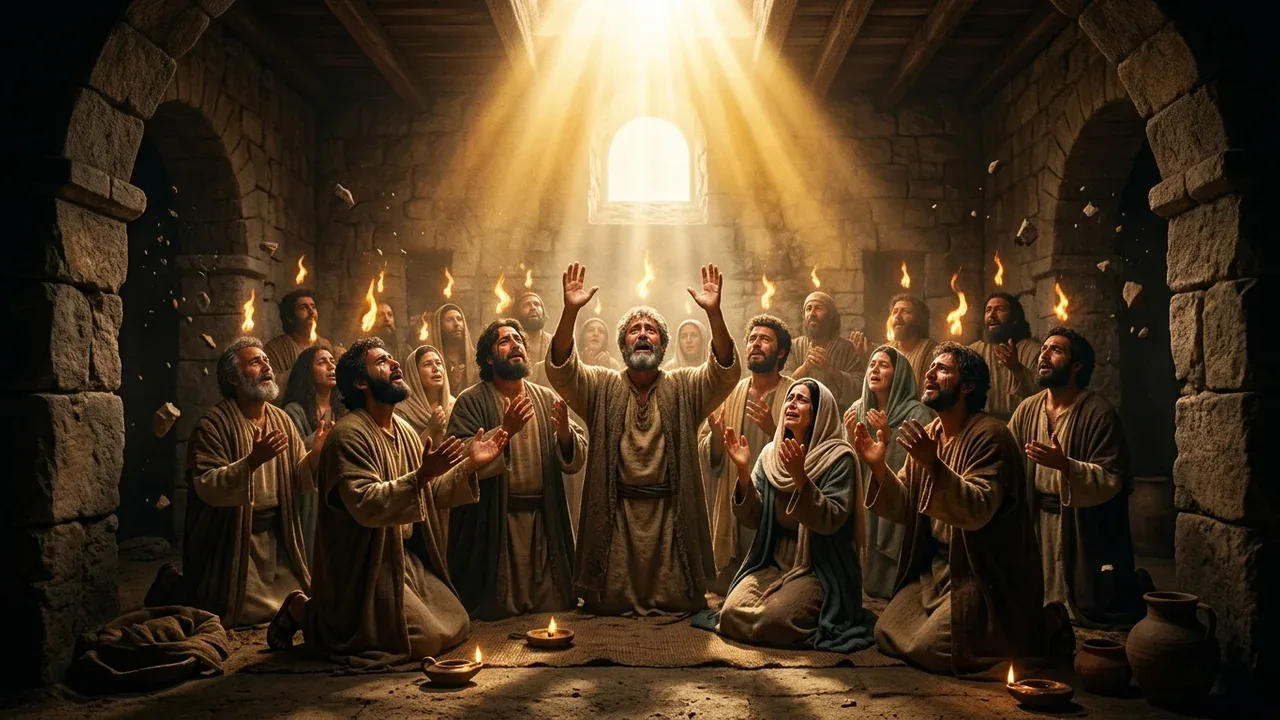 The Sanctuary of Hospitality: An early Christian house church gathering in the Roman home of Priscilla and Aquila, centered on apostolic scripture and prayer.
2. The Move to Ephesus and the Theological Mentorship of Apollos (Acts 18:18–28)
When Paul concluded his ministry in Corinth and set sail for Syria, Priscilla and Aquila demonstrated radical kingdom commitment by packing their household and sailing with him across the Aegean Sea to Ephesus, the intellectual, commercial, and religious capital of Asia Minor, famous for the colossal Temple of Artemis.
Paul left the couple in Ephesus to anchor, oversee, and nurture the fledgling missionary work while he journeyed onward to Antioch and Jerusalem. During this period, an extraordinary Jewish scholar named Apollos arrived in Ephesus from the intellectual center of Alexandria, Egypt.
Scripture describes Apollos with glowing praise: "an eloquent man and mighty in the Scriptures... fervent in spirit, he spoke and taught accurately the things of the Lord" (Acts 18:24–25). However, there was a critical gap in Apollos’ theology: he knew only the preparatory baptism of John the Baptist, lacking the full apostolic revelation of Jesus’ resurrection, the New Covenant, and the indwelling baptism of the Holy Spirit.
When Priscilla and Aquila heard Apollos preaching boldly in the Ephesian synagogue, they recognized his immense potential as well as his doctrinal limitations. Instead of publicly debating, criticizing, or embarrassing him before the congregation, Priscilla and Aquila handled the situation with masterly pastoral wisdom and gracious hospitality:
"When Aquila and Priscilla heard him, they took him aside and explained to him the way of God more accurately." (Acts 18:26)
Notice the profound spiritual maturity: Priscilla invited the great Alexandrian orator into her home, prepared meals, and gently tutored him in the deeper mysteries of the Gospel. Priscilla’s theological acumen, biblical mastery, and gracious pedagogy elevated Apollos from a zealous reformer into one of the most formidable, Spirit-empowered defenders of the Christian faith throughout Achaia and Corinth.
3. Risking Their Necks and Hosting House Churches (Romans 16:3–5; 1 Corinthians 16:19)
Priscilla and Aquila were fearless champions of the apostolic mission. When severe anti-Christian riots and persecution erupted in Ephesus—such as the silversmith riot instigated by Demetrius—or in Rome, they willingly put their own lives on the line to shield the Apostle Paul from assassination and mob violence.
Writing to the believers in Rome years later, Paul expressed an overwhelming debt of gratitude that echoed across all the Gentile churches:
"Greet Priscilla and Aquila, my fellow workers in Christ Jesus, who risked their own necks for my life, to whom not only I give thanks, but also all the churches of the Gentiles. Likewise greet the church that is in their house." (Romans 16:3–5)
The phrase "risked their own necks" (Greek: *ton heautōn trachēlon hypethēkan*) paints a vivid picture of laying one's neck on the executioner's chopping block. Priscilla was not a passive observer of early church history; she was an active, battle-tested general on the spiritual frontlines.
Furthermore, wherever Priscilla and Aquila resided—whether in Corinth (Acts 18), Ephesus (1 Corinthians 16:19: "Aquila and Priscilla greet you heartily in the Lord, with the church that is in their house"), or Rome (Romans 16:5)—their domestic villa was instantly consecrated as a functioning house church. In an empire that offered no public church buildings, Priscilla created sacred spaces where believers gathered for the Lord's Supper, apostolic teaching, vibrant prayer, and mutual care.
In Paul's very last epistle written from a dark Roman dungeon before his martyrdom under Emperor Nero, his thoughts turned once again to this cherished couple: "Greet Prisca and Aquila, and the household of Onesiphorus" (2 Timothy 4:19).
4. Five Enduring Spiritual Lessons from Priscilla
- Harmonious Marital Partnership in Ministry: Priscilla and Aquila are never mentioned separately in the New Testament. They worked at the same craft, opened the same home, traveled on the same mission field, and taught the same Gospel, providing a timeless blueprint for egalitarian Christian marriage and ministry.
- Theological Excellence and Gracious Discipleship: Priscilla possessed the biblical depth to mentor one of the greatest minds of the ancient world (Apollos), doing so privately, gently, and effectively without arrogance or territorialism.
- Sacrificial, Life-Risking Courage: Risking their necks for Paul proved that Priscilla's allegiance to Jesus Christ and His apostles surpassed personal comfort, social standing, and physical safety.
- The Strategic Ministry of Christian Hospitality: In every city they lived, Priscilla turned her living room into a sanctuary, demonstrating that authentic Christian hospitality is one of the most powerful catalysts for church planting and community transformation.
- Faithful Persistence Through Imperial Upheaval: Uprooted by imperial decrees from Rome to Corinth, then moving to Ephesus and back to Rome, Priscilla never allowed geographic displacement to derail her divine mission. Wherever God planted her, she built the Kingdom.
⚡ Fast Facts
- Named Before Her Husband in Most References: Out of the six times Priscilla and Aquila are mentioned in the New Testament (Acts 18:18, 18:26; Romans 16:3; 2 Timothy 4:19), Priscilla's name is placed FIRST four times, an extraordinary tribute to her prominence as a teacher and leader in the early church.
- Expelled from Rome by Emperor Claudius: In AD 49, Emperor Claudius expelled all Jews from Rome due to civil disturbances concerning 'Chrestus' (Christ), forcing Priscilla and Aquila to relocate to Corinth where they met Paul (Acts 18:2).
- Theological Mentorship of Apollos: When the brilliant Alexandrian scholar Apollos preached boldly in Ephesus knowing only the baptism of John, Priscilla and Aquila invited him to their home and 'explained to him the way of God more accurately' (Acts 18:26).
- Risking Their Necks for Paul: In Romans 16:3–4, Paul writes with profound gratitude: 'Greet Priscilla and Aquila, my fellow workers in Christ Jesus, who risked their own necks for my life, to whom not only I give thanks, but also all the churches of the Gentiles.'
❓ Frequently Asked Questions (FAQs)
Priscilla and Aquila were skilled leatherworkers and tentmakers (*skenopoioi*). When Paul arrived in Corinth, he stayed and worked with them because they shared the exact same trade, weaving Cilician goat-hair cloth (*cilicium*) by day and reasoning in the synagogues on the Sabbath.
They hosted thriving New Testament house churches in at least three major global centers of the Roman Empire: in Corinth (Acts 18), in Ephesus (1 Corinthians 16:19), and in Rome (Romans 16:5).
Priscilla and Aquila are never mentioned apart from one another in Scripture. They functioned as an indivisible, harmonious team in marriage, manual trade, theological teaching, missionary travel, and church planting.