During the turbulent era of the Judges—when moral compromise darkened the land of Israel, tribal civil wars raged, and "everyone did what was right in his own eyes"—a tender, radiant ray of divine grace shone forth from the small village of Bethlehem in Judah. The Book of Ruth is a literary and theological masterpiece, chronicling how an impoverished, widowed gentile woman named Ruth the Moabite entered the covenant family of Yahweh through selfless love, steadfast endurance, and the redeeming grace of Boaz, becoming the great-grandmother of King David and a celebrated matriarch in the royal messianic lineage of Jesus Christ.
1. Tragedy in Moab and the Immortal Vow of Loyalty (Ruth 1)
The narrative begins with desperate hardship and famine. A severe drought struck the hill country of Judah, driving a man named Elimelech, his wife Naomi, and their two sons, Mahlon ("Sickly") and Chilion ("Pining"), to leave Bethlehem ("House of Bread") and seek refuge in the pagan plateau of Moab across the Salt Sea.
Tragedy struck repeatedly in the foreign land. Elimelech died, leaving Naomi alone with her two sons. The young men married Moabite women—Orpah and Ruth. But after approximately ten years, both Mahlon and Chilion died childless, leaving three destitute widows in an ancient patriarchal culture where unattached women faced severe poverty, starvation, and vulnerability without legal protection.
Hearing that the Lord had visited His people in Judah by giving them bread, Naomi resolved to return to her ancestral home in Bethlehem. She urged her two daughters-in-law to return to their mothers' homes, their families, and their gods, blessing them to find rest in the houses of new husbands. Orpah wept, kissed Naomi, and turned back to her pagan deities (Chemosh). But Ruth clung tenaciously to her grieving mother-in-law, uttering one of the most sublime and unbreakable confessions of covenant commitment in all of world literature:
"Entreat me not to leave you, or to turn back from following after you; for wherever you go, I will go; and wherever you lodge, I will lodge; your people shall be my people, and your God, my God. Where you die, I will die, and there will I be buried. The Lord do so to me, and more also, if anything but death parts you and me." (Ruth 1:16–17)
Ruth renounced her Moabite heritage, her cultural security, and her pagan gods to bind her destiny irrevocably to Naomi and the God of Israel. When the two exhausted women arrived in Bethlehem, the whole town was stirred, and Naomi lamented in deep sorrow: "Do not call me Naomi ('Pleasant'); call me Mara ('Bitter'), for the Almighty has dealt very bitterly with me. I went out full, and the Lord has brought me home again empty." Yet God’s sovereign grace was already preparing a harvest of sweetness and abundance.
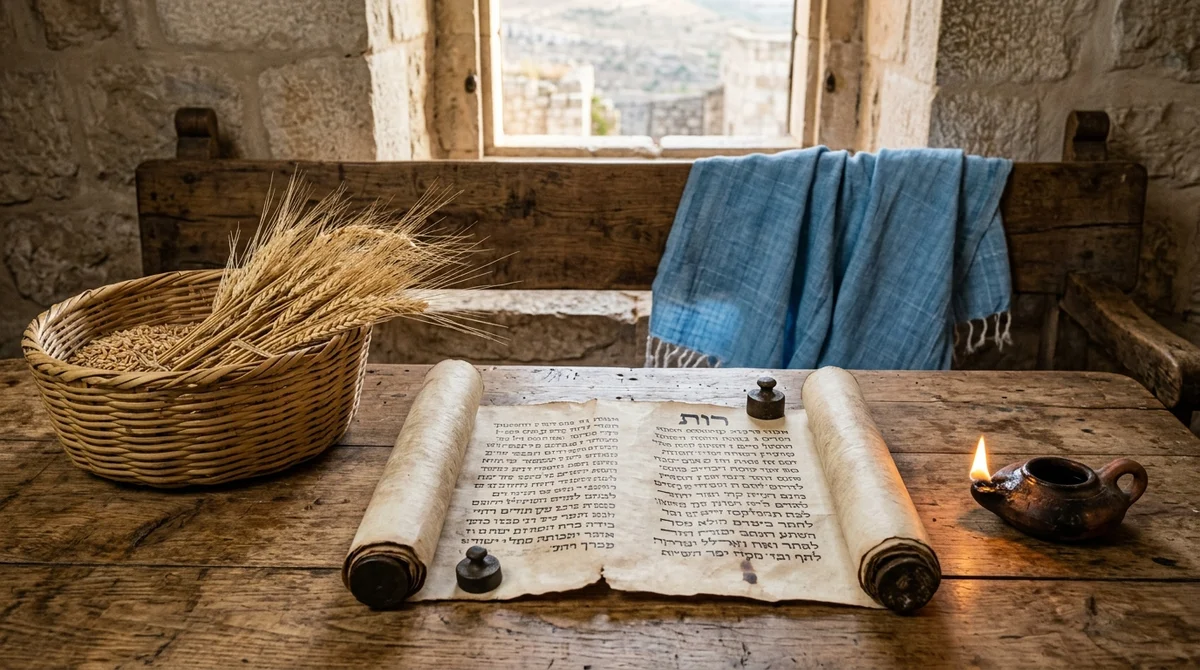 The Golden Grain of Hesed: An ancient Hebrew scroll of Ruth beside fresh sheaves of Bethlehem barley, symbolizing covenant redemption and divine providence.
2. Gleaning in the Fields of Boaz: Divine Providence (Ruth 2)
Under the compassionate welfare laws of the Mosaic Covenant (Leviticus 19:9–10; 23:22; Deuteronomy 24:19), landowners were strictly forbidden to harvest the corners of their fields or pick up dropped grain stalks; these were legally reserved for the poor, the stranger, the fatherless, and the widow.
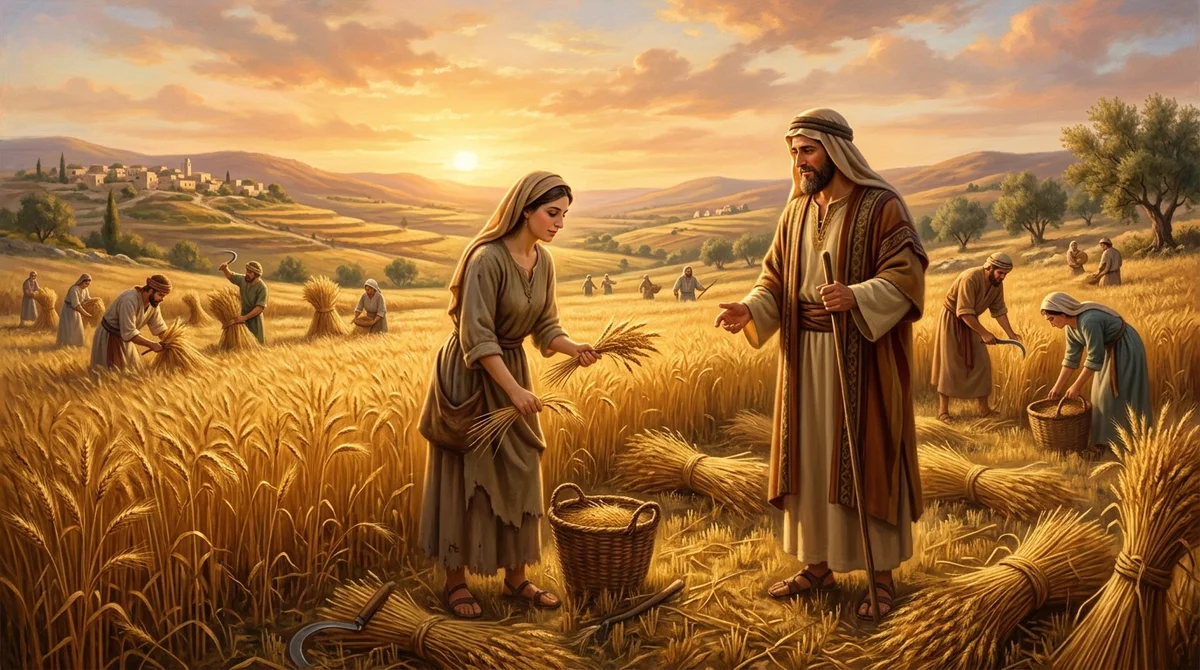
Stepping out in humble initiative and sacrificial diligence to provide sustenance for her elderly mother-in-law, Ruth went out into the scorching sun to glean behind the reapers. Scripture records with beautiful literary understatement: "And she happened to come to the part of the field belonging to Boaz, who was of the family of Elimelech" (Ruth 2:3). What appeared to human eyes as a random occurrence was guided by the unseen hand of Almighty God.
Boaz, a wealthy, honorable, and godly nobleman of the tribe of Judah, arrived from Bethlehem and greeted his harvesters with covenant warmth: "The Lord be with you!" to which they replied: "The Lord bless you!" Seeing Ruth working tirelessly from early morning without resting except for a brief moment in the shelter, Boaz inquired about her identity. Having heard of her steadfast love for Naomi and how she left her father and mother to dwell among a people unknown to her, Boaz approached Ruth with extraordinary generosity:
"The Lord repay your work, and a full reward be given you by the Lord God of Israel, under whose wings you have come for refuge." (Ruth 2:12)
Boaz commanded his young men never to touch or insult Ruth, invited her to drink freely from his private water jars, shared roasted grain and bread dipped in wine vinegar with her at mealtime, and instructed his harvesters to intentionally pull out handfuls of barley from the bundles and leave them for her to gather. When Ruth beat out what she had gleaned that evening, it was an ephah of barley (nearly 30 pounds of grain), along with leftover roasted food for Naomi.
3. The Midnight Proposal at the Threshing Floor (Ruth 3)
Recognizing that Boaz was a close relative with the sacred right and duty of redemption (Hebrew: Go'el), Naomi devised a bold, culturally specific plan to secure a permanent home and protection for Ruth.
At the conclusion of the barley harvest, after Boaz had finished winnowing the grain in the cool evening breeze on the hilltop limestone threshing floor and lay down to sleep peacefully beside the heap of winnowed grain, Ruth washed, anointed herself with fragrant oils, and put on her finest cloak. Slipping quietly through the darkness, she uncovered his feet and lay down.
At midnight, Boaz was startled awake and turned over to discover a woman lying at his feet. "Who are you?" he asked in the darkness. Ruth replied with profound reverence, dignity, and spiritual boldness:
"I am Ruth, your maidservant. Spread the corner of your garment over your maidservant, for you are a close relative (kinsman-redeemer)." (Ruth 3:9)
The Hebrew word for the corner of a garment is kanaph—the exact same word Boaz had used in chapter 2 when he prayed that God would reward Ruth under whose "wings (kanaph)" she had sought refuge! Ruth was boldly saying: "Boaz, be the instrument of God's covenant mercy. Spread your protective marriage wings over me according to the Law of the Redeemer."
Deeply moved by her virtue, Boaz praised Ruth for not running after younger or wealthier men, proclaiming: "Blessed are you of the Lord, my daughter! All the people of my town know that you are a virtuous woman (eshet chayil)." He promised to fulfill the duty of the Redeemer, provided a closer unnamed relative did not exercise his prior legal right. Before dawn, Boaz measured out six measures of barley into Ruth's shawl so she would not return empty-handed to Naomi.
4. Legal Redemption at the City Gate and the Royal Birth (Ruth 4)
The following morning, Boaz went up to the town gate—the official civic and judicial court of ancient Israel. He summoned the closer kinsman and ten elders of Bethlehem to sit as witnesses.
Boaz presented the legal land transaction: Naomi was selling the ancestral parcel of land that belonged to their late brother Elimelech. The closer kinsman eagerly agreed to buy the field. But Boaz immediately presented the full covenant requirement: "On the day you buy the field from Naomi, you must also acquire Ruth the Moabitess, the wife of the dead, to perpetuate the name of the dead through his inheritance."
Fearing that marrying a foreign widow and fathering children would jeopardize and divide his own financial estate, the closer relative declined to redeem. In accordance with ancient Hebrew custom, he drew off his sandal and handed it to Boaz, legally surrendering all rights of redemption.
Boaz declared before all the elders and the assembled townspeople: "You are witnesses this day that I have bought all that belonged to Elimelech, Chilion, and Mahlon... Moreover, Ruth the Moabitess I have acquired as my wife to perpetuate the name of the dead upon his inheritance." All the elders blessed them, praying that Ruth would be like Rachel and Leah who built up the house of Israel.
The Lord blessed Ruth with conception, and she gave birth to a healthy baby boy. The women of Bethlehem rejoiced with Naomi, praising God: "Blessed be the Lord, who has not left you this day without a close relative! He shall be to you a restorer of life and a nourisher of your old age; for your daughter-in-law, who loves you, who is better to you than seven sons, has borne him!" (Ruth 4:14–15).
They named the child Obed ("Servant / Worshiper"). Obed grew up to become the father of Jesse, and Jesse became the father of King David. Centuries later, through this exact royal line in the very town of Bethlehem, Jesus Christ the Messiah was born into the world (Matthew 1:5–16; Luke 2:4–7).
5. Four Profound Spiritual Lessons from the Life of Ruth
- Covenant Loyalty (*Hesed*): True godly love is not a temporary emotion; it is an active, sacrificial commitment that chooses faithfulness even in the face of loss, poverty, and uncertainty.
- God Welcomes and Elevates the Outsider: God’s redemptive grace is not restricted by race, ethnicity, or pedigree. A humble foreign outcast who sought refuge under Yahweh's wings became the ancestress of the King of Kings.
- Unseen Providence in Daily Faithfulness: God does not work solely through parting seas and thunderbolts; He weaves His eternal kingdom plans through daily integrity, hard work, gleaning in fields, and quiet acts of kindness.
- Christ Our Kinsman-Redeemer: Just as Boaz loved, redeemed, and elevated destitute Ruth into wealth, honor, and joy, Jesus Christ stepped into our human family, paid our insurmountable debt of sin with His own blood on the cross, and made us co-heirs of His eternal kingdom.
⚡ Fast Facts
- The Hebrew Word 'Hesed': The central theological heartbeat of the Book of Ruth is 'Hesed'—a rich Hebrew word denoting steadfast covenantal love, sacrificial loyalty, and unmerited mercy that transcends duty.
- The Kinsman-Redeemer (Go'el): Under Mosaic Law (Leviticus 25), a 'Go'el' was a close relative who had the legal right and moral obligation to buy back alienated family property and marry a childless widow to preserve the family name.
- The Harvest Timing: Naomi and Ruth arrived in Bethlehem at the exact beginning of the barley harvest (late March/April), setting the divine stage for Ruth to glean in Boaz's fields according to the poor-laws of Leviticus 19:9-10.
- Inclusion in Matthew 1: Ruth is one of only five women explicitly named in the genealogy of Jesus Christ in Matthew 1:5, demonstrating God's radical grace toward gentiles and outcasts.
❓ Frequently Asked Questions (FAQs)
Ruth was a Moabite—a pagan nation historically hostile to Israel (Deuteronomy 23:3). By leaving her homeland, family, and gods, she knowingly chose poverty, social stigma, and cultural isolation to serve the living God of Israel with zero guarantee of marriage or security.
Under Naomi's cultural guidance, Ruth approached Boaz on the threshing floor after the harvest festival. By uncovering his feet and asking him to spread the corner of his garment (*kanaph*) over her, she was not acting immorally; she was making a formal, modest proposal under the Law of the Kinsman-Redeemer for Boaz to take her under his covenantal protection.
Boaz perfectly typifies Jesus Christ as the ultimate Kinsman-Redeemer: He was related to us by taking on human flesh (Hebrews 2:14), He possessed the full financial ability to redeem us, He had the willing heart to pay our debt, and He raised us from poverty and death into royal inheritance and eternal fruitfulness.