In the fifth century BC, the Persian Empire stretched from the lush Indus River Valley to the cataracts of the Nile, spanning 127 provinces under the iron rule of King Ahasuerus (historically known as Xerxes I). In the fortified citadel of Susa, amidst towering alabaster pillars, gilded lion capitals, and fragrant palace gardens, unfolded one of the most suspenseful and dramatic stories in biblical history: the ascent of an orphaned Jewish girl named Hadassah who became Queen Esther, risking her royal crown and her very life to rescue her people from total annihilation.
1. An Orphan in Exile: The Rise of Hadassah (Esther 1–2)
Following the Babylonian conquest and the destruction of Jerusalem in 586 BC, tens of thousands of Jewish families were displaced across the empire. Among these exiles was Hadassah, a young maiden of the tribe of Benjamin whose father and mother had died. She was adopted and raised as a beloved daughter by her older cousin, Mordecai, a righteous court official who sat at the King’s Gate in Susa.
When Queen Vashti was deposed for refusing to parade her beauty before drunken imperial nobles, King Ahasuerus issued an empire-wide decree gathering the most beautiful young virgins to Susa. Under the guidance of Hegai, the custodian of the harem, Hadassah underwent twelve months of intensive beauty treatments—six months with oil of myrrh and six months with sweet spices. Mordecai instructed her to conceal her Jewish identity, giving her the Persian name Esther (derived from the Persian root for 'Star' or 'Myrtle').
When Esther was presented before King Ahasuerus, her radiant modesty, graceful dignity, and inner character captivated the monarch:
"The king loved Esther more than all the other women, and she obtained grace and favor in his sight more than all the virgins; so he set the royal crown upon her head and made her queen instead of Vashti." (Esther 2:17)
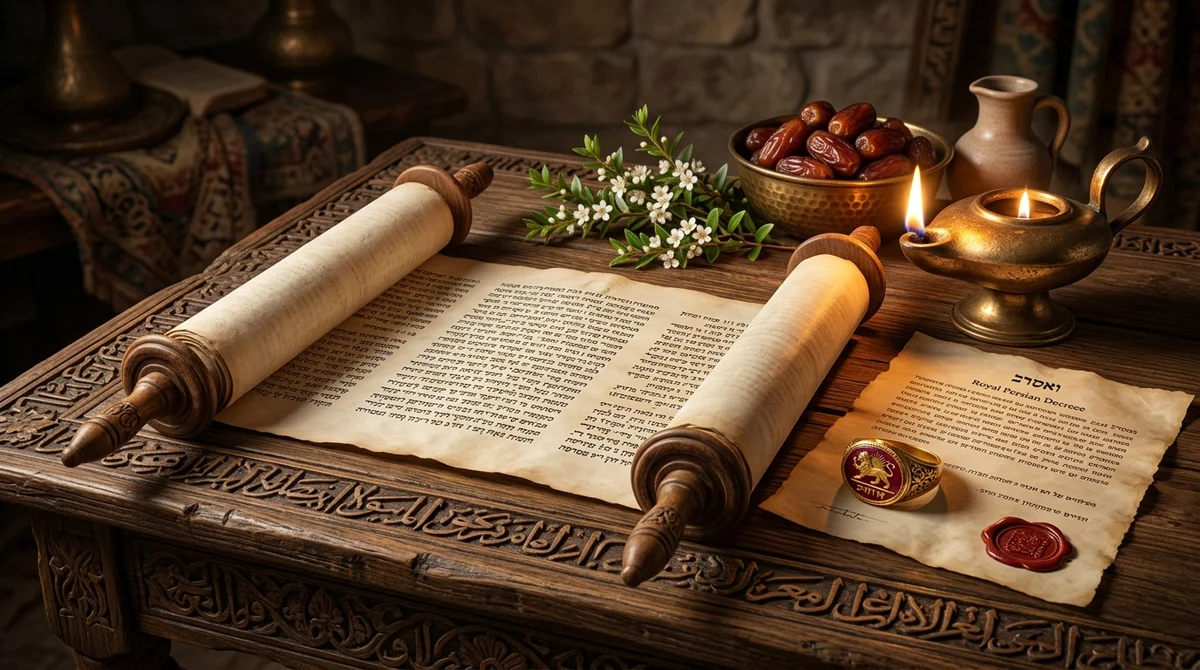 The Golden Scepter of Grace: Megillat Esther alongside the Persian royal signet ring, commemorating the providential salvation of God's covenant people.
2. The Seed of Amalek and the Shadow of Genocide (Esther 3)
The peaceful atmosphere of the palace was shattered by the rapid political elevation of Haman the Agagite. Haman was a direct descendant of King Agag of the Amalekites—an ancient, predatory nation that had attacked the weary Israelites from behind in the wilderness (Exodus 17:8; 1 Samuel 15).
When the King commanded all officials to bow down and pay homage to Haman, Mordecai steadfastly refused. As a faithful worshiper of Yahweh, Mordecai would not prostrate himself before an arrogant, idolatrous Amalekite. Filled with demonic rage, Haman decided that executing Mordecai alone was insufficient. He resolved to wipe out every Jewish man, woman, and child across all 127 provinces of the Persian Empire.
Haman cast the Pur (the lottery) to select an auspicious date, bribed King Ahasuerus with 10,000 talents of silver (equivalent to millions in modern currency), and had the royal scribes seal an irrevocable imperial edict declaring that on the thirteenth day of the twelfth month (Adar), the population had permission to slaughter all Jews and plunder their goods.
3. "For Such a Time as This": The Turning Point (Esther 4)
When the decree reached Susa, Mordecai tore his clothes, put on sackcloth with ashes, and wept bitterly in the city square. Esther sent fresh garments to her cousin, but Mordecai refused them, sending her a copy of the fatal edict and commanding her to go before the King to plead for her people.
Esther faced a terrifying dilemma: Persian imperial protocol dictated that anyone who entered the inner court without an express royal invitation was sentenced to immediate death, unless the King chose to extend his solid golden scepter. Esther had not been called into the King’s presence for thirty days.
Mordecai’s reply across the palace walls delivered the immortal challenge that has echoed through millennia:
"Do not think in your heart that you will escape in the king’s palace any more than all the other Jews. For if you remain completely silent at this time, relief and deliverance will arise for the Jews from another place, but you and your father’s house will perish. Yet who knows whether you have come to the kingdom for such a time as this?" (Esther 4:13–14)
Esther's faith triumphed over fear. She requested that Mordecai gather every Jew in Susa to fast with her for three days and three nights, taking neither food nor water. She resolved: "I will go to the king, which is against the law; and if I perish, I perish!"
4. The Golden Scepter and the Sleepless King (Esther 5–6)
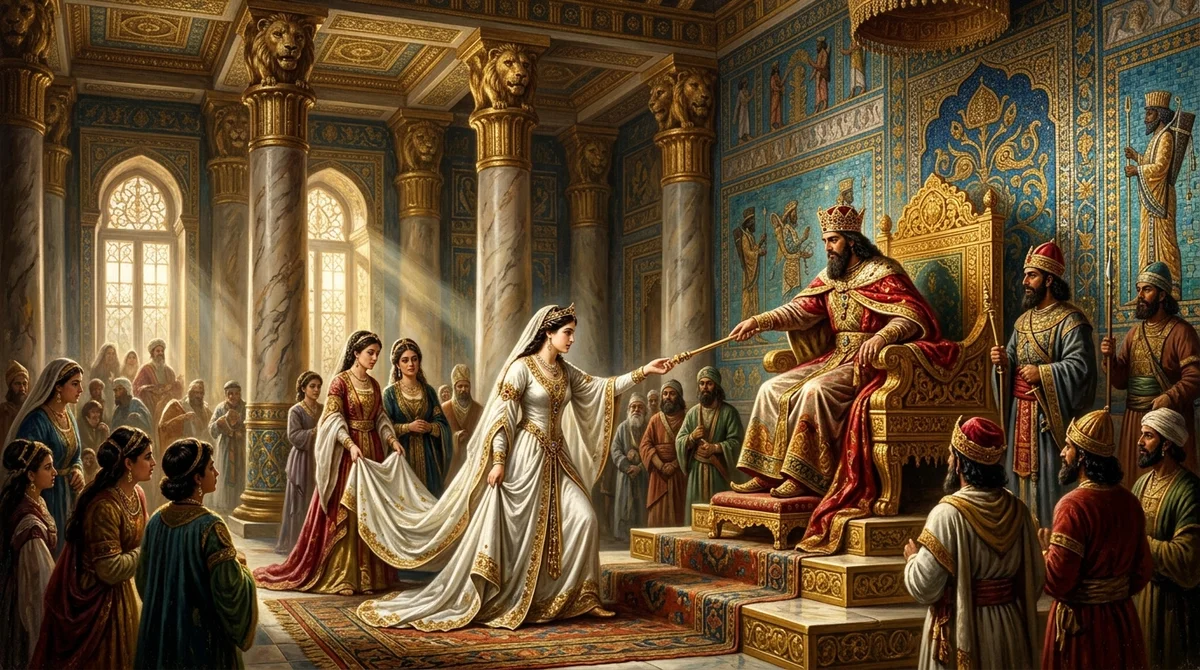
On the third day, clad in her royal robes, Esther stood trembling in the inner court of the palace. King Ahasuerus sat upon his royal throne. When his eyes fell upon Esther standing in the courtyard, divine favor swept over his heart. He extended the golden scepter in his hand. Esther stepped forward and touched the tip of the scepter, securing her life.
Instead of blurting out her request in front of court sycophants, Esther displayed masterful wisdom and poise. She invited the King and Haman to an exclusive banquet. At the banquet, when the King asked for her petition up to half the kingdom, she invited them to a second banquet the following evening.
Haman left the palace exhilarated with pride, but upon seeing Mordecai still refusing to bow at the gate, his fury boiled over. Encouraged by his wife Zeresh, Haman erected a colossal gallows 50 cubits high (75 feet) outside his mansion, intending to hang Mordecai the very next morning.
The Sovereign Insomnia: That exact night, God kept King Ahasuerus awake. Unable to sleep, the King ordered the chronicles of his reign to be read aloud. By divine appointment, the scribe read the record of how Mordecai had previously exposed a palace assassination plot, saving the King’s life. When the King learned that Mordecai had never been rewarded, Haman entered the court to ask for Mordecai’s execution.
The King asked Haman: "What should be done for the man the king delights to honor?" Thinking the King meant him, Haman proposed dressing the man in royal robes, placing him on the King's steed with a royal crest, and parading him through the streets. The King commanded: "Hurry, take the apparel and the horse, and do so for Mordecai the Jew!" In total humiliation, Haman was forced to lead his arch-rival through Susa, proclaiming his honor.
5. The Second Banquet and the Great Deliverance (Esther 7–10)
At the second banquet, with wine flowing, the King asked again: "What is your petition, Queen Esther?" With tears and solemn majesty, Esther pulled back the curtain:
"If I have found favor in your sight, O king, let my life be given me at my petition, and my people at my request. For we have been sold, my people and I, to be destroyed, to be killed, and to be annihilated!" (Esther 7:3–4)
Shocked, the King demanded: "Who is he, and where is he, who would dare presume in his heart to do such a thing?" Esther pointed directly across the table: "The adversary and enemy is this wicked Haman!"
Terror gripped Haman. When the King stepped into the garden in rage and returned to find Haman falling upon Esther's couch begging for mercy, the attendants covered Haman's face. Harbonah, one of the royal eunuchs, informed the King of the 75-foot gallows Haman had prepared for Mordecai. The King commanded: "Hang him on it!" (Esther 7:9–10).
Because a Persian royal law could not be revoked, the King gave Mordecai his signet ring to write a new counter-edict allowing the Jews across all 127 provinces to assemble, arm themselves, and defend their lives against any attacker. On the thirteenth of Adar, the Jewish people won a decisive victory over their enemies, and the Feast of Purim was instituted as an everlasting celebration of divine joy and deliverance.
6. Four Enduring Spiritual Lessons from Queen Esther
- God’s Invisible Hand (Providence): Even when God seems silent or hidden in our circumstances, His sovereign providence is constantly working behind the scenes to orchestrate victory for His people.
- Divine Positioning: You are not where you are by accident. Whether in a boardroom, classroom, hospital, or government office, God has placed you "for such a time as this."
- Prayer and Fasting Precede Power: Before taking strategic action, Esther engaged in deep spiritual warfare through corporate fasting and total surrender to God.
- Courage is Fear That Has Said Its Prayers: True courage does not mean the absence of fear; it means doing what is right in obedience to God even when your life is on the line.
⚡ Fast Facts
- God's Name is Never Mentioned: The Book of Esther is one of only two biblical books (along with Song of Solomon) that never explicitly mentions the name of God, yet His sovereign invisible providence orchestrates every single detail.
- Hadassah to Esther: Her Hebrew birth name was 'Hadassah' (meaning 'Myrtle branch'—symbol of peace and fragrance), while her Persian court name 'Esther' derived from the Persian word for 'Star' (or the Babylonian goddess Ishtar).
- The Lethal Golden Scepter Law: In ancient Persia, anyone who entered the inner palace court of the King without a royal summons faced immediate execution, unless the King extended his solid golden scepter (Esther 4:11).
- The Origin of Purim: The Feast of Purim commemorates the deliverance of the Jewish people, named after 'Pur' (the Persian word for the lottery/lots cast by Haman to select the day of extermination).
❓ Frequently Asked Questions (FAQs)
Esther recognized that human charm and royal rank were powerless against demonic genocidal plots without divine intervention. Before risking execution by approaching the King uninvited, she mobilized the entire Jewish community in Susa to join her in a 72-hour absolute fast (no food or water), surrendering her life completely to God's will: 'If I perish, I perish.'
Mordecai reminded Esther that her elevation to the Persian throne was not an accidental stroke of personal good fortune, but a divine assignment. God had sovereignly positioned her in the corridors of imperial power specifically to be the instrument of deliverance during her nation's most perilous crisis.
Esther serves as a prophetic type of Christ: an intercessor who willingly laid down her life, stepped into the presence of the King on behalf of a condemned people, broke the power of the enemy's unalterable death decree, and turned impending annihilation into victorious joy and celebration.