In the hill country of Ephraim, during the closing years of the Judges when the priesthood of Israel was decaying in corruption at Shiloh, lived a woman whose persistent, brokenhearted tears unlocked the dawn of a glorious new era: Hannah. Her story in 1 Samuel 1–2 is a profound narrative of personal anguish transformed into prophetic intercession. In her deepest vulnerability, Hannah showed how an ordinary woman, crushed by barrenness and relational mockery, could lay hold of the Almighty in prayer, birth a nation’s spiritual deliverer, and sing a song that foretold the coming of the Messiah.
1. The Crucible of Barrenness and Provocation (1 Samuel 1:1–8)
Hannah was the beloved wife of Elkanah, a Levite dwelling in Ramathaim-Zophim. But their home was divided by polygamy and silent grief. Elkanah had two wives: Hannah and Peninnah. Peninnah had borne many sons and daughters, but "Hannah had no children, because the Lord had closed her womb" (1 Samuel 1:5–6).
In the ancient Near East, barrenness was not only a profound personal tragedy; it was viewed as a societal disgrace and a sign of divine disfavor. To compound her grief, Peninnah mercilessly provoked and ridiculed Hannah year after year, especially when the family made their annual pilgrimage to the Tabernacle in Shiloh to offer sacrifices to Yahweh.
Though Elkanah gave Hannah a double portion of the sacrificial meat and asked with tender helplessness: "Hannah, why do you weep? Why do you not eat? Am I not better to you than ten sons?"—his well-meaning comfort could not heal the deep ache in her soul. Hannah knew that human comfort could never substitute for divine intervention.
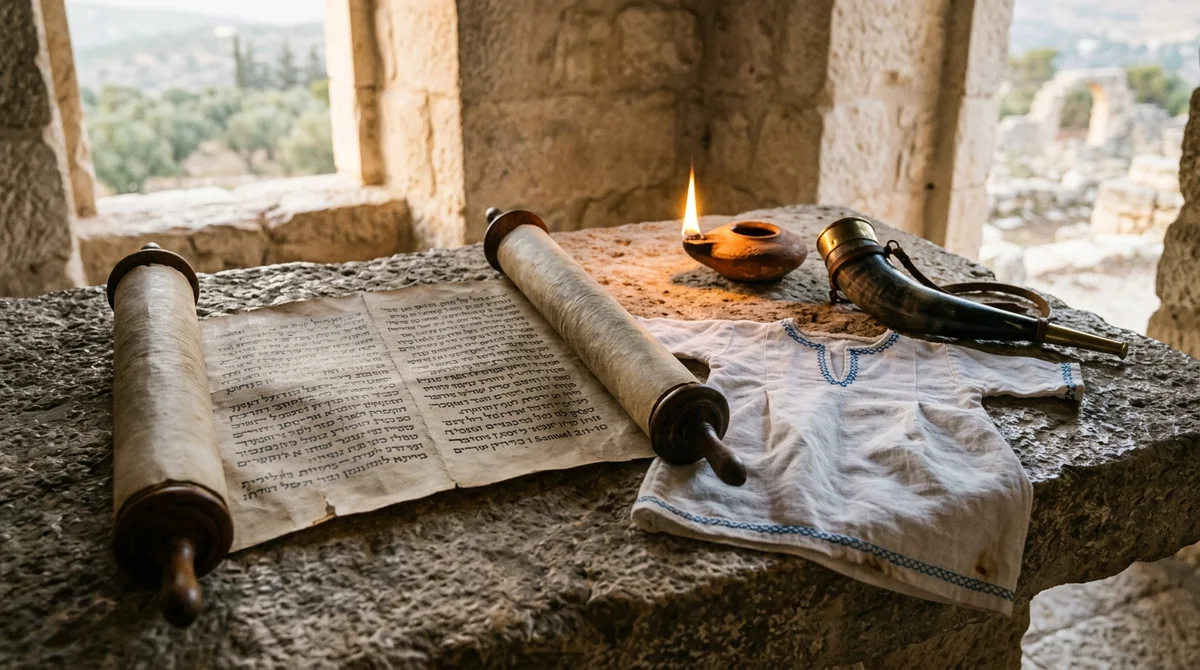 The Prayer That Birthed a Prophet: An ancient scroll of Hannah's Song of Praise beside a young child's linen ephod and a horn of anointing oil.
2. Pouring Out the Soul Before the Lord (1 Samuel 1:9–18)
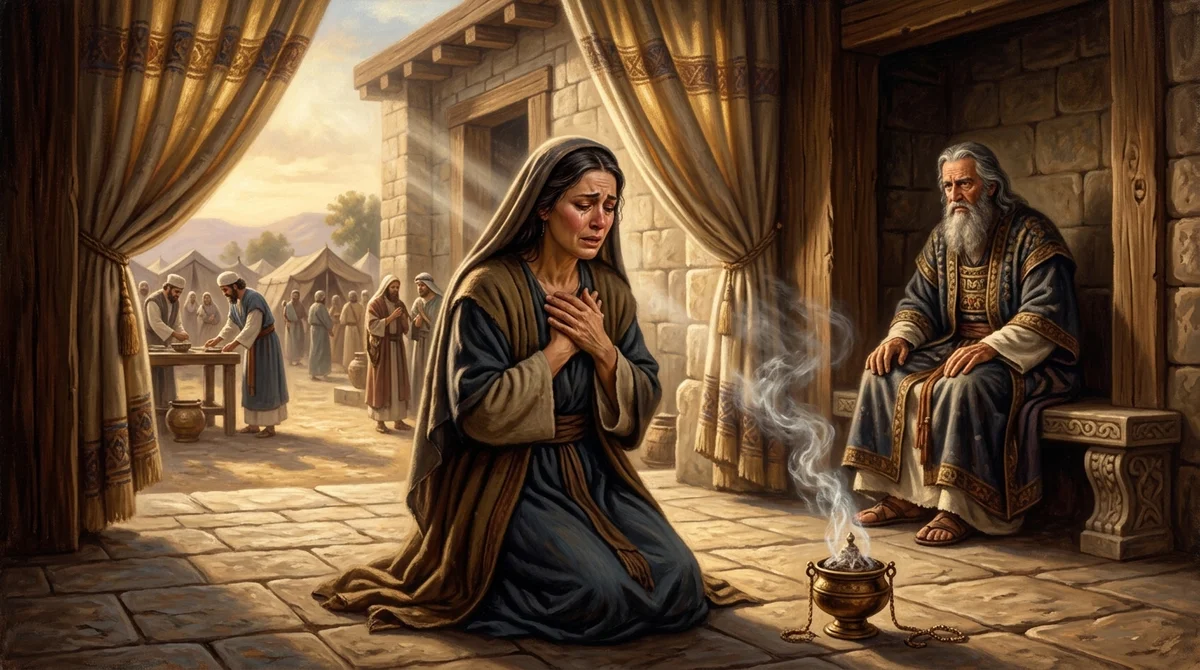
After the sacrificial meal in Shiloh, Hannah rose and walked into the Tabernacle courtyard. Standing before the presence of Yahweh near the doorpost where aged High Priest Eli sat on his seat, Hannah collapsed in deep anguish.
She did not recite dry religious formulas. Scripture records: "And she was in bitterness of soul, and prayed to the Lord and wept in anguish" (1 Samuel 1:10). In her desperate prayer, she uttered a radical vow to Yahweh Tsebaoth (The Lord of Hosts):
"O Lord of hosts, if You will indeed look on the affliction of Your maidservant and remember me, and not forget Your maidservant, but will give Your maidservant a male child, then I will give him to the Lord all the days of his life, and no razor shall come upon his head." (1 Samuel 1:11)
Hannah was making a lifelong Nazirite vow (Numbers 6). She was not asking for a son merely to flaunt before Peninnah or to secure her old age; she was offering the child back to God to serve a spiritually decaying nation.
As she continued praying silently, her lips moved but no sound came from her throat. Eli watched her and assumed she was drunk from the feast, sternly rebuking her: "How long will you be drunk? Put your wine away from you!"
Hannah replied with gentle, dignified humility: "No, my lord, I am a woman of sorrowful spirit. I have drunk neither wine nor intoxicating drink, but have poured out my soul before the Lord."
Recognizing her genuine devotion, Eli pronounced a priestly blessing: "Go in peace, and the God of Israel grant your petition which you have asked of Him." Hannah believed the promise. She went her way, ate food, and her face was no longer sad.
3. The Birth of Samuel and the Surrendered Vow (1 Samuel 1:19–28)
The family rose early the next morning, worshiped before the Lord, and returned home to Ramah. In the fullness of time, the Lord remembered Hannah. She conceived and gave birth to a son, naming him Samuel (Hebrew: Shemu'el, meaning "Heard of God" / "Asked of God"), declaring: "Because I have asked him from the Lord."
Hannah nursed and cared for the child at home until he was weaned (approximately three to four years old in ancient culture). Many parents would have hesitated, rationalized, or broken their vow once the long-awaited child was in their arms. But Hannah's integrity was absolute.
Taking the young boy, along with three bulls, an ephah of flour, and a skin of wine, Hannah brought Samuel to the Tabernacle in Shiloh. Presenting the child to Eli, she declared with radiant joy:
"For this child I prayed, and the Lord has granted me my petition which I asked of Him. Therefore I also have lent him to the Lord; as long as he lives he shall be lent to the Lord." (1 Samuel 1:27–28)
Young Samuel knelt and worshiped the Lord there. Hannah entrusted her precious toddler to the care of God's sanctuary, knowing that what is placed in God's hands is never lost.
4. The Song of Hannah: The Prophetic Magnificat (1 Samuel 2:1–10)
Hannah did not walk away from Shiloh mourning the loss of her child; she erupted in one of the most magnificent theological hymns in all of Scripture:
"My heart rejoices in the Lord; my horn is exalted in the Lord... No one is holy like the Lord, for there is none besides You, nor is there any rock like our God... The bows of the mighty are broken, and those who stumbled are girded with strength... The Lord makes poor and makes rich; He brings low and lifts up." (1 Samuel 2:1–8)
Hannah’s prayer is not merely personal thanksgiving; it is high prophetic theology. She is the first person in Scripture to mention the coming of God's Anointed King (Hebrew: Mashiach / Messiah): "He will give strength to His king, and exalt the horn of His anointed" (1 Samuel 2:10). Her son Samuel would later anoint King David, from whose line the ultimate Messiah, Jesus Christ, was born.
God honored Hannah’s extraordinary sacrifice. Every year, she stitched a new little linen tunic and brought it to Samuel at Shiloh. Scripture records that the Lord visited Hannah, blessing her with three more sons and two daughters (1 Samuel 2:21).
5. Four Powerful Spiritual Lessons from Hannah
- Take Your Pain Directly to the Altar: When provoked, misunderstood, and deeply hurt, Hannah did not retaliate against Peninnah; she poured out her tears directly before the Lord in raw, honest prayer.
- Surrendered Stewardship: The blessings God gives us—our children, talents, and resources—are not ours to hoard. When we dedicate them back to God, He uses them to impact generations.
- Faith Changes Your Demeanor Before the Answer Arrives: After receiving Eli's blessing, Hannah’s countenance changed from depression to peace before she had even conceived. Real faith rests in God's promise.
- God Exalts the Humble: The barren woman became the joyful mother of six, and her firstborn became the greatest prophet, priest, and judge of his generation, anointing the royal dynasty of Israel.
⚡ Fast Facts
- The Meaning of 'Hannah' and 'Samuel': Hannah's Hebrew name (Channah) means 'Grace' or 'Favor', while the name of her son Samuel (Shemu'el) means 'Heard of God' or 'Asked of God'.
- The First Use of 'Lord of Hosts' (Yahweh Tsebaoth): Hannah is the very first person in the entire Bible to address God with the majestic title 'Lord of Hosts' (1 Samuel 1:11), appealing to the Commander of heavenly angel armies in her personal helplessness.
- Prototype of the Magnificat: Hannah's triumphant Song of Praise in 1 Samuel 2:1–10 served as the direct theological blueprint and inspiration for Mary's Magnificat in Luke 1:46–55 a thousand years later.
- The Annual Linen Coat: Every year when Hannah traveled to Shiloh for the annual sacrifice, she lovingly brought a newly stitched linen robe (me'il) that she had made for young Samuel as he served in the Tabernacle (1 Samuel 2:19).
❓ Frequently Asked Questions (FAQs)
In the ancient Near East, public prayers were always recited audibly with raised voices. When Eli saw Hannah's lips moving passionately while no voice came out as she wept silently before the Ark, he assumed she was intoxicated from the sacrificial feast and rebuked her, unaware she was pouring out her soul in agony before Yahweh.
Under Numbers 6, a Nazirite was someone consecrated entirely to God's service, marked by never cutting their hair and abstaining from wine. Hannah vowed that if God gave her a son, she would not keep him for herself, but give him back to the Lord as a lifelong Nazirite to serve in the sanctuary all the days of his life.
Because Hannah kept her vow and surrendered her firstborn Samuel to the Lord's service, God honored her radical generosity. Scripture records in 1 Samuel 2:21 that the Lord visited Hannah, and she conceived and gave birth to three more sons and two daughters—a total of six children.