Across the muddy waters of the Jordan River stood Jericho—the ancient "City of Palms"—shielded by impenetrable double stone ramparts rising forty feet into the sky. Within this pagan fortress lived a woman named Rahab. Trapped in a corrupt Canaanite culture and marginalized as an innkeeper and prostitute, Rahab’s life seemed destined for destruction. Yet, beneath the shadow of impending divine judgment, she demonstrated an astonishing, world-overcoming faith in Yahweh that shattered ethnic boundaries, erased generational shame, and etched her name forever into the royal messianic lineage of Jesus Christ.
1. The Report That Shook the Nations (Joshua 2:1–11)
Following the death of Moses, Joshua prepared the children of Israel to cross the Jordan and conquer the Promised Land. From their encampment at Shittim, Joshua dispatched two trusted covert reconnaissance scouts to assess the defenses and morale of Jericho.
The spies entered the city gates at dusk and lodged at the house of Rahab, which was strategically built directly into the outer casemate wall of the fortress. When the King of Jericho received military intelligence that Israelite infiltrators had entered Rahab’s inn, he immediately sent armed soldiers demanding: "Bring out the men who have come to you and entered your house, for they have come to search out all the country!"
Rahab had already brought the spies up to her flat roof and hidden them under thick stalks of drying flax laid out in rows. Misdirecting the king's guards by telling them the men had slipped out the city gates just before closing at dusk, she sent the pursuers racing toward the Jordan River fords.
Climbing up to the roof under the starry desert sky, Rahab uttered one of the most sublime and unexpected theological confessions in the Old Testament:
"I know that the Lord has given you the land, that the terror of you has fallen on us, and that all the inhabitants of the land are fainthearted because of you. For we have heard how the Lord dried up the water of the Red Sea when you came out of Egypt, and what you did to the two kings of the Amorites... for the Lord your God, He is God in heaven above and on earth beneath." (Joshua 2:9–11)
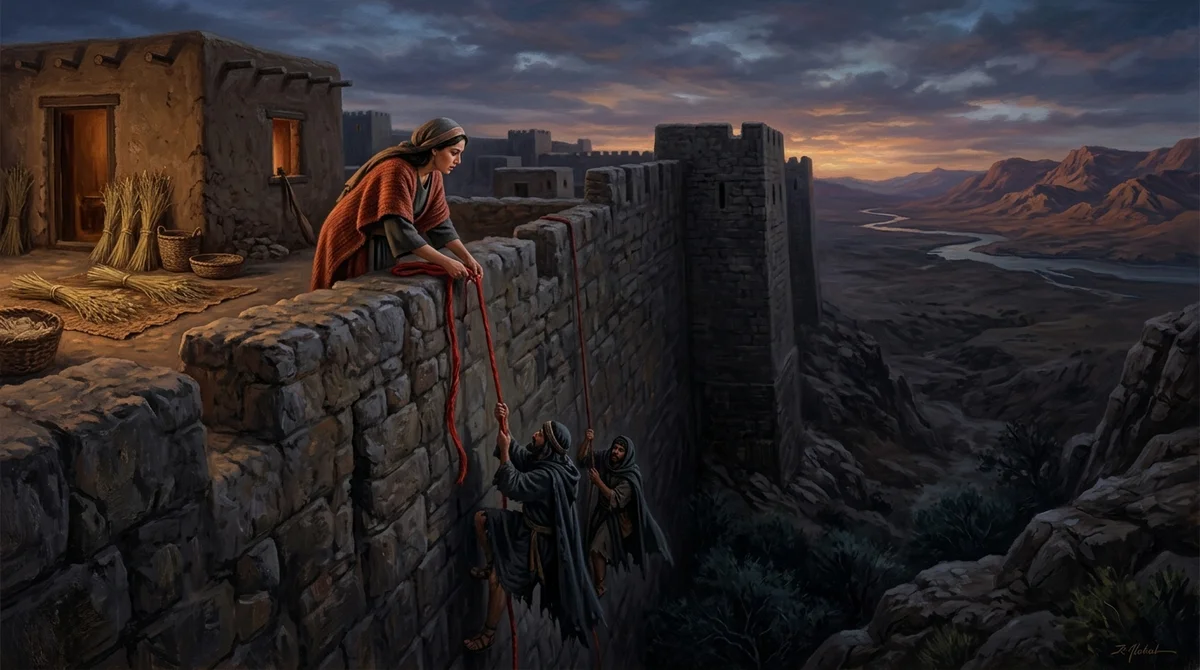
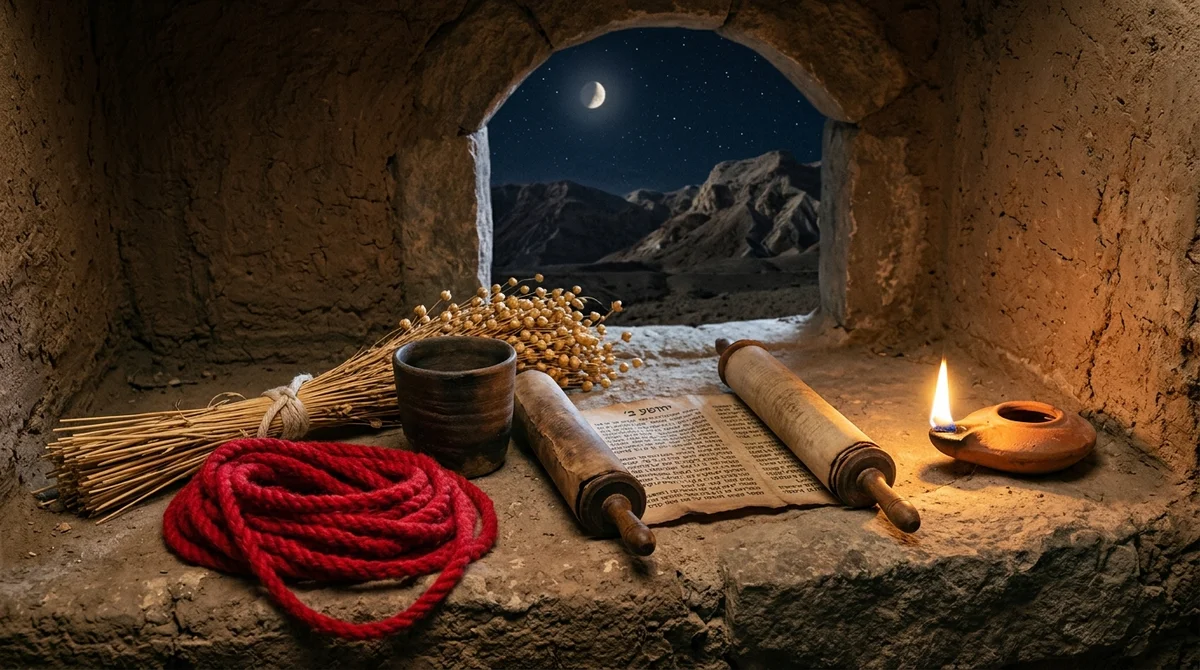 The Scarlet Cord of Redemption: The crimson rope hung from the window of Rahab's house on the wall of Jericho, a prophetic type of the blood of Christ.
2. The Covenant of the Scarlet Cord (Joshua 2:12–24)
Having recognized the absolute supremacy and holiness of Yahweh, Rahab negotiated a sacred covenant of mercy and deliverance for her family:
"Now therefore, I beg you, swear to me by the Lord, since I have shown you kindness, that you also will show kindness to my father’s house, and give me a true token, and spare my father, my mother, my brothers, my sisters, and all that they have, and deliver our lives from death."
The spies replied with solemn oath: "Our lives for yours, if none of you tell this business of ours!" They established three non-negotiable conditions for her household's salvation:
- The Scarlet Cord (*Tikvat Chūt Hashānī*): She must tie the thick crimson cord—the very rope used to lower the spies down the outer sheer wall—firmly in her window.
- The Sanctuary of the Home: Her entire family (father, mother, siblings, and all relatives) must remain gathered inside her house during the military assault; anyone stepping outside into the street forfeited immunity.
- Absolute Secrecy: She must not betray their mission or expose the covenant to the King of Jericho.
Rahab lowered the spies safely down through the window outside the city wall, advised them to hide in the Judean wilderness caves for three days until the search parties returned, and immediately tied the vibrant scarlet cord in her window as an unshakeable beacon of faith.
3. The Fall of Jericho and the Rescue of Rahab (Joshua 6)
For six consecutive days, the Israelite army marched silently around the towering walls of Jericho once a day, with seven priests bearing rams' horns before the Ark of the Covenant. Inside the fortress, terror paralyzed the inhabitants, but from the window on the north wall hung the vibrant scarlet cord.
On the seventh day, Israel circled the fortress seven times. At Joshua's command, the priests blew a mighty blast on the shofars, and all the people shouted with a great shout of praise. Supernaturally, the massive outer walls collapsed outward flat to the ground (Hebrew: taḥtehā)—except for the specific portion of the wall holding Rahab's house!
Joshua commanded the two young spies: "Go into the harlot’s house, and from there bring out the woman and all that she has, as you swore to her." (Joshua 6:22).
Rahab and her entire extended family were escorted safely out of the city into the camp of Israel before the fortress was burned to ashes. Scripture records with historical honor: "And Joshua spared Rahab the harlot, her father’s household, and all that she had. So she dwells in Israel to this day" (Joshua 6:25).
4. The Transformed Lineage: Into the Genealogy of Christ (Matthew 1:5)
Rahab did not remain a perpetual refugee or an outcast in Israel. Her genuine faith was welcomed into the covenant community of God's people.
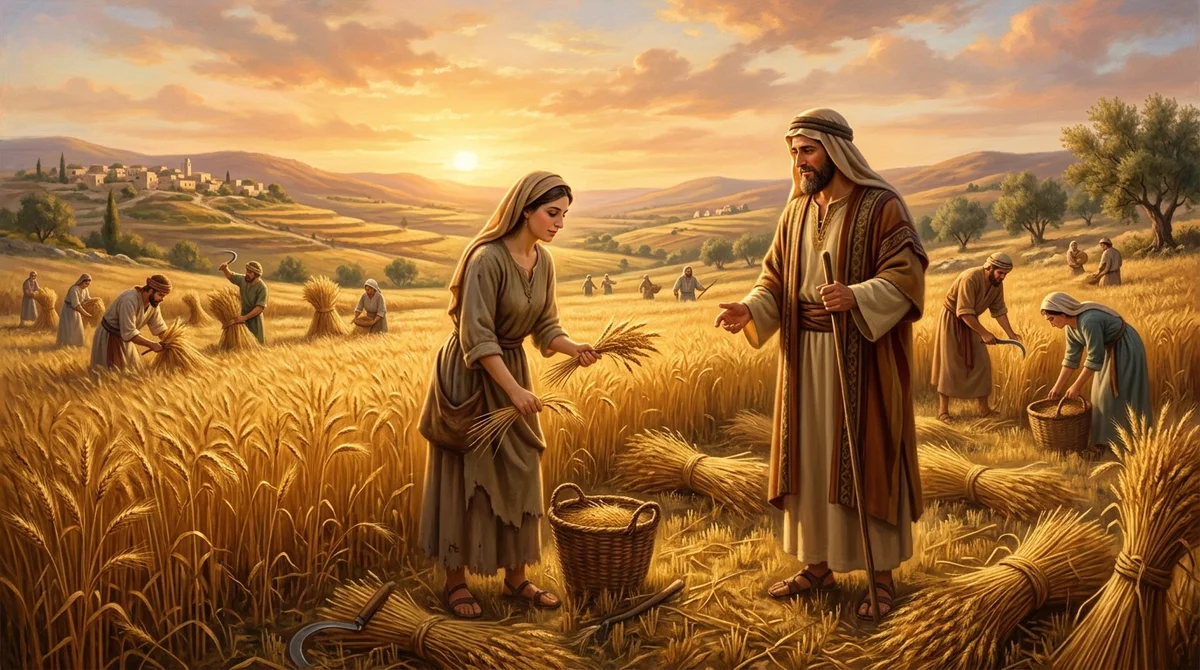
She married Salmon, a prominent prince of the tribe of Judah (the son of Nahshon, the tribal leader of Judah during the wilderness wanderings). Together, Salmon and Rahab had a son named Boaz. Having experienced extraordinary grace and deliverance herself, Rahab raised Boaz to be a man of extraordinary honor, generosity, and compassion—the very man who would later redeem Ruth the Moabitess!
Through Boaz, Rahab became the great-great-grandmother of King David, and her name is immortalized in Matthew 1:5 as an ancestress of Jesus Christ, the Savior of the world.
5. Four Profound Spiritual Lessons from Rahab of Jericho
- Your Past Does Not Define Your Future: Rahab was a Canaanite prostitute in a doomed pagan city, yet her faith in Yahweh erased her past and elevated her into the royal messianic lineage.
- Faith Requires Decisive Action: True faith is not passive intellectual agreement; as James 2:25 declares, Rahab’s faith was justified because she actively welcomed the messengers and risked her life for God's kingdom.
- The Power of Household Intercession: Rahab did not ask for personal salvation alone; she pleaded for her entire family, and every single relative who gathered under the scarlet cord was saved.
- The Scarlet Cord of Christ’s Blood: Just as the crimson rope in the window shielded Rahab's house from the wrath that destroyed Jericho, the shed blood of Jesus Christ on Calvary provides complete, unbreakable protection from eternal judgment.
⚡ Fast Facts
- The Scarlet Cord (*Tikvat Chūt Hashānī*): The crimson rope hung from Rahab's window is a celebrated biblical typology of the blood of Jesus Christ, providing shelter from divine judgment just as the Passover lamb's blood protected Israel in Egypt.
- Hall of Faith (Hebrews 11:31): Rahab is one of only two women specifically praised by name in Hebrews 11 (the 'Hall of Faith'), alongside Sarah, commended for receiving the spies in peace.
- Mother of Boaz: According to Matthew 1:5, Rahab married Prince Salmon of the tribe of Judah and gave birth to Boaz, making her the mother-in-law of Ruth and the great-great-grandmother of King David.
- Archaeology of Jericho: Modern archaeological excavations at Tell es-Sultan (ancient Jericho) reveal that a short section of the outer city wall on the north side did NOT collapse, matching the biblical record of Rahab's house built into the city wall.
❓ Frequently Asked Questions (FAQs)
Rahab explained in Joshua 2:9-11 that the inhabitants of Jericho had heard how Yahweh dried up the Red Sea 40 years earlier and defeated the Amorite kings Sihon and Og. While others trembled in terror, Rahab's heart received divine revelation, confessing: 'Yahweh your God, He is God in heaven above and on earth beneath.'
Jericho was a major center for flax production in the Jordan Valley. Stalks of flax were laid out on flat rooftops to dry in the sun before being spun into linen. This provided a natural, thick hiding place that concealed the two Israelite spies from the King of Jericho's soldiers.
Paul (in Hebrews 11:31) highlights Rahab's inward *faith* that trusted God's promises above earthly empires, while James (in James 2:25) highlights Rahab's outward *works*—her faith was not mere intellectual belief, but active courage that risked her life to protect God's messengers.