During the dark and fractured era of the Judges, when Israel repeatedly forsook the covenant of Yahweh and suffered under the crushing heel of pagan oppressors, God raised up an extraordinary beacon of spiritual wisdom, judicial integrity, and decisive military faith: Deborah. Holding court under the famous "Palm of Deborah" in the hill country of Ephraim, she was not merely a ruler; she was a prophetess, a judge, a poet, and a self-described "Mother in Israel" whose unwavering trust in God broke twenty years of brutal Canaanite tyranny.
1. The Cry of an Oppressed Nation (Judges 4:1–5)
Following the death of Judge Ehud, the children of Israel again turned away from Yahweh, falling into idolatry. Consequently, the Lord sold them into the oppressive hand of Jabin king of Canaan, who reigned in the northern stronghold of Hazor. His military was commanded by Sisera, a ruthless warlord operating out of Harosheth-hagoyim with nine hundred iron chariots.
For twenty agonizing years, King Jabin harshly oppressed the Israelites. Travel along main commercial highways ceased out of terror; trade collapsed; villagers abandoned their homes for fear of raiders; and Israel possessed neither shield nor spear among forty thousand men (Judges 5:6–8).
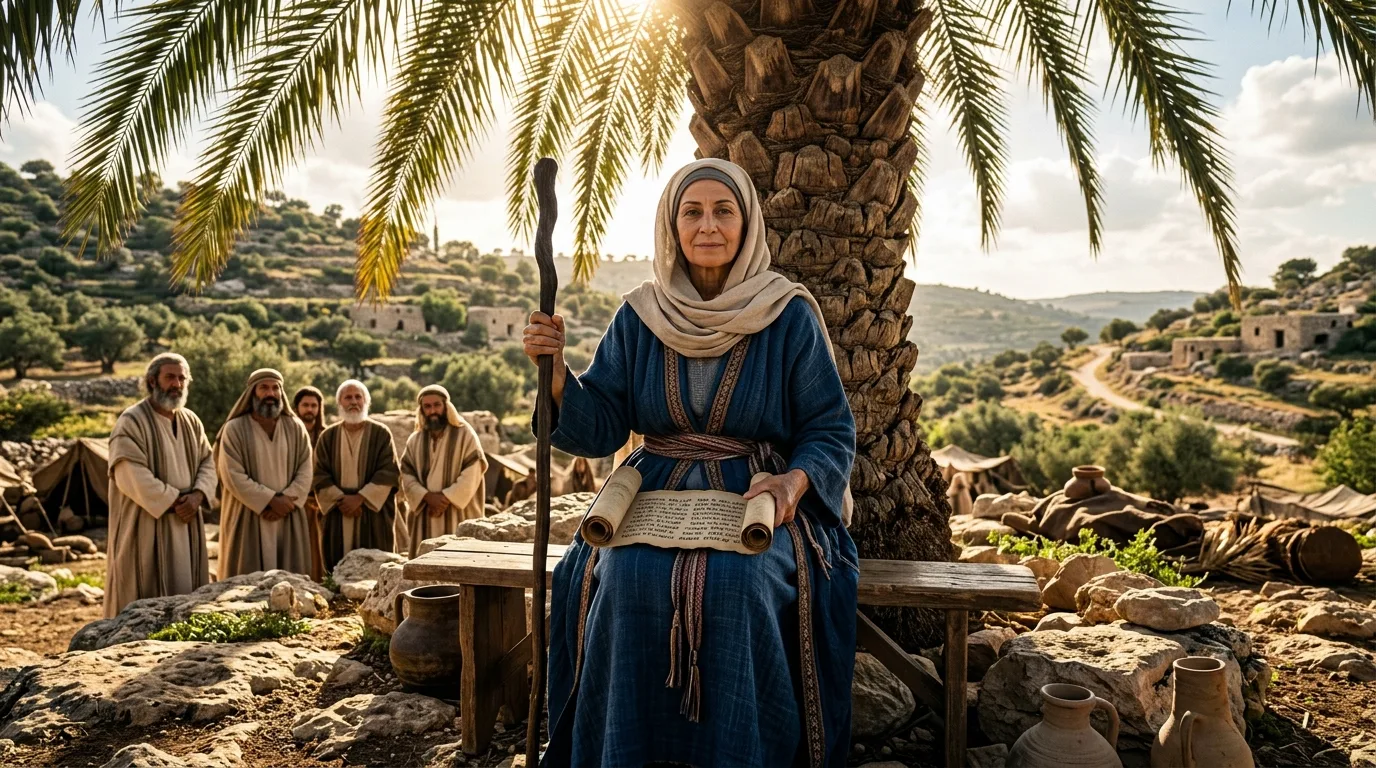
In this atmosphere of paralyzing fear, God did not raise a mighty warrior like Samson or a royal champion, but a godly woman of deep prayer and discernment: Deborah (Hebrew: Devorah, meaning "Bee"), the wife of Lappidoth. She held court under the palm tree between Ramah and Bethel in Ephraim, where the children of Israel came up to her for justice and divine counsel.
 The Battle of the Kishon: The Song of Deborah scroll beside ancient chariot relics, commemorating the miraculous victory at Mount Tabor.
2. The Prophetic Summons to Barak (Judges 4:6–10)
Moved by the Holy Spirit, Deborah sent for Barak son of Abinoam from Kedesh in Naphtali and delivered a direct divine commission:
"Has not the Lord God of Israel commanded: 'Go and deploy troops at Mount Tabor; take with you ten thousand men of the sons of Naphtali and of the sons of Zebulun; and against you I will deploy Sisera, the commander of Jabin’s army, with his chariots and his multitude at the River Kishon; and I will deliver him into your hand'?" (Judges 4:6–7)
Barak, keenly aware of the terrifying disparity between foot soldiers armed with basic farm tools and 900 iron chariots commanding the flat plains, replied with conditional obedience: "If you will go with me, then I will go; but if you will not go with me, I will not go!"
Deborah replied with fearless spiritual clarity: "I will surely go with you; nevertheless there will be no glory for you in the journey you are taking, for the Lord will sell Sisera into the hand of a woman." Deborah arose and accompanied Barak to Kedesh, where ten thousand men mobilized in faith.
3. Supernatural Rain and the Torrent of Kishon (Judges 4:11–16; 5:19–22)
Barak marched his ten thousand volunteer warriors up to the summit of Mount Tabor, a prominent dome-shaped limestone mountain overlooking the expansive Jezreel Valley. When Sisera learned of the revolt, he assembled all 900 iron chariots and his vast army along the banks of the River Kishon.
From a human military perspective, attacking iron chariots in open valley terrain was suicide. But Deborah spoke the word of faith:
"Up! For this is the day in which the Lord has delivered Sisera into your hand. Has not the Lord gone out before you?" (Judges 4:14)
Barak charged down the mountain. At that precise moment, Almighty God intervened from heaven. As Deborah's victory hymn vividly describes: "The stars from their courses fought against Sisera. The torrent Kishon swept them away, that ancient torrent, the torrent Kishon" (Judges 5:20–21).
A sudden, violent cloudburst inundated the valley. The Kishon River overflowed into a roaring flash flood, transforming the alluvial valley floor into a quagmire of thick mud. The 900 iron chariots—Sisera’s greatest military pride—bogged down, their wheels hopelessly stuck. Panic seized the Canaanite army as Barak’s infantry swept over them.
4. The Tent of Jael and Total Deliverance (Judges 4:17–24)
Seeing his invincible army disintegrating, Sisera abandoned his stuck chariot and fled on foot toward the north. Exhausted and dehydrated, he arrived at the nomadic encampment of Heber the Kenite, whose family had an official peace treaty with King Jabin.
Heber’s wife, Jael, stepped out of her tent to greet the fleeing commander: "Turn aside, my lord, turn aside to me; do not fear." She hid him under a rug inside the women's quarters (where ancient custom strictly forbade male entry). When he asked for a little water, she opened a skin of curdled milk, gave him a nourishing drink, and covered him again.
Sisera instructed her: "Stand at the door of the tent, and if any man comes inquiring, 'Is there any man here?' say, 'No.'"
Overcome by physical exhaustion, Sisera fell into a deep sleep. Taking a wooden tent peg and a heavy mallet in her hands, Jael approached him silently and drove the peg straight through his temple into the ground.
When Barak arrived in hot pursuit, Jael stepped out and said: "Come, and I will show you the man whom you seek." Entering the tent, Barak saw the feared general lying dead with the tent peg through his head. Exactly as Deborah had prophesied, the ultimate honor of the victory belonged to a woman.
5. The Song of Deborah: Theology of Praise (Judges 5)
On that glorious day of liberation, Deborah and Barak erupted in a majestic hymn of praise (Judges 5), celebrating Yahweh's majesty, recalling the trembling of Mount Sinai, honoring the faithful tribes who volunteered, and blessing Jael above women.
The closing verse of the Song of Deborah stands as a timeless prayer for all who love God:
"Thus let all Your enemies perish, O Lord! But let those who love Him be like the sun when it comes out in full strength." (Judges 5:31)
Because of Deborah’s faithful spiritual leadership and courage, Scripture records that the land had peace for forty years.
6. Five Transformative Leadership Lessons from Deborah
- Spiritual Discernment Precedes Strategic Action: Deborah spent years listening to God beneath her palm tree before commanding an army. True godly authority is birthed in quiet communion with God.
- Maternal Servant Leadership: Deborah did not dominate; she nurtured. By rising as a "Mother in Israel," she restored dignity, unity, and courage to a fragmented nation.
- Catalyst for Others: Deborah did not usurp the military role; she empowered Barak, walked beside him, and bolstered his wavering faith so he could fulfill his divine calling.
- God Neutralizes Human Pride: The 900 iron chariots that terrorized Israel became useless in the mud of Kishon. God uses the simplest elements of nature to shatter the greatest human arrogance.
- Living in Radiant Strength: Those who love the Lord are destined to shine "like the sun coming out in its full strength," overcoming fear and bringing divine peace to their generation.
⚡ Fast Facts
- The Meaning of 'Deborah' and 'Lappidoth': 'Deborah' in Hebrew means 'Bee' (symbolizing industriousness, organization, and discernment), while her husband's name 'Lappidoth' means 'Torches' or 'Flames'.
- Only Female Judge in the Bible: Out of all the twelve judges recorded in the Book of Judges, Deborah is the only woman, functioning uniquely as both a recognized prophetess (like Moses and Samuel) and a supreme civil judge.
- The Song of Deborah (Judges 5): Her victory song in Judges 5 is recognized by biblical scholars and linguists as one of the oldest and most sublime poetic compositions in the entire Hebrew Bible, dating directly to the late Bronze Age.
- Title of 'Mother in Israel': Deborah defined her own leadership not with militaristic arrogance, but as a protective maternal shepherd: 'Village life ceased in Israel until I, Deborah, arose, arose a mother in Israel' (Judges 5:7).
❓ Frequently Asked Questions (FAQs)
Barak recognized that Deborah possessed authentic prophetic communion with Yahweh. In ancient near eastern warfare, marching into battle was a spiritual act; Barak knew that having the prophetess present assured the troops of God's presence, strategic direction, and divine favor.
As Barak's 10,000 foot soldiers charged down Mount Tabor, God unleashed a supernatural, unseasonable torrential rainstorm (Judges 5:20–21). The Kishon River violently overflowed its banks, turning the Jezreel Valley into deep mud that trapped and immobilized Sisera's heavy iron chariots.
Deborah prophesied to Barak that the honor of defeating the enemy general would not belong to him, for the Lord would sell Sisera into the hand of a woman (Judges 4:9). When Sisera fled on foot, Jael, the wife of Heber the Kenite, invited him into her tent, gave him milk, and drove a tent peg through his temple while he slept.