In the rugged Judean wilderness of Carmel and Maon, during the tense years when David fled from the murderous pursuit of King Saul, lived one of the most brilliant, tactful, and courageous women in biblical history: Abigail. Married to an arrogant, harsh, and foolish landowner named Nabal, Abigail faced an impending catastrophe when her husband insulted David and incited a bloodbath. With breathtaking speed, humility, and prophetic eloquence, Abigail stepped between four hundred armed warriors and certain death, single-handedly turning wrath into peace and saving the future king of Israel from moral ruin.
1. The Contrast of Carmel: Beauty and the Churl (1 Samuel 25:1–11)
Following the death of Prophet Samuel, David retreated with his six hundred loyal men into the wilderness of Paran. In the region of Maon lived an exceedingly wealthy man named Nabal of the house of Caleb, who owned three thousand sheep and a thousand goats grazing in Carmel.
Scripture presents an unforgettable portrait of marital contrast:
"The name of the man was Nabal, and the name of his wife Abigail. And she was a woman of good understanding and beautiful appearance; but the man was harsh and evil in his doings." (1 Samuel 25:3)
Throughout the grazing season, David’s men had served as an impenetrable protective wall around Nabal’s shepherds and flocks, guarding them from desert marauders and wild beasts without ever demanding payment or stealing a single lamb.
During the festive season of sheep-shearing—an ancient near eastern time of lavish hospitality and open generosity—David sent ten young men with a peaceful greeting, politely requesting whatever provisions Nabal could spare.
Nabal responded with arrogant venom, insulting David's lineage: "Who is David, and who is the son of Jesse? There are many servants nowadays who break away each one from his master! Shall I take my bread and my water and my meat that I have killed for my shearers, and give it to men when I do not know where they are from?"
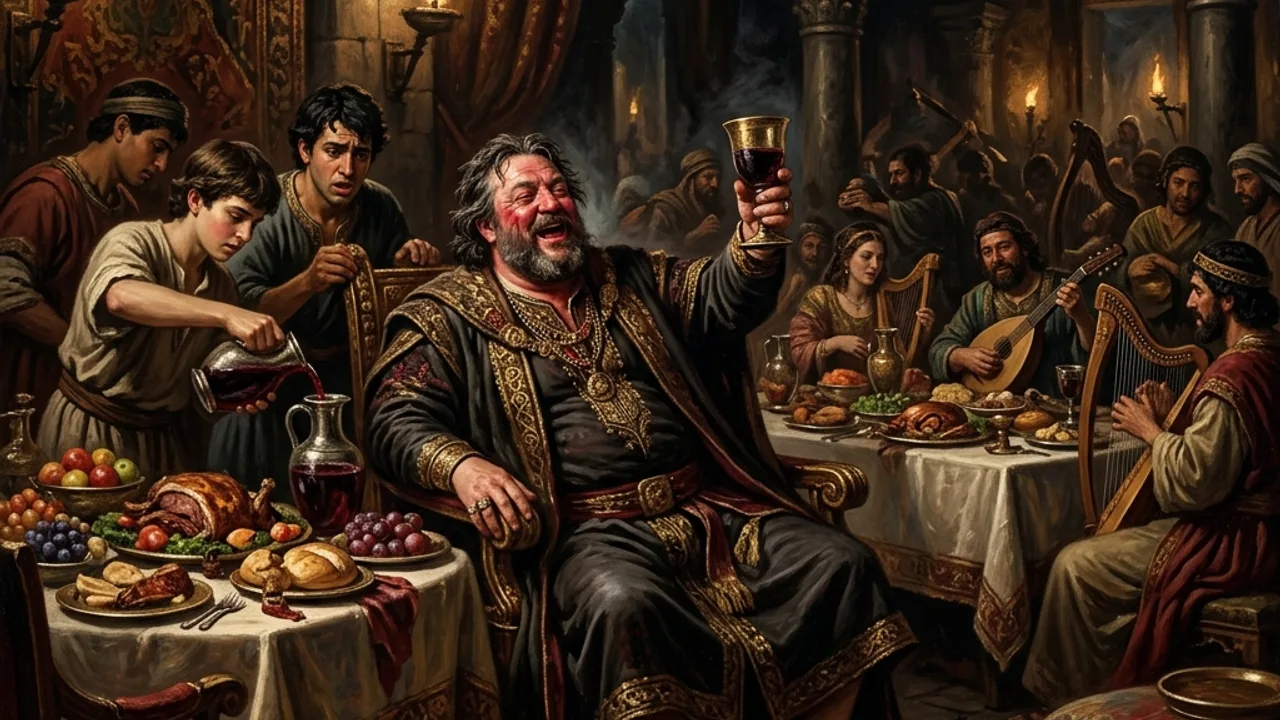 The Contrast of Folly and Wisdom: Nabal's drunken revelry in his Carmel manor while Abigail acts decisively to avert judgment.
2. The Impending Bloodbath and Abigail's Decisive Action (1 Samuel 25:12–19)
When David received the insulting report, righteous indignation turned into vengeful wrath. Straping on his sword, David ordered: "Every man gird on his sword!" Four hundred armed warriors marched behind David, intent on annihilating every male in Nabal's household before daybreak.
One of Nabal’s shepherds ran directly to Abigail, warning her: "David sent messengers out of the wilderness to greet our master, and he reviled them. But the men were very good to us... Now therefore, know and consider what you will do, for harm is determined against our master and against all his household, for he is such a scoundrel that one cannot speak to him!"
Abigail did not panic, freeze, or complain about her husband. With astonishing logistical efficiency, she quickly gathered:
- Two hundred loaves of fresh bread
- Two skins of wine
- Five dressed sheep
- Five seahs (about 35 liters) of roasted grain
- One hundred clusters of raisins
- Two hundred cakes of pressed figs
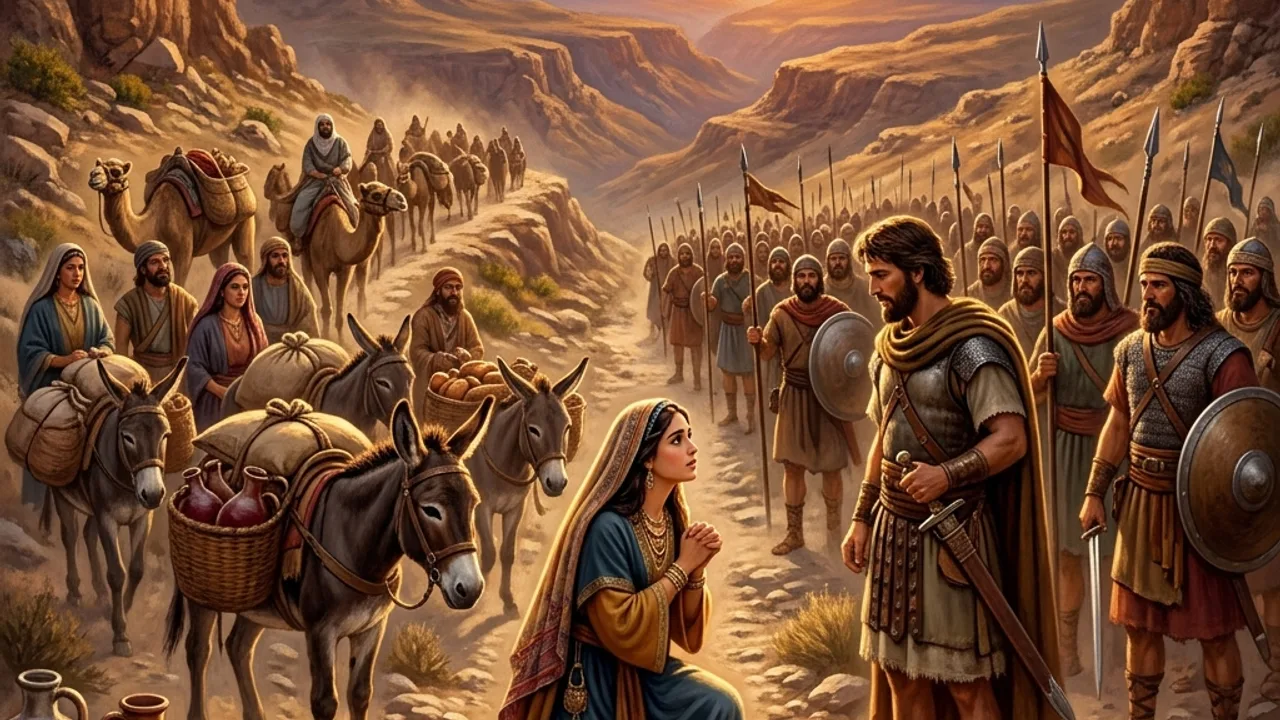
Loading the vast caravan onto donkeys, she sent her servants ahead, riding behind them down the mountain pass without telling her foolish husband.
3. The Intercession of Grace: Falling at David's Feet (1 Samuel 25:20–31)
As Abigail rode into a ravine of the mountain, David and his four hundred armed men were descending toward her. David was swearing an oath of complete destruction.
Seeing David, Abigail dismounted quickly, fell on her face before him, and bowed herself to the ground. In a masterclass of humble diplomacy, theological depth, and prophetic wisdom, she took the full blame upon herself:
"On me, my lord, on me let this iniquity be! And please let your maidservant speak in your ears, and hear the words of your maidservant... Please do not let my lord regard this scoundrel Nabal. For as his name is, so is he: Nabal is his name, and folly is with him!" (1 Samuel 25:24–25)
She presented her gift, and then spoke with prophetic authority about David’s eternal destiny:
"The Lord will certainly make for my lord an enduring house, because my lord fights the battles of the Lord... and the soul of my lord shall be bound in the bundle of the living with the Lord your God; and the lives of your enemies He shall sling out, as from the pocket of a sling... that this will be no grief to you, nor offense of heart to my lord, either that you have shed blood without cause, or that my lord has avenged himself." (1 Samuel 25:28–31)
Abigail reminded David of who he was: the future anointed King of Israel who fought the battles of Yahweh, not a petulant warlord seeking petty personal revenge. By referencing the "pocket of a sling," she subtly recalled David's great victory over Goliath, re-centering his focus on divine faith.
4. David's Awakening and the Death of Nabal (1 Samuel 25:32–39)
David was deeply convicted and awestruck by her wisdom. His anger melted into praise:
"Blessed is the Lord God of Israel, who sent you this day to meet me! And blessed is your advice and blessed are you, because you have kept me this day from coming to bloodshed and from avenging myself with my own hand." (1 Samuel 25:32–33)
David accepted her gifts and told her: "Go up in peace to your house. See, I have heeded your voice and respected your person."
When Abigail returned home, Nabal was holding a lavish feast like a king, thoroughly drunk. Abigail wisely waited until morning when the wine had worn off to explain how narrowly he had escaped death.
Hearing the news, Nabal suffered a catastrophic stroke: "his heart died within him, and he became like stone." Ten days later, the Lord struck Nabal, and he died.
When David heard of Nabal’s death, he praised God for judging the wicked without David taking vengeance. David sent messengers proposing marriage to Abigail. She bowed with humility: "Here is your maidservant, a servant to wash the feet of the servants of my lord," and rode out to become David’s wife.
5. Five Spiritual Lessons from Abigail
- Wisdom Combined with Decisive Action: When a crisis strikes, godly wisdom does not waste time in self-pity; it acts quickly, generously, and strategically to defuse danger.
- The Power of a Soft Answer: As Proverbs 15:1 teaches, "A soft answer turns away wrath." Abigail’s profound humility and gentleness disarmed four hundred furious warriors.
- Reminding Others of Their God-Given Identity: When leaders are about to make disastrous emotional decisions, a godly counselor lovingly reminds them of their calling and future legacy.
- Letting God Avenge: Abigail urged David to leave vengeance to Yahweh (Romans 12:19). God dealt with Nabal in His own perfect timing and righteous justice.
- Bound in the Bundle of the Living: Those who place their lives under the lordship of Christ are permanently secured in the covenant protection of the Almighty.
Biblical Keywords & Theological Roots
My father is joy / Cause of joy; designating a woman whose inner spiritual vitality brings flourishing, rejoicing, and life to otherwise devastated environments.
Good understanding / Keen discerning intellect; a rare biblical phrase describing profound emotional intelligence, spiritual acumen, and practical tactical wisdom.
The bundle of the living with Yahweh your God; Abigail's immortal prophetic blessing (1 Sam 25:29) assuring David that his life was eternally safeguarded in God's protective pouch.
Fool, churlish, senseless, withered, religiously tone-deaf; denoting an arrogant individual who defies social and divine obligations despite abundant material prosperity.
Blessing, generous gift, present of reconciliation; the peace offering of provisions Abigail brought to appease David's wrath and avert catastrophic bloodshed.
Ancient Near Eastern & Archaeological Context
Abigail lived in the rugged hill country of southern Judah during the transitional Iron Age I period (ca. 1020–1000 BC), when King Saul’s centralized monarchy was disintegrating and David operated as an outlaw chieftain in the wilderness of Paran and En Gedi. The setting of 1 Samuel 25 centers around Maon and Carmel (identified as modern Khirbet el-Karmil, located about ten miles south of Hebron). Archaeological surveys at Carmel have uncovered extensive Iron Age terraces, rock-cut agricultural cisterns, watchtowers, and large stone sheepfolds, corroborating the biblical picture of an elite pastoral estate managing thousands of sheep and goats.
In the semi-arid Judean highlands, pastoralists faced constant raids from desert nomads (such as the Amalekites and Bedouin). David and his band of 600 warriors functioned as a voluntary protective buffer (*chomah*, or 'wall') for Nabal’s shepherds. In Ancient Near Eastern pastoral culture, the annual Sheep-Shearing Festival (*gezez ha-tzon*) was the pastoral equivalent of the harvest feast—a sacred season of abundant butchering, open-handed hospitality, social reciprocity, and gift-giving. To deny provisions to men who had protected one's livelihood was not merely rude; it was a brazen violation of sacred Near Eastern covenant hospitality (*khesed*), warranting severe social and military retaliation.
Practical Discipleship & Spiritual Application
- Courageous Peacemaking in Crisis: Blessed are the peacemakers, for they shall be called sons and daughters of God. Abigail did not freeze in fear or gossip; she took immediate, sacrificial action to stand in the breach and stop impending violence.
- The Power of a Humble Soft Answer: Abigail averted the slaughter of her entire household by taking Nabal's guilt upon herself and speaking with exquisite humility: 'A soft answer turns away wrath, but a harsh word stirs up anger' (Proverbs 15:1).
- Prophetic Vision Over Present Emotion: When David was blinded by vengeful rage, Abigail reminded him of his eternal destiny—that he was anointed to fight the Lord's battles and be bound in the bundle of the living. Speak destiny into people when anger tempts them to compromise their calling.
- Letting God Avenge Your Injustices: Abigail prevented David from shedding innocent blood with his own hands. Within ten days, the Lord Himself dealt with Nabal. Never take vengeance into your own hands; leave room for God's righteous judgment.
Support Independent Biblical Research
Did this study bless you? Help support our independent bilingual research and interactive visual Bible tools.
⚡ Fast Facts
- The Meaning of 'Abigail' and 'Nabal': In Hebrew, 'Abigail' means 'My Father's Joy' or 'Source of Joy', while her husband's name 'Nabal' literally means 'Fool' or 'Senseless' (1 Samuel 25:25).
- Only Woman Described as Both Intelligent and Beautiful: Abigail is the only woman in the entire Hebrew Bible explicitly described with the dual compliment of having 'good understanding' (sekel tov) and 'beautiful appearance' (tovat to'ar) (1 Samuel 25:3).
- The 'Bundle of the Living' Prophecy: Abigail uttered one of the most famous blessings in Jewish history: 'The soul of my lord shall be bound in the bundle of the living with the Lord your God' (1 Samuel 25:29)—a phrase inscribed on Jewish tombstones worldwide to this day.
- Preventing David from Bloodguilt: David acknowledged that Abigail’s intervention prevented him from committing mass murder in a fit of rage, preserving his moral integrity before ascending the throne of Israel.
❓ Frequently Asked Questions (FAQs)
Why was David so enraged by Nabal's insult?
David and his 600 men had acted as a protective wall around Nabal's 3,000 sheep and 1,000 goats in the wilderness of Paran, never taking a single animal. During sheep-shearing (a customary time of lavish hospitality), Nabal insulted David as a runaway slave and refused to share bread or meat.
How did Abigail intercede without her husband's knowledge?
Recognizing that disaster was imminent, Abigail acted with decisive speed. She packed 200 loaves of bread, two skins of wine, five dressed sheep, five seahs of roasted grain, 100 clusters of raisins, and 200 fig cakes onto donkeys, intercepting David's armed force in a mountain ravine.
What happened to Nabal and how did Abigail become David's wife?
When Abigail returned, Nabal was holding a kingly drinking feast. When she told him the next morning how close he came to death, his heart died within him and he became paralyzed like stone. Ten days later, the Lord struck Nabal and he died; David then sent messengers and took Abigail as his wife.