The spring air in the subtropical Jordan Valley was sweet with the fragrance of blooming orange blossoms and aromatic balsam gardens as Jesus began His final ascent to Jerusalem. The ancient oasis of Jericho—the City of Palms—pulsed with electric excitement. Tens of thousands of Jewish pilgrims from Galilee and Perea were streaming down the road, joining the festive caravan toward the Holy City for the annual Passover festival. Word spread like wildfire through the bazaar that the miracle-working Prophet of Nazareth, who had just raised Lazarus from the dead in nearby Bethany, was entering through the city gates.
1. The Outcast with a Golden Vault
Living in opulent luxury inside a Roman-style villa was a man named Zacchaeus. His name derived from the noble Hebrew Zakkai, meaning "pure, righteous, or innocent." Yet his life was a tragic mockery of that sacred name. Zacchaeus was not merely a common tax collector; Luke designates him as the Architelōnēs—the Chief Tax Collector of the entire Jericho customs district.
In first-century Judea, tax farming was a cutthroat business. Zacchaeus had purchased the imperial franchise from Rome, advancing large sums to the provincial treasury. In return, he stationed sub-collectors along the trade caravans, extorting exorbitant customs duties on spices, grain, and balsam. While his money chests overflowed with Roman denarii and silver shekels, his social standing was bankrupt. To his fellow Jews, he was a traitor, a collaborator with pagan oppressors, and a thief. He was barred from entering the local synagogue, his testimony was disqualified in civil courts, and religious Pharisees used his very name as a curse.
Yet behind the cold, ruthless exterior of the wealthy tax baron was a soul starving for reality. Zacchaeus had heard reports of Jesus—a Rabbi who dined with publicans, loved outcasts, and looked upon broken sinners without contempt. An uncontrollable yearning seized his heart: he sought to see who Jesus was (Luke 19:3).
2. The Scramble Up the Sycamore Tree
Rushing into the crowded streets, Zacchaeus collided with a physical impossibility: he could not see Jesus because of the crowd, for he was of short stature (Luke 19:3). The dense throng of patriotic pilgrims shoulder-to-shoulder formed an impenetrable human wall. Worse still, the moment bystanders recognized the hated tax chief, they intentionally closed ranks, elbowing him backward with contempt. No one would yield a fraction of an inch to let the extortioner see the Prophet.
A proud aristocrat would have retreated in bitter humiliation to his guarded palace. But desperation knows no pride. Casting aside all oriental dignity, gathering up the flowing hem of his costly linen tunic, the wealthy commissioner sprinted ahead of the cheering multitude like a peasant boy.
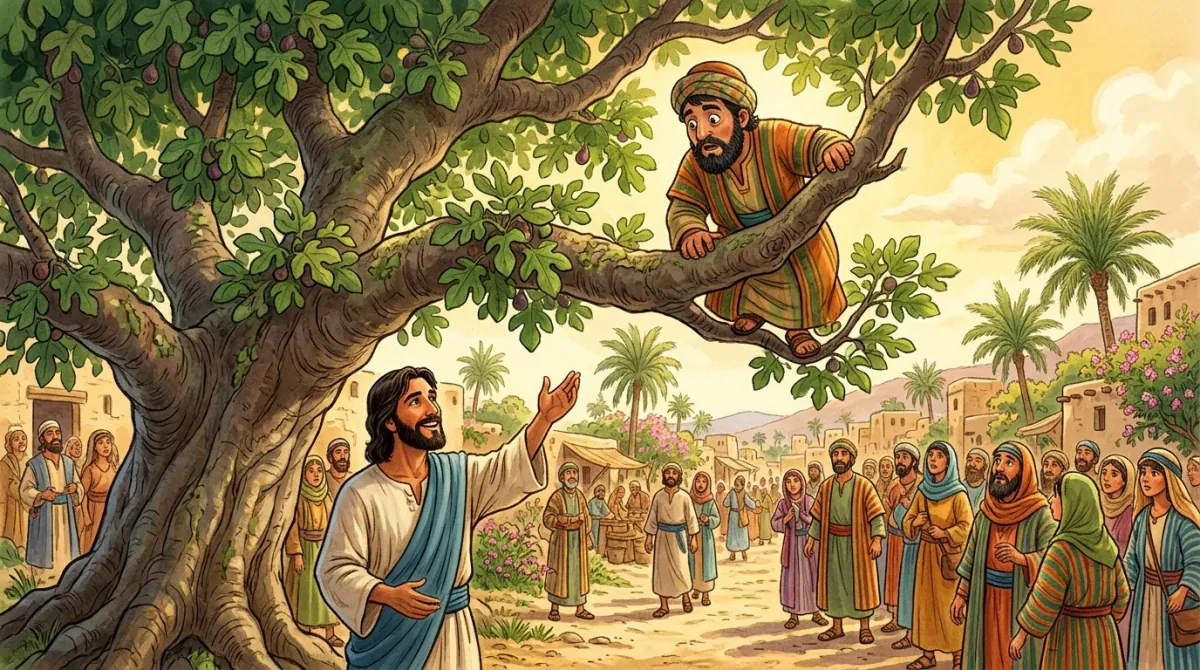
Scanning the road ahead, his eyes caught the sprawling boughs of an Egyptian sycamore-fig tree (Ficus sycomorus). These hardy trees grew low to the ground with broad horizontal branches, frequently planted along highways to provide shade for travelers. Wrapping his arms around the rough bark, Zacchaeus scrambled up into the leafy canopy, perching on a sturdy branch directly above the roadway. Hidden among the broad green leaves and clusters of fig fruit, he waited with a pounding heart, hoping only to catch a fleeting glimpse of the Master’s face.
3. The Gaze That Changed Everything
The roar of the crowd grew deafening as Jesus advanced along the dust road, flanked by His disciples and surrounded by pressing multitudes. As Christ reached the sycamore tree, His sandals abruptly halted. The crowd came to a bewildered standstill.
Lifting His eyes straight into the green foliage above, Jesus locked His gaze directly onto the trembling, wide-eyed tax collector. The Savior of the world did not look with disgust, condemnation, or cold curiosity. He looked with the radiant, warm affection of a Shepherd who had just found His lost sheep. Then, shattering the silence of the avenue, Jesus called out:
"Zacchaeus, make haste and come down, for today I must stay at your house!" (Luke 19:5)
Consider the staggering revelation of grace in those words! Jesus did not ask who was in the tree; He called the despised publican by his personal name! Before Zacchaeus had prayed a prayer, confessed a sin, or performed a religious deed, Christ announced an unreserved, self-invited appointment of fellowship. In the ancient Near East, to enter a man’s home and share table fellowship was the ultimate covenant pledge of peace, acceptance, and brotherhood.
Overwhelmed by sovereign love, Zacchaeus scrambled down from the tree with undignified haste and welcomed Jesus into his life with overflowing joy (Luke 19:6).
4. The Murmur of the Religious Elite
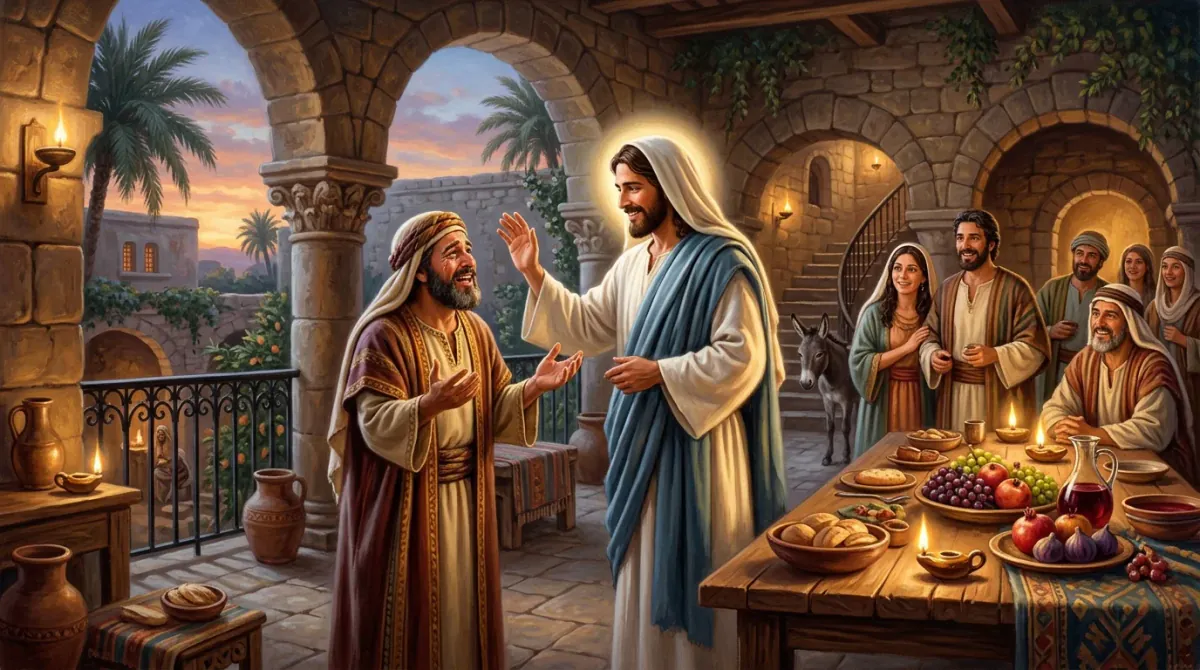 Inside his Jericho villa, the transformed Zacchaeus stands before Jesus with open hands, pledging fourfold restitution and giving half his wealth to the poor.
While joy erupted in Zacchaeus’ heart, dark resentment swept through the crowd. Luke notes with tragic realism: "When they saw it, they all complained, saying, 'He has gone to be a guest with a man who is a sinner!'" (Luke 19:7).
The religious leaders were scandalized. There were hundreds of pious priests and devout Levites living in Jericho who would have considered it an honor of a lifetime to host the Prophet of Nazareth. Yet Jesus deliberately bypassed the homes of the self-righteous to lodge in the contaminated palace of the city’s chief extortioner! How often does religious legalism grumble against the scandalous extravagance of divine grace!
5. Radical Repentance at the Banquet Table
Inside the spacious, tiled courtyard of Zacchaeus’ villa, the atmosphere was transformed. Surrounded by the aroma of roasted lamb, bread, and fruits, with glowing oil lamps illuminating the stone arches, Christ sat in loving communion with the tax collector and his household.
Jesus did not deliver a scathing lecture on financial ethics or threaten Zacchaeus with hellfire. He simply poured out His unearned grace. And under the warmth of that divine love, the icy fortress of Zacchaeus’ greed melted in an instant.
Rising to his feet before the banquet table, standing in solemn reverence before Jesus, Zacchaeus made a public vow that stunned everyone present:
"Look, Lord, I give half of my goods to the poor; and if I have cheated anyone of anything, I restore fourfold!" (Luke 19:8)
This was not a token tip or a public relations gesture; it was an act of financial radicalism! Under Mosaic civil law (Leviticus 6:5; Numbers 5:7), a person guilty of extortion was required to repay the stolen capital plus a twenty percent penalty. But Zacchaeus voluntarily applied the extreme restitution mandated in Exodus 22:1 for malicious armed theft—fourfold restitution! Between liquidating half his total estate for poor relief and returning four times what he had extorted, Zacchaeus effectively gave away his entire fortune in a single afternoon. When the treasure of the Kingdom captured his soul, earthly gold became worthless gravel.
6. Salvation Has Come to This House
Looking upon the transformed man with radiant joy, Jesus spoke the divine absolution that echoed into eternity:
"Today salvation has come to this house, because he also is a son of Abraham." (Luke 19:9)
The religious crowd called Zacchaeus an apostate dog; Jesus declared him a true son of Abraham—not merely by biological descent, but by the living faith that walks in the steps of Abraham's surrender. The stolen gold had been relinquished, the broken relationships were restored, and the name Zakkai—"Pure and Righteous"—was finally fulfilled by the justifying grace of God.
Then, sealing this magnificent encounter, Jesus unveiled the foundational mission statement of His entire incarnation:
"For the Son of Man came to seek and to save that which was lost." (Luke 19:10)
Zacchaeus thought he was seeking Jesus by climbing that sycamore tree; but in truth, the Son of God had traveled from eternity to that dusty Jericho street corner to seek him! No heart is too covetous, no past is too stained, and no soul is too lost for the sovereign, seeking love of Jesus Christ.
Ancient Near Eastern & Archaeological Context
Known historically as the 'City of Palms,' Jericho was an opulent, subtropical desert oasis situated roughly fifteen miles northeast of Jerusalem in the Jordan Valley, nearly 800 feet below sea level. King Herod the Great had lavishly transformed Jericho into his winter palace resort, complete with Roman baths, swimming pools, aqueducts, and theater complexes.
Strategically, Jericho served as a premier international customs station. Through its gates passed all commercial caravans traveling between Perea, Decapolis, Arabia, and the Judean hill country. Most lucratively, the region was world-famous for its prized royal balsam gardens (*opobalsamum*)—an exquisite aromatic resin used for royal perfumes, holy incense, and medical unguents that commanded astronomical prices in Rome.
As the Architelōnēs (Chief Tax Collector), Zacchaeus was the wealthy capitalist who bid on and secured the imperial tax concession for the entire district. He held the legal authority to employ lower-tier publicans, dictate toll rates, and call upon Roman garrisons to enforce collection. To the observant Jew, Zacchaeus was an apostate traitor who grew rich off Roman oppression. He was socially despised, disqualified from testifying in Jewish courts, and viewed as irredeemable by the religious elite.
Practical Discipleship & Spiritual Application
- Swallowing Pride to Seek Jesus: Zacchaeus was a wealthy aristocrat, yet he cast aside his social dignity and climbed a tree like a common boy just to see Christ. God honors desperate, unashamed hunger that refuses to let social status hinder spiritual encounter.
- Christ Calls You by Name: In a sea of tens of thousands of cheering pilgrims, Jesus stopped beneath the tree, looked up, and addressed Zacchaeus by his personal name. You are never lost in the crowd to God; He knows your name, your secrets, your hurts, and your hiding place.
- Authentic Repentance Touches the Wallet: Zacchaeus did not merely shed emotional tears; he immediately made fourfold restitution and surrendered half his wealth to the poor. True spiritual rebirth manifests practically in radical financial integrity, generosity, and justice toward those we have wronged.
- The Supreme Mission of the Son of Man: Christ’s visit to Zacchaeus reveals the heartbeat of the Gospel: 'The Son of Man came to seek and to save that which was lost.' No past is too dark, no reputation is too tarnished, and no heart is too hardened for the transformative mercy of Jesus.
Support Independent Biblical Research
Did this study bless you? Help support our independent bilingual research and interactive visual Bible tools.
⚡ Fast Facts
- Chief Tax Collector Rank: Zacchaeus is the only person in the New Testament designated as an 'Architelōnēs'—a regional tax commissioner who auctioned tax franchises and employed subordinate publicans
- Jericho Customs Hub: Jericho was a fabulously wealthy royal winter resort renowned for its lucrative royal balsam trade, making its customs post one of the most profitable in the Roman Empire
- Radical Fourfold Restitution: Under Levitical law (Leviticus 6:5), defrauded funds required repayment plus a twenty percent fine; Zacchaeus voluntarily offered fourfold restitution—the strict penalty for deliberate theft under Exodus 22:1
- Name Irony Redeemed: The name Zacchaeus derives from the Hebrew 'Zakkai', meaning 'Pure / Innocent / Clean'; Christ transformed a man known for filthy extortion into the reality of his holy name
❓ Frequently Asked Questions (FAQs)
Why did the Jewish crowds despise Zacchaeus so intensely?
Tax collectors (publicans) were regarded as treasonous traitors who collaborated with the pagan Roman Empire to oppress their own Jewish brethren. They purchased tax franchises from Rome and used Roman military power to extort arbitrary surcharges above the quota for personal enrichment. As the 'chief tax collector' of Jericho, Zacchaeus was viewed as the wealthy kingpin of systemic extortion, classified religiously alongside harlots, Gentiles, and thieves.
Why did Zacchaeus climb a sycamore-fig tree?
Luke notes that Zacchaeus was physically short of stature (tē hēlikia mikros ēn). In a dense crowd of thousands of pilgrims surging toward Jerusalem, no one would grant the despised tax collector a front-row view. The Egyptian sycamore-fig tree (Ficus sycomorus) had low, sturdy lateral branches and broad foliage, making it easily climbable while providing foliage to partially obscure the dignified official from public ridicule.
What is the theological significance of Jesus declaring 'He also is a son of Abraham'?
By calling Zacchaeus a 'son of Abraham,' Jesus was not merely referencing his physical Hebrew lineage; He was restoring the despised outcast to full covenant status in the household of God through the justification of faith. Zacchaeus’ radical generosity and fourfold restitution proved that true repentance is authentic when it touches a person’s wallet and transforms their treatment of the vulnerable.