The morning sun cast long, amber shadows across the lush palm groves of ancient Jericho, illuminating an ancient oasis nestled deep within the Jordan River depression. Jericho was a city of sensory marvels—the sweet scent of balsam sap drying in stone vats, the whispering fronds of date palms bending in the desert breeze, and the opulent white marble columns of Herod the Great’s winter palaces gleaming against the barren limestone crags of the Judean wilderness. Yet for one man sitting in the suffocating chalk dust beside the Roman arterial road leading out of the city gates, the grandeur of Jericho existed only as a tapestry of sound, smell, and unyielding darkness. His name was Bartimaeus, the son of Timaeus. Blind from youth, he lived in perpetual night, dependent entirely upon the copper coins tossed into his coarse woolen mantle by passing merchants and religious pilgrims.
On this particular springtime morning, however, the road was not merely busy; it was vibrating with seismic human energy. Tens of thousands of Galilean pilgrims were surging toward the western highway, chanting the ancient Psalms of Ascent as they prepared for the grueling, seventeen-mile climb through the bandit-infested Ascent of Adummim to Jerusalem for the Feast of the Passover. As the dense throng kicked up billows of pale dust that coated Bartimaeus’s unwashed beard and bare feet, his finely tuned ears caught something extraordinary. The murmuring crowd was not discussing grain prices or Roman tax assessments; they were whispering with hushed breath about a prophet from Nazareth. 'Jesus the Nazarene is passing by!' the word rippled through the ranks.
To the average traveler, Jesus of Nazareth was a controversial rabbi whose fame had swept the provinces of Galilee and Decapolis. But to the blind beggar seated in the dirt, the name ignited a spark that set his entire soul ablaze. Bartimaeus had listened for months to travelers recounting the wondrous deeds of this Galilean: how lepers were cleansed with a touch, how deaf ears were unstopped, and how the blind in Bethesda and Capernaum had opened their eyes to behold the light of day. In his heart, Bartimaeus had meditated upon the ancient scrolls of the prophet Isaiah: 'Then the eyes of the blind shall be opened, and the ears of the deaf shall be unstopped; then the lame shall leap like a deer, and the tongue of the dumb sing.' This was not merely an earthly rabbi; this was the long-awaited Son of David, the rightful King of Israel whose scepter would establish the reign of divine righteousness.
Gathering all the air his lungs could hold, Bartimaeus shattered the decorum of the pilgrimage procession. With a raw, visceral roar that tore through his parched throat, he shouted: 'Jesus, Son of David, have mercy on me!'
The reaction of the crowd was instantaneous, cold, and censorious. Religious travelers walking near the front of the entourage turned with scowling faces, snapping sharp rebukes at the noisy mendicant. 'Be silent, beggar!' they hissed. 'Hold your tongue! Do you not see that the Master is journeying to Jerusalem on royal business? Who are you to interrupt the prophet with your wretched screeching?' To the sophisticated pilgrims, Bartimaeus was a social blemish, an embarrassment, a discarded vessel of human misery whose noisy desperation threatened to spoil the dignified majesty of the procession. Worse still, by shouting 'Son of David'—a provocative, royal Messianic title—he was courting the lethal wrath of the Roman garrison stationed at the nearby fortress of Cypros.
Yet intimidation only intensified his resolve. When worldly religion told him to be silent, holy desperation compelled him to roar. Mark’s Gospel records that he cried out pollō mallon—'all the more intensely, by a great deal more.' His voice became a clarion trumpet echoing off the baked limestone canyon walls: 'Huios David, eleēson me! Son of David, have mercy on me!' He was not seeking casual attention; he was storming the gates of heaven, knowing that if the Nazarene passed beyond the city perimeter without touching him, the veil of darkness would envelope him until the day he died.
And then, the universe paused.
In the midst of the swirling dust, surrounded by hundreds of shouting, jostling disciples and festive travelers, Jesus stood still (stas ho Iēsous). The footsteps of the Creator of the ends of the earth halted in the dirt of Jericho. The sovereign Lord, whose face was set like flint toward Gethsemane, Gabbatha, and Golgotha, stopped His march because the desperate cry of a blind outcast had arrested His heart. Turning toward His disciples and the very crowd that had just rebuked the beggar, Jesus commanded: 'Call him here.'
The fickle mood of the crowd instantly reversed. Those who had snarled at him moments earlier now leaned down with patronizing enthusiasm: 'Cheer up! Arise, He is calling you!'
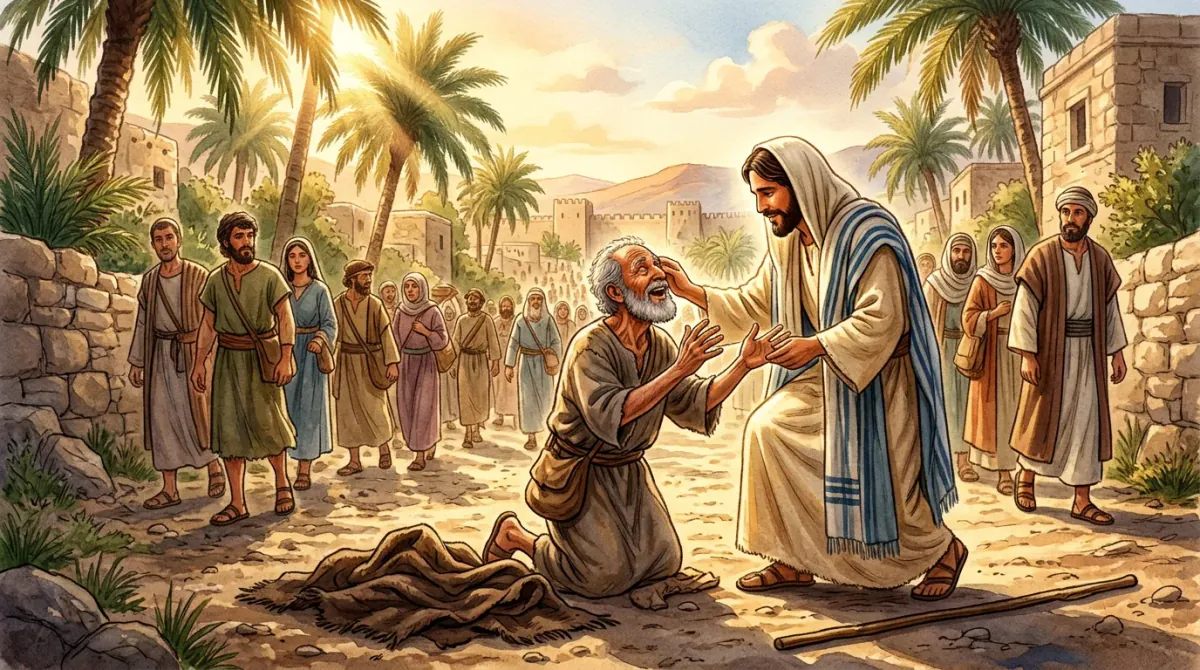
What happened next was an act of radical, unforgettable faith. Bartimaeus did not merely stand up; he cast away his beggar's cloak (apobalōn to himation autou). In first-century Roman Palestine, an impoverished beggar’s heavy woolen outer mantle was his worldly all. It was his nighttime blanket, his sunshade, his shelter against howling desert squalls, and the sacred spread upon which copper coins were cast. Under local municipal codes, it was his recognized permit to sit by the highway and beg. To discard that garment was an irrevocable act of holy abandonment. Bartimaeus was declaring to the visible and invisible worlds: I will never need this begging blanket again. My days in the dust are finished. Leaping to his feet with agile joy, he allowed eager hands to guide his stumbling steps through the parting crowd until he stood face-to-face with the Son of God.
Standing inches away from the trembling beggar, smelling the sweat and dust of his garments, Jesus did not immediately pronounce a healing formula. Instead, He honored the man’s human dignity by asking a piercing, beautiful question: 'What do you want Me to do for you?'
Why would omniscience ask the obvious? Because Jesus refuses to treat broken people as passive objects of charity. For decades, whenever a stranger paused before Bartimaeus, the blind man had been conditioned to chant: 'Alms, master! A copper coin for the blind!' Christ was inviting him to cast off the beggarly expectations of his past. He was inviting him to step out over the abyss of human impossibility.
Bartimaeus did not ask for silver. He did not ask for gold or social rehabilitation. Falling upon his knees, tears carving clean rivulets down his sun-blackened cheeks, he addressed Jesus with an Aramaic title of supreme adoration: 'Rabbouni! That I may receive my sight!' (Rabbouni, hina anablepsō!). In Jewish tradition, 'Rabbi' meant teacher, but 'Rabbouni' meant 'My Sovereign Lord and Master.' It was a confession of absolute kingship. Bartimaeus was not merely asking for ocular repair; he was asking for light from the Father of lights.
Jesus looked upon him with infinite tenderness. No muddy saliva was mixed, no tedious ritual performed. Christ simply spoke the sovereign decree of grace: 'Go your way; your faith has made you well.' The Greek phrase—hē pistis sou sesōken se—carried double significance: 'Your faith has healed you, and your faith has saved you.'
Instantly, the paralyzed optic nerves were electrified with divine life. The opaque cataracts dissolved. The dead corneas cleared. For the very first time in his memory, photons struck the retina of Bartimaeus. Light—blinding, golden, radiant light—flooded his consciousness. He saw the azure sky vaulted above the palms of Jericho; he saw the rugged limestone crags of the Judean peaks; but above all, the very first object that filled his newly opened eyes was the gentle, radiant, smiling face of Jesus of Nazareth.
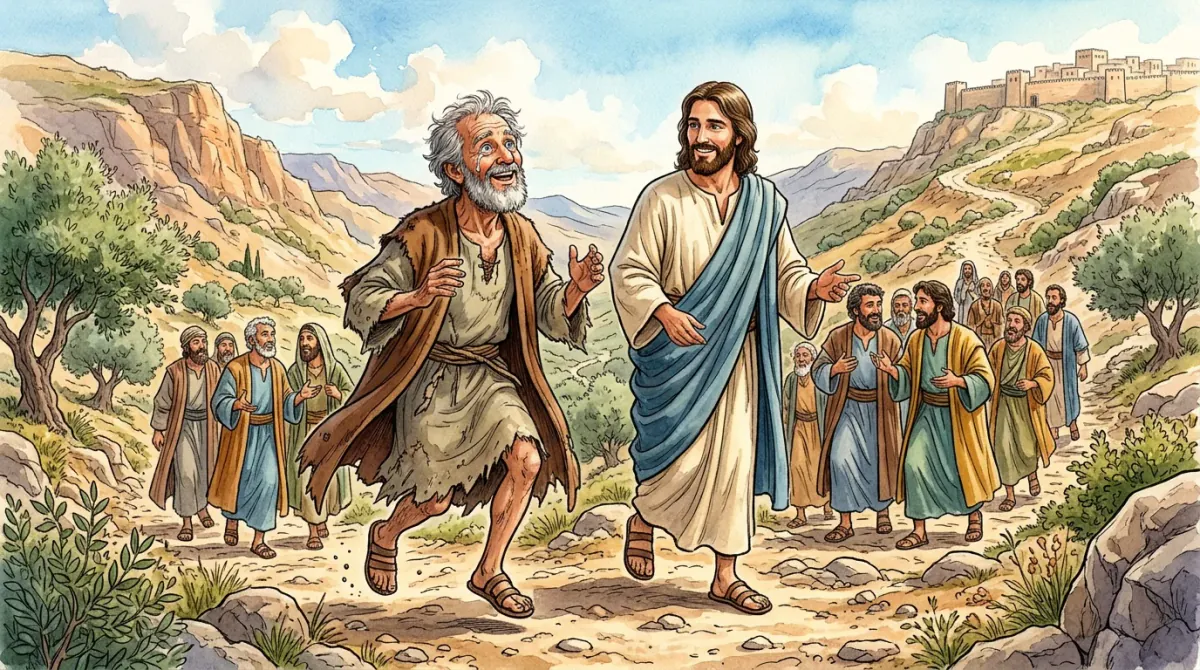
Weeping aloud, laughing with uncontrollable awe, Bartimaeus fell prostrate in worship. The crowd, previously cynical, erupted in thunderous praise, glorifying God for the mighty wonder wrought in their midst. But notice what happened next: Jesus had told him, 'Go your way.' Bartimaeus was a free man; he could have returned to his village to boast of his miracle, or re-entered Jericho to embrace family and celebrate his newfound fortune. But Bartimaeus had discovered that his 'way' was wherever Jesus walked. Casting his discarded beggar's cloak forever behind him, he leaped into the pilgrim ranks and followed Jesus in the way (ēkolouthei autō en tē hodō).
Along the perilous, ascending switchbacks climbing toward the cross of Calvary, Bartimaeus walked beside the Savior. He who had sat by the roadside in darkness became an eyewitness of the King of Glory, demonstrating that when a desperate soul dares to call upon the Son of David, the Lord halts His procession, shatters the bonds of darkness, and transforms an outcast beggar into a lifelong disciple of the Lamb.
Ancient Near Eastern & Archaeological Context
Ancient Jericho occupied a strategic and luxurious geographical position in the Jordan River valley. Situated roughly fifteen miles northeast of Jerusalem and 800 feet below sea level, Jericho was an emerald oasis fed by copious natural springs, famous for its royal date-palm groves, fragrant balsam orchards, and winter palaces constructed by Herod the Great and his son Archelaus. Because of its mild winter climate and fertile soil, Jericho was known throughout the Mediterranean world as the 'City of Palms' and served as a bustling customs checkpoint along the major international trade and pilgrimage route leading from Perea across the Jordan up into the Judean highlands.
Every spring during the season of the Passover, tens of thousands of Jewish pilgrims from Galilee and the diaspora converged on Jericho. To avoid traveling through hostile Samaritan territory, Galilean pilgrims routinely crossed the Jordan River into Perea, journeyed south along the eastern bank, recrossed the river near Jericho, and then faced the grueling, perilous seventeen-mile ascent through the rocky, bandit-infested Judean wilderness up to Jerusalem—a brutal climb that ascended over 3,300 vertical feet through the notorious 'Ascent of Adummim' (the pass of the Good Samaritan). Because massive caravans of pilgrims sang the Psalms of Ascent as they walked, festive crowds created immense commotion outside the city gates.
In the ancient Greco-Roman and Jewish worlds, people suffering from congenital or acquired blindness were entirely dependent on public charity. Deprived of medical recourse and barred from regular employment, blind individuals congregated along the busy arterial highway junctions leading into cities, where wealthy travelers and pilgrims were culturally and religiously expected to practice tzedakah (righteous almsgiving). In first-century Roman Judaea, public mendicants wore a distinctive, coarse woolen outer mantle (himation) that effectively served as a communal license to beg. Sitting in the choking dust of the roadside, Bartimaeus was a fixture of social misery—until the true King of Israel walked past his begging station.
Practical Discipleship & Spiritual Application
- Desperate Persistence Against Opposition: When worldly voices, religious critics, and hostile circumstances command you to be silent, follow the pattern of Bartimaeus by crying out to Christ all the more passionately; true faith refuses to be muffled by crowd intimidation.
- Radical Abandonment of Past Identities: To lay hold of Christ's supernatural future, we must willingly cast away our 'beggar's cloaks'—the old habits, victim mentalities, sinful crutches, and false securities that tethered us to our past brokenness.
- Specific and Daring Prayer: When the King of glory asks 'What do you want Me to do for you?', do not insult His infinite majesty with timid, lukewarm petitions; dare to ask for the impossible, believing that He is able to do immeasurably more than all we ask or imagine.
- From Roadside Beggar to Roadway Disciple: Miraculous deliverance is never given merely for personal luxury, but for active kingdom discipleship; once Bartimaeus received his sight, he did not return home to boast, but immediately followed Jesus along the road toward the Cross.
Support Independent Biblical Research
Did this study bless you? Help support our independent bilingual research and interactive visual Bible tools.
⚡ Fast Facts
- Messianic Title Breakthrough: Bartimaeus was the first recorded person in Mark's Gospel to publicly address Jesus with the royal Davidic title 'Son of David' (Huios David), recognizing Him as the promised King of Israel
- The Beggar's Cloak (Himation): In Roman Judaea, a mendicant's outer garment functioned as an officially registered license to beg; casting it away demonstrated absolute certainty of total restoration before sight was even given
- Geographical Climax: Jericho sat roughly 800 feet below sea level, while Jerusalem stood 2,500 feet above sea level; this healing was Christ's final recorded public miracle before entering the holy city for His crucifixion
- Aramaic Reverence (Rabbouni): Instead of ordinary polite terms, Bartimaeus addressed Jesus as 'Rabbouni' ('My Great Master'), an intensely personal title of submission found only here and at the empty tomb with Mary Magdalene
❓ Frequently Asked Questions (FAQs)
Why did the crowd sternly order Bartimaeus to keep quiet?
The pilgrim crowd viewed Bartimaeus as a public nuisance and an embarrassing distraction. In the ancient Near East, blind beggars were marginalized outcasts considered under divine curse. Furthermore, the crowd was escorting Jesus as a celebrated Galilean prophet on His festive ascent to Passover; an impoverished beggar shouting subversive political slogans like 'Son of David'—which could trigger immediate Roman military intervention from the nearby fortress—was perceived as dangerous and undignified. However, Christ inverted worldly hierarchy by halting the entire procession to honor the desperate faith of a blind outcast.
What is the spiritual significance of Bartimaeus casting off his cloak?
In first-century Palestinian society, a blind beggar's heavy outer mantle (*himation*) was his most prized earthly possession. It served as his bed at night, his shelter from desert gales, and his collection cloth spread on the ground to gather coins. More importantly, it was his social identity. By throwing it aside (*apobalōn to himation*), Bartimaeus severed all ties to his former life of dependence and helplessness before he even saw Christ's face. He knew that once he met the Son of David, he would never need to beg in the roadside dust again.
Why did Jesus ask Bartimaeus 'What do you want Me to do for you?' when his blindness was obvious?
Jesus never treated suffering humans as mere cases or generic statistics; He treated them as sacred individuals with personal agency. While blindness was his obvious physical affliction, begging had conditioned Bartimaeus to ask passersby for small copper coins. By posing this direct question, Christ invited him to articulate his deepest longing, elevating his expectation from temporary financial relief to eternal transformation. Furthermore, this question directly contrasted with James and John's selfish request in the preceding passage ('Grant us to sit at Your right hand'), proving that true spiritual vision belongs to the humble.