Word reached Jesus across the muddy currents of the Jordan River in Perea, where He had taken refuge from the murderous plots of the Jerusalem Sanhedrin. The message brought by breathless couriers was short, urgent, and laced with profound covenant intimacy: "Lord, behold, he whom You love is sick" (John 11:3). The sisters of Bethany—Martha and Mary—did not demand an instant miracle; they simply laid their heartbreak before the Master, confident that His tender affection for their brother Lazarus would propel Him immediately across the twenty-mile trek back to Judea.
1. The Sovereign Delay of Love
Yet the response of Jesus stunned His disciples. Looking steadily at the messenger, Christ declared with prophetic authority: "This sickness is not unto death, but for the glory of God, that the Son of God may be glorified through it" (John 11:4). Then follows one of the most paradoxical, spiritually staggering sentences in the entire Fourth Gospel:
"Now Jesus loved Martha and her sister and Lazarus. So, when He heard that he was sick, He stayed two more days in the place where He was." (John 11:5–6)
Human logic equates love with immediate rescue. When those we cherish face agony, we rush to intervene. But divine love operates on an eternal timetable. Jesus loved this family with a love so immense that He refused to settle for a common, localized healing. Had Christ traveled instantly, He might have healed Lazarus of a severe fever—a wonderful sign, but one easily dismissed by skeptical Jerusalem authorities. Instead, Christ chose to let death do its worst, so that the ultimate enemy might be visibly, irrevocably conquered before the eyes of the nation.
After two days, Jesus said to His alarmed disciples: "Let us go to Judea again." Remembering the recent barrage of stones, the disciples protested: "Rabbi, lately the Jews sought to stone You, and are You going there again?" Jesus explained that Lazarus had fallen asleep, and that He was going to wake him. Misunderstanding sleep as natural convalescence, the disciples were corrected plainly by Christ: "Lazarus is dead. And I am glad for your sakes that I was not there, that you may believe."
2. The Agony of Bethany: Four Days in the Tomb
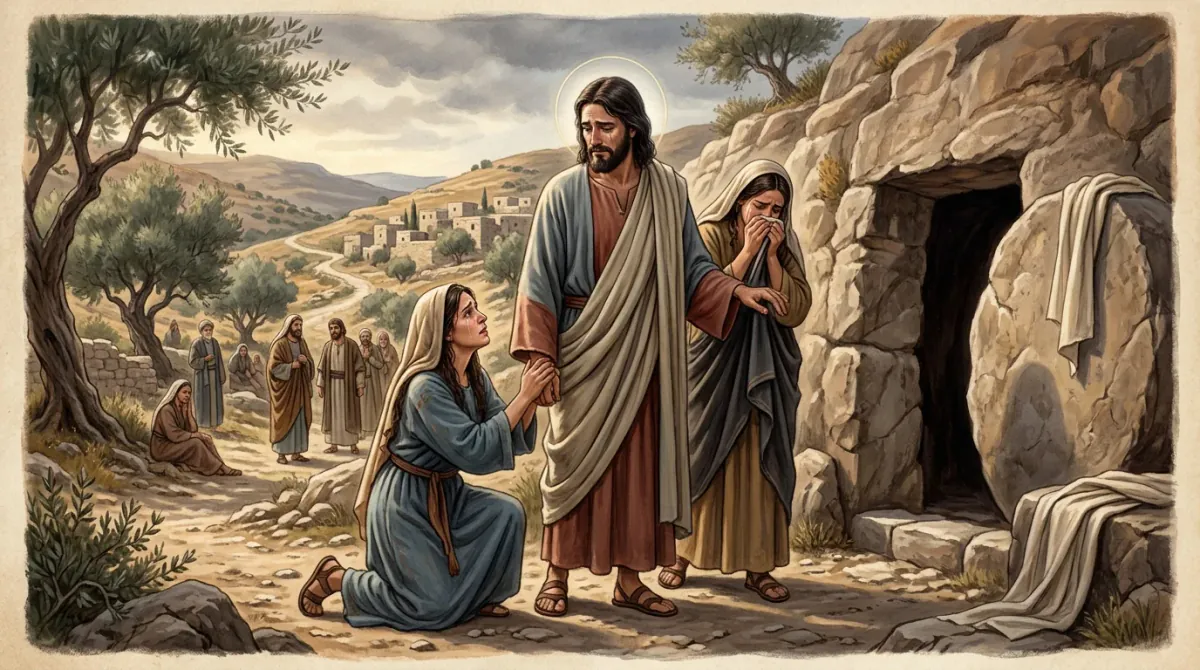 Outside the rock tomb of Bethany, Jesus weeps with divine compassion alongside Mary and Martha, sharing in the raw sorrow of human mortality.
When Jesus and His entourage reached the outskirts of Bethany, nestled on the eastern ridge of the Mount of Olives, a somber veil hung over the village. Lazarus was not merely dying; he had already been sealed inside a subterranean limestone cave for four full days. The home was packed with mourning friends, family, and professional wailers who had come from Jerusalem to sit in the dust and chant traditional laments.
Hearing that Jesus was approaching, Martha—always the woman of decisive action—rose up and hurried outside the village to meet Him, while Mary remained immobilized in weeping inside the house. Falling at Christ’s feet, Martha poured out the agonizing ache that had haunted her for four days: "Lord, if You had been here, my brother would not have died!" (John 11:21). Her words were not a bitter accusation, but the desperate lament of love: why had He taken so long? Yet even in her grief, a flicker of persistent faith remained: "But even now I know that whatever You ask of God, God will give You."
3. 'I Am the Resurrection and the Life'
Jesus looked upon Martha’s tear-stained face and spoke with sovereign calm: "Your brother will rise again." Martha replied with orthodox Pharisaic theology: "I know that he will rise again in the resurrection at the last day." Like many believers, Martha pushed her hope into a distant, abstract theological dogma reserved for the end of time.
Then, standing upon the dusty Judean roadway, Jesus dropped the eternal anchor of Christian revelation:
"I am the resurrection and the life. He who believes in Me, though he may die, he shall live. And whoever lives and believes in Me shall never die. Do you believe this?" (John 11:25–26)
With these monumental words, Christ decentralized theology from a calendar event into His own living Person! Resurrection is not merely an eschatological program; it is Christ Himself. Physical death has no power to extinguish life in those who belong to Him. Pierced to the heart, Martha made the supreme confession of the New Testament: "Yes, Lord, I believe that You are the Christ, the Son of God, who is to come into the world."
4. Jesus Wept: The Tears of the Creator
Martha hurried back and whispered secretly to her sister: "The Teacher has come and is calling for you." Mary sprang to her feet and rushed out of the village. When she saw Jesus, she collapsed at His feet, weeping bitterly and echoing her sister’s cry: "Lord, if You had been here, my brother would not have died."
When Jesus saw Mary weeping, and the Jewish mourners who accompanied her wailing aloud, the Gospel records an extraordinary physiological reaction: "He groaned in the spirit and was troubled" (John 11:33). The Greek verb enebrimēsato conveys intense indignation—a furious, holy inward rage. Christ was not angry at the grieving sisters; He was experiencing incandescent divine fury against Satan, the curse of sin, and the obscene tyranny of death that violently tears human beings away from those who love them.
"Where have you laid him?" Christ asked. They answered: "Lord, come and see."
And then, as He walked toward the cemetery, the shortest and most tender verse in the Bible unfolded:
"Jesus wept." (John 11:35)
The original Greek uses edakrysen—silent, overflowing tears streaming down His face. The Creator of the universe, who held the power to raise the dead with a single syllable, stopped to weep! He did not despise human tears; He shared them. Onlookers whispered in awe: "See how He loved him!"
5. 'Take Away the Stone!'
Arriving at the sepulcher—a natural cave hewn into the limestone ridge with a massive flat boulder blocking the entrance—Jesus was again deeply moved within Himself. Looking at the rugged men standing nearby, He commanded with sudden authority:
"Take away the stone!" (John 11:39)
Martha gasped in horror. As the mistress of the house, she was horrified by the impending social indignity. In the warm climate of Judea, decomposition set in rapidly. She protested bluntly: "Lord, by this time there is a stench, for he has been dead four days!" In the King James idiom: 'Lord, he stinketh.' Four days meant the soul had departed, decay had ravaged the flesh, and the stench of death would be overpowering.
Jesus turned to her with gentle firmness: "Did I not say to you that if you would believe you would see the glory of God?" Yielding to His authority, the men stepped forward, wedged their levers beneath the boulder, and rolled the heavy stone aside with a grinding scrape. A chill, dark draft carrying the unmistakable odor of mortality blew out from the cavern.
6. 'Lazarus, Come Forth!'
Lifting His eyes toward heaven, Jesus bypassed all magical incantations and prayed aloud in filial communion with the Father: "Father, I thank You that You have heard Me. And I know that You always hear Me, but because of the people who are standing by I said this, that they may believe that You sent Me" (John 11:41–42).
Having finished His prayer, Jesus stepped toward the gaping mouth of the tomb. Drawing a deep breath, He shouted with a voice like the crack of thunder:
"LAZARUS, COME FORTH!" (Lazarus, deuro exō!)
Saint Augustine observed with timeless insight that Jesus had to specify Lazarus by name; had He simply shouted 'Come forth!', every cemetery on earth would have surrendered its dead on the spot!
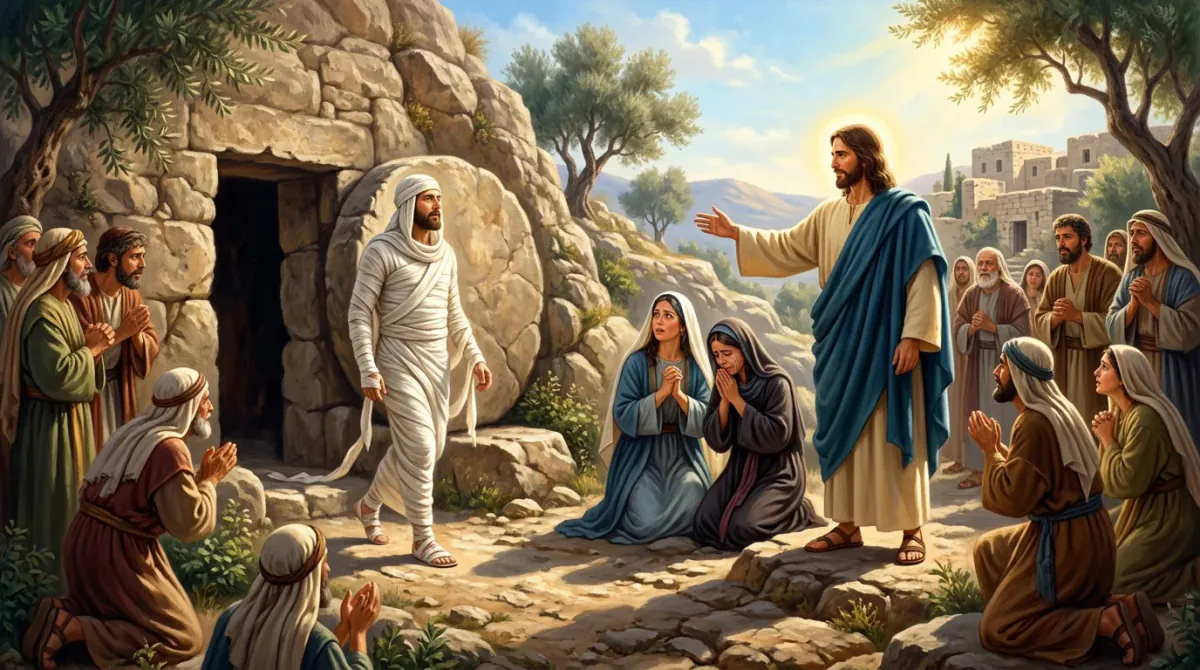
For three breath-holding seconds, silence hung over the Bethany ridge. Then, from the black depths of the cave, the sound of movement was heard—the rustling of linen bandages against stone flagstones. Out from the darkness into the blinding golden sunlight shuffled the figure of a living man! He was bound hand and foot with graveclothes, and his face was tightly wrapped in a white sweat-cloth (soudarion). He was alive! His heart was pumping, blood coursing through his veins, his flesh fully restored from decay.
While the onlookers stood frozen in paralyzed terror and astonishment, Jesus spoke the final practical command of grace:
"Loose him, and let him go!" (John 11:44)
Weeping family members rushed forward, cutting away the burial bindings, uncovering the smiling, weeping face of Lazarus. The resurrection of Lazarus was the climatic public sign of Christ's earthly ministry. It proved forever that Jesus holds the keys of death and Hades; it foreshadowed His own glorious empty tomb; and it sent shockwaves through Jerusalem that sealed the religious authorities' resolve to nail the Lord of Glory to the Cross.
Ancient Near Eastern & Archaeological Context
Bethany was a tranquil agricultural village situated on the eastern slope of the Mount of Olives, approximately fifteen stadia (under two miles) from Jerusalem. It served as a beloved haven of domestic refuge for Jesus and His disciples during their visits to Judea. Here lived the close-knit family of Martha, Mary, and Lazarus, whose hospitality Jesus frequently enjoyed.
First-century Jewish burial customs were swift and deeply ritualistic. Because decomposition progressed rapidly in the arid Middle Eastern climate, bodies were anointed with aromatic spices, wrapped in multiple layers of linen strips (keiriai), and interred inside family rock-cut cave tombs before sunset on the day of death. A heavy disc-shaped stone or large blocking boulder was rolled across the mouth of the sepulcher to protect the deceased from wild scavengers and grave robbers.
Crucially, rabbinic tradition (codified in the *Midrash Rabbah* on Genesis and Leviticus) taught that after death, the soul hovered around the body for three days, seeking to re-enter. But once the fourth day arrived, the countenance changed, internal organs began to putrefy, and the soul departed permanently to Sheol. Therefore, by the time Jesus reached Bethany, Lazarus was in the fourth day of burial. In the eyes of every attending Jew, resurrection was impossible by any standard. It was precisely at this point of total biological hopelessness that Christ staged the supreme sign of His public ministry.
Practical Discipleship & Spiritual Application
- Trusting God's Perfect Timing in Delays: Divine delays are never divine denials. When heaven seems silent in your crisis, remember that Jesus delayed visiting Bethany not because He lacked love, but because He was preparing a greater miracle that would reveal His glory.
- Christ as the Present Resurrection: Do not push your hope into an abstract, distant future. Jesus is not merely a memory of the past or a hope for the final day; He is the living Resurrection and Life for your dying circumstances today.
- The Comfort of a Weeping Savior: When you walk through seasons of grief and shattered dreams, you are not served by a detached, stoic deity. Jesus weeps with you in your heartbreak, entering into your pain before He speaks life into your tomb.
- Rolling Away the Stones of Unbelief: Jesus commands us to roll away the stones that block His power. Surrender your cynicism, remove your human excuses, and believe that the Voice that summoned Lazarus from the grave can awaken new life in your soul.
Support Independent Biblical Research
Did this study bless you? Help support our independent bilingual research and interactive visual Bible tools.
⚡ Fast Facts
- The Four-Day rabbinic Threshold: Ancient Jewish burial tradition held that the soul hovered near the corpse for three days, but by Day 4, facial decay set in and resurrection was considered humanly impossible
- Shortest Verse, Deepest Heart: John 11:35 ('Jesus wept' - Dakryō) reveals Christ's unreserved human empathy and His righteous divine anger against the devastation of death
- The Direct Trigger of the Crucifixion: John 11:46–53 reveals that the raising of Lazarus was the immediate catalyst that caused Caiaphas and the Sanhedrin to formally decree Christ's execution
- Personalized Resurrection Summons: Saint Augustine famously observed that if Jesus had not specifically addressed 'Lazarus' by name when shouting 'Come forth!', all the dead in the tombs of the earth would have risen simultaneously
❓ Frequently Asked Questions (FAQs)
Why did Jesus deliberately delay two days before going to Bethany?
Jesus loved Martha, Mary, and Lazarus, yet He purposefully remained two days longer in Perea so that Lazarus would be indisputably dead and entombed for four full days. Had Jesus arrived earlier and healed him while still breathing, critics would have dismissed it as a natural recovery from fever. By allowing Lazarus to pass into advanced decomposition, Christ orchestrated an undeniable sign of His absolute supremacy over death, preparing His disciples for His own impending resurrection.
What is the meaning of Jesus groaning in the spirit and weeping?
The Greek verbs used in John 11:33 and 11:38 (embrimaomai) denote intense indignation and inner churning, while verse 35 uses dakryō (to shed quiet tears). Jesus was not weeping from helplessness or despair; He was experiencing holy outrage against Satan, sin, and the cruel tyranny of death that ravages human beings whom He created for immortality, combined with pure pastoral love for Mary, Martha, and suffering humanity.
Why did Jesus command the bystanders to roll away the stone and unbind Lazarus?
While Christ alone has the divine power to speak resurrection life into a rotting corpse, He invites human cooperation in the ordinary realms of obedience. Humans could not give life to Lazarus, but they could roll away the stone and untie the linen graveclothes. God will not do for us what He has commanded us to do: we are called to remove the stones of unbelief and help unbind new believers from the lingering wrappings of their old life.