Centuries before the Roman legions marched across the Mediterranean, the prophet Daniel had stood in the golden courts of Babylon as chief of the imperial governors and master of the royal sages (*Rab-Mag*—Daniel 2:48; 5:11). In the prestigious academies of the Euphrates, Daniel’s prophecies concerning the precise timeline of the Messiah's coming (Daniel 9:24-27) and Balaam's ancient oracle—"A Star shall come out of Jacob; a Scepter shall rise out of Israel" (Numbers 24:17)—had been meticulously preserved on baked clay tablets and parchment scrolls. Generation after generation of eastern astronomers scanned the velvet night skies of Mesopotamia, awaiting the celestial herald of the King of the Universe. In the fullness of time, an extraordinary, supernatural radiant light pierced the eastern horizon. The search of the ages had begun!
1. The Astronomers of the East and the Royal Star
Matthew opens the narrative with dramatic grandeur: "Now after Jesus was born in Bethlehem of Judea in the days of Herod the king, behold, wise men from the East came to Jerusalem, saying, 'Where is He who has been born King of the Jews? For we have seen His star in the East and have come to worship Him.'" (Matthew 2:1-2).
The Greek word Matthew employs is Magoi. These were not circus conjurers or occult sorcerers; they were elite Persian and Median priestly scholars, royal advisors who studied astronomy, natural science, medicine, and philosophy. In the ancient Near East, no monarch could ascend the throne of the Parthian Empire without the counsel and confirmation of the high council of the Magi.
What was this "star"? While astronomical historians debate whether it was a rare triple conjunction of Jupiter and Saturn in the constellation Pisces (the sign of Judea), a bright supernova, or a comet, the biblical text makes clear that this celestial beacon possessed supernatural, directional movement. It was none other than the *Shekinah* glory of Yahweh taking visible form in the heavens, guiding those who earnestly sought the truth.
Mounting heavily laden camel caravans, surrounded by armed Persian cavalry for protection against desert marauders, these noble scholars embarked upon an arduous journey of nearly one thousand miles. They crossed the scorching gravel of the Arabian desert and traversed the Euphrates trade routes for months, driven by an unquenchable hunger to lay their crowns at the feet of the King of Kings.
2. Jerusalem Shaken and Herod's Paranoia
When this imposing foreign caravan finally crested the Mount of Olives and clattered through the stone gates of Jerusalem, their first question sent shockwaves through the capital: "Where is He who has been born King of the Jews?"
Notice their precise phrasing: "born King." Herod the Great had not been born king; he was an Idumean (Edomite) usurper who had purchased his royal title from Mark Antony, Octavian, and the Roman Senate in 40 BC through lavish bribes and ruthless political intrigue.
Matthew records the collective panic: "When Herod the king heard this, he was troubled, and all Jerusalem with him." (Matthew 2:3).
Herod was now in his late sixties, suffering from terminal physical decay, morbid paranoia, and terrifying delusions of conspiracies. He had already drowned his young brother-in-law Aristobulus, murdered his beloved wife Mariamne, and strangled his own sons Alexander and Aristobulus when he suspected them of treason. When Herod was "troubled," the gutters of Jerusalem typically ran with blood.
Immediately, the king convened a mandatory summit of all chief priests and Torah scribes, demanding: "Where is the Christ to be born?" Without a moment’s hesitation, the theological scholars unrolled the scroll of the Minor Prophets and quoted Micah 5:2 from memory:
"So they said to him, 'In Bethlehem of Judea, for thus it is written by the prophet: "But you, Bethlehem, in the land of Judah, are not the least among the rulers of Judah; for out of you shall come a Ruler who will shepherd My people Israel."' " (Matthew 2:5-6).
Here lies the tragic irony of human religion: The Jewish scribes knew the scripture down to the exact geographical coordinate; they were only five miles away from the birthplace of their long-awaited Messiah. Yet not a single scribe, priest, or Pharisee laced up his sandals to investigate! Pagan astronomers traveled a thousand miles across harsh deserts to worship, while the religious elite of Jerusalem could not be bothered to walk five miles down the road.
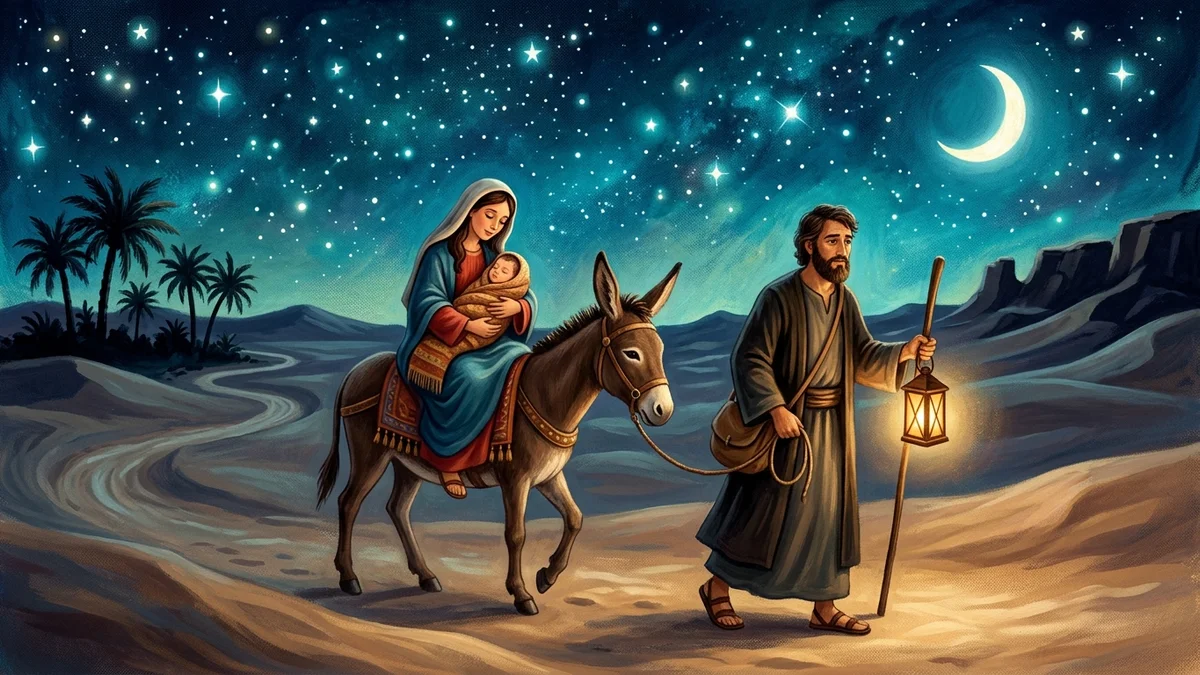 Caravaggio's masterwork 'Rest on the Flight into Egypt' (c. 1597), capturing Joseph and Mary sheltering the infant Christ amid their perilous nighttime escape into the African desert.
3. The Guiding Star and the Manger Replaced by a House
Herod called the Magi into a secret, midnight chamber. Feigning theological curiosity, he pumped them for intelligence, inquiring diligently about the exact chronological moment the star had first appeared in the eastern skies. Concealing his murderous intent behind a veil of false piety, Herod instructed them:
"Go and search carefully for the young Child, and when you have found Him, bring back word to me, that I may come and worship Him also." (Matthew 2:8).
The Magi departed Jerusalem under the cover of night. As they took the road south toward Bethlehem, the supernatural star reappeared before them: "And behold, the star which they had seen in the East went before them, till it came and stood over where the young Child was. When they saw the star, they rejoiced with exceedingly great joy!" (Matthew 2:9-10).
Matthew makes a critical chronological distinction: "And when they had come into the HOUSE, they saw the young Child with Mary His mother..." (Matthew 2:11).
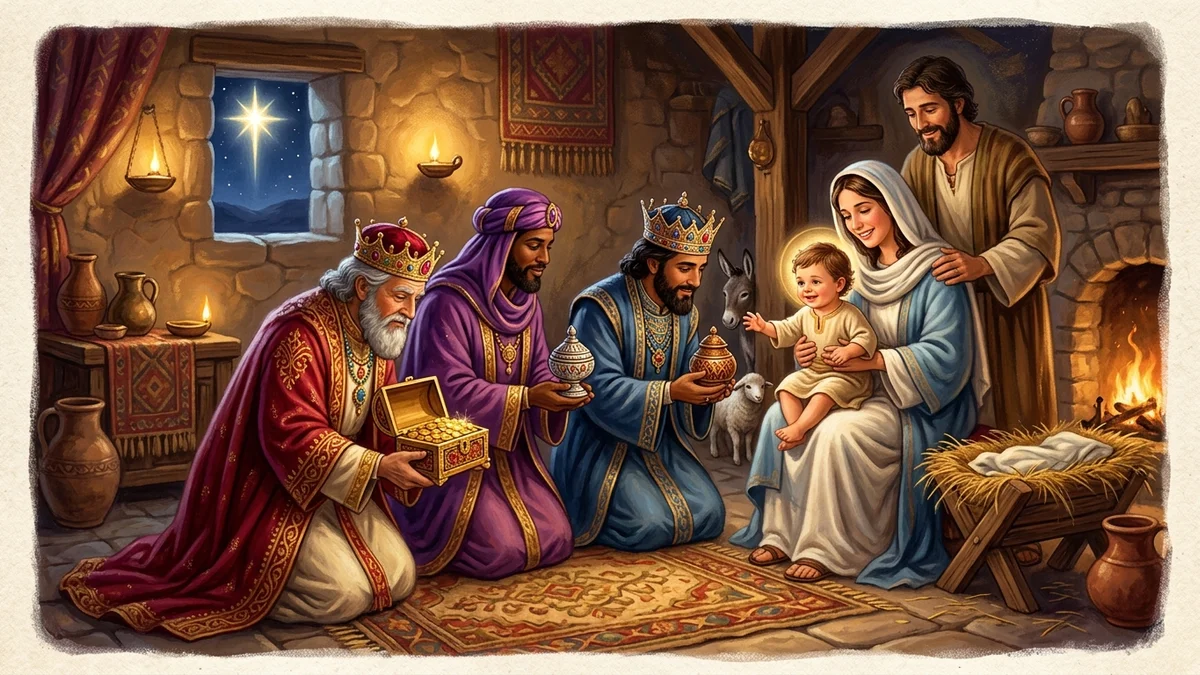
The Magi did not arrive at the stable on the night of the Nativity. By this time, weeks or months had passed. Joseph and Mary had moved out of the temporary lower quarters into a normal house (*oikian*) in Bethlehem, where Joseph had likely resumed his trade as a carpenter.
4. Prostration and the Three Prophetic Treasures
As the eastern aristocrats stepped across the humble threshold of the stone cottage, they did not see an earthly throne room draped in purple silk, nor royal bodyguards clad in armor. They saw an ordinary peasant woman holding a toddler on her lap. Yet their spiritual eyes were opened!
The dignified, silk-robed dignitaries "fell down and worshiped Him" (Greek: prosekynesan). They prostrated their bearded faces into the dust, acknowledging this child as the supreme Sovereign of all heaven and earth. Then, opening their travel-stained leather treasure chests, they presented three royal offerings:
- GOLD (Chrysos): The universal metal of kingship. It proclaimed that this child was born to wear an everlasting crown, the rightful King of David's line whose kingdom shall have no end.
- FRANKINCENSE (Libanos): The costly, aromatic white gum resin harvested from desert trees in southern Arabia, reserved exclusively for the sacred golden altar of incense in God's presence. It proclaimed His divine nature and His eternal High Priesthood.
- MYRRH (Smyrna): A bitter, fragrant red resin used in the ancient world for medicinal pain relief, but preeminently as an expensive embalming spice to preserve dead bodies for burial (John 19:39). It cast a dark, prophetic shadow across the toddler's play: this King had come into the world to die as a sacrificial victim!
In God's marvelous providence, these valuable treasures were not merely symbolic. They provided the exact portable liquid wealth Joseph and Mary would desperately need within hours to survive as political refugees in a foreign land!
5. Midnight Flight into Egypt and the Rage of Herod
Having laid their treasures at His feet, the Magi prepared to return to Jerusalem. But God intervened directly in their subconscious: "Then, being divinely warned in a dream that they should not return to Herod, they departed for their own country another way." (Matthew 2:12).
The moment their caravan slipped into the eastern desert, the angel of the Lord shattered Joseph's sleep in Bethlehem:
"Arise, take the young Child and His mother, flee to Egypt, and stay there until I bring you word; for Herod will seek the young Child to destroy Him." (Matthew 2:13).
Joseph's hallmark character was instant, unquestioning obedience. He did not wait for sunrise. That very night, under the cover of ink-black darkness, Joseph packed their few belongings, strapped the gifts of gold and frankincense to the beast, placed Mary and the toddler Jesus upon it, and slipped out of Bethlehem unnoticed.
They trekked through the hostile wilderness of the Negev, crossing the Wadi el-Arish (the River of Egypt) into Roman Egypt. Outside Herod's legal jurisdiction, Egypt was home to over one million Jewish exiles, with thriving communities in Alexandria and Leontopolis. There, using the gold of the Magi, the Holy Family lived in quiet safety, fulfilling the ancient prophecy of Hosea 11:1: "Out of Egypt I called My Son."
6. The Cry of Rama and the Resettlement in Nazareth
Back in Jerusalem, Herod realized with towering fury that the Persian scholars had outwitted him (*enepaichthe*). Stripped of his veneer of piety, the monster revealed his true fangs. Calculating the timeline according to the star’s appearance two years prior, Herod dispatched a detachment of brutal mercenaries to Bethlehem:
"Then Herod, when he saw that he was deceived by the wise men, was exceedingly angry; and he sent forth and put to death all the male children who were in Bethlehem and in all its districts, from two years old and under..." (Matthew 2:16).
The quiet olive hills of Ephrathah erupted in horrific screams. Soldiers tore nursing toddlers from their mothers' arms, butchering them with iron swords. Matthew sees in this monstrous tragedy the echo of Jeremiah’s lament: "A voice was heard in Ramah, lamentation, weeping, and great mourning, Rachel weeping for her children, refusing to be comforted, because they are no more" (Jeremiah 31:15).
Yet tyrants cannot outmaneuver the Almighty. Within months, Herod died an agonizing, putrid death in his winter palace at Jericho, eaten alive by disease and worms.
The angel returned to Joseph in Egypt: "Arise, take the young Child and His mother, and go to the land of Israel, for those who sought the young Child's life are dead" (Matthew 2:20). Hearing that Herod's bloodthirsty son Archelaus ruled over Judea, Joseph was divinely directed in a dream to turn north toward Galilee, settling in the secluded mountain hollow of **Nazareth**.
Thus was fulfilled what was spoken by the prophets: "He shall be called a Nazarene" (Matthew 2:23)—from the Hebrew Netzer (the "Branch" of Isaiah 11:1). The King of the cosmos grew up in holy obscurity, despised by the world, yet preparing to unleash the Kingdom of God upon the earth!
Biblical Keywords & Theological Roots
Magi, oriental sages, astronomer-priests from ancient Persia or Babylon who studied celestial movements and ancient sacred writings.
To prostrate oneself in worship, falling to one's knees and kissing the ground or feet of a divine monarch.
Frankincense; pure, aromatic gum resin burned exclusively in sacred worship and temple sacrifices before Yahweh.
Myrrh; bitter, aromatic resin used in sacred anointing oil and ancient embalming of dead bodies for burial.
Ancient Near Eastern & Archaeological Context
Herod the Great (ruled 37–4 BC) was an exceptionally capable architect who rebuilt the Second Temple in magnificent marble, yet he was an infamous tyrant plagued by pathologically homicidal paranoia. His final years in Jericho were marked by excruciating physical disease and murderous political purges. The Magi likely traveled along the ancient Fertile Crescent trade routes from the Parthian Empire, Rome's formidable eastern rival. An armed caravan of noble foreign dignitaries entering Jerusalem inquiring about a rival monarch inevitably sent imperial shockwaves through Herod's court.
Support Independent Biblical Research
Did this study bless you? Help support our independent bilingual research and interactive visual Bible tools.
⚡ Fast Facts
- The Greek term 'Magoi' refers to Persian/Babylonian priestly scholars skilled in astronomy, philosophy, and ancient prophecies inherited from Daniel's era
- The three royal gifts possessed profound prophetic meaning: Gold for Christ's eternal Kingship, Frankincense for His Divine Priesthood, and Myrrh for His sacrificial burial
- By the time the Magi arrived, the Holy Family was residing in a house ('oikian'), not the temporary stable of the Nativity night
- Herod's slaughter targeted male children two years old and younger based on the precise time the star had originally appeared to the Magi
❓ Frequently Asked Questions (FAQs)
The Bible never specifies the number, names, or royal status of the Magi; tradition assumed there were three because of the three specific gifts mentioned (gold, frankincense, myrrh). The biblical text designates them as 'wise men' or 'magi' (astronomer-philosophers) from the East, likely from ancient Persia or Parthia.
Herod the Great was an Idumean (Edomite) appointed client-king of Judea by the Roman Senate in 40 BC. Deeply illegitimate in the eyes of Jews and plagued by clinical paranoia, he had already executed his beloved Hasmonean wife Mariamne, several of his sons, and dozens of nobles to secure his crown. A legitimate 'born King of the Jews' of the Davidic line threatened his dynasty.
Matthew cites Hosea 11:1: 'Out of Egypt I called My Son.' Just as the nation of Israel as God's corporate son was delivered out of Egyptian bondage through the Exodus, so Jesus Christ, the true and faithful Israel, was sheltered in Egypt and called forth to inaugurate the ultimate spiritual Exodus from sin.