Forty days had elapsed since the starry night in Bethlehem when angelic choirs shook the hills of Migdal Eder. In accordance with the ancient covenant given to Abraham, the holy child had been circumcised on the eighth day and given the name commanded by Gabriel: JESUS (Yeshua—"Yahweh is Salvation"). Now, the sacred timeline dictated by the Law of Moses arrived. Under the golden morning sun, Joseph and Mary climbed the southern steps of Mount Moriah, carrying the infant Creator into His own earthly sanctuary. Amid thousands of bustling pilgrims, wealthy merchants, and formalist priests, heaven had prepared two aged, eagle-eyed intercessors whose lifelong prayers were about to be crowned with glory.
1. The Law of Moses and the Offering of the Poor
The Gospel of Luke meticulously documents the Holy Family's absolute fidelity to the Scriptures: "Now when the days of her purification according to the law of Moses were completed, they brought Him to Jerusalem to present Him to the Lord (as it is written in the law of the Lord, 'Every male who opens the womb shall be called holy to the Lord'), and to offer a sacrifice according to what is said in the law of the Lord, 'A pair of turtledoves or two young pigeons.'" (Luke 2:22-24).
Two distinct legal requirements intersected on this fortieth day. First was the purification of the mother (Leviticus 12:1-8). After giving birth to a male infant, a Hebrew mother observed forty days of ritual separation, at the close of which she was required to bring a yearling lamb for a burnt offering and a pigeon for a sin offering. But Leviticus 12:8 contained a gracious clause: "And if she is not able to bring a lamb, then she may bring two turtledoves or two young pigeons."
Second was the presentation and redemption of the firstborn son (*Pidyon ha-Ben*). Since the fateful night of the first Passover in Egypt, when the destroying angel struck the firstborn of Egypt while sparing Israel under the blood of the lamb, God declared: "Consecrate to Me all the firstborn... it is Mine" (Exodus 13:2). Every firstborn male belonged exclusively to the altar, to be symbolically redeemed through a silver temple ransom of five shekels (Numbers 18:16).
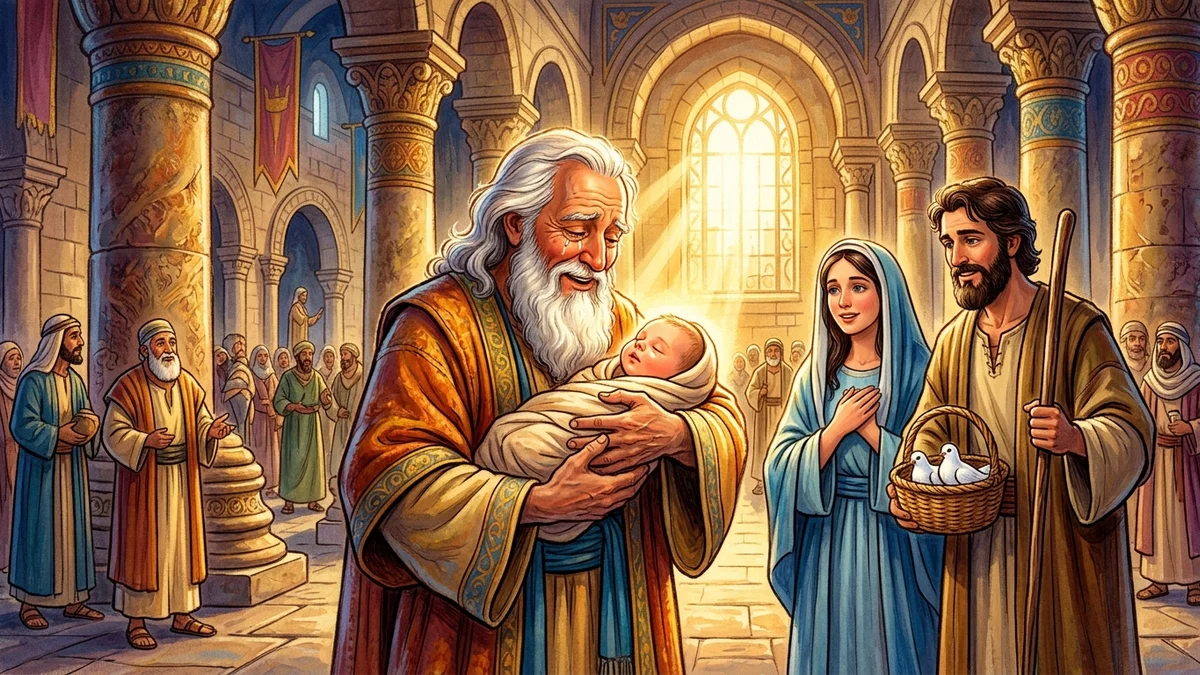
Joseph and Mary did not bring a yearling lamb from the wealthy estates of Judea. They carried a wicker cage containing two fluttering turtledoves—the biblical badge of poverty. The King of the universe, who owns the cattle on a thousand hills, entered His Temple under the legal standing of the destitute. The Maker of the universe was bought with the offering of the poorest of the land!
2. Righteous Simeon and the Holy Spirit's Secret
As the young parents passed through the monumental Nicanor Gate leading into the Court of the Women, an aged man shuffled through the stone porticoes. Luke introduces him with majestic reverence:
"And behold, there was a man in Jerusalem whose name was Simeon, and this man was just and devout, waiting for the Consolation of Israel, and the Holy Spirit was upon him." (Luke 2:25).
Simeon was not a member of the aristocratic Sadducees who compromised with Rome, nor was he an arrogant Pharisee enamored with legalistic trivialities. He belonged to the quiet, faithful remnant (*Anawim*) who lived in unceasing prayer. He was waiting for the Consolation of Israel (Hebrew: Nechamat Yisrael)—the Messianic redemption promised by Isaiah: "Comfort, comfort My people, says your God" (Isaiah 40:1).
Years earlier, amid the darkness of Roman subjugation, an extraordinary personal promise had been whispered into his spirit: "And it had been revealed to him by the Holy Spirit that he would not see death before he had seen the Lord's Christ." (Luke 2:26). Decades had passed. Simeon's eyesight had grown dim, his beard silvered with age, and his steps grew slow. Cynics undoubtedly whispered that an old man's dreams were fading into the grave. But God's promises never rot in the ground.
On that very morning, the third Person of the Trinity stirred Simeon's spirit: "So he came by the Spirit into the temple." It was not coincidence or routine habit; it was a divine appointment choreographed from before the foundation of the world.
 Fra Angelico's contemplative masterpiece 'Presentation of Jesus at the Temple' (San Marco, Florence), capturing the sacred moment Simeon embraces the Light of the World in the presence of prophetess Anna.
3. The Nunc Dimittis: Embracing Salvation
Simeon entered the crowded courtyard just as Joseph and Mary stepped forward toward the officiating priest. Surrounded by mothers holding wealthy offerings of lambs and fine flour, nothing outwardly distinguished this peasant couple from Nazareth. Yet the Holy Spirit whispered to Simeon’s heart: "Behold, the One!"
With trembling hands, tears spilling down his wrinkled cheeks, the aged saint approached the astonished young mother. He reached out his arms, and Mary, recognizing the divine light in his eyes, yielded her forty-day-old child. Simeon gathered the Creator of the cosmos against his chest! Looking toward heaven, he erupted into the immortal canticle that has echoed across church history as the **Nunc Dimittis**:
"Lord, now You are letting Your servant depart in peace, according to Your word; for my eyes have seen Your salvation which You have prepared before the face of all peoples: A light to bring revelation to the Gentiles, and the glory of Your people Israel!" (Luke 2:29-32).
The words are breathtaking in their theological altitude. The Latin phrase Nunc dimittis servum tuum, Domine uses the metaphor of an ancient night watchman stationed upon the ramparts. His long, exhausting night shift is finally over; the dawn has broken, and the master permits him to lay down his mantle and retire in peace.
Notice the universal, cosmic scope of Simeon’s prophecy. First-century popular Jewish theology expected a militant Jewish Messiah who would conquer the Gentiles and subjugate Rome under Israel's iron heel. But Simeon, quoting the Suffering Servant songs of Isaiah (Isaiah 42:6, 49:6), saw through the Holy Spirit that this child was first a **Light of revelation to the pagan Gentiles**, and second, the true spiritual glory of Israel! Salvation was not an imperial fortress for one nation; it was an open fountain prepared before the face of all peoples.
4. The Sign Spoken Against and the Pierced Soul
Joseph and Mary stood transfixed: "And Joseph and His mother marveled at those things which were spoken of Him" (Luke 2:33). Simeon blessed them, lifting his priestly hands over the young parents. But as he looked directly into the innocent, youthful face of Mary, the gentle warmth of his voice shifted into a solemn, chilling prophetic cadence:
"Then Simeon blessed them, and said to Mary His mother, 'Behold, this Child is destined for the fall and rising of many in Israel, and for a sign which will be spoken against (yes, a sword will pierce through your own soul also), that the thoughts of many hearts may be revealed.'" (Luke 2:34-35).
Here, in the midst of joyous temple music, the shadow of Golgotha fell squarely across the infant's cradle. Simeon unveiled the polarizing nature of Christ: He would not be universally applauded. He would be a stone of stumbling: the proud, self-righteous Pharisees would fall over Him, while the humble, broken tax collectors and harlots would rise into the kingdom through faith. He would be a *semeion antilegomenon*—a divine sign fiercely opposed, mocked, and rejected by men.
Then came the personal dagger: "Yes, a sword will pierce through your own soul also." The Greek word used for "sword" is rhomphaia, denoting not a small defensive dagger, but the massive, double-edged Thracian broadsword designed to hack through armor and cleave flesh to the bone.
Thirty-three years later, Simeon’s prophecy found its devastating fulfillment. On a windswept hill outside Jerusalem's Damascus Gate, Mary stood at the foot of the Roman cross. She watched those same tiny feet she had swaddled in Bethlehem spiked to raw cedar wood. She saw those tiny hands that had gripped her fingers torn by iron nails. As Roman soldiers gambled for His seamless tunic and the crowd hurled vicious blasphemies, that spiritual broadsword sheared straight through Mary's maternal soul. Yet through that agonizing sacrifice, the true moral reality of every human heart was stripped bare before the holiness of God!
5. Anna the Prophetess: Eighty-Four Years of Intercession
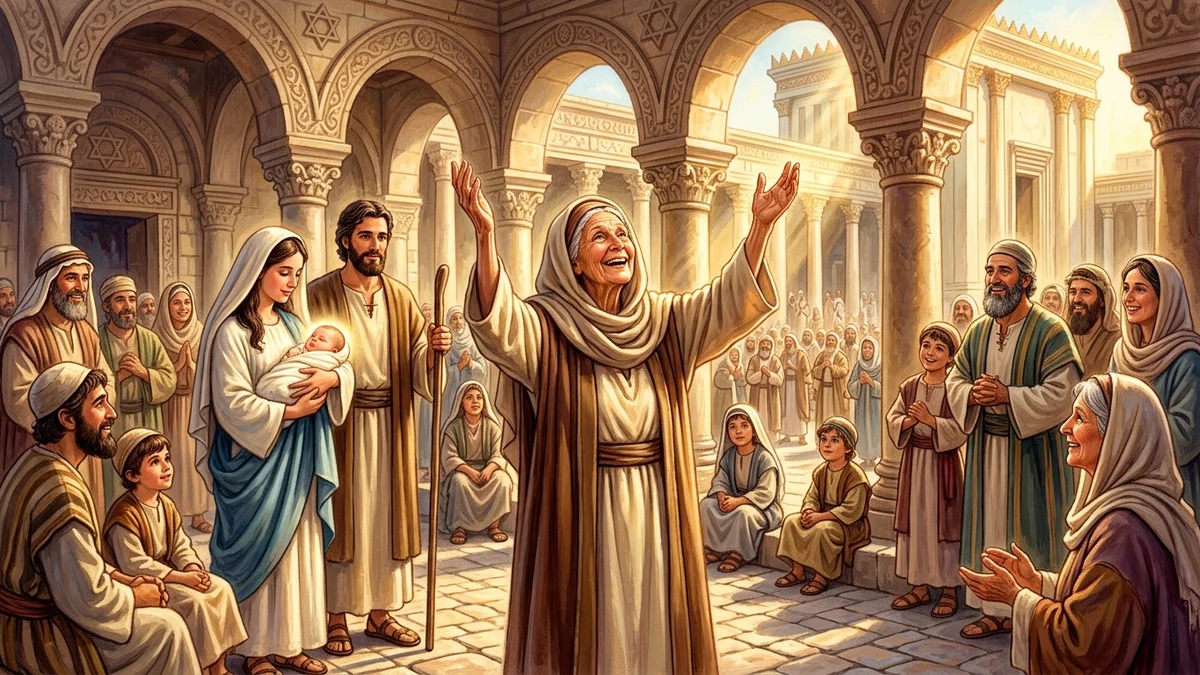
At that climactic moment, as Simeon finished his oracle, another towering spiritual giant entered the scene:
"Now there was one, Anna, a prophetess, the daughter of Phanuel, of the tribe of Asher. She was of a great age, and had lived with a husband seven years from her virginity; and this woman was a widow of about eighty-four years, who did not depart from the temple, but served God with fastings and prayers night and day." (Luke 2:36-37).
Anna's life was a monument to unyielding spiritual discipline. Widowed in her youth after only seven years of marriage, she refused to seek another husband or settle into worldly comforts. For over six decades, her home had been the sacred courts of God's house. While corrupt high priests bought their offices from Roman governors and political zealots plotted bloody revolts, this elderly widow weaponized fasting and tears, waging spiritual warfare on behalf of her nation.
Luke notes she was from the tribe of Asher—one of the ten northern tribes carried away by Assyria seven centuries earlier. Her presence proved that God had preserved a holy, faithful remnant from every single tribe of Israel!
"And coming in that instant she gave thanks to the Lord, and spoke of Him to all those who looked for redemption in Jerusalem." (Luke 2:38).
"In that instant"—at the precise micro-second Simeon released the child—Anna walked up. Looking upon the infant, the prophetic spirit ignited within her withered frame. She broke into triumphant thanksgiving and immediately turned to the circles of faithful intercessors who gathered in the temple porticoes, announcing with fiery conviction that the Redeemer of Israel had arrived!
Having fulfilled all things required by the Law of the Lord, Joseph, Mary, and the infant Jesus returned to Galilee, to their own city of Nazareth. Luke concludes the sacred narrative with a glimpse of Christ's perfect human development: "And the Child grew and became strong in spirit, filled with wisdom; and the grace of God was upon Him" (Luke 2:40). The Presentation in the Temple stands as an eternal beacon: God rewards patient, lifelong intercession, and no one who waits upon the Lord shall ever be put to shame!
Biblical Keywords & Theological Roots
Consolation, comfort, solace; in Luke 2:25 translating the messianic expectation of 'Nechamat Yisrael' (Isaiah 40:1).
A large, heavy Thracian broadsword or javelin; used in Luke 2:35 for the deep, piercing grief Mary would suffer at Calvary.
Redemption of the firstborn son, ordained in Exodus 13:13 and Numbers 18:15-16, presenting the infant before Yahweh.
Ancient Near Eastern & Archaeological Context
According to Leviticus 12, a mother remained ritually unclean for forty days following the birth of a male child. At the conclusion of this period, the parents were required to travel to the Temple in Jerusalem to present two offerings: a yearling lamb for a burnt offering and a pigeon or turtledove for a sin offering. However, Leviticus 12:8 mercifully provided that if the mother's means were insufficient for a lamb, she could bring two turtledoves or two young pigeons. Joseph and Mary's presentation of the two birds historical evidence of their deep economic poverty.
Support Independent Biblical Research
Did this study bless you? Help support our independent bilingual research and interactive visual Bible tools.
⚡ Fast Facts
- The offering of two turtledoves or two young pigeons was the specific provision of the Mosaic Law for families too impoverished to afford a yearling lamb (Leviticus 12:8)
- Simeon's song of praise is known historically in Christian liturgy as the 'Nunc Dimittis', from its opening Latin words meaning 'Now You dismiss'
- The Greek word 'paraklesis' (consolation) matches the Hebrew 'Nechamat Yisrael'—the long-awaited messianic comforting of Israel promised in Isaiah 40:1
- Prophetess Anna belonged to the northern tribe of Asher, proving that faithful remnants of the ten northern tribes remained actively worshipping in Judea
❓ Frequently Asked Questions (FAQs)
Under the Mosaic covenant (Exodus 13:2, 12-15; Numbers 18:15-16), every firstborn male belonged to God in memory of the Passover deliverance from Egypt and had to be redeemed through an offering. Jesus was 'born under the Law to redeem those who were under the Law' (Galatians 4:4-5), fully submitting to righteous ordinances from infancy.
Simeon prophesied the deep maternal agony Mary would endure thirty-three years later at Golgotha. As she stood beneath the cross watching her beloved Son scourged, mocked, and crucified as a 'sign spoken against', her mother's heart would experience emotional and spiritual anguish akin to being impaled by a Roman broadsword (rhomphaia).
Unlike many contemporary nationalistic expectations that envisioned a political conqueror only for Jews, Simeon quoted Isaiah 42:6 and 49:6, proclaiming Christ as 'A light to bring revelation to the Gentiles, and the glory of Your people Israel', revealing that salvation was universally prepared for all nations.