For seven centuries, the prophetic words of Micah had echoed across the barren limestone terraces of Judea like an unresolved melody: "But you, Bethlehem Ephrathah, though you are little among the thousands of Judah, yet out of you shall come forth to Me the One to be Ruler in Israel, whose goings forth are from of old, from everlasting" (Micah 5:2). In the royal palace of Rome, Emperor Caesar Augustus sat upon his gilded throne, master of the Mediterranean world, entirely oblivious to the Hebrew scriptures. Yet with a single stroke of his imperial stylus, he set into motion the exact geopolitical machinery required to bring a poor Galilean virgin ninety miles south to the ancestral city of David. In the mysterious providence of Almighty God, the decrees of earthly emperors serve only to fulfill the eternal blueprints of heaven!
1. The Imperial Decree and the Road to Ephrathah
The Gospel of Luke anchors the Incarnation within verifiable human history: "And it came to pass in those days that a decree went out from Caesar Augustus that all the world should be registered. This census first took place while Quirinius was governing Syria" (Luke 2:1-2). Augustus, proud architect of the *Pax Romana*, sought a comprehensive inventory of taxable subjects across the empire. In client-kingdoms like Judea, Roman administrators accommodated local Jewish traditions, requiring men to enroll in the ancestral village of their patriarchal house.
For Joseph, a humble carpenter living in the despised hill town of Nazareth, this meant embarking upon a grueling journey of nearly ninety miles. His betrothed wife, Mary, was in the final trimester of a pregnancy conceived not of human will, but by the overshadowing power of the Holy Spirit. Traveling southward down the Jordan Valley to avoid hostile Samaritan villages, and then climbing the steep, bone-chilling ascents toward the Judean plateau, each step was agony. Mary rode upon a beast of burden, her body aching with the rhythmic contractions of approaching labor, while Joseph walked beside her, staff in hand, scanning the rocky crags for desert brigands and wolves.
They were not aristocracy traveling with retinue and litters. They were poor peasants carrying the eternal Word of God (*Logos*) wrapped beneath mortal flesh. As the sun sank behind the Judean ridge, casting long shadows over terraced olive groves, the silhouette of Bethlehem appeared—a dusty, crowded hilltop town swarming with returning descendants of the Davidic line.
2. No Room in the Katalyma: Born in a Manger
When Joseph and Mary finally staggered into Bethlehem, the town was bursting at its seams. Relatives’ homes were packed to capacity, and every corner of the village echoed with the chatter of travelers and braying donkeys. Luke records with profound, heartbreaking brevity: "And she brought forth her firstborn Son, and wrapped Him in swaddling cloths, and laid Him in a manger, because there was no room for them in the inn" (Luke 2:7).
Centuries of romanticized tradition have painted the "inn" as a heartless commercial tavern keeper slamming a wooden door in the faces of a desperate couple. But the original Greek text reveals a far more intimate and culturally authentic reality. The word Luke uses is katalyma, which signifies the upper guest chamber of a typical peasant home—the very same word Luke uses in chapter 22 for the Upper Room where Jesus celebrated the Last Supper. When Luke intends to describe a commercial wayside inn, as in the Parable of the Good Samaritan, he uses a completely different word: pandocheion.
In ancient Judean architecture, a family home consisted of a single large living space with an elevated rear platform where the family slept and entertained guests (the *katalyma*), and a lower ground level near the doorway where household animals were brought inside at night to protect them from winter frost and theft. Carved directly into the limestone floor of this lower tier were shallow depressions—feed troughs or mangers (*phatne*)—where oxen and sheep could feed.
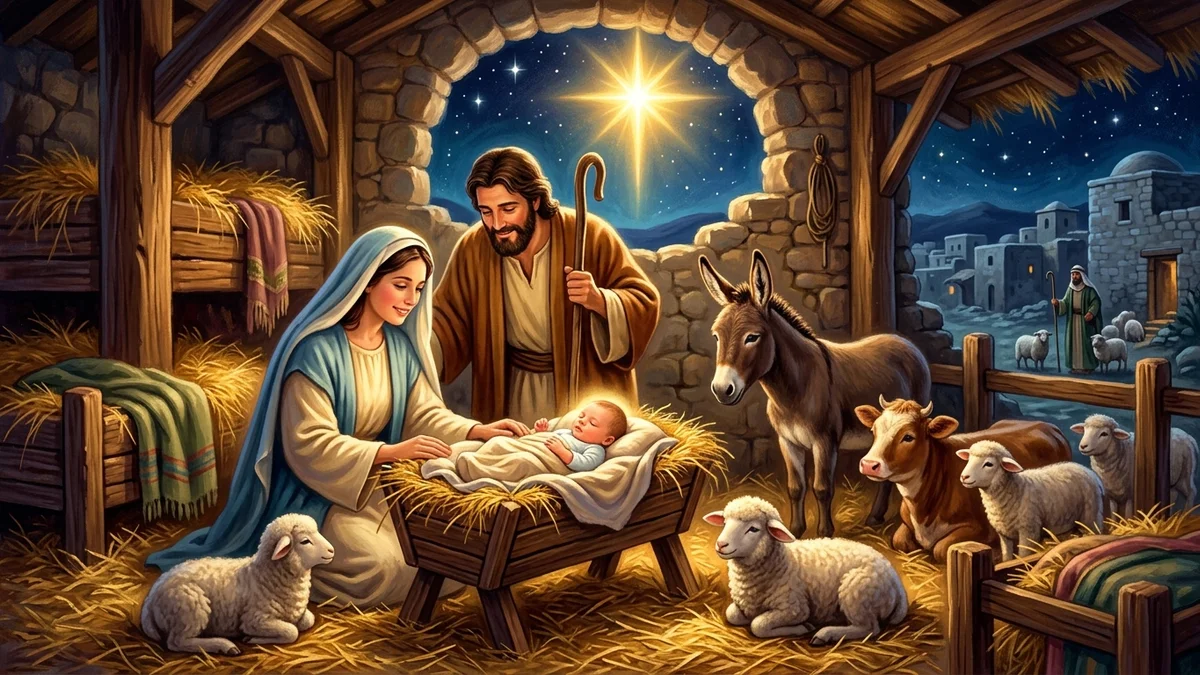
Because the guest chamber of Joseph's relatives was already overflowing with elderly kin, the hospitable family welcomed the laboring maiden into the warm, sheltered privacy of the lower animal quarters. There, amid the earthy scent of clean straw and the quiet breath of resting beasts, the Creator of the universe drew His first breath of cold Judean air. Mary wrapped Him tenderly in spargana—long strips of clean linen wrapped around the infant's limbs according to ancient Hebrew custom to keep them straight and warm—and laid the King of Glory into an animal feeding trough! The Ancient of Days had arrived, clothed in human fragility.
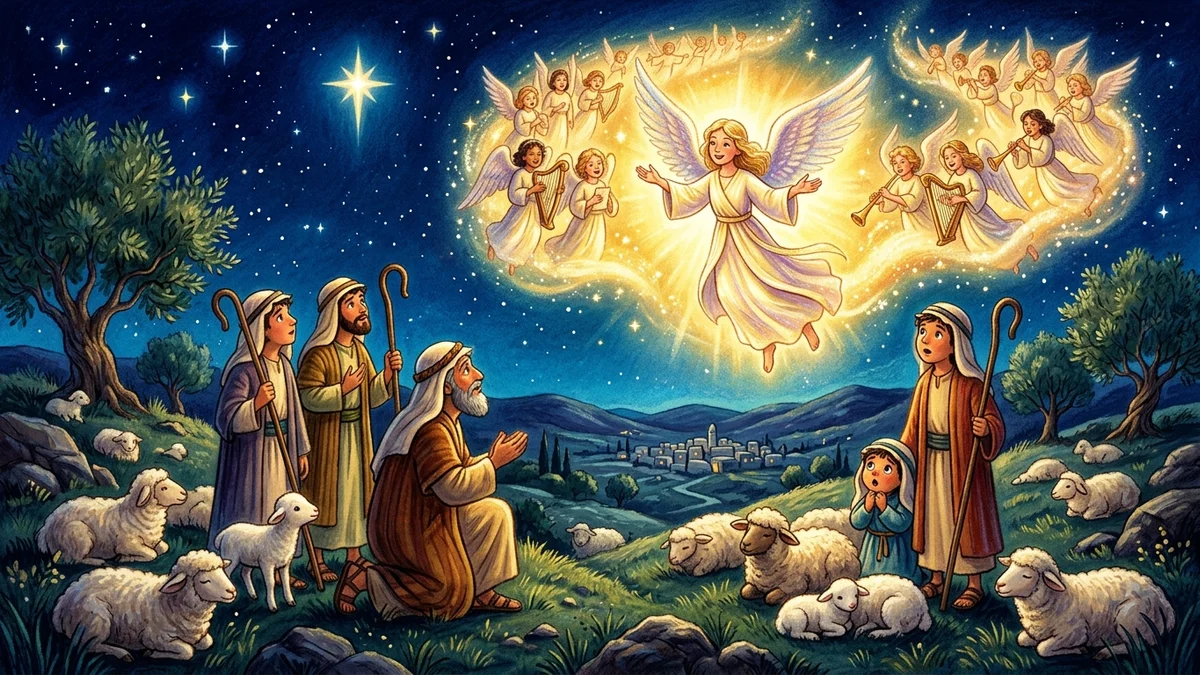 Carl Bloch's transcendent masterpiece 'The Shepherds and the Angel' (1879), capturing the blinding Shekinah glory of God shattering the midnight darkness of the Judean hills.
3. Migdal Eder: Midnight Glory over the Outcasts
While Jerusalem slept under the heavy stupor of Roman occupation and Herod rested in paranoid luxury within the marble halls of his fortress, heaven bypassed kings, emperors, and high priests. God dispatched His royal embassy not to the Sanhedrin or Caesar's palace, but to an open, windswept field where night shepherds kept vigil over their flocks.
Luke records: "Now there were in the same country shepherds living out in the fields, keeping watch over their flock by night. And behold, an angel of the Lord stood before them, and the glory of the Lord shone around them, and they were greatly afraid" (Luke 2:8-9).
In first-century Jewish society, shepherds occupied the lowest rungs of the social ladder. Because their duties kept them perpetually isolated in the fields, unable to observe the punctilious ceremonial washing rituals of the Pharisees, they were deemed ritually unclean. Their testimony was legally inadmissible in a Jewish court of law. Yet God, who delights in choosing the foolish and despised things of this world to confound the mighty, chose these very men to be His prime witnesses.
Moreover, geographical archaeology reveals that these fields lay near Migdal Eder—the "Tower of the Flock" mentioned in Genesis 35:21 and Micah 4:8. According to ancient rabbinic records preserved in the Mishnah (Shekalim 7:4), the flocks grazing in the valleys surrounding Bethlehem were not ordinary domestic sheep. They were specially consecrated sacrificial lambs destined for the daily morning and evening burnt offerings (*Tamid*) and the annual Passover slaughter at the Temple in Jerusalem!
The men guarding these flocks were priestly shepherds trained to inspect newly born lambs for blemishes. It was to these very men—custodians of the symbolic sacrificial lambs—that the archangel appeared to announce the arrival of the ultimate, spotless Lamb of God who would take away the sin of the world!
4. The Angelic Anthem: Peace to Men of Goodwill
As the shepherds fell prostrate in paralyzing dread before the blinding radiance of the *Shekinah*—the uncreated light of God's presence—the angel spoke words that altered the course of human history:
"Do not be afraid, for behold, I bring you good tidings of great joy which will be to all people. For there is born to you this day in the city of David a Savior, who is Christ the Lord. And this will be the sign to you: You will find a Babe wrapped in swaddling cloths, lying in a manger!" (Luke 2:10-12).
Notice the divine paradox: The angel declared royal titles that shook the foundations of imperial Rome. Caesar Augustus claimed the title *Soter* (Savior) and claimed that Roman conquest brought peace to the earth. But the angel proclaimed the true Savior, the Anointed Messiah (*Christos*), who is none other than Yahweh in the flesh (*Kyrios*). And the proof of His divinity was not a crown of gold or an army of legions, but a helpless infant wrapped in swaddling rags and resting in an animal feed trough!
Before the stunned shepherds could comprehend the proclamation, the veil between dimensions tore wide open:
"And suddenly there was with the angel a multitude of the heavenly host praising God and saying: 'Glory to God in the highest, and on earth peace, goodwill toward men!'" (Luke 2:13-14).
The phrase "heavenly host" (*plethos stratias ouraniou*) refers to the military legions of heaven—an innumerable army of holy angels. Yet they did not brandish swords of judgment. They sang an unearthly, multi-dimensional chorus of pure adoration. In the highest heavens, supreme glory belonged to God; and on the fractured, bloodstained earth below, true reconciliation and *Shalom* was now inaugurated between the Holy Creator and rebellious humanity through the newborn Prince of Peace.
5. Running to the Manger: The First Evangelists
When the angelic choir withdrew into the starry heights and the darkness returned, the night air hung heavy with the perfume of eternity. The shepherds did not debate, rationalize, or delay. They looked into each other's trembling eyes and said: "Let us now go even to Bethlehem and see this thing that has come to pass, which the Lord has made known to us!" (Luke 2:15).
Leaving their sheep in the care of the Almighty, they hurried into the sleeping town with breathless haste (*speusantes*). Guided by the divine sign, they searched through the stone dwellings until they found the precise scene the angel had described: Joseph standing sentinel, young Mary resting pale yet radiant, and the tiny newborn infant sleeping peacefully in the limestone manger.
The rough, weathered men dropped to their calloused knees upon the straw. Their hands, hardened by sheep shearings and defense against predators, trembled as they gazed into the tiny face of their Creator. They recounted to the astonished parents everything the heavenly host had declared concerning this child. The shepherds, whose words were rejected by human courts, became heaven's chosen ambassadors—the very first evangelists of the Christian era!
While the shepherds went out into the dawn, glorifying and praising God for all they had seen and heard, waking the sleeping villagers with their joyous shouts, Luke records an exquisite portrait of Mary's holy interior life:
"But Mary kept all these things and pondered them in her heart." (Luke 2:19).
The Greek word for "pondered" is symballousa, meaning to fit together scattered pieces of a puzzle. Mary took Gabriel's annunciation, Elizabeth's prophetic blessing, Joseph's angelic dream, the arduous mountain journey, the humble manger, and the wild, ecstatic testimonies of the rough shepherds, weaving them into an unshakeable tapestry of faith. In that quiet cave-stable in Bethlehem, the ancient promise made in Eden had finally dawned: the Seed of the woman had arrived to crush the serpent's head!
Biblical Keywords & Theological Roots
Guest chamber, lodging place, or public shelter; used in Luke 2:7 for the family guest quarters, distinct from 'pandocheion' (commercial inn).
To wrap in swaddling bands, binding a newborn child in linen strips for protection and posture.
A feeding trough or manger for domestic livestock, often carved directly from limestone in Judean cave dwellings.
Tower of the Flock; pastoral site near Bethlehem where sacrificial sheep destined for the Jerusalem temple were bred and guarded.
Ancient Near Eastern & Archaeological Context
Under Emperor Caesar Augustus, Rome enforced censuses across its provinces to systematically calculate tributary taxation and military rosters. In Judea, governed client-monarch Herod the Great, Jewish customs permitted citizens to register according to ancestral tribal lineage. For Joseph, this meant trekking from Nazareth in Galilee south through the Jordan Valley to Bethlehem in Judea—the ancestral village of King David. First-century Judean stone homes typically consisted of an upper family room (katalyma) and a stepped-down lower terrace where livestock were sheltered overnight from winter chill and mountain predators.
Support Independent Biblical Research
Did this study bless you? Help support our independent bilingual research and interactive visual Bible tools.
⚡ Fast Facts
- The Greek word 'katalyma' translates to 'guest room' or upper chamber of a family house, rather than a modern commercial hotel
- Bethlehem, meaning 'House of Bread' (Beit Lechem), became the birthplace of Him who declared 'I am the Bread of Life'
- The shepherds kept watch near Migdal Eder ('Tower of the Flock'), the traditional grazing pasture for Passover sacrificial lambs destined for the Jerusalem Temple
- Swaddling bands ('spargana') were linen strips tightly wrapped around newborns to keep limbs straight and symbolize parental protection
❓ Frequently Asked Questions (FAQs)
Christ's birth in a feeding trough in humble Bethlehem fulfilled Old Testament prophecy (Micah 5:2) and demonstrated the nature of His kingdom. By entering humanity in poverty rather than aristocratic splendor, Jesus identified with the lowly, broken, and marginalized, proving that salvation is accessible to all people without barrier.
According to Jewish historical tradition (Mishnah Shekalim 7:4), flocks grazing between Jerusalem and Bethlehem at Migdal Eder were uniquely designated for temple sacrifices. Thus, the angelic announcement of the ultimate 'Lamb of God who takes away the sin of the world' was delivered first to the very shepherds who cared for sacrificial lambs.
Seven centuries before Christ, the prophet Micah declared that Israel's eternal ruler must come forth from Bethlehem Ephrathah (Micah 5:2). Joseph and Mary lived in Nazareth, over eighty miles to the north. Caesar Augustus's empire-wide tax registration compelled them to travel to Joseph's ancestral city of David, showing God's absolute sovereignty over earthly empires.