Recorded in Matthew 20:1-16, the Parable of the Workers in the Vineyard strikes a fatal blow against religious meritocracy. Framed by Christ's radical axiom that "the last will be first, and the first will be last," this narrative dismantles human notions of earning favor with God and unveils the magnificent, non-negotiable sovereignty of divine grace.
1. The Early Dawn and the Contracted Wage
The parable commences at sunrise (6:00 AM) as a landowner enters the marketplace (agora) where day laborers gathered with their tools, waiting to be hired. The owner struck a legal contract: "He agreed to pay them a denarius for the day and sent them into his vineyard" (Matthew 20:2). A silver denarius was the standard, dignified subsistence wage for a full twelve-hour day of intense agricultural toil. These first workers began their day with certainty, stability, and a fair covenant.
2. The Succession of Market Visits: Grace to the Idle
As the harvest clock ticked, the owner repeatedly revisited the market at the 3rd hour (9:00 AM), 6th hour (12:00 PM), and 9th hour (3:00 PM), finding more men and sending them to the vines with a promise: "I will pay you whatever is right." Finally, at the 11th hour—5:00 PM, with barely sixty minutes of daylight remaining—he found men still standing aimlessly. "Why have you been standing here all day long doing nothing?" he asked. Their response was heartbreaking: "Because no one has hired us." They were the unchosen, the frail, the passed-over. Yet the master commanded them: "You also go into the vineyard."
3. The Twilight Reckoning: Reversing the Payroll
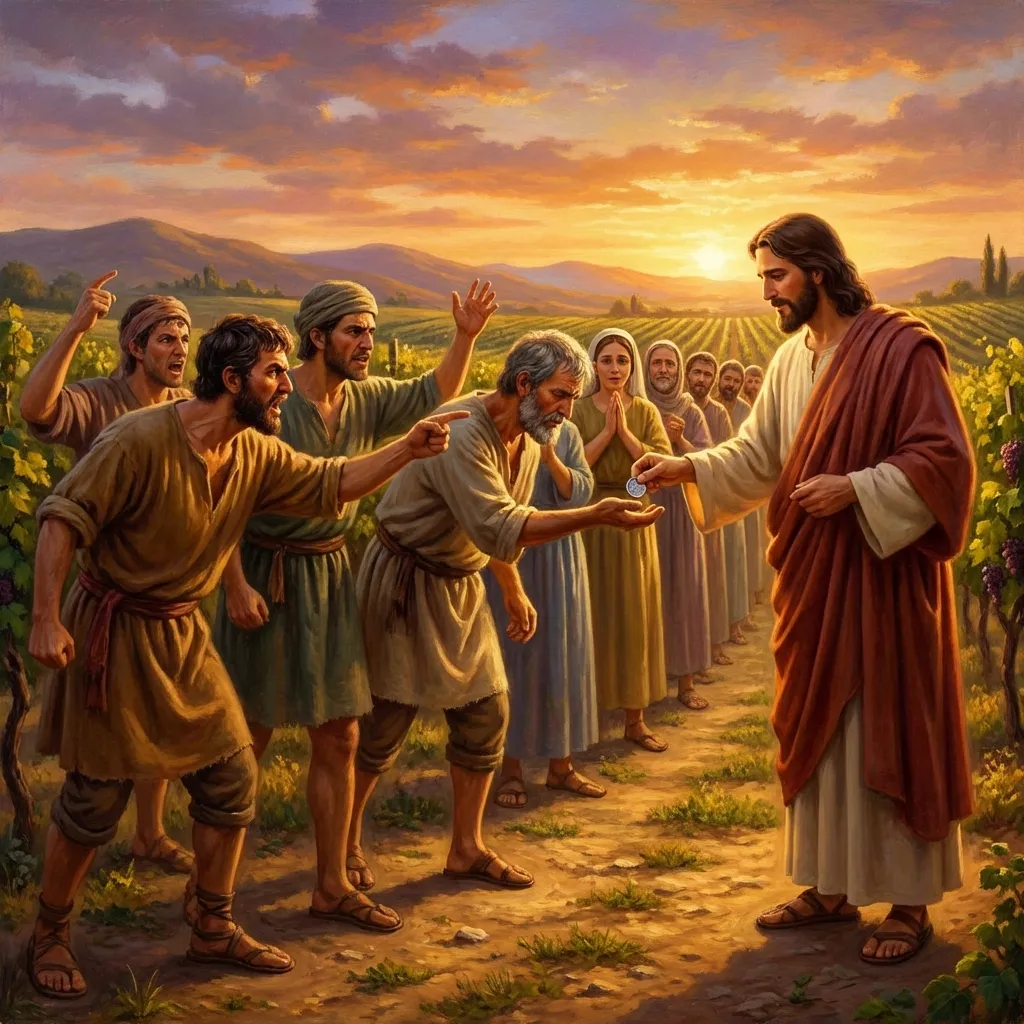
At dusk (6:00 PM), Jewish law required all day laborers to be paid (Leviticus 19:13). The owner instructed his foreman: "Call the workers and pay them their wages, beginning with the last ones hired and going on to the first" (Matthew 20:8). This inverted payroll protocol was deliberate; had the first workers been paid first and dismissed, they would have missed the revelation of the master's radical grace. When the 11th-hour workers stepped forward, having laboured only sixty minutes, each received a gleaming silver denarius—a full day's wage!
4. The Murmuring of the Firstborn Laborers
Seeing this extraordinary generosity, the dawn workers rubbed their hands in anticipation: "When those came who were hired first, they expected to receive more. But each one of them also received a denarius" (Matthew 20:10). Indignation erupted. They confronted the landowner: "These who were hired last worked only one hour, and you have made them equal to us who have borne the burden of the work and the heat of the day!" (Matthew 20:12). Their complaint was not financial injustice—they received every penny of their agreed wage—but wounded pride that latecomers were elevated to their exact status.
5. Sovereign Goodness: "Is Your Eye Evil Because I am Good?"
The landowner's reply is a masterpiece of biblical grace: "Friend, I am not being unfair to you. Didn't you agree to work for a denarius? Take your pay and go. I want to give the one who was hired last the same as I gave you. Don't I have the right to do what I want with my own money? Or are you envious because I am generous?" (Matthew 20:13-15). God is beholden to no human balance sheet. He never treats anyone with less than absolute justice, but He is perpetually free to lavish unmerited mercy upon whom He wills. In the Kingdom, salvation is never a wage to be claimed, but a gift to be received in humble adoration.
Biblical Keywords & Theological Roots
Denarius; standard silver coin representing a full, fair day's subsistence wage for a Roman-era day laborer.
Evil eye; an ancient Semitic idiom denoting jealous resentment, begrudging envy at another's blessing.
Equal, identical in status, measure, or reward; reflecting God's radical grace that levels human pride.
Ancient Near Eastern & Archaeological Context
In the Judean hill country, the late-summer grape harvest was a high-stakes, frantic race against the impending autumn rains (*yoreh*). If torrential downpours struck before the clusters were harvested, the entire grape crop would ferment, split, and rot on the vine, causing financial ruin. Landowners routinely hired every available day laborer (*misthios*), scouring the village market until dusk. Day laborers formed the most vulnerable economic class—unlike indentured servants who received food and lodging, day laborers survived strictly on daily cash wages. Paying one denarius to a one-hour laborer was not an economic miscalculation; it was an act of profound social compassion ensuring that the laborer's family would not starve that night.
🔑 Key Spiritual Takeaways
- Grace is Not Merit-Based: Kingdom salvation and eternal life are sovereign gifts of divine generosity, not wages earned by human labor.
- The Danger of Spiritual Entitlement: Longtime believers are prone to harbor bitterness when late converts receive the exact same heavenly inheritance.
- God is Always Just and Beyond Generous: God never underpays anyone who serves Him, but He reserves the absolute right to lavish grace upon whom He pleases.
- The First Shall Be Last: Human hierarchical expectations are totally inverted in the Kingdom of Heaven.
Support Independent Biblical Research
Did this study bless you? Help support our independent bilingual research and interactive visual Bible tools.
⚡ Fast Facts
- The Succession of Hours: The landowner went out at five distinct intervals: early morning (6:00 AM), 3rd hour (9:00 AM), 6th hour (12:00 PM), 9th hour (3:00 PM), and the 11th hour (5:00 PM).
- The Market Economy: Unhired day laborers (*ergatai*) gathered at dawn in the town square (*agora*); failure to be hired meant their families went hungry that evening.
- Reversed Payroll: Under Mosaic Law (Leviticus 19:13; Deuteronomy 24:15), day laborers had to be paid before sundown; the owner intentionally paid the last-hired first to make a theological point.
- Sovereign Generosity: The early workers received exactly what they agreed upon (one denarius); their grievance was not injustice, but envy provoked by the master's lavish grace toward others.
❓ Frequently Asked Questions (FAQs)
Why were the early workers upset if they received their agreed-upon wage?
The early workers suffered from the poison of comparative entitlement. When they saw the one-hour workers receive a full denarius, they assumed they would receive more. Their grievance was not that they were shortchanged (they got the fair market wage they agreed to), but that the owner treated the latecomers as equals (*isous*), offending their pride.
What does the 'evil eye' (ophthalmos ponēros) mean in Matthew 20:15?
In ancient Semitic thought, an 'evil eye' referred to envy, stinginess, and malice directed at another person's prosperity. The master asked: 'Are you envious because I am generous?' (literally: 'Is your eye evil because I am good?'). It exposes how human hearts resent divine grace when given to the undeserving.
How does this parable relate to Peter's question in Matthew 19:27?
Directly preceding this parable, Peter asked: 'We have left everything to follow you! What then will there be for us?' Jesus told this parable to warn the disciples that while their sacrifices would be rewarded, kingdom service must never devolve into a mercantile bargaining spirit that despises latecomers (such as the thief on the cross or the Gentiles).