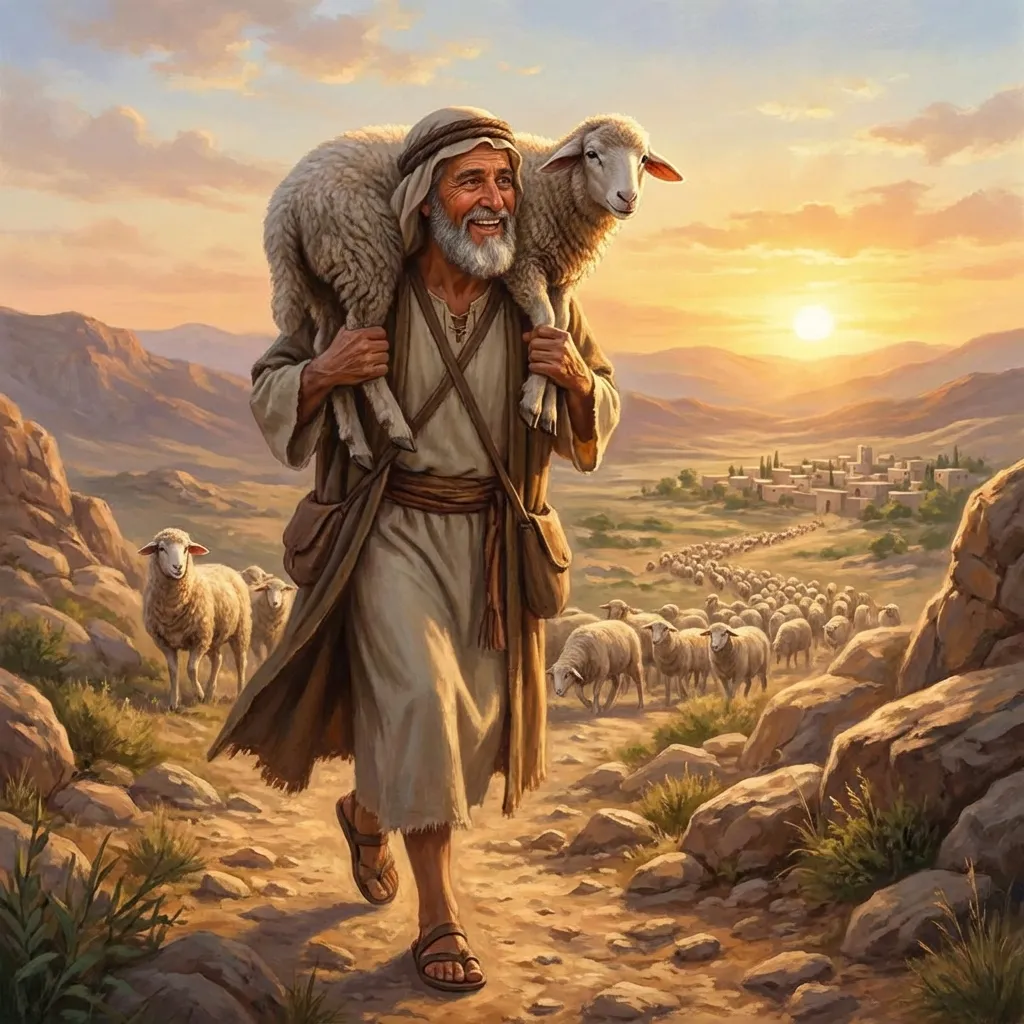
In Luke 15:1-7, the religious elite—the Pharisees and scribes—muttered in bitter disgust: "This man welcomes sinners and eats with them." In response to their self-righteous sneer, Jesus unleashed the three greatest parables of grace in human literature: the Lost Sheep, the Lost Coin, and the Prodigal Son. The opening masterpiece, the Parable of the Lost Sheep, unveils the relentless, pursuing heart of God.
1. The Vulnerability of a Lost Sheep
Unlike cats or dogs, a sheep possesses no innate homing mechanism, no sharp fangs for defense, and no blinding speed to escape predators. When a sheep wanders off the grassy plateau into rocky ravines, it becomes paralyzed with terror, bleating helplessly until a hyena or wolf tears it to pieces. A lost sheep cannot find its own way home; unless the shepherd searches for it, death is absolute certainty.
2. The Relentless Pursuit
Jesus asked His listeners: "Suppose one of you has a hundred sheep and loses one of them. Doesn't he leave the ninety-nine in the open country and go after the lost sheep until he finds it?" (Luke 15:4). Notice the phrase: "until he finds it." The shepherd does not give up after twenty minutes, or turn back when rain begins to fall. He scrambles down steep brambles and dangerous cliffs, driven by love, refusing to return empty-handed.
3. Carried on Joyful Shoulders
Luke 15:5 records what happens when the shepherd locates the trembling, exhausted creature: "And when he finds it, he joyfully puts it on his shoulders and goes home." He does not beat it with a staff, curse it for making him hike in the dark, or drag it on a rope. He tenderly hoists the fifty-pound creature across his shoulders, bearing its full weight. This is the Gospel of grace: Christ carries the total burden of our recovery upon His own shoulders.
4. The Extravagant Celebration
Returning home to the village, the shepherd calls together his friends and neighbors, shouting: "Rejoice with me; I have found my lost sheep!" A casual observer might consider throwing a neighborhood feast over one common sheep financially irrational. But in the economy of heaven, human logic is superseded by the joy of redemption. The rescue of one lost soul sparks an uncontrollable celebration.
5. Joy in the Presence of Angels
Jesus delivered the breathtaking climax: "I tell you that in the same way there will be more rejoicing in heaven over one sinner who repents than over ninety-nine righteous persons who do not need to repent" (Luke 15:7). Heaven does not throw parties over religious conformity, outward piety, or intellectual perfection. The courts of glory erupt in celestial song the moment one broken, wandering sinner collapses into the saving arms of Jesus Christ.
Biblical Keywords & Theological Roots
Lost, perishing, destroyed; wandering aimlessly away from the flock, completely helpless to rescue itself.
'Joy in heaven'; the explosive celestial celebration among angels when a single lost sinner repents.
'Lays it on his shoulders rejoicing'; the tender Shepherd bearing the entire weight of the exhausted sheep home.
Ancient Near Eastern & Archaeological Context
In the arid Judean wilderness and the rocky pasturelands of the Transjordan, pastoral shepherding was an arduous, high-risk profession. Flocks typically comprised between 50 to 100 sheep, often co-owned by several peasant families. A shepherd was legally and financially liable under ancient Near Eastern grazing codes (such as the Code of Hammurabi and rabbinic tradition) for any animal lost through negligence, requiring proof of torn carcasses if attacked by wolves or lions. In rugged limestone terrain riddled with ravines, crevices, and thorny scrub, a separated sheep would freeze in panic, unable to find its way back alone. The shepherd carried the exhausted 80-pound animal on his shoulders, bearing the burden of its salvation back to the village fold.
🔑 Key Spiritual Takeaways
- The Seeking Heart of God: God does not wait passively for the lost to find their way back; He aggressively tracks us into the darkest wilderness until He rescues us.
- Individually Treasured: In God's eyes, the individual is never lost in the crowd; one single lost soul is worth the shepherd's total pursuit.
- Carried by Sovereign Grace: The sheep does not walk back by its own willpower; the Shepherd bears the full weight of our salvation upon His shoulders.
- Heaven Celebrates Repentance: Heaven rejoices more over one broken sinner coming home than over ninety-nine self-righteous people who think they need no repentance.
Support Independent Biblical Research
Did this study bless you? Help support our independent bilingual research and interactive visual Bible tools.
⚡ Fast Facts
- Shepherd Metaphor: In Luke 15:1-7 and Matthew 18:12-14, Jesus delivered this parable in response to Pharisees grumbling: 'This man welcomes sinners and eats with them.'
- The Ninety-Nine Left Behind: The shepherd leaves the ninety-nine safe in the open fold to aggressively pursue the single lost sheep until he finds it.
- Carried on Shoulders: An exhausted, terrified lost sheep will freeze in fear; the shepherd does not beat or drag it, but lovingly lifts it onto his strong shoulders.
- Communal Celebration: Arriving home, the shepherd calls together his friends and neighbors, shouting: 'Rejoice with me; I have found my lost sheep!'
❓ Frequently Asked Questions (FAQs)
Why did the Pharisees complain about Jesus eating with tax collectors and sinners?
In first-century Jewish culture, table fellowship implied intimate communion, covenant endorsement, and moral approval. Pharisees feared ceremonial contamination and considered tax collectors national traitors. Jesus responded that healthy people do not need a doctor, but the sick.
Why did the shepherd leave ninety-nine sheep in the open country to find one?
The ninety-nine were not abandoned in danger; they were left together safely in their accustomed pasture or under the care of subordinate shepherds. The emphasis of the parable is the shepherd's relentless, personalized love: not a single sheep can be spared or written off as collateral damage.
How does this parable reveal the character of Jesus as the Good Shepherd?
In Ezekiel 34:11-12, God declared: 'I myself will search for my sheep and look after them.' Jesus fulfills this divine role directly, demonstrating in Luke 15 and John 10 that He is the Good Shepherd who lays down His life to seek and save the lost.