In Luke 10:25-37, a theological expert in the Mosaic Law stood up to test Jesus with the ultimate question: "Teacher, what must I do to inherit eternal life?" When Jesus directed him to the greatest commandments—loving God wholeheartedly and loving one's neighbor as oneself—the lawyer sought to limit his moral duty by asking: "And who is my neighbor?" In response, Christ delivered the immortal Parable of the Good Samaritan.
1. The Blood-Stained Road to Jericho
Jesus set the narrative along the notorious seventeen-mile desert descent from Jerusalem down to Jericho. Dropping over 3,300 feet through barren limestone gorges, this desolate pass was so plagued by violent highwaymen that it was nicknamed the 'Pass of Blood' (Adummim). A Jewish traveler was ambushed, beaten bloody, stripped naked of all clothes, and left half-dead in the burning midday gravel.
2. The Failure of Religious Orthodoxy
By coincidence, a Temple priest journeyed down the same path, returning from his liturgical duties in Jerusalem. Seeing the bloody body, he crossed to the opposite side of the road and hurried past. A Levite, a sacred Temple assistant, followed soon after; he walked over, looked at the victim, and also crossed to the far side. Under Levitical law (Leviticus 21:1), touching a corpse disqualified a priest from eating sacred offerings for seven days. Both religious men prioritized ritual ceremonial purity over rescuing a dying human brother.
3. The Despised Samaritan Steps In
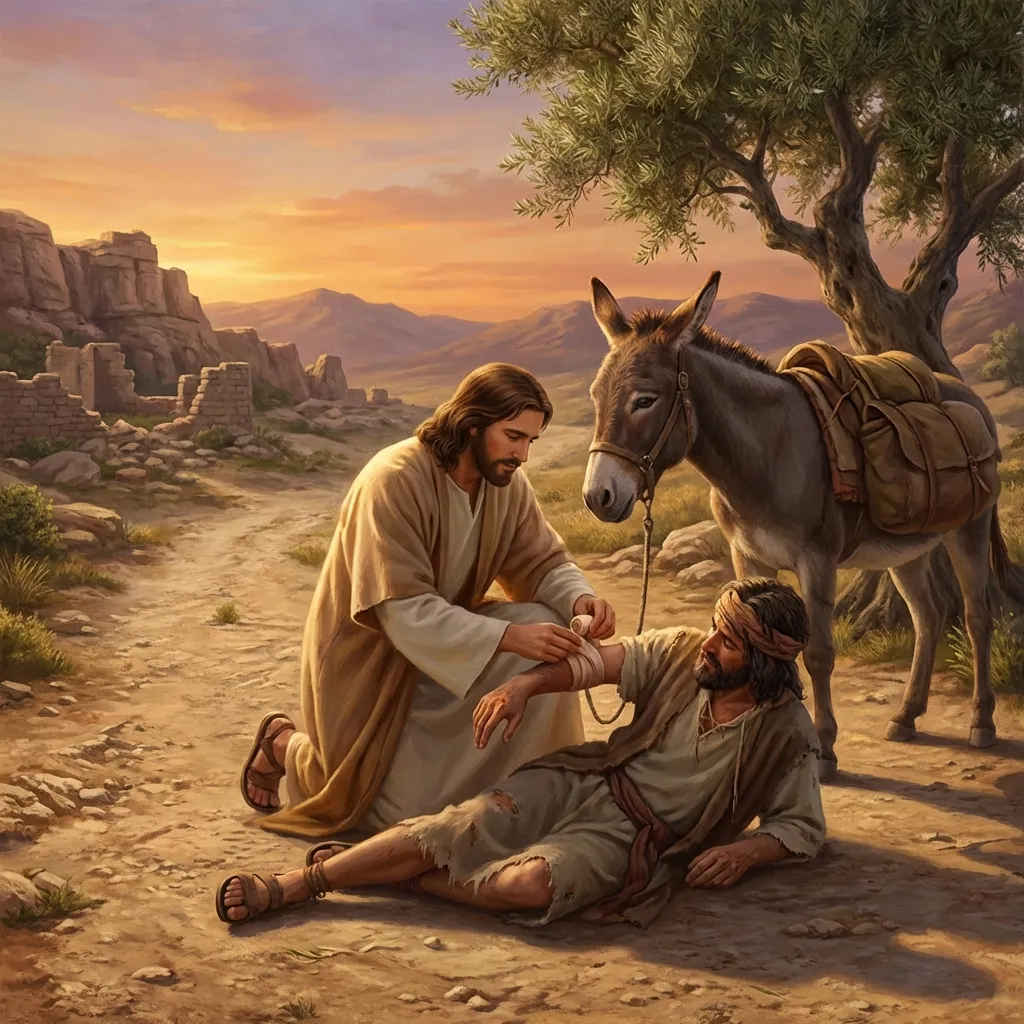
Then came a Samaritan. In first-century Jewish thought, Samaritans were hated as heretical, racially corrupt half-breeds; Jews cursed them in synagogues and avoided walking through their territory. Yet when this despised outcast saw the bloody Jewish traveler, Luke 10:33 records: "His heart went out to him." Compassion shattered ethnic and historical hatred. He knelt in the dirt, poured in medicinal olive oil to soothe and wine to disinfect the lacerations, and bound the wounds with his own clothes.
4. Lavish Sacrificial Care
The Samaritan hoisted the wounded man onto his own riding donkey and walked beside him down to a roadside inn (pandocheion). He spent the entire night personally nursing the victim. The next morning, he handed the innkeeper two silver denarii (two days' wages for an agricultural laborer, covering weeks of lodging) and gave an open checkbook guarantee: "Look after him, and when I return, I will reimburse you for any extra expense you may have."
5. Go and Do Likewise
Jesus turned to the shocked lawyer and asked: "Which of these three do you think was a neighbor to the man who fell into the hands of robbers?" The lawyer could not even bring his lips to utter the hated word 'Samaritan.' He answered: "The one who had mercy on him." Jesus commanded: "Go and do likewise." Authentic holiness is measured not by theological trivia or ritual piety, but by active, sacrificial mercy shown to suffering humanity.
Biblical Keywords & Theological Roots
Neighbor, the one near you; the expert in the law asked 'Who is my neighbor?', seeking to limit the boundary of love.
Moved with deep pity, visceral compassion; the despised Samaritan saw the bloody victim and his heart broke with mercy.
Inn, public khan/caravanserai; where all are received, paying two denarii to secure the victim's full medical recovery.
Ancient Near Eastern & Archaeological Context
The 17-mile desert road descending over 3,300 feet from Jerusalem to Jericho traversed the barren, jagged limestone gorge of the Judean wilderness. Known historically as 'The Ascent of Blood' (*Ma'ale Adummim*), the route was notorious for violent Bedouin bandits and highwaymen who ambushed isolated travelers. Priests and Levites frequently commuted along this highway between their temple duties in Jerusalem and their residential villas in Jericho. Under rabbinic purity codes (Leviticus 21:1-3), touching a dead corpse rendered a priest ceremonially defiled for seven days, disqualifying him from collecting tithes and ministering. Samaritans and Jews shared centuries of bitter ethnic and theological hostility following the 5th-century BC schism and the Hasmonean destruction of the Samaritan temple on Mount Gerizim in 128 BC.
🔑 Key Spiritual Takeaways
- Love Has No Boundaries: The definition of 'neighbor' is not restricted by race, religion, nationality, or political affiliation.
- Dead Religion Leaves Victims Bleeding: The priest and Levite had orthodox theology and liturgical duties, but lacked basic mercy.
- Compassion Costs Money and Time: The Samaritan bound wounds with oil and wine, set the victim on his own donkey, paid the innkeeper, and promised to cover extra expenses.
- Go and Do Likewise: Jesus turned the question from 'Who is my neighbor?' (passive entitlement) to 'Which of these proved to be a neighbor?' (active love).
Support Independent Biblical Research
Did this study bless you? Help support our independent bilingual research and interactive visual Bible tools.
⚡ Fast Facts
- Dangerous Jericho Road: The 17-mile descent from Jerusalem to Jericho dropped 3,300 feet through barren limestone ravines notoriously nicknamed the 'Way of Blood' due to rampant banditry.
- Priestly Avoidance: The priest and Levite avoided the body to prevent ceremonial corpse uncleanness (Numbers 19:11), which would disqualify them from Temple duties.
- Two Denarii Provision: Two silver denarii was equal to two full days of a laborer's wages—sufficient to pay for weeks of food and lodging at an ancient roadside inn.
- Deep Ethnic Hatred: Jews viewed Samaritans as heretical outcasts, praying in synagogues that Samaritans would have no share in eternal life.
❓ Frequently Asked Questions (FAQs)
Why did the lawyer ask 'Who is my neighbor?' in Luke 10:29?
The lawyer wanted to 'justify himself' by defining his neighbor as narrowly as possible—limiting his obligation to love fellow Jewish peers while excluding Samaritans, Gentiles, and outcasts.
Why did the priest and Levite pass by on the other side?
The beaten traveler was stripped naked and unconscious, appearing dead. Under Leviticus 21:1, touching a corpse defiled a priest for a week, disqualifying him from collecting tithes or eating consecrated food. They placed ceremonial cleanliness above saving human life.
How does the Good Samaritan point prophetically to Jesus Christ?
Historically, church fathers (Augustine, Chrysostom) saw Christ as the true Good Samaritan: finding humanity stripped, beaten, and dying from sin; pouring in the oil of the Holy Spirit and the wine of His blood; carrying us to the inn (the Church); and promising to return.