Found in Luke 16:19-31, the narrative of the Rich Man and Lazarus is one of the most vivid and solemn discourses Jesus ever delivered. Drawing back the veil between the temporal realm and the eternal world, Christ reveals the terrifying consequences of comfortable self-indulgence and the glorious vindication of the righteous poor.
1. The Chasm of Earth: Purple Splendor vs Ulcerated Agony
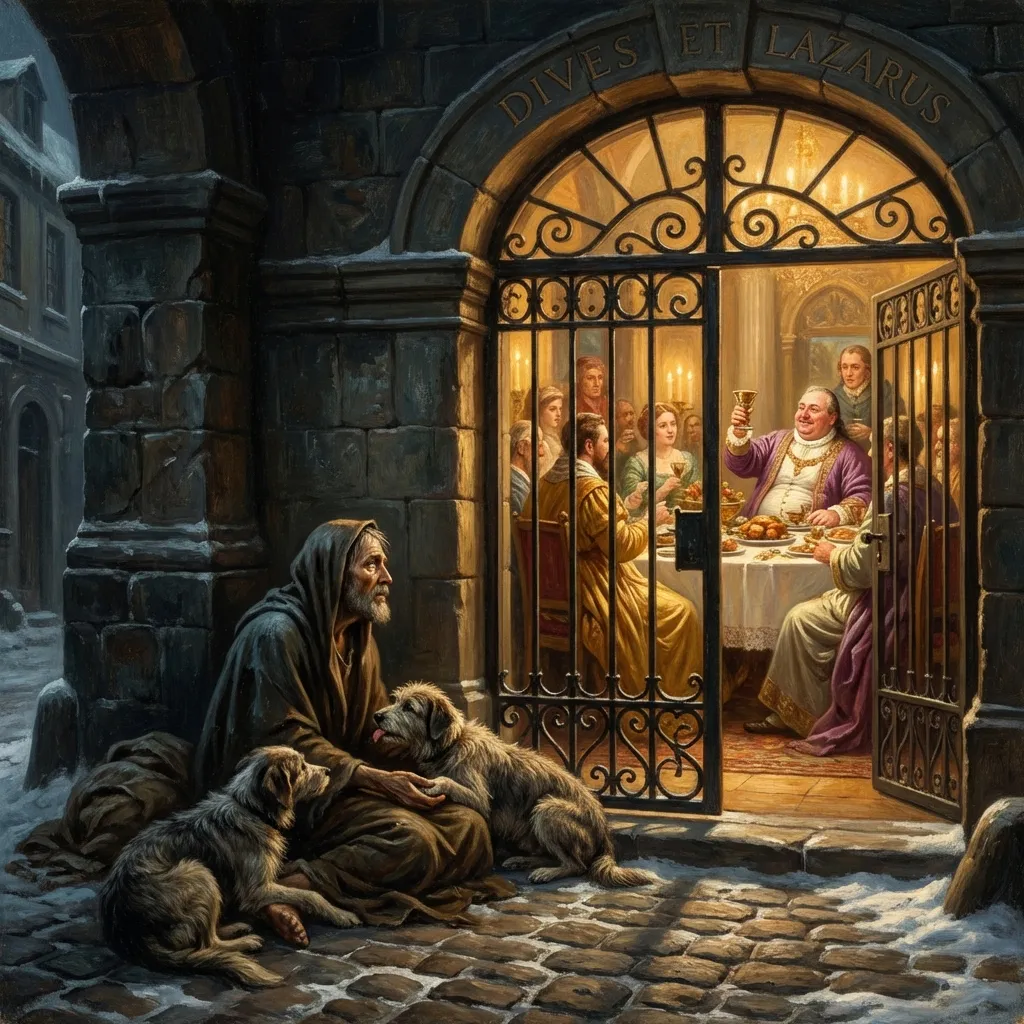
Jesus juxtaposes two polar opposites living in close proximity: "There was a rich man who was dressed in purple and fine linen and lived in luxury every day. At his gate was laid a beggar named Lazarus, covered with sores and longing to eat what fell from the rich man's table" (Luke 16:19-21). The rich man is cloaked in imperial Tyrian purple (porphyra) and delicate Egyptian byssus, dining on banquets daily. Just outside his fortified portal lies Lazarus—whose name signifies 'God is my help.' Paralyzed and ulcerated, Lazarus watched the scraps thrown to the floor while street dogs licked his open wounds. The rich man never physically harmed Lazarus, but his daily sin was callous, blind apathy.
2. The Great Equalizer: Death and the Cosmic Reversal
In time, physical mortality claimed both men, but their transitions could not have differed more radically: "The time came when the beggar died and the angels carried him to Abraham's side. The rich man also died and was buried" (Luke 16:22). Lazarus likely received no earthly funeral, his emaciated body cast into the valley of Hinnom; yet a celestial angelic escort carried him straight into the intimate embrace of Abraham. The rich man received an ornate, eulogy-filled burial, but his soul plunged immediately into the subterranean agony of Hades.
3. Torment, Thirst, and the Shattered Illusion of Status
Looking up from the flames of Hades, the rich man saw Abraham far away with Lazarus resting against his chest: "So he called to him, 'Father Abraham, have pity on me and send Lazarus to dip the tip of his finger in water and cool my tongue, because I am in agony in this fire'" (Luke 16:24). Even in torment, the rich man's pride had not dissolved; he still viewed Lazarus as an errand boy to be dispatched for his personal comfort. But Abraham gently reminded him of the cosmic audit: "Son, remember that in your lifetime you received your good things, while Lazarus received bad things, but now he is comforted here and you are in agony" (Luke 16:25).
4. The Irrevocable Gulf: No Second Chances Beyond the Grave
Abraham extinguished any hope of post-mortem relief: "And besides all this, between us and you a great chasm has been set in place, so that those who want to go from here to you cannot, nor can anyone cross over from there to us" (Luke 16:26). The boundary between heaven and hell is permanently fixed by divine decree. No prayers for the dead, no purgatorial purifications, and no transmigration of souls can span this chasm. The decisions made during our brief earthly pilgrimage seal our destination for all eternity.
5. The Sufficiency of the Scriptures
Realizing his own doom was irreversible, the rich man pleaded for his family: "Then I beg you, father, send Lazarus to my family, for I have five brothers. Let him warn them, so that they will not also come to this place of torment" (Luke 16:27-28). Abraham responded: "They have Moses and the Prophets; let them listen to them." When the rich man protested that a resurrected ghost would surely compel their repentance, Abraham delivered the final, devastating verdict: "If they do not listen to Moses and the Prophets, they will not be convinced even if someone rises from the dead" (Luke 16:31). A few weeks later, Jesus raised another man named Lazarus from the tomb, and the religious leaders conspired to assassinate both Lazarus and Jesus (John 11:53; 12:10). The problem of unbelief is never a lack of evidence; it is the rebellion of the human heart against the Word of God.
Biblical Keywords & Theological Roots
Bosom, embrace, side of intimate fellowship; specifically 'Abraham's bosom' denoting the place of blessed rest and paradise for righteous saints.
Hades, the intermediate netherworld of departed souls; specifically the compartment of anguish and torment for the unrepentant.
Chasm, gulf, deep impassable void; an eternally fixed divine boundary separating the blessed from the condemned.
Ancient Near Eastern & Archaeological Context
In first-century Jerusalem, the Sadducean priestly aristocracy (epitomized by the wealthy household of Annas and Caiaphas) lived in luxurious Greco-Roman palatial villas in the Upper City, overlooking the Temple Mount. They dressed in royal Tyrian purple and imported linen while controlling lucrative temple concessions. Crucially, the Sadducees dogmatically rejected the afterlife, the resurrection, and angelology (Acts 23:8). By depicting the afterlife with Abraham's bosom, conscious post-mortem agony, and the finality of biblical revelation ('Moses and the Prophets'), Jesus was delivering a devastating polemic against the opulent, skeptical priestly ruling class.
🔑 Key Spiritual Takeaways
- The Lethal Danger of Indifference: The rich man was not condemned for being wealthy, but for total, unfeeling apathy toward the starving destitute at his doorstep.
- Radical Eternal Reversal: Earthly social status is entirely eradicated in eternity; the despised beggar was comforted in paradise while the cloaked aristocrat suffered in flames.
- No Purgatorial Transition: Death instantly locks an individual's eternal destiny; the 'great chasm' permanently prohibits any crossing between torment and paradise.
- Scripture Over Sensationalism: Saving faith is birthed through humble submission to the Word of God, not through spectacular paranormal apparitions.
Support Independent Biblical Research
Did this study bless you? Help support our independent bilingual research and interactive visual Bible tools.
⚡ Fast Facts
- Only Named Protagonist: Lazarus is the only character in all of Jesus' parables endowed with a personal name—derived from Hebrew *El'azar*, meaning 'God is my help.'
- Royal Extravagance: The rich man wore purple (*porphyra*, dyed with secretions of rare marine snails) and fine Egyptian linen (*byssos*), garments reserved exclusively for royalty and high-ranking priests.
- Dogs vs Physician: Street dogs licking Lazarus' ulcerated sores represented the ultimate humiliation in Jewish culture, yet ironically offered more palliative relief than the rich homeowner.
- Sufficiency of Scripture: The story ends with a resounding affirmation: if people will not hear 'Moses and the Prophets,' they will not be persuaded even if someone rises from the dead.
❓ Frequently Asked Questions (FAQs)
Is the account of the Rich Man and Lazarus a literal history or a parable?
While historically debated because Jesus uses a real name (Lazarus) and mentions Abraham, the literary context of Luke 16 (following the Unjust Manager) indicates it is a theological parable utilizing contemporary Jewish cosmological imagery to teach moral accountability, the finality of death, and the authority of Scripture.
Why did Abraham refuse the rich man's request to send Lazarus back to warn his five brothers?
Abraham replied that the brothers already possessed 'Moses and the Prophets' (the complete Old Testament Scriptures). If a heart is so hardened that it refuses the written Word of God, even the miraculous apparition of a resurrected ghost will produce only superstitious terror, not genuine repentance unto salvation.
What does the 'great fixed chasm' (mega chasma) teach about purgatory or second chances after death?
Luke 16:26 explicitly states that no one can cross from torment to paradise or vice versa. The chasm is divinely fixed (*estēriktai*), completely refuting doctrines of post-mortem purgation, universalist reconciliation, or reincarnation; our earthly life is the sole window of repentance.