Delivered in the Temple courts during Passion Week, Matthew 21:33-46 contains the explosive Parable of the Wicked Tenants. Standing face-to-face with the high priests and Pharisees who were actively plotting His assassination, Jesus exposes their murderous conspiracy, catalogs centuries of prophetic blood, and announces the irrevocable transfer of God's Kingdom.
1. The Vineyard of Lavish Grace
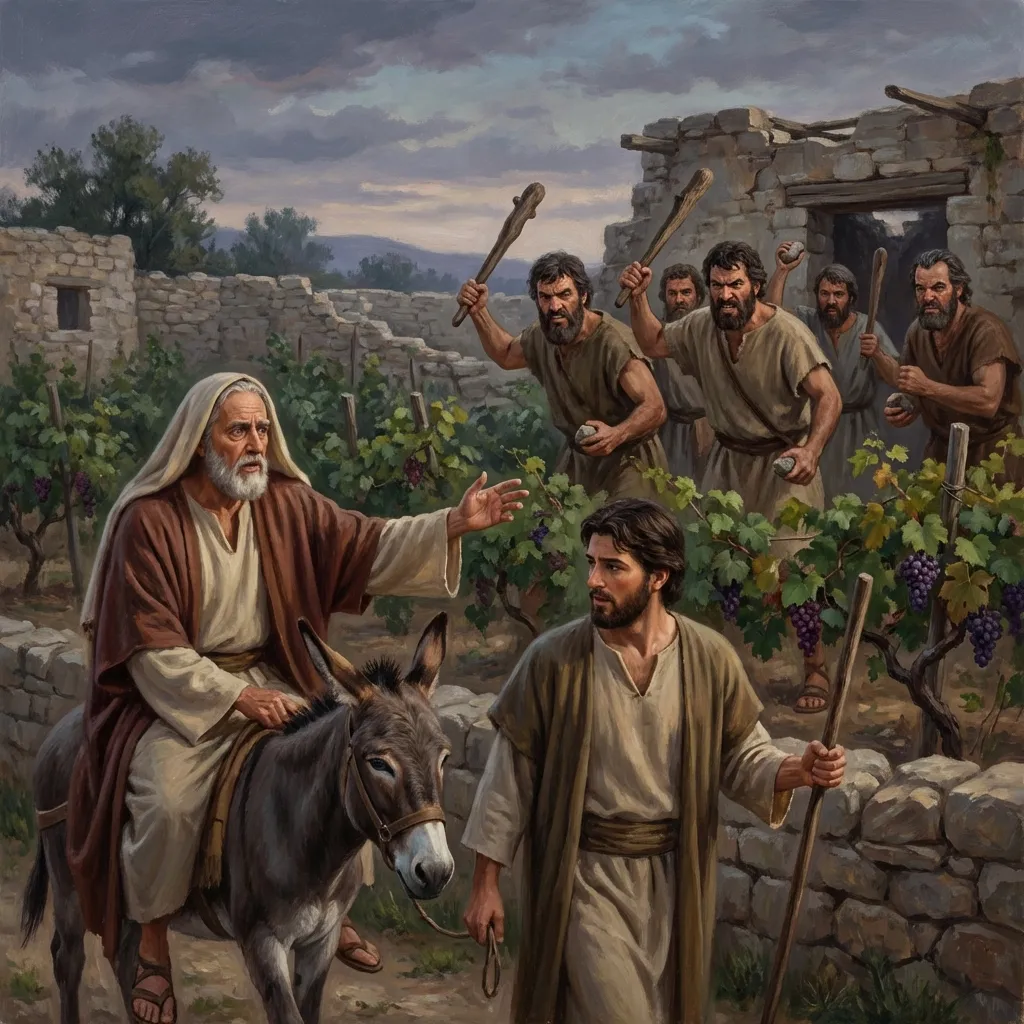
Jesus opened with imagery engraved on every Jewish heart: "There was a landowner who planted a vineyard. He put a wall around it, dug a winepress in it and built a watchtower. Then he rented the vineyard to some farmers and moved to another place" (Matthew 21:33). This language intentionally mirrored Isaiah's famous 'Song of the Vineyard' (Isaiah 5:1-7). The master spared no expense: the stone perimeter wall guarded against marauding jackals, the watchtower provided surveillance against thieves, and the rock-hewn vat was ready for juice. God provided everything necessary for Israel's leaders to shepherd His people into fruitful righteousness.
2. The Succession of Slaughtered Prophets
When harvest time approached, the absentee owner dispatched his personal servants to collect his rightful share of the produce. What followed was a shocking cascade of rebellion: "The tenants seized his servants; they beat one, killed another, and stoned a third. Then he sent other servants to them, more than the first time, and the tenants treated them the same way" (Matthew 21:35-36). This gruesome chronicle summarized the tragic spiritual history of Israel: Elijah driven into the desert, Zechariah murdered between the altar and the sanctuary (2 Chronicles 24:21), Jeremiah beaten and thrown into a muddy cistern, and Isaiah sawn in two under King Manasseh. The stewards had become armed rebels.
3. The Mission and Murder of the Beloved Son
In a breathtaking act of patient vulnerability, the landowner resolved: "Last of all, he sent his son to them. 'They will respect my son,' he said" (Matthew 21:37). But when the corrupt husbandmen saw the young man walking down the terraced slopes, their greed exploded into homicidal frenzy: "This is the heir. Come, let's kill him and take his inheritance. So they took him and threw him out of the vineyard and killed him" (Matthew 21:38-39). With prophetic precision, Jesus described His own impending death. Within seventy-two hours, these exact religious rulers would arrest Jesus, drag Him outside the city walls of Jerusalem, and crucify the Heir of the Universe on the hill of Golgotha.
4. The Inevitable Verdict of Sovereign Retribution
Jesus looked into the eyes of the priests and demanded: "Therefore, when the owner of the vineyard comes, what will he do to those tenants?" Unwittingly, the crowd pronounced their own doom: "He will bring those wretches to a wretched end, and he will rent the vineyard to other tenants, who will give him his share of the crop at harvest time" (Matthew 21:40-41). Jesus drove the blade home: "Therefore I tell you that the kingdom of God will be taken away from you and given to a people who will produce its fruit" (Matthew 21:43). The religious monopoly of the Jerusalem hierarchy was permanently shattered.
5. The Chief Cornerstone and the Shattered Builders
Christ concluded by quoting the Messianic anthem of Psalm 118:22-23: "The stone the builders rejected has become the cornerstone; the Lord has done this, and it is marvelous in our eyes." He warned: "Anyone who falls on this stone will be broken to pieces; anyone on whom it falls will be crushed" (Matthew 21:42, 44). The Jewish leaders knew He was speaking of them, yet fear of the multitude stayed their hands (Matthew 21:45-46). Jesus Christ is the ultimate cornerstone of human destiny. To submit to Him in repentance is to be redeemed; to reject Him is to be ground to dust beneath the weight of eternal judgment.
Biblical Keywords & Theological Roots
Tenant farmer, vinedresser, agricultural husbandman; representing the spiritual leadership of Israel entrusted with God's vineyard.
Heir, rightful inheritor; applied exclusively to the Son of God possessing supreme title to all creation.
Chief cornerstone; the foundational stone aligning and bearing the entire weight of God's spiritual temple.
Ancient Near Eastern & Archaeological Context
In 1st century Roman Palestine, absentee landlordism was common. Wealthy foreign investors or Jerusalem aristocrats purchased large tracts of the fertile Galilee and Jezreel plains, developing vineyards with stone walls, watchtowers to spot thieves and wild boars, and hewn-limestone winepresses (*gegat*). They leased them to local tenant sharecroppers (*geōrgoi*) under contracts requiring a set percentage of the grape harvest. Because Galilee was a hotbed of Zealot nationalism, tenant strikes occasionally turned violent, with tenants refusing to pay rent and physically murdering landlords' bailiffs to claim legal squatter ownership under ancient property squatter customs (*chazakah*).
🔑 Key Spiritual Takeaways
- Spiritual Stewardship is Accountable: God's servants do not own the vineyard; they are caretakers bound to render the fruit of righteousness to the Master.
- The Depth of Rebellious Depravity: Human sin is not mere ignorance; it is hostile insurrection against the rightful authority of the Son of God.
- The Transfer of the Kingdom: Religious monopoly is revoked; the Kingdom was taken from corrupt leaders and given to a multi-ethnic, fruit-bearing people (the Church).
- The Unshakable Cornerstone: Christ will either be the foundational Rock upon which you build your eternity, or the stumbling Stone that crushes you in judgment.
Support Independent Biblical Research
Did this study bless you? Help support our independent bilingual research and interactive visual Bible tools.
⚡ Fast Facts
- Passion Week Temple Setting: Delivered during Jesus' final confrontation with the chief priests, scribes, and elders in the Temple courts (Matthew 21:23).
- Echo of Isaiah's Vineyard Song: The opening description (planted, walled, press dug, tower built) directly quotes Isaiah 5:1-7, ensuring listeners instantly understood Israel was the vineyard.
- Murder of the Prophets: The succession of beaten, stoned, and slaughtered servants mirrors Israel's violent history of rejecting prophets (Zechariah, Jeremiah, Isaiah).
- Prophetic Foreshadowing of the Cross: The murder of the Son 'outside the vineyard' accurately predicted Jesus being marched outside the walls of Jerusalem to Golgotha to be crucified.
❓ Frequently Asked Questions (FAQs)
Who do the characters represent in the Parable of the Wicked Tenants?
The Landowner is God the Father; the Vineyard is the covenant nation of Israel; the Tenants are the religious leaders (Pharisees, Sadducees, Chief Priests); the Servants are the Old Testament prophets sent to demand spiritual fruit; the Son is Jesus Christ; and the 'other tenants' represent the Church made up of Jews and Gentiles.
Why did the tenants think killing the son would give them the inheritance?
Under ancient Palestinian property law (*chazakah*), if a landowner died intestate with no recognized heir, tenant farmers who occupied the land and improved it could legally claim permanent squatter ownership. Seeing the son sent alone, they foolishly assumed the owner had died, believing his murder would leave the estate legally uncontested.
What is the meaning of 'the stone that falls on someone will crush them' (Matthew 21:44)?
Jesus quotes Psalm 118:22 and Daniel 2:34-45. To fall upon the Stone in brokenness is repentance and salvation; but for the Stone to fall upon someone in final judgment means absolute, pulverizing destruction (*likmēsei*).