The sun was sinking behind the olive-draped ridges of lower Galilee, bathing the whitewashed limestone homes of Cana in warm apricot light. The air was rich with the fragrance of roasted lamb, pomegranates, and crushing sweet figs. Flutes and timbrels echoed through the narrow courtyard, where wedding guests in embroidered holiday robes danced beneath olive-oil lamps strung from terrace to terrace. Jesus of Nazareth had arrived from the Jordan wilderness, accompanied by His first small band of disciples—Andrew, Peter, Philip, and Nathanael, whose hometown was Cana itself. His mother Mary was already present, actively helping manage the domestic hospitality of the host family. Yet behind the laughter and rhythmic stamping of dancing feet, a quiet panic was erupting in the shadowed pantry. The earthen amphorae were empty. The wine had run out!
1. The Social Catastrophe of the Empty Goblet
John opens the narrative with historical anchoring: "On the third day there was a wedding in Cana of Galilee, and the mother of Jesus was there. Now both Jesus and His disciples were invited to the wedding" (John 2:1-2).
To understand the gravity of the crisis, modern readers must shed contemporary Western assumptions about weddings. In first-century Judea and Galilee, a wedding was not a two-hour ceremony followed by a quick dinner. It was a massive, week-long covenant festival involving an entire clan and village. The bridegroom was legally and socially bound to provide abundant food, entertainment, and wine (*oinos*) for up to seven continuous days.
In ancient Near Eastern honor-shame culture, wine was not merely a recreational beverage; it was the sacred symbol of celebration, divine blessing, and joyful hospitality (Psalm 104:15). To run out of wine in the middle of a wedding feast was a devastating, irreparable social disaster. It publicly branded the newly married couple and their family as stingy, impoverished, or incompetent hosts. In fact, ancient Jewish civil law (recorded in rabbinic sources) allowed wedding guests and the bride's relatives to file financial lawsuits against a groom who failed to provide adequate hospitality!
Mary, likely a close relative of the bride or groom given her active role in the household logistics, discovered the crisis before the guests did. She watched the panic-stricken servants frantically tilting the dark clay amphorae, scraping out only dregs. Without fanfare or panic, Mary turned to the one Person whose true identity she had treasured in her heart for thirty silent years:
"And when they ran out of wine, the mother of Jesus said to Him, 'They have no wine.'" (John 2:3).
Mary did not make a demanding request; she simply laid the human need before the Son of God. Her words carried three decades of maternal intimacy and suppressed expectation: "The time of silence is over. Manifest who You are!"
2. Woman, My Hour Has Not Yet Come
Christ's response has puzzled readers for centuries, yet in its original Koine Greek setting, it reveals supreme theological dignity:
"Jesus said to her, 'Woman, what does your concern have to do with Me? My hour has not yet come.'" (John 2:4; Greek: Ti emoi kai soi, gynai? Oupō hēkei hē hōra mou).
To Western ears, addressing one's mother as "Woman" sounds abrasive or cold. But in classical Greek, Gynai was an aristocratic address of elevated respect and honor—equivalent to addressing a queen as "Madam" or "Milady." Jesus would use this identical title from the agony of the cross when tenderly placing Mary into the care of the Apostle John: "Woman, behold your son!" (John 19:26).
The idiom Ti emoi kai soi was a common Semitic expression meaning: "What do we have in common in this matter?" Jesus was gently but firmly establishing a new relationship. His thirty years of quiet submission in the Nazareth carpenter's shop had concluded at the Jordan River. He was now operating not as Mary's domestic son, but as the incarnate Messiah, governed exclusively by the sovereign blueprint of His heavenly Father.
Furthermore, Jesus uttered the phrase that reverberates throughout John's Gospel: "My hour has not yet come." Throughout the Fourth Gospel, Christ's "hour" (hōra) refers specifically to His glorification through His suffering, death on the cross, and resurrection (John 12:23; 17:1). Performing public miracles would initiate the ticking clock of religious hostility that would inevitably culminate at Golgotha. Jesus was saying: "Mother, if I step onto the public stage today to perform signs, the road to the cross officially begins. Are you ready for that sword to pierce your soul?"
3. The Unshakeable Command: Whatever He Says to You, Do It
Mary’s response is one of the most sublime expressions of pure faith in sacred scripture. She did not argue, pout, or take offense at Christ's theological boundary. She completely stepped out of the way, surrendered all maternal authority, and pointed the domestic servants directly to the Son:
"His mother said to the servants, 'Whatever He says to you, do it.'" (John 2:5; Greek: Ho ti an legē hymin, poiēsate).
These are the final recorded words of Mary in the Gospel of John, and they stand as an eternal charter for all true discipleship. Mary did not tell the servants to look to her, to pray to her, or to depend on human ingenuity. She commanded absolute, unhesitating obedience to the voice of Jesus Christ. "Whatever He says—no matter how strange, illogical, or unconventional it may seem to your human eyes—do it without question!"
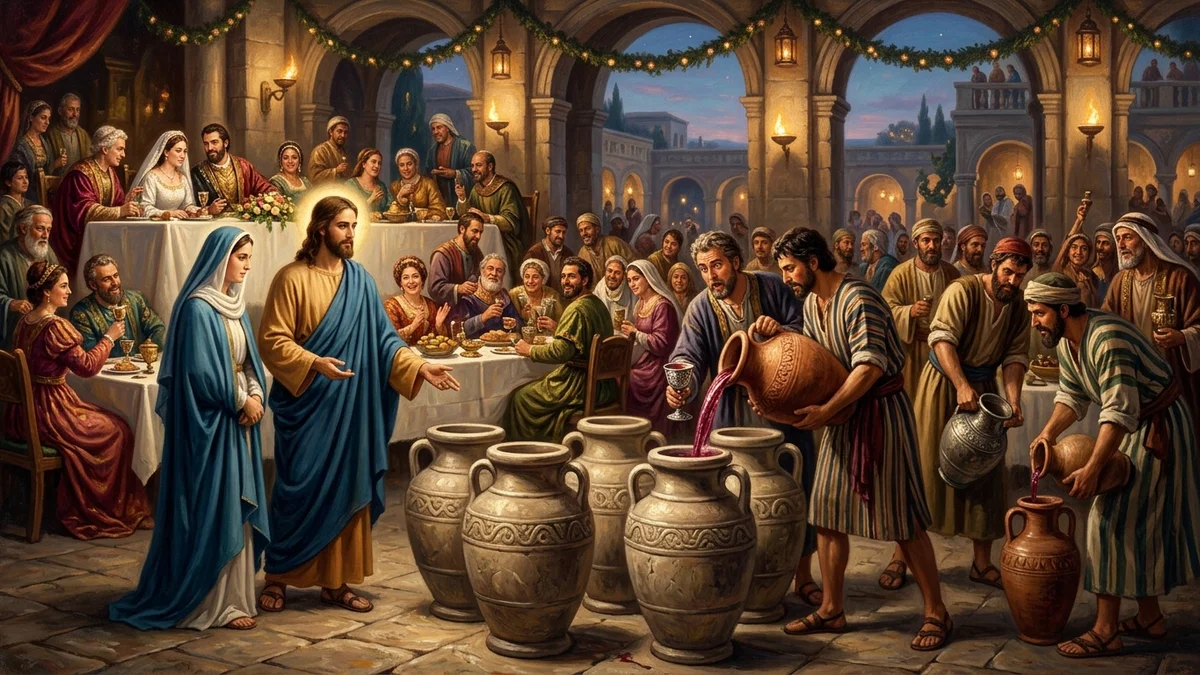
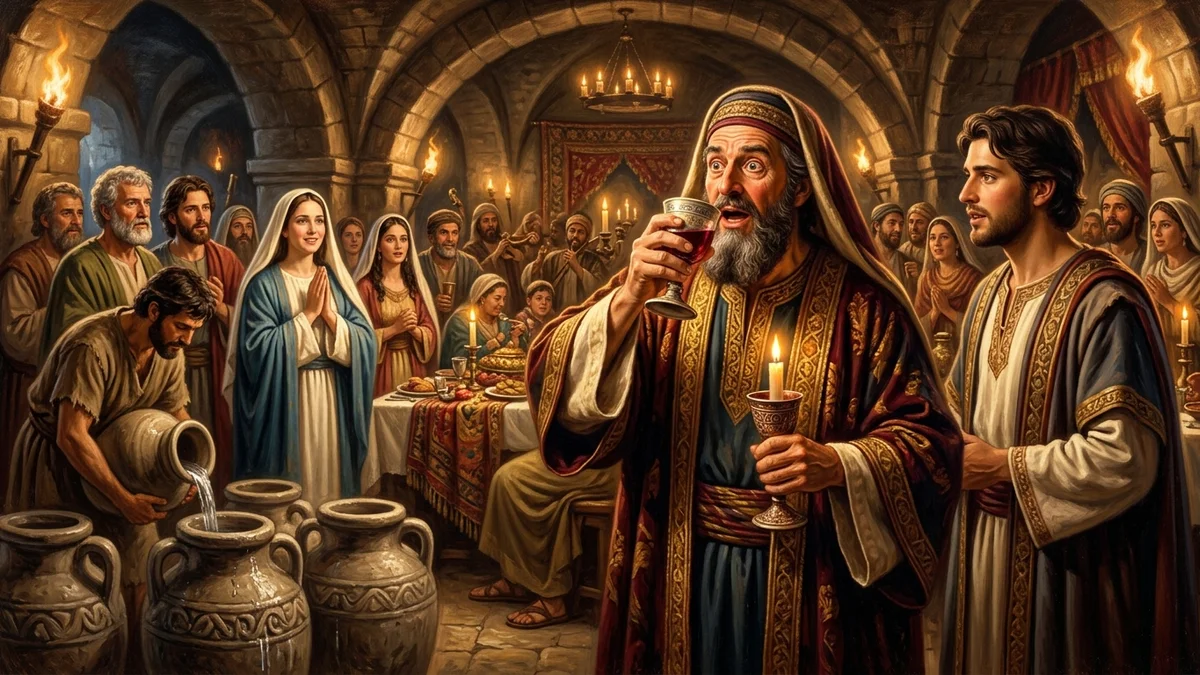 Fine-art depiction of the banquet toastmaster (architriklinos) tasting the goblet of miraculous wine in astonished disbelief, while Mary and the disciples observe the manifestation of Christ's glory.
4. Six Stone Jars: From Shadow to Substantial Grace
John records an extraordinary detail that unlocks the rich covenant symbolism of the miracle:
"Now there were set there six waterpots of stone, according to the manner of purification of the Jews, containing twenty or thirty gallons apiece." (John 2:6; Greek: ēsan de ekei lithinai hydriai hex).
Why did John emphasize that these jars were carved of stone? Under first-century Jewish Levitical purity laws (elaborated in the Mishnah tractate Kelim), porous terracotta clay vessels absorbed ceremonial impurities and, if defiled by contact with an unclean object or creeping thing, had to be completely shattered (Leviticus 11:33). Stone vessels, however, were completely immune to ritual uncleanness. Wealthy Galilean households used massive carved limestone jars to store water for the mandatory ritual hand-washings demanded by Pharisaic tradition before every meal.
Notice the numbers: Six is the biblical number of man and imperfection—one short of seven, the number of divine completion. These six jars represented the Old Covenant sacrificial and ceremonial system: cold, external, repetitive, and unable to permanently cleanse the human conscience from sin (Hebrews 10:1–4). They held between two and three metrētas each (approximately 20 to 30 gallons), totaling between 120 and 180 gallons!
Jesus looked upon the servants and gave a simple, direct command:
"Jesus said to them, 'Fill the waterpots with water.' And they filled them up to the brim." (John 2:7).
The servants hauled hundreds of pounds of water from the local village well, pouring bucket after bucket into the massive limestone mouths until the water lapped against the stone rims. John notes they filled them "up to the brim" (Greek: heōs anō)—a vital detail proving there was no physical space remaining for anyone to secretly add concentrated grape syrup, fermented wine, or human additives. It was pure, unadulterated water.
5. Instantaneous Molecular Creation
Then came the moment of quiet, effortless omnipotence:
"And He said to them, 'Draw some out now, and take it to the master of the feast.' And they took it." (John 2:8).
Notice what Jesus did NOT do: He chanted no incantations; He waved no hands; He touched no jars; He made no theatrical gestures. As Saint Augustine eloquently observed centuries later: "The One who each year turns rain into wine through the slow growth of the grapevine and the pressing of grapes, did in a single second at Cana what He normally does in nature over months."
Between the dipping of the ladle into the stone jar and the presentation of the cup to the banquet manager, the molecular structure of plain H2O obeyed the silent thought of its Creator. Complex organic sugars, rich tannins, anthocyanin pigments, and aged aromatic esters materialized out of nothing. The Creator bypassed the vine, the soil, the sun, the harvest, the winepress, and years of subterranean cellar fermentation in a single pulse of sovereign will!
6. The Verdict of the Architriklinos: The Best Wine Saved Until Now
The servants carried the brimming goblet to the architriklinos—the master of the feast, a distinguished guest appointed to oversee dining etiquette and evaluate food quality:
"When the master of the feast had tasted the water that was made wine, and did not know where it came from (but the servants who had drawn the water knew), the master of the feast called the bridegroom. And he said to him, 'Every man at the beginning sets out the good wine, and when the guests have well drunk, then the inferior. You have kept the good wine until now!'" (John 2:9-10).
The banquet manager was astonished. In ancient banquet customs, hosts followed a predictable pattern: they served their finest, most expensive vintage at the start when palates were sharp and sober; later in the week, when guests' senses were dulled, they substituted cheap, diluted wine.
Yet the wine Christ created was not watered-down plonk; it was a peerless, vintage masterpiece of supernatural quality! The world offers its best pleasures first—glitz, glamour, excitement—followed by the bitter hangover of guilt, addiction, emptiness, and death. But Jesus Christ saves His best for last: after repentance and the cross comes eternal joy, the resurrection body, and the unending glory of the Messianic banquet!
7. The Beginning of Signs: Glory Revealed
John concludes this historic event with a profound theological declaration:
"This beginning of signs Jesus did in Cana of Galilee, and manifested His glory; and His disciples believed in Him." (John 2:11; Greek: archēn tōn sēmeiōn... ephanerōsen tēn doxan autou).
John does not call this an act of magic; he calls it the beginning of signs (archē tōn sēmeiōn). A sign is a finger pointing to a greater reality. Moses' first sign in Egypt was turning water into blood—a sign of divine judgment and death upon Pharaoh's kingdom (Exodus 7:20). Christ's first sign was turning water into wine—a sign of grace, abundance, joy, and the inauguration of the New Covenant!
By providing over 150 gallons of royal wine, Jesus demonstrated the lavish, super-abounding generosity of God's grace. In Christ, the cold, empty stone jars of external ritualism are forever replaced by the living wine of the Holy Spirit. In that dusty village of Cana, the King unveiled His glory, and the faith of His disciples was permanently anchored in the Son of the Living God!
Biblical Keywords & Theological Roots
A sign, miracle with deep spiritual significance, or divine fingerprint verifying supernatural credentials and authenticating the Messiah.
Master of the feast, toastmaster, banquet director; from arche (chief) and triklinos (three-couch dining room arrangement).
Water pot, large stone jar or amphora designed to hold water for ceremonial purification rituals.
A measure, liquid amphora volume unit equivalent to approximately 8.5 to 10 gallons (38 to 40 liters).
Ancient Near Eastern & Archaeological Context
Cana of Galilee (identified with Khirbet Qana, 9 miles north of Nazareth) was a quiet agricultural village nestled along the rolling limestone hills of lower Galilee. First-century Jewish weddings were landmark community events celebrating the covenant union of families, spanning five to seven days of non-stop hospitality. In ancient honor-shame cultures, running out of wine was an irreparable social catastrophe that humiliated the groom and could result in legal lawsuits from the bride's family for breach of marriage contract. Six massive limestone jars stood in the home, chosen specifically because stone, according to Rabbinic halakhah (Mishnah Kelim), never absorbed ritual uncleanness, guaranteeing pure water for the ceremonial hand-washing mandated by Pharisaic tradition.
Support Independent Biblical Research
Did this study bless you? Help support our independent bilingual research and interactive visual Bible tools.
⚡ Fast Facts
- In ancient Jewish society, wedding festivities lasted seven full days; running out of wine was considered a catastrophic breach of hospitality that exposed the bridegroom's family to public humiliation and even legal liability
- Under Jewish Levitical law (Mishnah Kelim), stone vessels were unique because they could never contract ritual uncleanness, unlike porous clay pottery which had to be shattered if defiled
- The six stone jars held between two and three 'metretas' each (approx. 20 to 30 gallons), yielding a staggering total of 120 to 180 gallons (nearly 700 to 900 modern bottles) of premium wine
- The Greek term 'architriklinos' refers to the master of the feast or symposium banquet manager, an esteemed guest or professional toastmaster responsible for dining logistics
❓ Frequently Asked Questions (FAQs)
In modern English, 'Woman' sounds curt or disrespectful, but in ancient Koine Greek and Semitic culture, 'Gynai' was a title of deep, aristocratic respect and affection—similar to addressing a royal lady as 'Milady' or 'Madam'. Jesus used this same respectful address from the cross when entrusting Mary to the Apostle John (John 19:26). Prophetically, it echoed the 'woman' of Genesis 3:15, indicating that in His public Messianic office, Jesus was governed solely by His heavenly Father rather than maternal authority.
The six stone jars were specifically reserved for Jewish ritual hand-washing and purification rites (*katharismos*). By taking water destined for external, repetitive, burdensome Old Covenant cleansing rituals and transforming it into the vibrant, joy-giving wine of the wedding feast, Jesus dramatized that the era of external ceremonial washings was passing away. He was ushering in the New Covenant of internal transformation, abundant grace, and the joy of the Messianic banquet (Jeremiah 31:31–34; Amos 9:13).
The Gospel of John uniquely organizes Christ's public ministry around seven foundational 'signs' (*sēmeia*). A sign is not a mere spectacular magic trick designed to amaze crowds; it is a theological pointer revealing the identity, authority, and divine nature of Jesus Christ. Transforming water into aged vintage wine demonstrated Christ's absolute mastery over time, chemistry, and organic matter, revealing Him as the Creator who manifests the glory of God.