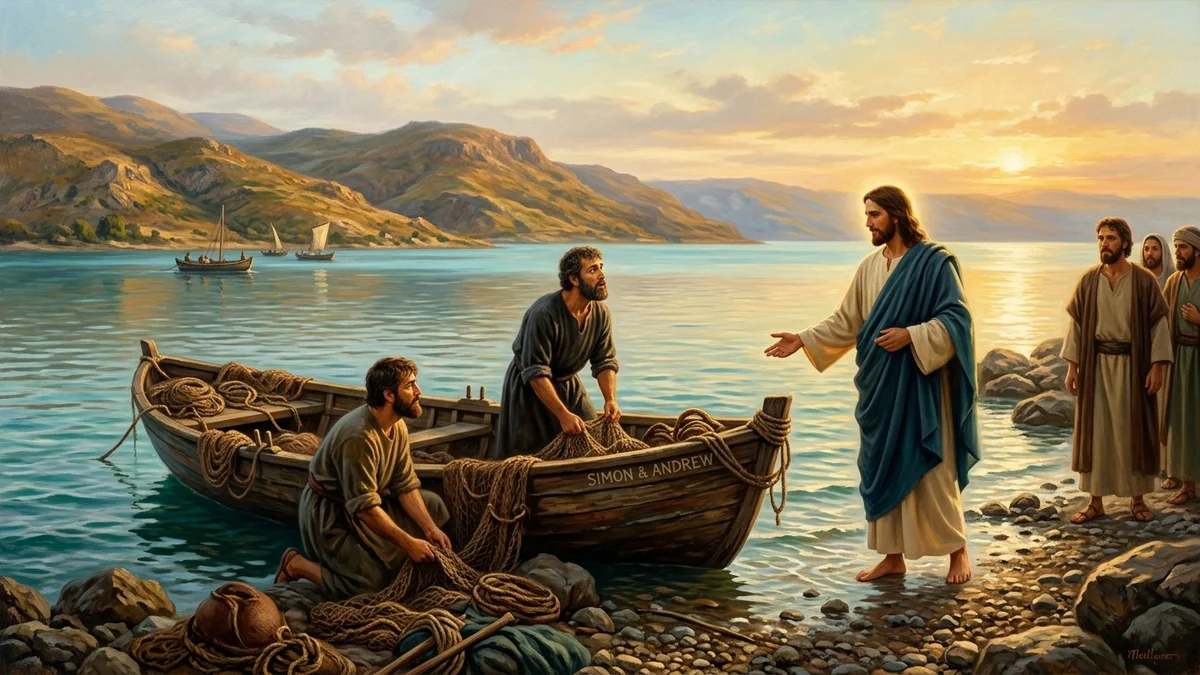
The mist hung heavy over the azure waters of Lake Gennesaret as dawn fractured the eastern peaks of the Golan Heights. Along the pebbled shore of Capernaum, the rhythmic slap of freshwater waves against timber hull was accompanied by a heavier, more discouraging sound: the weary sigh of exhausted workingmen. Four seasoned Galilean fishermen—Simon Peter, his brother Andrew, and their business partners James and John—dragged their soaked, heavy hemp nets onto the shingle. Their muscles throbbed with ache; their calloused palms were raw from hours of hauling cordage through freezing water. They had labored through the entirety of the nocturnal watch, scanning the dark swells under torchlight, casting and dragging again and again. Yet when morning cracked the horizon, their wicker storage baskets remained empty. Their fuel was burned, their nets fouled with lake weed, their business ledger written in red ink. Then, out of the gathering morning light, a young Rabbi arrived, followed by a burgeoning, eager crowd!
1. The Crowded Shore and the Carpenter’s Pulpit
Luke sets the dramatic scene with journalistic precision: "So it was, as the multitude pressed about Him to hear the word of God, that He stood by the Lake of Gennesaret, and saw two boats standing by the lake; but the fishermen had gone from them and were washing their nets" (Luke 5:1-2).
The crowds pressing around Jesus were spiritually ravenous. Having witnessed His authoritative teaching in the Capernaum synagogue and His supernatural power over sickness and demons, people from every Galilean hamlet swarmed the shore. The sheer physical pressure of the crowd threatened to push the Teacher into the water.
With brilliant acoustic and practical ingenuity, Jesus approached the empty boat belonging to Simon. Stepping over the low gunwale, He asked Simon to "put out a little from the land" (Luke 5:3). Simon, bleary-eyed and desperate to finish cleaning weed from his nets and sleep before the next night's shift, nevertheless complied. He pushed off the wooden skiff with an oar, letting it drift about twenty yards from the pebbled strand.
There, seated in the rocking boat, Christ created a natural acoustic amphitheater. The smooth surface of the calm freshwater acted as a parabolic reflector, amplifying His rich, resonant voice so that thousands lining the sloped shoreline could hear every syllable of the Gospel of the Kingdom without distortion. For an hour or more, the tired fishermen sat at His feet, captive to the living Word of God.
2. The Outrageous Command: Epanagage eis to Bathos
When the public sermon concluded, Jesus turned His attention from the masses on the shore to the broken heart of the solitary fisherman sitting beside Him. Luke records the moment that tested the core of Peter's worldview:
"When He had stopped speaking, He said to Simon, 'Launch out into the deep and let down your nets for a catch.'" (Luke 5:4; Greek: Epanagage eis to bathos).
To an experienced Galilean boat captain, this command seemed completely absurd. First, Jesus was an artisan carpenter from the landlocked inland hill country of Nazareth—what did He know about the specialized trade of deep-water gill-net fishing? Second, it was broad daylight; in the crystalline waters of the northern lake, fish would easily spot the dark linen mesh of the nets and flee. Third, Peter and his crew had just spent the entire night—the optimal feeding window for Galilean tilapia (*Sarotherodon galilaeus*)—sweating in vain.
Simon’s initial response reveals the raw friction between human professional logic and divine sovereignty:
"Master, we have toiled all night and caught nothing..." (Luke 5:5; Greek: Epistata, di' holēs tēs nyktos kopiasantes ouden elabomen).
The Greek word Peter uses for "toiled" is kopiasantes, meaning labor to the point of utter, bone-crushing exhaustion. Simon was essentially saying: "We are professionals. We know every current, every feeding ground, every depth of this lake. If there were fish to be caught, we would have caught them. Human expertise has completely failed."
Then came the pivotal pivot upon which the history of the early Church swung:
"...nevertheless at Your word I will let down the net!" (Luke 5:5; Greek: epi de tō rhēmati sou chalaso to diktyon).
Peter subordinated his professional pride, his physical fatigue, and his nautical common sense to the simple, naked authority of the Word of Christ. True faith does not begin when circumstances are favorable; it begins at the boundary where human capability ends and God speaks!
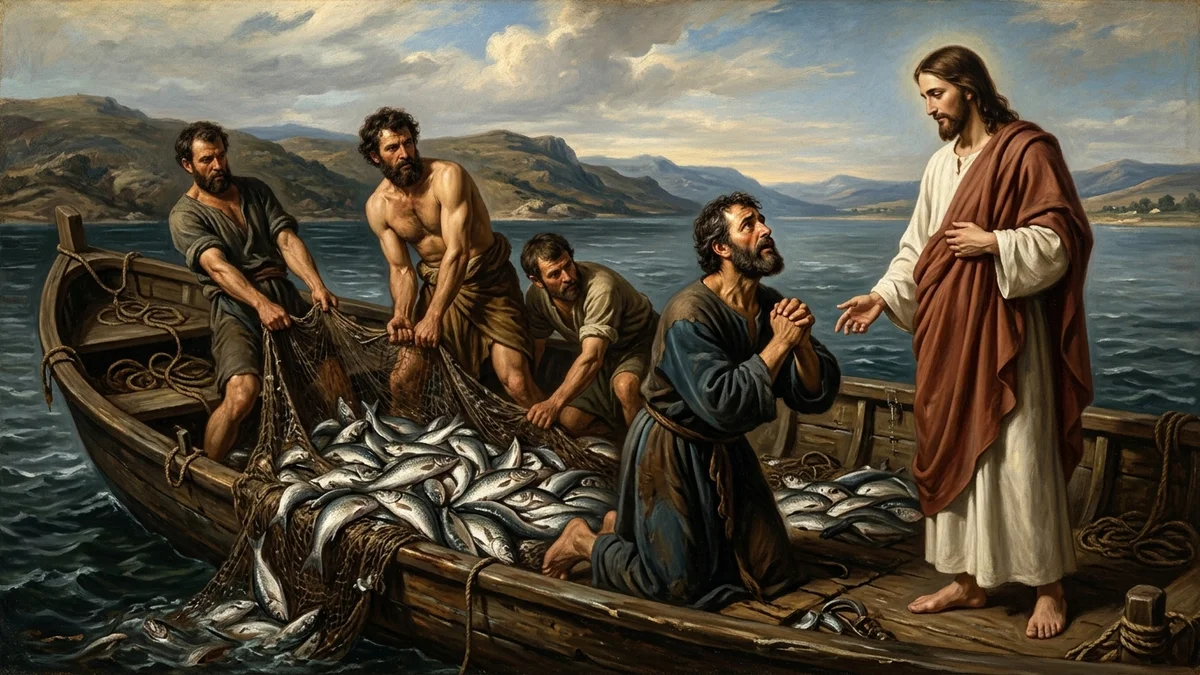 Fine-art depiction of Simon Peter falling prostrate at the knees of Jesus Christ amid overflowing nets bursting with glistening fish upon the Sea of Galilee.
3. The Rupturing Nets and Sinking Boats
Simon gripped the heavy cedar oars, pulling into the deep channel between Capernaum and the mouth of the upper Jordan River. The crew threw the heavy casting net over the side, letting the lead weights drag the linen webbing down into the green depths. What happened next shattered every law of nature:
"And when they had done this, they caught a great number of fish, and their net was breaking. So they signaled to their partners in the other boat to come and help them. And they came and filled both the boats, so that they began to sink." (Luke 5:6-7).
The Greek verb Luke employs for "breaking" is dierrēsseto—an imperfect passive meaning the thick braided cordage was actively tearing under an astronomical, unmanageable mass. The sea beneath the boat was churning white with thousands of thrashing silver scales.
Frantic and shouting over the splashing water, Simon waved wildly to James and John, whose boat was anchored near the shore. Rowing at full speed, the sons of Zebedee pulled alongside. Muscular arms strained as four men hoisted net load after net load over the gunwales. Glistening fish spilled across the cedar floorboards, burying feet, filling bilges, and piling higher and higher until the gunwales dropped to the water line. Both twenty-seven-foot wooden vessels began to list and sink under the sheer tonnage of supernatural bounty!
The One who had spoken the oceans into existence in Genesis 1 had silently commanded the shoals of the sea to swim into the waiting net. The fish were not merely caught; they were summoned by their Creator!
4. Exelthe Ap' Emou: The Cry of Unworthiness
Any ordinary merchant, seeing such a commercial jackpot, would have calculated profits, cheered with laughter, and hurried to market. But Simon Peter was not an ordinary merchant. He was a man suddenly confronted with the blinding holiness of the Living God.
Luke records the breathtaking theological turning point:
"When Simon Peter saw it, he fell down at Jesus' knees, saying, 'Depart from me, for I am a sinful man, O Lord!'" (Luke 5:8; Greek: Exelthe ap' emou, hoti anēr hamartōlos eimi, Kyrie).
Notice the shift in Peter's vocabulary. In verse 5, Peter called Jesus Epistata—"Master" or respectful Rabbi. But here, knee-deep in slippery fish and sloshing lake water, Peter fell prostrate and called Him Kyrios—"Lord", the title reserved for Yahweh Himself!
Peter’s reaction mirrors the great theophanies of the Old Testament. When the prophet Isaiah caught a glimpse of Adonai enthroned in the temple, he did not rejoice; he cried: "Woe is me, for I am undone! Because I am a man of unclean lips!" (Isaiah 6:5). When Job encountered the Almighty in the whirlwind, he declared: "I abhor myself, and repent in dust and ashes" (Job 42:6).
The miraculous abundance of fish did not make Peter feel rich; it made him feel utterly spiritually bankrupt. Standing before the pure, omniscient Creator who commanded the unseen creatures of the deep, Peter's hidden compromises, coarse speech, impatient temper, and moral failures stood naked under divine light. He felt entirely unfit to share the same wooden boat with the Holy One of Israel!
5. From Fishing Fish to Catching Men Alive
Jesus did not recoil from the trembling, weeping fisherman. He looked down upon Simon with eyes brimming with sovereign grace and spoken words that reoriented the course of world history:
"Do not be afraid. From now on you will catch men." (Luke 5:10; Greek: Mē phobou; apo tou nyn anthrōpous esē zōgrōn).
The Greek phrase Jesus chose is exquisitely profound: anthrōpous esē zōgrōn. The participle zōgrōn is derived from zōos ("alive") and agreuo ("to capture"). It literally means "to capture people alive for life!"
Consider the divine inversion: In secular fishing, live fish are pulled out of their natural watery element and brought onto the shore to die and be consumed. But in Christ’s apostolic fishery, dying humans drowning in the stormy, dark, toxic waters of sin and death are hauled up into the boat of salvation and brought into the sunlight of the Kingdom to be granted eternal life!
Jesus was saying: "Simon, you have spent your life mastering the art of the net—patience, vigilance, teamwork, enduring stormy nights, and knowing where the currents run. I will not waste those gifts. I am redeeming them. You will no longer drag fish to the marketplace; you will cast the gospel net across nations and pull drowning souls into the eternal Kingdom of God!"
6. Leaving All: The Cost and Glory of Discipleship
Luke concludes this apostolic commission with a verse of breathtaking simplicity and total surrender:
"So when they had brought their boats to land, they forsook all and followed Him." (Luke 5:11).
Think of what "forsaking all" meant in practical, economic terms. They had just secured the single greatest catch of their commercial careers. Those two sinking boatloads represented weeks, perhaps months, of revenue. The boats, the nets, the family trade inherited from their fathers, their security, their homes in Capernaum—they walked away from it all at the edge of the water.
They did not ask for signed employment contracts, guaranteed pensions, or detailed travel itineraries. When they looked into the eyes of Jesus, all the wealth of Galilee became like chaff. They left their nets behind because they had found the Pearl of Great Price.
From that morning by the Sea of Galilee, these unlettered, rough-hewn fishermen embarked on an odyssey that would shake the foundations of the Roman Empire. Within three short years, the very Simon Peter who fell weeping in the fish-slime of this boat would stand at Pentecost in Jerusalem, cast the Gospel net before thousands of listeners, and haul three thousand souls alive into the Kingdom in a single afternoon (Acts 2:41). The call of Christ still rings across the waters of the human soul today: "Follow Me, and I will make you fishers of men!"
Biblical Keywords & Theological Roots
Fishermen, mariners of the sea; used literally of commercial net-casters and figuratively of evangelists catching human souls.
To catch or take alive, from zoos (alive) and agreuo (to catch); capturing men not for death, but to rescue them for eternal life.
To put out to sea, to launch out into the deep waters away from the shallow shoreline.
Imperfect passive of diarrhesso: 'were beginning to burst or tear asunder' under the unbearable weight of the catch.
Ancient Near Eastern & Archaeological Context
First-century fishing around the Sea of Galilee was a lucrative, highly regulated imperial enterprise managed under royal Herodian tax syndicates. Fishermen like Simon Peter, Andrew, James, and John operated family partnerships (koinonoi) utilizing double-ended wooden rowing-and-sailing boats equipped with large linen casting-nets (amphiblestron) and heavy drag-nets (sagene). Roman officials taxed boats, fishing territories, catches, and salt-cured fish processed at Magdala (Taricheae). To abandon boats, nets, and curing facilities meant walking away from established financial independence and family business inheritances to embrace complete reliance on Jesus.
Support Independent Biblical Research
Did this study bless you? Help support our independent bilingual research and interactive visual Bible tools.
⚡ Fast Facts
- The Sea of Galilee (Yam Kinneret / Lake Gennesaret) sits approximately 700 feet below sea level, fed by freshwater springs and the snowmelt of Mount Hermon
- Peter and Andrew operated a commercial fishing cooperative alongside James and John, the sons of Zebedee, who employed hired day laborers (Mark 1:20)
- The phrase 'you will catch men' (Luke 5:10) uses the rare Greek compound 'anthrōpous esē zōgrōn', meaning literally 'capturing people alive for life and salvation'
- Archaeologists excavated a first-century Galilean wooden fishing boat near Gennesaret in 1986, measuring 27 feet long and 7.5 feet wide, constructed of cedar and oak
❓ Frequently Asked Questions (FAQs)
The Gospels describe a progressive discipleship relationship. John 1:35–42 records their initial spiritual introduction at the Jordan River through John the Baptist, where Simon was introduced to Jesus as Messiah and named Cephas. Afterwards, the disciples returned to Galilee and resumed their commercial fishing trade. Luke 5 (parallel to Matthew 4:18–22) records the subsequent, definitive life-call to abandon secular trade and follow Christ in full-time apostolic ministry.
Night fishing was the established industry standard in antiquity. In daylight, the crystalline mountain waters of Galilee made linen gill-nets easily visible to shoals of Musht (St. Peter's fish) and tilapia, which avoided them. At night, fish rose to feed near the water's surface, unable to detect the dark nets. Fishing all night and catching nothing signified total exhaustion and an empty business ledger.
Peter's reaction was not rejection, but the classic biblical response to a raw theophany—a manifestation of holy deity. Just as Isaiah cried 'Woe is me, for I am undone!' in the heavenly temple (Isaiah 6:5), Peter suddenly perceived that this gentle Galilean preacher possessed divine sovereignty over the hidden depths of the sea. Standing before unblemished holiness, Peter's own sinful unworthiness was exposed, producing reverent trembling.