Spring had arrived in the Judean hill country, and with it came the roaring, pulsing tide of the Passover pilgrimage. Roads leading from Galilee, Alexandria, Antioch, Rome, and Babylon were packed with singing caravans chanting the ancient Songs of Ascents. The city of Jerusalem groaned under the weight of three hundred thousand pilgrims. For three years, Jesus of Nazareth had walked the dusty roads of Galilee as an unassuming carpenter. Now, for the first time in His public Messianic ministry, He ascended Mount Moriah, passing through the massive Huldah Gates of the Temple Mount. He came not merely as an ordinary pilgrim carrying a sacrificial lamb, but as the sovereign Lord suddenly appearing in His own sanctuary, exactly as the prophet Malachi had thundered four centuries earlier: "And the Lord, whom you seek, will suddenly come to His temple... But who can endure the day of His coming? And who can stand when He appears? For He is like a refiner's fire!" (Malachi 3:1-2). What met His gaze in the sacred courts made the holy blood of the Son of God boil with incandescent indignation!
1. The Desecration of the Court of the Gentiles
John records the tragic scene with unsparing realism: "Now the Passover of the Jews was at hand, and Jesus went up to Jerusalem. And He found in the temple those who sold oxen and sheep and doves, and the money changers doing business." (John 2:13-14).
To comprehend why Christ reacted with such dramatic, violent zeal, one must visualize the architectural and spiritual layout of Herod’s magnificent Temple Mount. Enclosed by massive limestone retaining walls—some stones weighing over four hundred tons—the Temple complex was designed in concentric zones of increasing holiness: the Holy of Holies, the Holy Place, the Court of the Priests, the Court of Israel, and the Court of Women.
Encircling all these inner sacred courts lay the vast, sprawling Court of the Gentiles—a magnificent thirty-five-acre paved terrace flanked by towering marble colonnades known as Solomon’s Porch and the Royal Stoa.
This outer court was of monumental theological significance. It was the ONLY place in the entire sanctuary where non-Jewish foreigners, God-fearers, and truth-seekers from the pagan nations were permitted to enter, bow their faces to the earth, and seek the true God of Israel in quiet prayer and contemplation. It was the architectural embodiment of God's promise to Abraham that through his seed "all nations of the earth shall be blessed", and the fulfillment of Isaiah's soaring prophecy: "For My house shall be called a house of prayer for ALL NATIONS!" (Isaiah 56:7).
Yet what had the religious leadership done to this sacred international house of prayer? Under the direct authorization of the corrupt former High Priest Annas and his wealthy Sadducean syndicate, the entire Court of the Gentiles had been converted into a deafening, reeking, chaotic commercial livestock market and stock exchange! The sacred silence required for prayer was obliterated by the braying of donkeys, the terrified lowing of oxen, the bleating of sheep, the stench of animal manure baking in the spring sun, and the relentless haggling and cursing of greedy vendors. The only court designed to draw the nations to God was completely choked with human greed.
2. The Extortion of the High-Priestly Syndicate
The religious commerce taking place in the temple was not an innocent service for pilgrims; it was an organized, predatory extortion racket.
Every adult Jewish male was required by Exodus 30:13–16 to pay the annual half-shekel temple tax for the upkeep of the sanctuary. But Roman denarii, Greek drachmas, and provincial coins bore the engraved profiles of pagan emperors and blasphemous inscriptions proclaiming Caesar as divine. Because pagan coins were forbidden in the sacred treasury, pilgrims were forced to exchange their foreign currency for the official silver half-shekel of Tyre, which possessed high silver purity and no human emperor's face.
The money changers (Greek: kollybistai) operating the tables charged an exorbitant transaction fee—often up to 12 to 15 percent of the total value. A poor peasant pilgrim from Galilee or Egypt was gouged of his hard-earned savings just to convert his money into acceptable temple currency.
Even worse was the livestock monopoly. Jewish law required sacrificial animals to be without blemish (Leviticus 22:19–21). Temple inspectors (appointed by Annas) systematically examined any animals brought from home by pilgrims, virtually always finding some minute, fabricated flaw that disqualified the animal. The brokenhearted worshipper was then forced to purchase an pre-approved animal from the stalls controlled by the High Priest’s family—at prices inflated up to four to five times normal market value! The Talmud itself preserves an ancient lament condemning this corrupt dynasty: "Woe to the house of Annas! Woe to their serpent hiss! For they are high priests, their sons are treasury keepers, their sons-in-law are trustees, and their servants beat the people with staves!" (Pesachim 57a).
3. The Whip of Cords: Sovereign Righteous Zeal
Jesus did not react with a spontaneous, out-of-control temper tantrum. His actions were deliberate, sovereign, and deeply liturgical. John records a detail of supreme importance:
"When He had made a whip of cords, He drove them all out of the temple, with the sheep and the oxen, and poured out the changers' money and overturned the tables." (John 2:15; Greek: poiēsas phragellion ek schoinion).
Notice: Jesus did not instantly explode in fury. He bent down and gathered pieces of rush and hemp rope lying discarded on the pavement—cords originally used by cattle merchants to tether livestock. Slowly, methodically, He braided those rough fibers together into a three-cord whip (Greek: phragellion). Every knot tied in that rope was a deliberate, controlled act of holy preparation!
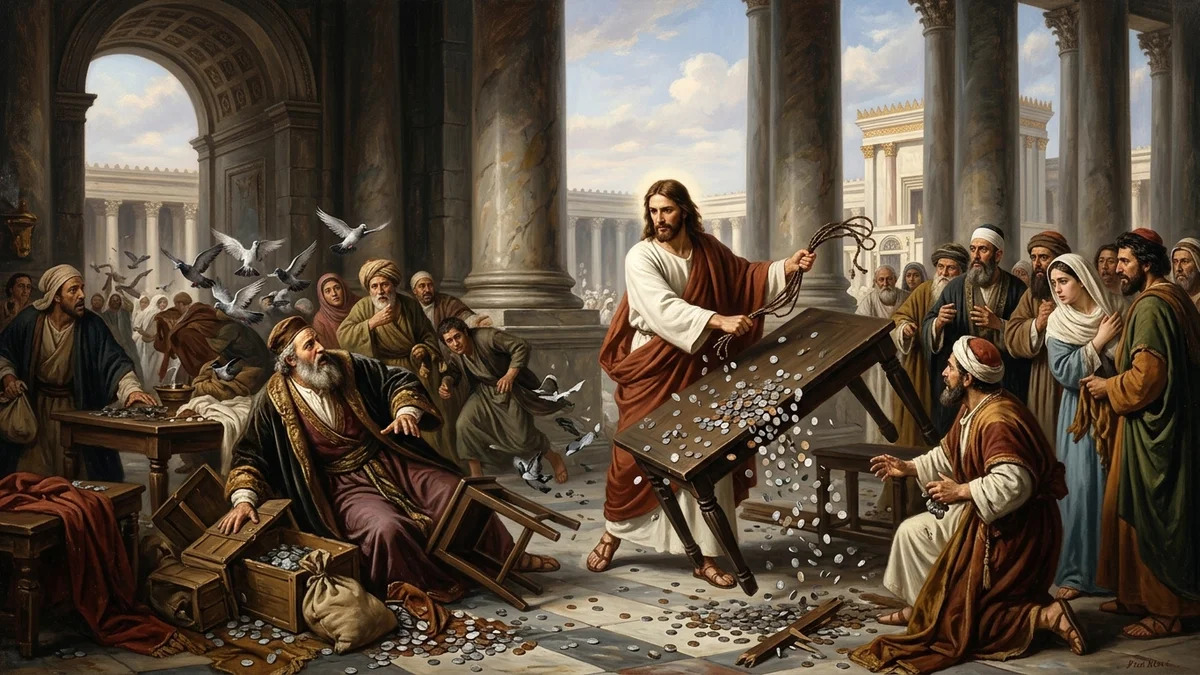
Then, with the majesty of the Lion of Judah, Christ moved across the marble courtyard. His eyes blazed with the pure, uncreated fire of divine holiness. Stepping up to the heavy, wooden transaction tables where stacks of silver Tyrian shekels, bronze lepton, and Roman denarii sat, Jesus gripped the edges and thrust upward!
Tables crashed upside down. Heavy wooden legs shattered against the stone pavement. Thousands of silver and bronze coins showered across the courtyard like a metallic rainstorm, rolling into stone crevices, bouncing down marble steps, and scattering into the crowd. Strongboxes overturned, spilling piles of currency into the dust.
Raising the whip of cords, Jesus drove the livestock forward. He did not whip innocent people, but cracked the cords through the air to drive the heavy oxen and panic-stricken sheep through the colonnades and out the massive gates, liberating the animals from their commercial pens. The corrupt merchants, stunned and terrified by the unearthly authority radiating from this solitary Prophet, scrambled and fled before His face!
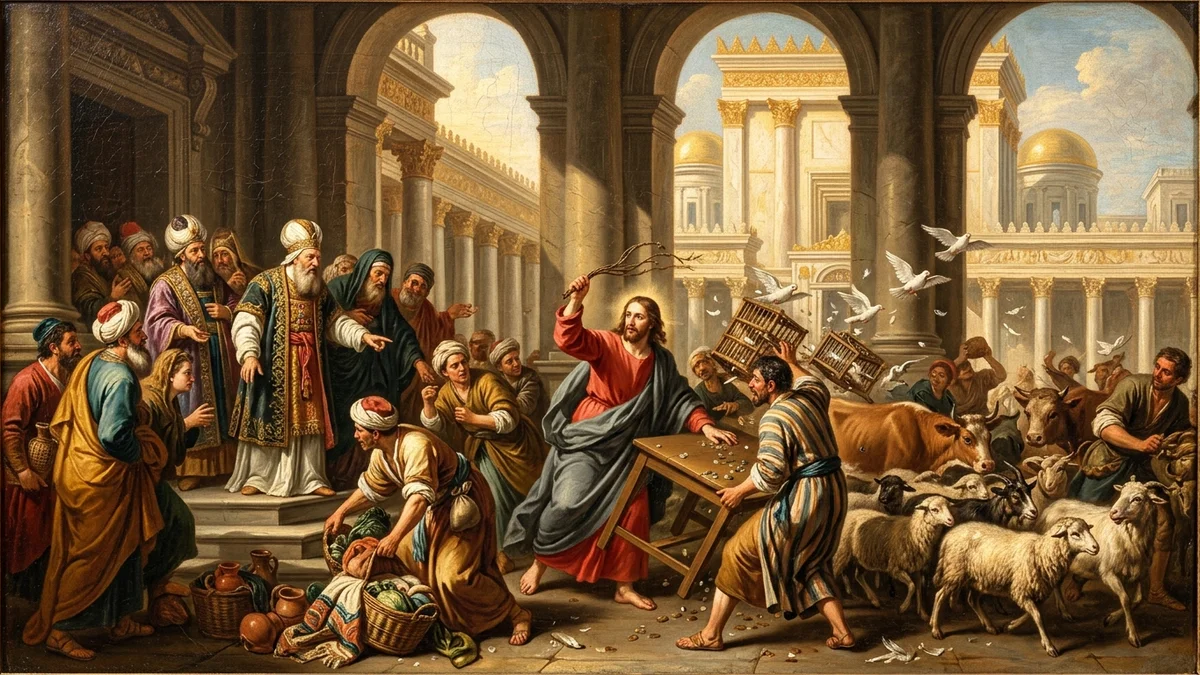 Dramatic fine-art depiction of Jesus Christ cleansing the Court of the Gentiles, overturning the money changers' tables and driving out livestock with holy apostolic zeal.
4. Take These Things Away: The House of Prayer Restored
Notice Christ's exquisite discrimination and justice even in the midst of holy judgment. When He came to the merchants selling doves—the sacrifice reserved by Leviticus 12:8 for the poorest widows and destitute worshippers—He did not smash their cages or let the birds fly away to be lost to their owners:
"And He said to those who sold doves, 'Take these things away! Do not make My Father's house a house of merchandise!'" (John 2:16; Greek: mē poieite ton oikon tou patros mou oikon emporiou).
With sovereign authority, Jesus commanded the dove merchants to pick up their wicker baskets and leave. Notice the title He used: "My Father's house!" He did not say "our Father's house", nor did He refer to it as the people's sanctuary. He stood as the Son who holds divine ownership over the estate.
The word Jesus used for "merchandise" is emporion, from which we derive the word "emporium." They had taken the glorious meeting place between holy God and sinful humanity and transformed it into a vulgar shopping mall!
As the dust settled and the echoes of rolling coins faded, an uncanny silence gripped Mount Moriah. Disciples who stood watching with beating hearts experienced a sudden revelation from the Hebrew scriptures:
"Then His disciples remembered that it was written: 'Zeal for Your house has eaten Me up.'" (John 2:17; citing Psalm 69:9; Greek: Ho zēlos tou oikou sou kataphagetai me).
The disciples recognized in Christ’s incandescent passion the fulfillment of King David's Messianic lament. The word "zeal" (zēlos) comes from a root meaning to boil or seethe with intense heat. Christ’s love for the purity of God’s dwelling was an all-consuming fire—a fire that would eventually provoke the hatred of the religious establishment and consume His own mortal life upon the cross!
5. Destroy This Temple: The Prophecy of the Resurrected Body
The Temple police and Sanhedrin officers, finally regaining their composure, rushed forward. But notice: they did not dare arrest Him on the spot! The moral majesty of Christ’s action was so self-evidently righteous that the conscience of the watching crowd was entirely on His side. Instead, the religious leaders demanded a legal justification for His unilateral action:
"So the Jews answered and said to Him, 'What sign do You show to us, since You do these things?'" (John 2:18; Greek: Ti sēmeion deiknyeis hēmin).
They were asking: "By whose authority do You act as Supreme Inspector of the Temple? Prove Your divine mandate with a supernatural sign from heaven!"
Jesus looked upon the grand limestone porticoes, the golden vine over the sanctuary door, and the massive ashlar blocks that gleamed like a mountain of snow under the spring sun, speaking the immortal riddle of the Gospel:
"Jesus answered and said to them, 'Destroy this temple, and in three days I will raise it up.'" (John 2:19; Greek: Lysate ton naon touton, kai en trisin hēmerais egerō auton).
The Jewish leaders laughed with contemptuous mockery:
"Then the Jews said, 'It has taken forty-six years to build this temple, and will You raise it up in three days?'" (John 2:20).
Herod the Great had begun his monumental reconstruction of the Temple complex in 20/19 BC. By the spring of AD 27/28, exactly forty-six years of continuous masonry labor had elapsed, and the outer colonnades were still being completed! To the earthly, literalistic minds of the Sanhedrin, Christ’s claim sounded like insane megalomania.
Yet John pulls back the veil with crystalline clarity:
"But He was speaking of the temple of His body." (John 2:21; Greek: Ekeinos de elegen peri tou naou tou sōmatos autou).
Notice the Greek distinction: The leaders used the word hieron, which referred to the entire physical Temple complex with its courtyards and walls. But Jesus used the word naos—the inner Holy of Holies, the direct dwelling place of the Shekinah glory!
Christ was proclaiming the dawn of an entirely new spiritual reality: The physical stone building on Mount Moriah was merely a temporary architectural shadow. The true, living, eternal Temple—where unblemished holiness dwells in human flesh, where the blood of atonement is offered, and where God reconciles humanity to Himself—is the person of Jesus Christ!
Jesus invited His enemies: "Go ahead. Crush this body on the anvil of Calvary. Pierce its hands and feet. Lay it dead in the cold limestone garden tomb. But on the third day, by the sovereign power of the living God, I will raise it up!"
6. The True Discerning of the Human Heart
John concludes this historic Passover encounter with a profound postscript on faith and discernment:
"Now when He was in Jerusalem at the Passover, during the feast, many believed in His name when they saw the signs which He did. But Jesus did not commit Himself to them, because He knew all men, and had no need that anyone should testify of man, for He knew what was in man." (John 2:23-25).
Crowds marveled at His miraculous signs, but Jesus refused to entrust Himself to superficial, sensation-seeking popularity. The word for "commit" is the same Greek root as "believe" (episteuen). They believed in Him superficially, but He did not believe in their shallow loyalty. He saw past outward religious smiles and flattering words, piercing straight into the secret motives of the human heart.
The cleansing of the Temple was a prophetic declaration that God will not tolerate counterfeit religion, commercialized spirituality, or barriers that block seeking souls from finding divine grace. Today, the Holy Spirit has made the bodies of believers the temple of the Living God (1 Corinthians 6:19). Christ still comes with loving, purifying zeal into our lives—to overturn the tables of worldly compromise, cleanse our hearts from spiritual greed, and restore our souls into true, unhindered houses of prayer!
Biblical Keywords & Theological Roots
A scourge or whip made of cords; derived from the Latin flagellum, fashioned by Jesus from tethering ropes in the temple.
A money changer or small-coin broker who exchanged foreign currencies for the sacred Tyrian temple tax shekel for a steep commission.
A market place, commercial bazaar, or emporium; turning the house of prayer into a greedy merchandise exchange.
Zeal, fervent jealousy, deep moral indignation burning like a consuming fire for God's holy honour (Psalm 69:9).
Ancient Near Eastern & Archaeological Context
Passover (Pesach) drew hundreds of thousands of Jewish and proselyte pilgrims from across the Mediterranean basin to Jerusalem, swelling the city's population from 50,000 to over 300,000. Under Mosaic law, every adult male had to present an unblemished sacrificial lamb, kid, or ox, and pay the annual half-shekel temple tax (Exodus 30:13). The reigning High Priest Annas (and his son-in-law Caiaphas) turned this religious requirement into an extortionate monopoly. Inside the vast 35-acre Court of the Gentiles—surrounded by Solomon's Porch and the Royal Stoa—they operated the 'Bazaars of the Sons of Annas'. Corrupt temple inspectors disqualified animals brought from home, forcing pilgrims to buy livestock from high-priestly stalls at inflated prices up to four times market value.
Support Independent Biblical Research
Did this study bless you? Help support our independent bilingual research and interactive visual Bible tools.
⚡ Fast Facts
- The commercial stalls inside the Court of the Gentiles were notoriously known in the Talmud as the 'Bazaars of the Sons of Annas' (Chanuyot Bene Chanan), controlled directly by the wealthy former High Priest Annas
- The Temple tax had to be paid exclusively in Tyrian silver half-shekels because Roman and Greek coins bore blasphemous images of pagan emperors, allowing money changers (kollybistai) to extort fees up to 12-15%
- The Court of the Gentiles spanned approximately 35 acres, paved with patterned marble stones and surrounded by magnificent Corinthian colonnades (Solomon's Porch and the Royal Stoa)
- Jesus made a whip of cords ('phragellion ek schoinion') from the discarded hemp and rush ropes used to tether sacrificial cattle in the animal pens
❓ Frequently Asked Questions (FAQs)
Most conservative evangelical scholars hold that Jesus cleansed the Temple twice: first at the beginning of His public ministry during His first Passover (recorded in John 2:13–25), and secondly during Holy Week at the climax of His ministry following the Triumphal Entry (recorded in Matthew 21, Mark 11, and Luke 19). The differences in Christ's spoken words ('house of merchandise' in John vs. 'den of thieves' in the Synoptics) and differing subsequent dialogues reflect two distinct historic confrontations with the corrupt temple establishment.
Not at all. Scripture explicitly distinguishes between selfish, sinful anger and righteous holy indignation (Ephesians 4:26). Christ's actions were deliberate, controlled, and morally pure—He took time to plait the whip of cords rather than acting in a blind rage. His anger was fueled entirely by zeal for God's holiness and compassion for marginalized Gentile worshippers whose only place of prayer was being trampled by religious extortionists.
When Jewish religious authorities demanded a miraculous sign to authenticate His authority to cleanse the Temple courts, Jesus uttered a profound prophetic riddle. While the authorities assumed He meant the magnificent physical stone sanctuary built by Herod over 46 years, John explicitly clarifies that 'He was speaking of the temple of His body' (John 2:21). The physical Temple in Jerusalem was merely a temporary architectural shadow; Christ Himself is the true, living Sanctuary where God meets humanity, destroyed on Calvary and supernaturally raised on the third day.