Stone walls and fortified gates provide physical defense against military invaders, but only the uncompromised Word of God can protect the soul of a nation. In September 445 BC, with the walls of Jerusalem securely completed in record time, the people did not gather for a military parade or a political coronation. Instead, a spontaneous spiritual hunger ignited across the city. Tens of thousands of men, women, and children poured into the open square before the Water Gate, demanding that Ezra bring out the Book of the Law of Moses. What followed was one of the purest, most transformative revivals in sacred history—a day when holy tears turned into heavenly joy, and an entire nation consecrated itself anew to the living God.
1. The Assembly at the Water Gate: Thirst for the Word
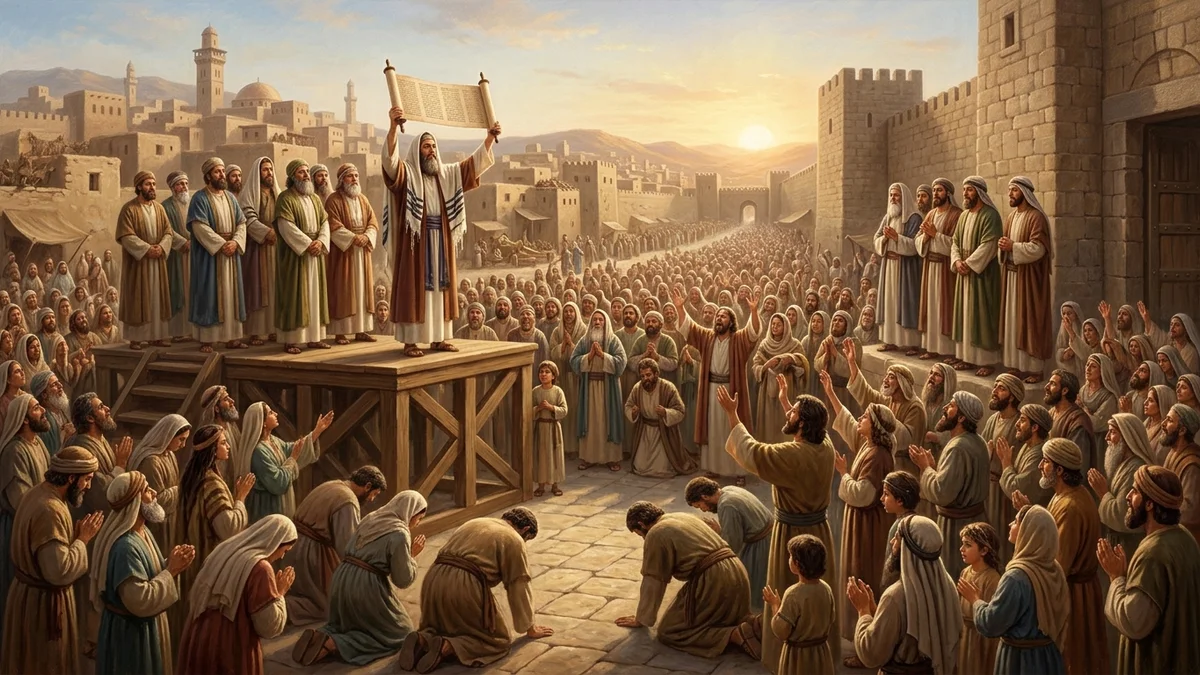
On the first day of the seventh month (Tishri, the biblical Feast of Trumpets), all the people gathered together "as one man" into the open plaza before the Water Gate on the eastern slope of Jerusalem.
The initiative came not from the government or the priesthood, but from the grass roots: the people themselves cried out to Ezra the scribe to bring the Book of the Law of Moses.
Ezra brought the Law before the assembly of men, women, and all children who were old enough to understand. He stood upon a specially constructed, elevated wooden platform so that he was visible to the entire sea of people. Flanking him on the right and left were thirteen faithful priests and civic leaders.
The moment Ezra unrolled the great parchment scroll in the sight of all the people, a wave of profound reverence swept over the crowd: all the people stood up!
Ezra blessed the Lord, the great God. And all the people answered with thunderous unison, lifting up their hands: "Amen! Amen!" And they bowed their heads and worshipped the Lord with their faces to the ground (Nehemiah 8:6).
2. Preaching with Understanding: The First Expository Sermon
From the first light of daybreak until the heat of midday—roughly six continuous hours—Ezra read aloud from the Torah. Scripture notes: "The ears of all the people were attentive to the Book of the Law."
Because many of the younger generation had been born in Babylon and spoke primarily Aramaic, a team of thirteen gifted Levites circulated through the dense crowds:
"So they read distinctly from the book, in the Law of God; and they gave the sense, and helped them to understand the reading." (Nehemiah 8:8).
This is the ancient birthplace of Christian expository preaching: reading the text distinctly, explaining its grammatical and historical meaning, and applying its truths directly to the hearts of the listeners.
3. Tears of Conviction Turned to the Joy of the Lord
As the pure mirror of God’s holiness was held up before the nation, an overwhelming conviction shattered their hearts. The people realized how deeply their culture, families, and marriages had deviated from God's commands. Sobs began to ripple through the crowd, until the entire open square erupted into loud, bitter weeping.
Then Nehemiah the governor, Ezra the priest and scribe, and the Levites who taught the people stepped forward with pastoral comfort:
"This day is holy to the Lord your God; do not mourn nor weep... Go your way, eat the fat, drink the sweet, and send portions to those for whom nothing is prepared; for this day is holy to our Lord. Do not sorrow, for THE JOY OF THE LORD IS YOUR STRENGTH!" (Nehemiah 8:9-10).
This is one of the grandest theological truths in Scripture. Godly sorrow has its rightful place, but once sin is confessed, lingering despair dishonors the grace of God. True spiritual strength does not come from self-flagellation or religious depression, but from overflowing joy in God’s forgiving character, unfailing mercy, and covenant love!
The people wiped their tears, embraced one another, and feasted with great merriment, "because they understood the words that were declared to them."
4. The Rediscovery of the Feast of Booths (Sukkot)
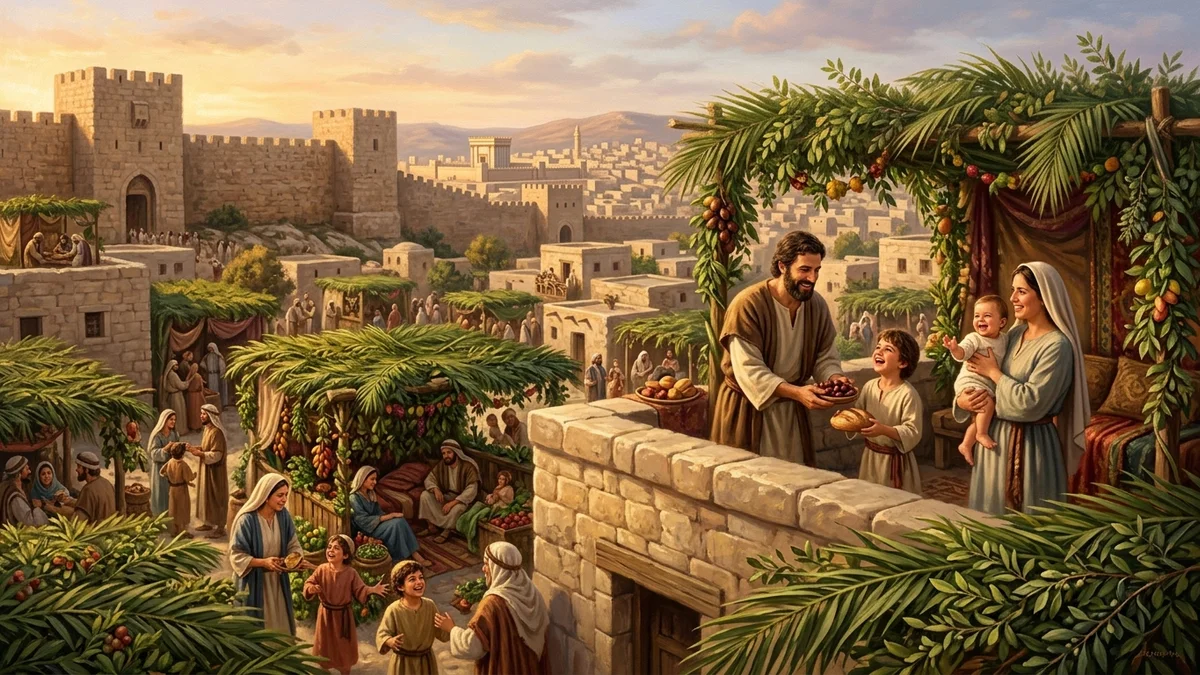 Judean families joyfully built leafy booths of olive, myrtle, and palm branches across rooftops and courtyards, celebrating the greatest Feast of Tabernacles since Joshua.
On the second day, the family heads returned to Ezra for deeper study of the Law. While reading Leviticus 23, they made an electrifying discovery: God had commanded that in the seventh month, the children of Israel should dwell in leafy booths to remember how God sheltered them when bringing them out of Egypt!
They immediately issued a proclamation throughout Jerusalem and all their towns: "Go out to the mountain, and bring olive branches, branches of oil trees, myrtle branches, palm branches, and branches of leafy trees, to make booths, as it is written." (Nehemiah 8:15).
The hills of Judea were harvested. Within days, thousands of fragrant, leafy green booths arose on flat stone rooftops, in private courtyards, in the courts of the Temple, and in the open squares of the Water Gate and Ephraim Gate.
For seven glorious days, the entire nation lived outdoors in their green booths, listening daily to Ezra read the Book of the Law: "And there was very great gladness. For since the days of Joshua the son of Nun until that day the children of Israel had not done so!" (Nehemiah 8:17).
5. The National Fast and the Signed Covenant
The revival reached its climax on the twenty-fourth day of Tishri. The children of Israel assembled with fasting, sackcloth, and earth on their heads. They separated themselves from all foreigners, stood and confessed their sins for a fourth of the day, and worshipped the Lord for another fourth of the day.
The Levites led the assembly in the longest recorded prayer in the Bible (Nehemiah 9), recounting God's magnificent faithfulness from Abraham through the Red Sea, the wilderness manna, and the prophets, acknowledging that God was entirely righteous in all the judgments that had befallen them.
Then, they took a radical step beyond temporary emotion: they made a solemn, binding covenant in writing (Nehemiah 9:38).
Nehemiah the governor, the priests, the Levites, and the leaders placed their personal seals upon the document. The entire community entered into a curse and an oath to walk in God’s Law, swearing four specific lifestyle reforms:
- Family Purity: Never to give their daughters to pagan neighbors or take foreign wives (Nehemiah 10:30).
- Sabbath Holiness: To buy no goods, grain, or food on the Sabbath day or any holy day (Nehemiah 10:31).
- Economic Justice: To leave the land fallow in the seventh year and cancel all debts (Nehemiah 10:31).
- Sacred Stewardship: To bring the firstfruits of their ground, the firstborn of their livestock, and a faithful tithe to the storehouses, concluding with the solemn pledge: "We will not neglect the house of our God!" (Nehemiah 10:39).
Spiritual Reflections & Practical Life Application:
- Cultivate a Thirst for God's Word: The people stood on their feet for six hours listening to Scripture. Do you hunger for the Bible, or do you treat Sunday sermons as a chore? Return to the pure milk of the Word.
- Expository Preaching Transforms Lives: True revival is not emotional hype; it is born when Scripture is read distinctly, its meaning explained, and its truth applied to the conscience.
- The Joy of the Lord Is Your Strength: Never let condemnation paralyze you. Confess your sins, receive Christ’s total forgiveness, and let the joy of your salvation become your daily strength against temptation!
- Put Your Faith in Writing: Emotional decisions fade; permanent lifestyle commitments endure. Anchor your spiritual resolutions in concrete disciplines—prayer, Sabbath rest, sexual purity, and generous tithing.
⚡ Fast Facts
- The revival took place on the first day of the seventh month (Tishri / Feast of Trumpets) in 445 BC
- Ezra read the Torah continuously for roughly six hours (from daybreak until noon)
- Thirteen Levites circulated through the crowd translating from Hebrew to Aramaic and explaining the sense
- Famous spiritual truth revealed: 'The joy of the Lord is your strength' (Nehemiah 8:10)
❓ Frequently Asked Questions (FAQs)
As the Scriptures were read and explained, the people experienced deep conviction of the Holy Spirit. They realized how far their personal lives, marriages, families, and nation had drifted from God's holy standards, recognizing that their past sufferings were the righteous judgments of God.
True biblical repentance should not terminate in paralyzing sorrow or hopeless despair. Once sin is confessed, believers must rejoice in God's redeeming mercy, covenant faithfulness, and forgiving grace, because joy in God's character provides the spiritual vitality and strength to live obediently.
In Nehemiah 10, the leaders and people signed a written oath pledging: (1) not to intermarry with pagan neighbors, (2) to honor the Sabbath by ceasing all commerce, (3) to forgive debts in the sabbatical seventh year, and (4) to faithfully bring tithes, firstfruits, and temple tax so that God's house would not be neglected.