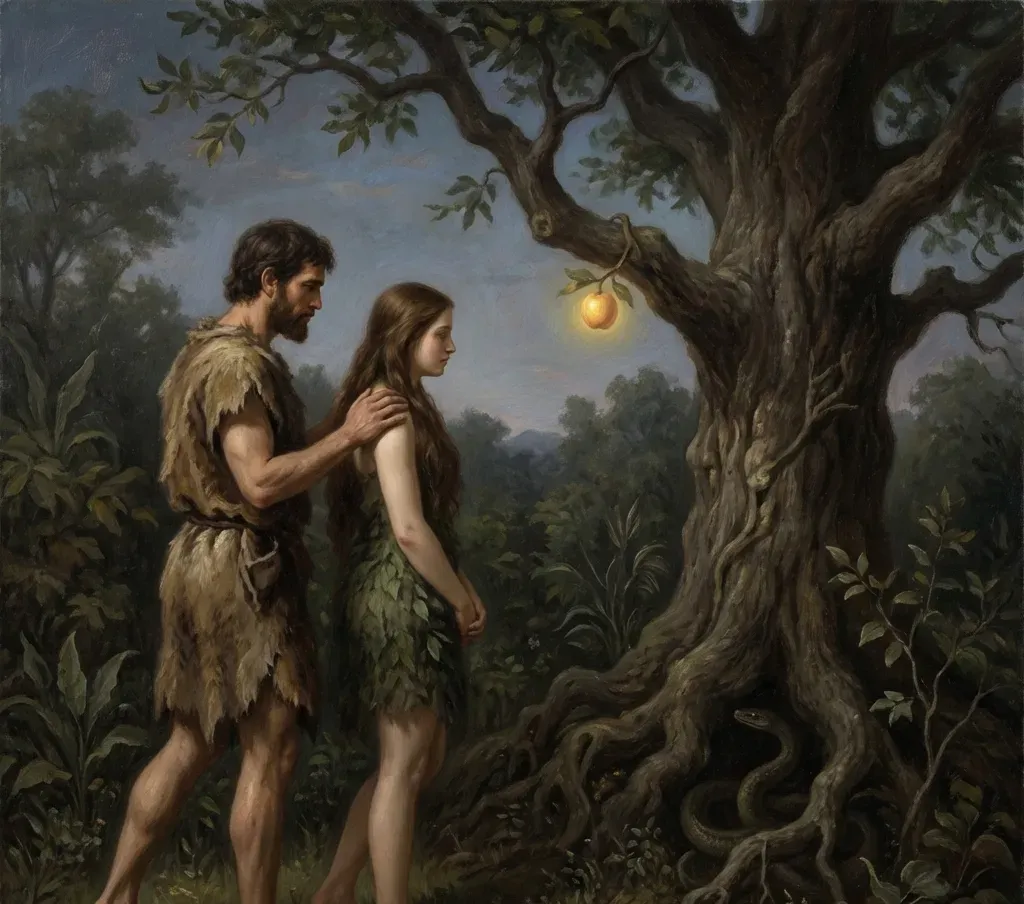
For an idyllic dawn of human history, the cosmos reflected the serene, unblemished harmony of its Creator. In the lush sanctuary of Eden, Adam and Eve walked in unbroken, unhindered intimacy with the Lord God. There existed no sickness, no sorrow, no anxiety, and no shadow of mortality. Commissioned as royal priests, they enjoyed the boundless bounty of the entire orchard, bound only by a single protective perimeter of divine love: "You may freely eat of every tree of the garden; but of the tree of the knowledge of good and evil you shall not eat, for in the day that you eat of it you shall surely die" (Genesis 2:16-17). It was a test not of arbitrary restriction, but of creaturely trust and loving allegiance.
1. The Subtle Infiltration: Weaponizing Doubt
Into this pristine sanctuary crept a dark intruder. The serpent is introduced with chilling precision: he was Arum—more cunning, subtle, and shrewd than any beast of the field. He did not arrive with the violent roar of an open enemy; he approached Eve with a soft, calculated interrogative aimed straight at the character of God: "Did God really say, 'You shall not eat of every tree of the garden'?" (Genesis 3:1).
Examine the deadly psychology of the temptation. The deceiver first exaggerated the prohibition, framing God's generous abundance as stingy scarcity. Eve attempted to defend the boundary, but in doing so, she subtly distorted God's word by adding her own restriction: "nor shall you touch it, lest you die." Perceiving her vulnerability, the serpent struck with a blatant, brazen contradiction of divine authority: "You will not surely die! For God knows that when you eat of it your eyes will be opened, and you will be like God, knowing good and evil" (Genesis 3:4-5).
The temptation was tripartite, targeting the core of human desires (1 John 2:16): the fruit was good for food (lust of the flesh), pleasing to the eyes (lust of the eyes), and desirable for gaining wisdom independently of God (pride of life). Eve yielded her trust to the creature rather than the Creator. She took the fruit, ate, and handed it to her husband, who was with her in passive abdication of his spiritual leadership. He ate with open eyes.
2. The Collapse of Innocence: The Agony of Shame
The promised enlightenment proved to be a catastrophic curse. No godhood descended upon them; instead, their moral innocence perished in an instant. The text records: "Then the eyes of both of them were opened, and they knew that they were naked" (Genesis 3:7).
Suddenly, holy vulnerability turned into humiliating exposure. The glory of God that had formerly clothed them like a garment was stripped away. Overcome by guilt and dread, they desperately stitched together broad fig leaves to fashion aprons (chagorot)—the inaugural, pathetic human attempt to self-atoned through the work of their own hands.
As the breeze of the day whispered through the garden, the familiar, comforting sound of the Lord God walking in the sanctuary echoed through the trees. Formerly, this sound signaled the joy of holy fellowship; now, it struck cold terror into their guilty hearts. For the first time in cosmic history, humans hid from their loving Father among the dense thickets of the garden.
3. The Pastoral Interrogation and the Blame Game
The voice of the Almighty pierced the foliage: "Where are you?" (Genesis 3:9). This was not the inquiry of an ignorant observer seeking coordinates; it was the broken-hearted cry of a Father summoning His wayward children to confession and repentance.
Adam stepped out from the shadows, stammering: "I heard the sound of You in the garden, and I was afraid because I was naked; and I hid myself." God responded with searching questions: "Who told you that you were naked? Have you eaten from the tree of which I commanded you that you should not eat?"
Rather than falling upon their knees in genuine repentance, fallen human nature displayed its ugly reflex: deflection, self-justification, and accusation. Adam pointed his finger directly at the woman and at God Himself: "The woman whom You gave to be with me, she gave me of the tree, and I ate." In a single sentence, Adam blamed his wife and impugned the character of God who provided her. When questioned, Eve immediately passed the indictment downward: "The serpent deceived me, and I ate."
4. The Sentence and the First Ray of Gospel Hope
 Driven out from paradise, humanity carries the divine promise of the Seed of the woman.
God pronounced righteous judicial sentences according to the order of rebellion:
- To the Serpent: Cursed above all livestock, condemned to crawl in the dust, and sentenced to ultimate destruction.
- To the Woman: Pain in conception and childbearing multiplied, and marital relationships infected by tension and power struggles.
- To the Man: The fertile ground cursed because of him; work transformed from joyful vocation into agonizing, sweat-soaked toil amid thorns and thistles, terminating in physical death: "For dust you are, and to dust you shall return" (Genesis 3:19).
Yet right in the darkest epicentre of condemnation, God unveiled the foundational anchor of the entire Bible: the Protoevangelium (Genesis 3:15). Speaking directly to the serpent, God declared:
"And I will put enmity between you and the woman, and between your seed and her Seed; He shall bruise your head, and you shall bruise His heel."
Here stands the primordial Gospel. A future male champion—the singular Seed of the woman, born without human paternity (Galatians 4:4)—would engage in cosmic warfare with the ancient serpent. On the cross of Calvary, Satan would strike His heel in agonizing suffering; but through that very death and resurrection, Christ would crush Satan's head, demolishing his kingdom, sin, and death forever!
5. The Sacrificial Covering and the Guarded Gate
Before driving the fallen couple from the garden, Yahweh Elohim performed a profound, prophetic act of mercy: "Also for Adam and his wife the Lord God made tunics of skin, and clothed them" (Genesis 3:21).
The fragile, withered fig leaves were stripped away. In their place, an innocent animal had to die. Blood was shed in the sanctuary of Eden. God Himself took the hide of the sacrifice and tenderly draped it over their trembling, ashamed bodies. This was the Bible's first scarlet thread: atonement requires a substitutionary sacrifice; innocent life must be poured out to cover the guilty sinner.
Finally, in an act of protective grace, God banished humanity from Eden. Lest fallen man reach out, eat of the Tree of Life, and immortalize himself in an eternal state of sin and misery, God drove him out. At the eastern gate of Eden, God stationed the Cherubim—the terrifying celestial guardians of divine holiness—and a flaming, whirling sword turning every way to guard the path to the Tree of Life.
The gate of paradise was barred by divine justice. Yet across the subsequent centuries of biblical history, that fiery sword would eventually fall not on guilty humanity, but upon the Son of God on the hill of Golgotha. When Jesus cried, "It is finished!", the temple veil was torn from top to bottom, the cherub-guarded way back to the Tree of Life was reopened, and paradise regained became the eternal inheritance of all who believe.
Biblical Keywords & Theological Roots
Crafty, subtle, shrewd; deliberate wordplay contrasting with arummim ('naked' in Gen 2:25) to highlight twisted intellect.
Serpent, shining one, whisperer; the creature indwelt and weaponized by the adversary to deceive humanity.
Tunics of skin / animal hide; requiring the first shedding of innocent sacrificial blood to cover human shame.
Seed, offspring, descendant; specifically pointing forward to the coming Davidic and virgin-born Messiah.
Ancient Near Eastern & Archaeological Context
In the ancient Near East, royal gardens were designed as living sanctuaries where gods walked in intimate communion with earthly monarchs. Eden functioned as the primeval temple-sanctuary of Yahweh, oriented toward the east, abounding with sacred river currents, precious gold, and onyx stones (features later reproduced in the Tabernacle and Solomon’s Temple). In this cosmic sanctuary, Adam and Eve served as consecrated royal priests tasked with keeping (shamar) and guarding the holy space.
The serpent was not an ordinary animal, but a rebel figure aligned with the chaotic, dragon-like sea adversaries common in ancient Semitic cosmology (such as Leviathan and Rahab). In ancient shame-honor cultures, public exposure was the ultimate degradation; when Adam and Eve grasped for moral autonomy, their sudden realization of nakedness triggered profound existential shame. Their fragile fig leaf aprons represented humanity's futile self-righteous attempt to manufacture atonement, which God graciously replaced through the sacrificial offering of animal skins.
Practical Discipleship & Spiritual Application
- Guarding the Mind Against Rationalized Deception: Temptation invariably begins by subtly distorting God's commandments and casting aspersion upon His generous love ('Did God really say?'). We must anchor our minds firmly in unchanging biblical truth.
- Abandoning the Blame Game: Fallen human nature reflexively shifts responsibility to others, circumstances, or even God Himself. Spiritual healing and authentic forgiveness begin only when we take full ownership of our sins through honest confession.
- Resting in Christ's Imputed Righteousness: Our self-made 'fig leaves' of moral effort, ritualism, and religious performance can never cover the shame of sin. Only the righteousness of Jesus Christ, purchased by His sacrificial blood, can clothe us before a holy God.
- Living in the Victory of Genesis 3:15: Though the enemy still prowls, his defeat is already sealed. The resurrected Christ has crushed the serpent's head, empowering us to walk in daily spiritual triumph.
⚡ Fast Facts
- Anatomy of Temptation: The serpent attacked God's goodness and word before soliciting direct disobedience.
- Immediate Alienation: Sin shattered relational peace across four spheres: with God (fear/hiding), within self (nakedness/shame), with others (blame/deflection), and with nature (thorns/sweat).
- The Protoevangelium: Genesis 3:15 records the first messianic prophecy, promising that the Seed of the woman would suffer a bruised heel while crushing the serpent's head.
- Substitutionary Grace: God shed innocent animal blood to provide tunics of skin (kethoneth or), foreshadowing the Lamb of God who clothes sinners in His righteousness.
❓ Frequently Asked Questions (FAQs)
The tree was not magical or inherently poisonous; rather, it represented the boundary of human creaturehood. The test challenged humanity to trust God's sovereign definition of good and evil rather than seizing moral autonomy to decide morality independently.
God did not ask for geographic information; He asked a tender, convicting pastoral question designed to grant Adam an opportunity to confess, acknowledge his fallen state, and seek mercy.
Known as the Protoevangelium (first gospel), it prophesies a mortal battle between the serpent and the collective offspring of humanity, culminating in a specific male individual (the Seed of the woman, born of a virgin) who would suffer a wounded heel on the cross while executing a fatal crushing blow to Satan's head and kingdom.