Ten generations following the expulsion from Eden, the human race had multiplied rapidly across the fertile plains of the ancient world. Yet alongside human civilization grew an insidious, pervasive darkness. The moral decay was not superficial; Scripture records with piercing sorrow: "The Lord saw how great the wickedness of the human race had become on the earth, and that every inclination of the thoughts of the human heart was only evil all the time" (Genesis 6:5). The pristine sanctuary of God's earth had been defiled by violent oppression (chamas), deceit, and moral rot. The Lord's heart was grieved to the very core. Justice demanded cosmic reckoning.
1. The Solitary Pilgrim: Noah's Walk with God
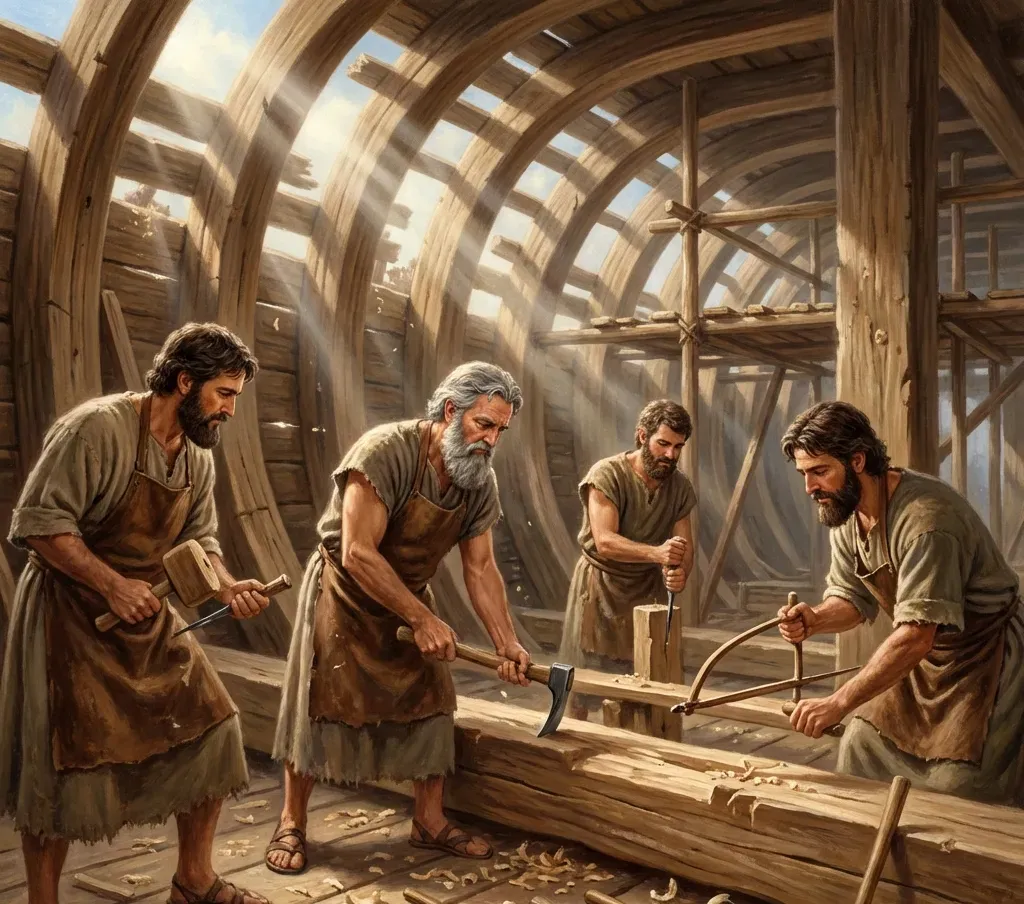 Guided by unyielding faith, Noah constructs the colossal vessel on dry ground.
Yet amid the deafening roar of global rebellion, heaven’s gaze settled upon a solitary figure: Noah. Genesis 6:8 introduces the turning point of early history: "But Noah found grace (chen) in the eyes of the Lord." Noah was not sinless, but he was Tamim—blameless, upright, and possessed of wholehearted integrity among the corrupt men of his era. While humanity ran headlong toward spiritual destruction, Noah walked step-by-step in unbroken fellowship with God.
God revealed His secret counsel to His faithful servant: "I am going to put an end to all people, for the earth is filled with violence because of them. Make yourself an ark of gopher wood" (Genesis 6:13-14). God did not command Noah to construct a military fortress or a swift galley; He ordered the assembly of a Tevah—a colossal floating sanctuary designed strictly for survival, preservation, and salvation.
The architectural specifications were astonishing: 300 cubits long (approx. 450 feet), 50 cubits wide (75 feet), and 30 cubits high (45 feet). This 6:1 length-to-width ratio represents the ultimate hydrodynamic stability formula, rendering the vessel practically unshakeable against colossal ocean swells. Coated inside and out with pitch (kaphar), the vessel was waterproofed against the abyss. For over a century, Noah endured the ridicule of a cynical world. As his hammers echoed across dry plains far from the sea, his faithful obedience served as a living sermon of righteousness (2 Peter 2:5). Hebrews 11:7 declares that by faith Noah, being divinely warned of things not yet seen, moved with godly fear and prepared an ark for the saving of his household, by which he condemned the world and became heir of the righteousness which is according to faith.
2. The Gathering of Creation and the Divine Hand of Safety
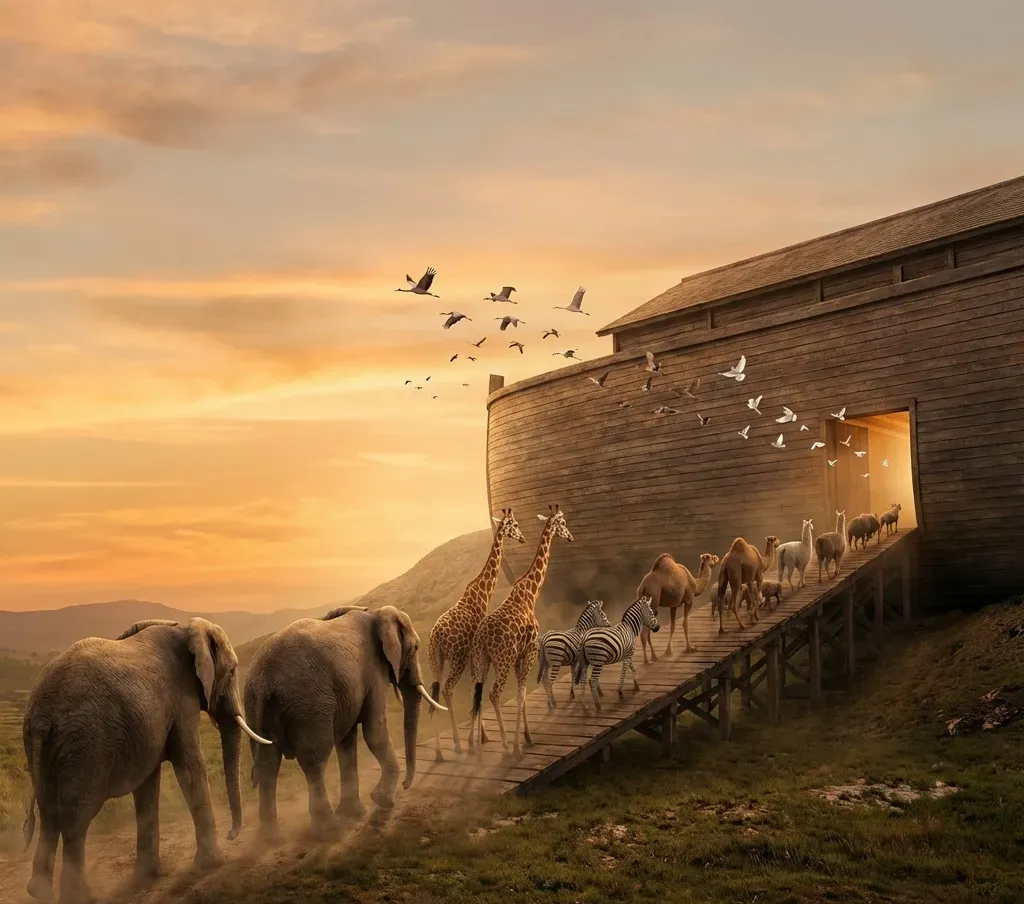 Guided by divine instinct, pairs of every living creature embark upon the Ark.
When the colossal vessel stood complete, Noah did not need to hunt across mountains and jungles. The same Sovereign Lord who formed all creatures commanded them to assemble. Guided by supernatural instinct, creatures of every kind marched toward the open ramp: creeping things, soaring birds, and terrestrial mammals, two by two, male and female, along with seven pairs of clean animals designated for sacrifice and worship.
Noah, his wife, his three sons (Shem, Ham, Japheth), and their wives stepped across the threshold. Eight human souls entrusted their lives to God's vessel. Then occurred one of the most poignant sentences in sacred history: "And the Lord shut him in" (Genesis 7:16). God Himself swung the massive wooden door shut, sealing His children within divine mercy and shutting out the unrepentant world. The day of patient grace had expired; the hour of righteous reckoning had arrived.
3. The Deluge: The Deep Bursts Forth
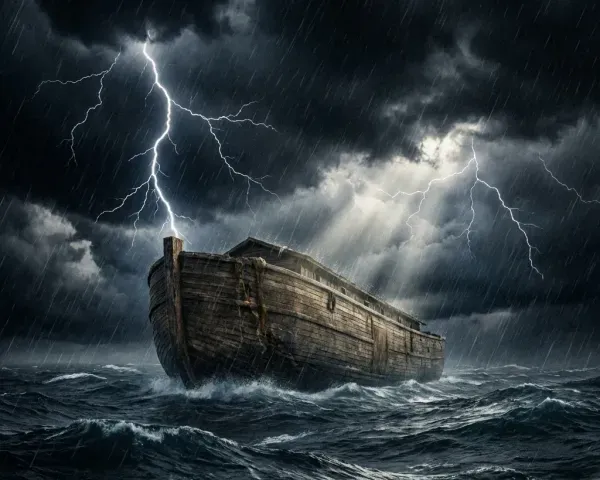
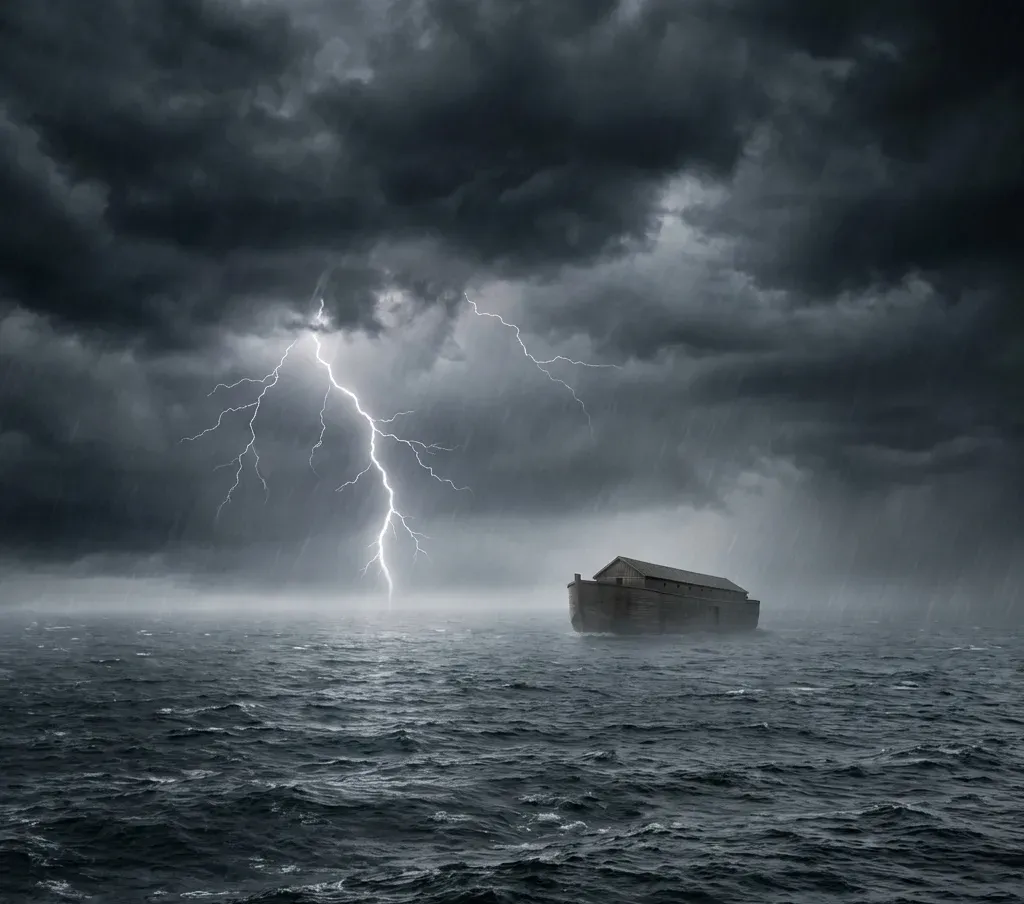 Cataclysmic subterranean fountains and celestial torrents submerge the ancient world.
Seven days later, the catastrophe began. This was not a localized rainfall; it was a cosmic de-creation. Scripture records: "On that day all the springs of the great deep burst forth, and the floodgates of the heavens were opened" (Genesis 7:11). Tectonic fissures ruptured across the oceanic floor; subterranean reservoirs blasted through the earth's crust; and torrential celestial downpours fell continuously for forty days and forty nights.
The surging waters lifted the colossal Ark from the valley floor. Higher and higher the waters climbed, obliterating fortified cities, majestic forests, and rolling foothills, until even the highest mountain peaks were submerged beneath twenty feet of surging, chaotic ocean. The noisy, violent world was reduced to utter silence. Only the solitary Ark rode the churning currents of judgment, preserved under the watchful eye of the Almighty.
4. The Olive Branch: Resurrection of Hope
For one hundred and fifty days the floodwaters prevailed. But Genesis 8:1 opens with a glorious gospel declaration: "Then God remembered Noah." Divine remembrance does not signify that God had forgotten; in biblical Hebrew, God "remembering" means He actively stepped forward to fulfill His covenant pledge.
God caused a mighty wind (Ruach) to blow over the waters, echoing the primeval breath of Genesis 1:2. The subterranean fountains ceased, and the Ark came to rest upon the rugged mountains of Ararat. As the water receded, Noah dispatched a raven, which flew back and forth over the desolate expanse. Next, he released a dove; finding no resting place for the sole of her foot, she returned to the Ark.
Seven days later, Noah released the dove a second time. In the golden light of evening, she returned, holding in her beak a freshly plucked olive leaf! It was the sacrament of resurrection. Life had triumphed over death; vegetation was regenerating; the curse of judgment had passed. Seven days later, the dove was sent forth once more, and she returned no more, finding her permanent home in a renewed earth.
5. The Rainbow Covenant: The Unstrung Bow
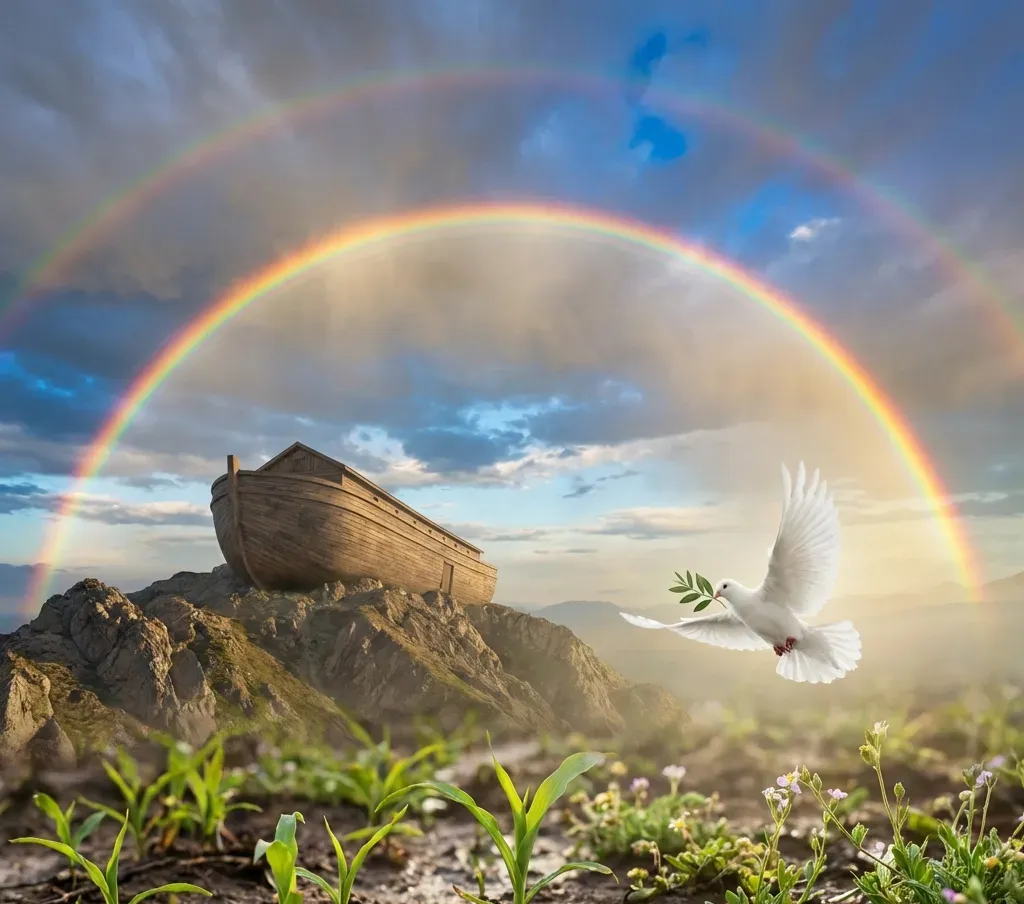 The war bow laid aside: God sets His rainbow in the clouds as an eternal covenant of grace.
At God's command, Noah opened the doors and stepped onto dry ground. His first act on the washed earth was not to construct a palace or plant a commercial vineyard; he built an altar to the Lord. Taking clean animals, he offered fragrant burnt offerings in humble adoration. The Lord smelled the pleasing aroma and proclaimed:
"Never again will I curse the ground because of humans... As long as the earth endures, seedtime and harvest, cold and heat, summer and winter, day and night will never cease." (Genesis 8:21-22)
Then God painted across the retreating storm clouds the eternal token of His covenant: the Rainbow (qeshet). In the ancient world, the bow was the primary weapon of warfare. But notice the orientation: God’s bow in the sky is an unstrung warrior's bow, pointed upward toward heaven rather than downward toward humanity. God was declaring: "My wrath is satisfied; my battle with humanity is laid down. Should this covenant ever be broken, the arrow of divine judgment will strike my own heart rather than humanity."
Centuries later, that prophetic promise was fulfilled when Jesus Christ absorbed the arrow of divine wrath on the cross. Today, Christ stands as our eternal Ark of salvation. In Him, we pass through the waters of judgment and emerge into the new creation of everlasting peace.
Biblical Keywords & Theological Roots
Grace, unmerited divine favor, pleasantness; first theological appearance in Scripture in Genesis 6:8.
Blameless, upright, having wholehearted moral integrity among his contemporaries.
Ark, chest, floating refuge vessel without steering mechanism; identical Hebrew noun used for baby Moses' basket.
To coat with pitch / tar; linguistically identical to the root for 'atonement' (Kipper) and 'ransom' (Kopher).
Covenant, solemn binding treaty ratified by divine oath and pledged protection.
Ancient Near Eastern & Archaeological Context
The biblical Flood account shares literary motifs with Mesopotamian flood literature, including the Epic of Gilgamesh (Tablet XI) and the Atrahasis Epic, proving the widespread ancient memory of a catastrophic primeval deluge. However, the ideological and theological divergences are staggering.
In Atrahasis and Gilgamesh, the gods (Enlil, Ea, Ishtar) resolve to annihilate humanity simply because the noisy human population disturbed their divine sleep; the survivor (Utnapishtim) escapes through deception; the Mesopotamian boat is an unseaworthy cube (120x120x120 cubits); and after the flood, the starving deities swarm like ravenous flies around the altar because they relied on human sacrifices for food. In stark contrast, Genesis presents Yahweh as a holy, morally righteous God executing measured justice against pervasive bloodshed and injustice (chamas). Noah's Ark features the hydrodynamically stable proportions of 300x50x30 cubits (a 6:1 length-to-beam ratio, the identical ratio utilized in modern supertankers to prevent capsize in monster seas). God remembers (zakar) Noah not out of physical hunger, but out of His eternal, steadfast covenant love.
Practical Discipleship & Spiritual Application
- Walking Counter-Culturally in a Corrupt Generation: Noah chose the lonely path of righteousness when all of society normalized evil. Faithfulness to God often requires the courage to stand alone against the tide of popular opinion.
- Entering the Ark of Salvation (Jesus Christ): Noah’s Ark had only one door. Today, Christ declares Himself to be the singular Door of salvation. Those who enter into Him by faith are shielded completely from divine judgment.
- Trusting God's Perfect Timing in the Waiting Seasons: Noah endured months of rocking in darkness, surrounded by torrential waters and animal stalls, yet 'God remembered Noah.' God never abandons His children in the enclosed seasons of waiting.
- Resting Under the Sign of the Unstrung Bow: The rainbow reminds us that God's covenant of grace stands unshakeable. Even after our deepest storms, His mercy arches across our sky, calling us to live in peaceful hope.
⚡ Fast Facts
- Noah's Blameless Walk: In a generation where every thought was evil continually, Noah found grace (chen) and walked faithfully with God.
- Naval Engineering Precision: The Ark measured 300 cubits long, 50 cubits wide, and 30 cubits high—a flawless 6:1 stability ratio mirrored in modern cargo vessels.
- The Divine Hand of Safety: Genesis 7:16 explicitly records: 'And the Lord shut him in'—salvation was initiated, sustained, and sealed by God alone.
- The Rainbow Covenant: The bow (qeshet) set in the clouds was an inverted warrior's bow, symbolizing that God's wrath was unstrung and laid aside toward creation.
❓ Frequently Asked Questions (FAQs)
Genesis 6 reveals that the earth was totally corrupt and filled with violent oppression (chamas). God's grief was not petulant anger, but the holy sorrow of a righteous Father cleansing His defiled sanctuary to preserve a remnant for redemption.
The Ark is a supreme type of Jesus Christ. Just as the Ark had only one door and absorbed the crushing fury of the waters while keeping those inside secure, Christ is the only Door of salvation (John 10:9) who bore the wrath of God for all who reside in Him (1 Peter 3:20-21).
The freshly plucked olive leaf demonstrated that new vegetation had regenerated under the dry land. In biblical theology, the olive branch became the enduring symbol of peace, spiritual resurrection, and the cessation of judgment.