
Great leaders are forged not in classrooms of theoretical statecraft, but in the crucible of weeping prayer, strategic vision, and relentless courage under fire. In 445 BC, ninety-three years after the first exiles returned to Judea, the holy city of Jerusalem remained a vulnerable, disgraced ruins—its ancient stone ramparts breached and toppled, its gates charred black by Babylonian fires, and its inhabitants living in daily reproach. Into this scene of despair stepped Nehemiah, the royal cupbearer to the King of Persia. Armed with fervent prayer, administrative brilliance, and a holy refusal to back down before mocking adversaries, Nehemiah mobilized an entire community to accomplish the impossible: rebuilding the colossal fortified walls of Jerusalem in just fifty-two days!
1. The Report from Jerusalem and the Cupbearer’s Tears
In the month of Kislev in the twentieth year of Persian King Artaxerxes I, Nehemiah was in the royal winter fortress of **Susa**. His brother Hanani arrived from Judea with a devastating eyewitness report:
"The survivors who are left from the captivity in the province are there in great distress and reproach. The wall of Jerusalem is also broken down, and its gates are burned with fire." (Nehemiah 1:3).
The news shattered Nehemiah's heart: "So it was, when I heard these words, that I sat down and wept, and mourned for many days; I was fasting and praying before the God of heaven." (Nehemiah 1:4).
For four solid months (from Kislev to Nisan), Nehemiah wept, fasted, and prayed, confessing the sins of his nation and standing on the covenant promises given to Moses.
In the month of Nisan (April 445 BC), while serving wine to King Artaxerxes and Queen Damaspia, the king noticed sadness on his trusted cupbearer’s face: "Why is your face sad, since you are not sick? This is nothing but sorrow of heart."
Nehemiah was gripped with fear—showing sadness before an emperor could be punished with execution. But firing a lightning prayer to the God of heaven, Nehemiah answered boldly: "May the king live forever! Why should my face not be sad, when the city, the place of my fathers' tombs, lies waste, and its gates are burned with fire?"
The king asked, "What do you request?" Nehemiah requested a royal leave of absence, letters of safe conduct through imperial governors, and a royal requisition for timber from Asaph, the keeper of the king’s forest, "and the king granted them to me according to the good hand of my God upon me." (Nehemiah 2:8).
2. The Midnight Inspection of the Ruined Walls
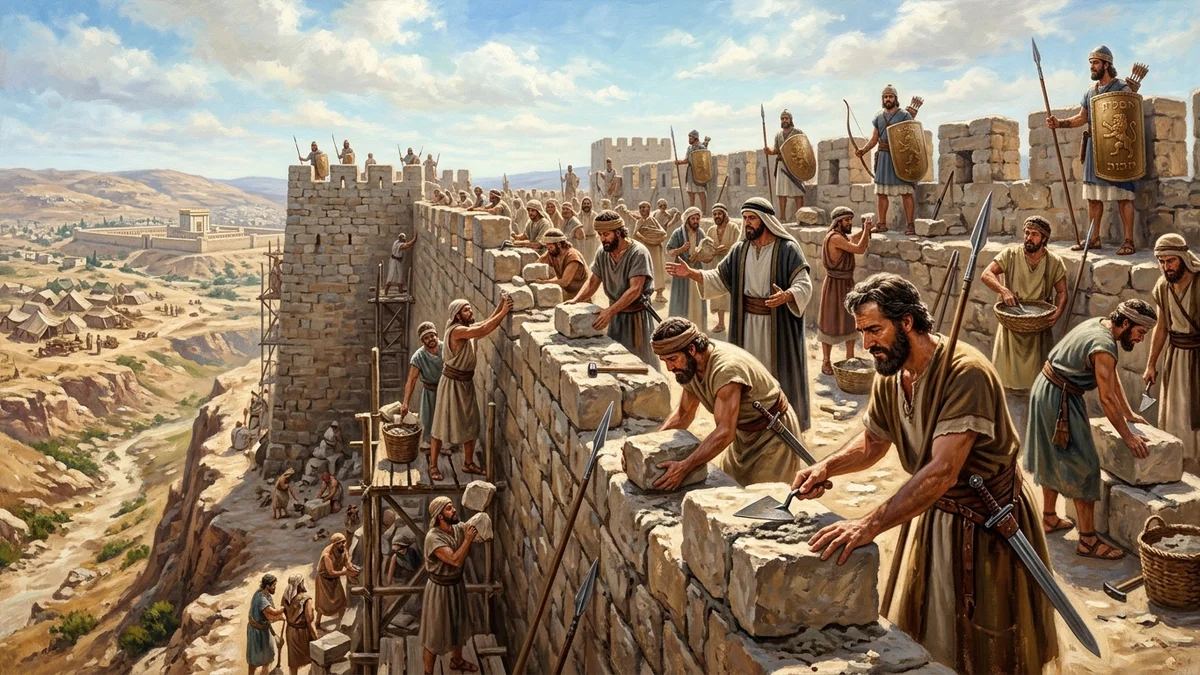 With trowels in one hand and spears in the other, families, priests, and goldsmiths rebuilt the high stone ramparts of Jerusalem in 52 days.
Arriving in Jerusalem with a cavalry escort, Nehemiah stayed three days in silence, telling no one what God had put in his heart to do.
On the third night, while the city slept, Nehemiah slipped out through the Valley Gate on horseback with only a few trusted men. By the flickering light of torches, he surveyed the blackened rubble of the Dragon Well, the Dung Gate, and the Fountain Gate. The devastation was so impassable that his mount could not even find a footing through the mountainous debris.
Having personally verified the wreckage, Nehemiah assembled the priests, nobles, and rulers the next morning with an impassioned battle cry:
"You see the distress that we are in, how Jerusalem lies waste, and its gates are burned with fire. Come and let us build the wall of Jerusalem, that we may no longer be a reproach!" (Nehemiah 2:17).
When he recounted the good hand of his God upon him and the king’s words, the people caught the divine fire: "Let us rise up and build!" So they strengthened their hands for this good work.
3. Organized Unity: Every Family Building Their Section
Nehemiah Chapter 3 is a masterclass in organizational mobilization. Nehemiah divided the entire circumference of the two-and-a-half-mile wall into specific sections, assigning each sector to specific families, guilds, and professions:
- High Priest Eliashib and his fellow priests rebuilt the **Sheep Gate** through which sacrificial lambs entered.
- Goldsmiths, perfume-makers, and merchants laid massive ashlar blocks and set up heavy wooden doors.
- Shallum, ruler of half the district of Jerusalem, repaired his section alongside **his daughters**!
- Families repaired the wall directly **opposite their own houses**, giving them personal motivation for defense.
Only the wealthy nobles of Tekoa refused to put their shoulders to the work of the Lord (Nehemiah 3:5), while ordinary citizens doubled their efforts to compensate.
4. The Enemy's Attacks: Mockery, Conspiracy, and Treachery
When **Sanballat the Horonite** (governor of Samaria), **Tobiah the Ammonite**, and **Geshem the Arab** heard the walls were rising, they attacked with three progressive waves of psychological warfare:
Phase 1 — Sarcastic Mockery: Sanballat raged before the Samaritan army: "What are these feeble Jews doing? Will they revive the stones out of the heaps of rubbish?" Tobiah added: "Whatever they build, if even a fox goes up on it, he will break down their stone wall!" (Nehemiah 4:2-3). Nehemiah did not enter a verbal debate; he prayed: "Hear, O our God, for we are despised!" and the people kept building until the wall reached half its height.
Phase 2 — Armed Military Threat: Enraged that the gaps were closing, the enemies conspired to launch a surprise military raid to massacre the workers. Half the Jews were exhausted, crying that the rubble was too heavy. Nehemiah instituted a brilliant defense strategy:
"From that time on, half of my servants worked on construction, while the other half held the spears, the shields, the bows, and the armor... Those who built on the wall, and those who carried burdens, loaded themselves so that with one hand they worked at construction, and with the other held a weapon!" (Nehemiah 4:16-17).
A trumpeter stayed beside Nehemiah at all times: "The work is great and extensive, and we are separated far from one another on the wall. Wherever you hear the sound of the trumpet, rally to us there. Our God will fight for us!"
Phase 3 — Deceitful Assassination Plots: When the walls were finished and only the doors remained, Sanballat invited Nehemiah four times to a parley in the plain of Ono to assassinate him. Nehemiah famously answered: "I am doing a great work, so that I cannot come down. Why should the work cease while I leave it and go down to you?" (Nehemiah 6:3). When a false prophet hired by Tobiah tried to lure him into hiding inside the Temple, Nehemiah rebuked the cowardice: "Should such a man as I flee?"
5. Finished in 52 Days: God’s Hand Recognized by Enemies
On the **twenty-fifth day of the month of Elul (September 445 BC)**, an astonishing milestone in world history was accomplished:
"So the wall was finished on the twenty-fifth day of Elul, in fifty-two days. And it happened, when all our enemies heard of it, and all the nations around us saw these things, that they were very much disheartened in their own eyes; for they perceived that this work was done by our God!" (Nehemiah 6:15-16).
What had sat in ruins for 141 years since Nebuchadnezzar burned it in 586 BC was completely rebuilt, fortified, gated, and secured in just fifty-two days! Even pagan enemies were forced to admit that human hands alone could never have accomplished such a feat without the supernatural power of the God of Israel.
6. Christological Typology: The True Builder and Defender
Nehemiah’s life and work foreshadow Jesus Christ:
- Leaving the Palace to Rescue the Ruins: Nehemiah left the luxurious comforts of the Persian court to live among the rubble of Jerusalem; Jesus left the glory of heaven to walk among the broken rubble of fallen humanity.
- The Unstoppable Builder: Jesus declared: "I will build My church, and the gates of Hades shall not prevail against it" (Matthew 16:18). No mockery, persecution, or demonic conspiracy can stop Christ from building His eternal Kingdom.
- Building and Battling: Just as Nehemiah’s men built with a trowel and fought with a sword, believers are called to build the Kingdom while wielding the Sword of the Spirit, which is the Word of God (Ephesians 6:17).
Spiritual Reflections & Practical Life Application:
- Turn Heartbreak into Prayer and Action: When you see brokenness in your family, community, or nation, do not just complain. Weep, fast, pray, and then ask God: "What can I do to help rebuild?"
- Work with Both Hands: In the Christian life, you must be a builder and a warrior. Build your character and ministry, but keep your spiritual armor on at all times against the enemy's attacks.
- Refuse to Come Down: When critics, distractions, and compromise call you to waste time in the "plain of Ono," declare: "I am doing a great work for God, and I will not come down!"
- Unity Overcomes Impossibilities: When everyone takes responsibility for their own section of the wall, miracles happen in record time. Work together for God's glory!
⚡ Fast Facts
- Nehemiah served as the trusted royal cupbearer to Persian Emperor Artaxerxes I at Susa in 445 BC
- Nehemiah inspected the charred walls secretly by night on horseback before speaking to the leaders
- The builders worked with a construction tool in one hand and a spear/sword strapped to their side
- The colossal stone wall of Jerusalem was completed in just 52 days on the 25th of Elul (Nehemiah 6:15)
❓ Frequently Asked Questions (FAQs)
Without fortified stone walls and sturdy gates, Jerusalem remained defenseless against hostile surrounding nations, vulnerable to economic plundering, military invasion, and constant humiliation, preventing the city from flourishing as the covenant center of worship.
When mocked ('Even if a fox jumps on it, it will break'), Nehemiah prayed. When threatened with armed ambush, he posted half the men as armed guards with spears and bows. When invited to a deceitful parley on the plain of Ono, he refused: 'I am doing a great work, so that I cannot come down' (Nehemiah 6:3).
Wealthy Jewish nobles were charging exorbitant interest and enslaving the children of impoverished citizens who mortgaged their fields for food and Persian taxes. Nehemiah was deeply indignant, confronted the nobles, and forced them to cancel debts and restore land (Nehemiah 5).