Prompted by the Apostle Peter's inquiry—"Lord, how many times shall I forgive my brother when he sins against me? Up to seven times?"—Jesus shattered human scorekeeping with the Parable of the Unforgiving Servant in Matthew 18:21-35. By contrasting an astronomical, unpayable debt with a microscopic, petty grievance, Christ exposes the monstrous hypocrisy of a Christian harboring an unforgiving spirit.
1. The Cosmic Debt of Ten Thousand Talents
Jesus described a king settling accounts with his servants. One debtor was brought in who owed him ten thousand talents (myria talanta). In Greek, 'myriad' was the largest numeral, and 'talent' was the highest unit of currency. A single talent was worth 6,000 denarii (twenty years of manual wages); ten thousand talents equaled 60,000,000 denarii—nearly two hundred thousand years of labor! The total annual tax revenue of Judea under Rome was only 600 talents. The servant owed more than the treasury of empires. It represents humanity's infinite, unpayable debt of sin before a holy God.
2. Unconditional Sovereign Pardon
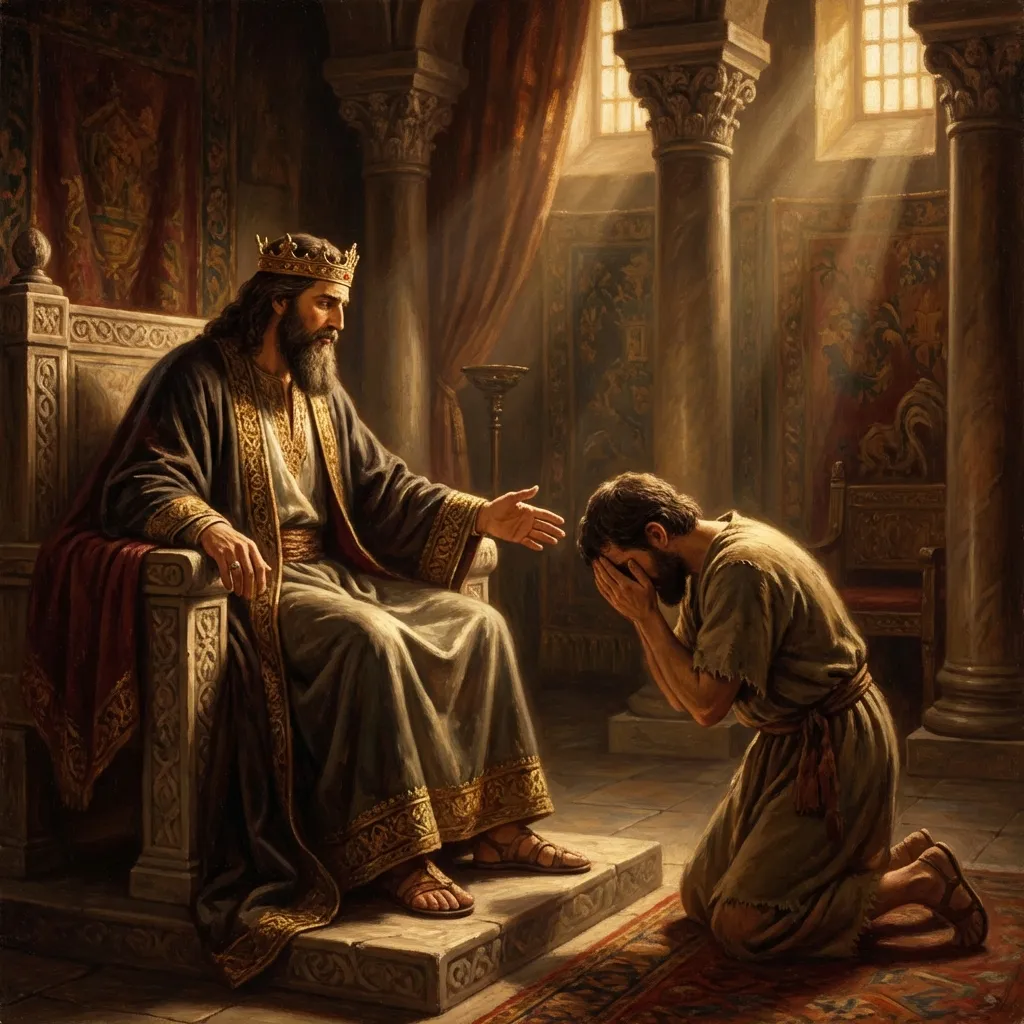
Since the debtor had no means to pay, the king ordered him, his wife, his children, and all he owned to be sold into slavery. The servant fell on his face and pleaded: "Be patient with me, and I will pay back everything." It was an absurd, impossible promise! Yet Matthew 18:27 records: "The servant's master took pity on him, canceled the debt and let him go." He did not grant a payment plan; he wiped the multi-billion-dollar slate completely clean. This is the scandal of the Cross.
3. The Choking of a Fellow Servant
Stepping out of the palace courtyard with the ink of his pardon still wet, that same servant found a fellow servant who owed him a hundred denarii (about three months' wages—a tiny 1/600,000th of what he had just been forgiven). He grabbed him by the throat and began choking him, demanding: "Pay back what you owe me!" When his peer fell down and spoke the exact same words—"Be patient with me, and I will pay it back"—he refused, throwing him into debtor's prison until he could pay.
4. The Fury of the King
When the other servants reported what happened, the king called the wicked servant back: "You wicked servant! I canceled all that debt of yours because you begged me to. Shouldn't you have had mercy on your fellow servant just as I had on you?" (Matthew 18:32-33). In anger, his master handed him over to the torturers (basanistais) until he should pay back all he owed.
5. From the Heart: The Law of Mercy
Jesus concluded with the most chilling warning in the Gospels: "This is how my heavenly Father will treat each of you unless you forgive your brother or sister from your heart" (Matthew 18:35). We do not forgive because the offender deserves it; we forgive because we have been lavishly forgiven at Calvary. Unforgiveness is an agonizing prison of our own making, cutting us off from the sweet fellowship of divine grace.
Biblical Keywords & Theological Roots
Ten thousand talents; an unpayable, astronomical debt representing roughly 60,000,000 denarii (the annual tax revenue of entire nations).
One hundred denarii; roughly one hundred days of labor (a petty fraction: 1/600,000th of what he had just been forgiven).
Tormentors, torturers, jailers; the bitter prison of spiritual torment delivering unforgiving souls over to inner agony.
Ancient Near Eastern & Archaeological Context
The financial scale of Matthew 18:23-35 is deliberately staggering and impossible. A talent equaled 6,000 denarii; ten thousand talents (*myriōn talantōn*) represented 60,000,000 denarii—an incomprehensible national debt requiring 200,000 years of daily wages to satisfy! For historical context, the entire Roman provincial tax collected from Judea, Samaria, and Idumea combined was barely 600 talents annually. The servant's debt exceeded the GDP of multiple empires. By contrast, the fellow servant owed 100 denarii (roughly three months of daily wages—one six-hundred-thousandth of the forgiven debt). Seizing his peer by the throat, choking him, and demanding payment unmasked monstrous, irrational hypocrisy against the boundless grace of the King.
🔑 Key Spiritual Takeaways
- Our Cosmic Debt to God: Every human being owes God an infinite debt of sin (10,000 talents) that we could never repay in ten thousand lifetimes.
- Forgiven People Must Forgive: Having received limitless cancellation of our sins at the Cross, harboring bitterness against others is grotesque hypocrisy.
- The Proportion of Offenses: What others owe us (100 denarii) is microscopic compared to what Christ has forgiven us (10,000 talents).
- The Prison of Unforgiveness: Refusing to forgive locks our own souls in a prison of bitterness, severing us from the experiential flow of God's mercy.
Support Independent Biblical Research
Did this study bless you? Help support our independent bilingual research and interactive visual Bible tools.
⚡ Fast Facts
- Peter's Question on Forgiveness: Jesus told this parable in response to Peter asking: 'Lord, how many times shall I forgive my brother? Up to seven times?'
- Impossible Debt: 10,000 talents was larger than the entire Roman imperial treasury's annual tax intake from Judea, Samaria, and Idumea combined (600 talents).
- Violent Choking: After receiving total pardon, the forgiven servant found a fellow servant owing him a petty debt, grabbed him, and began choking him.
- Delivered to the Tormentors: The king revoked the pardon and handed the unmerciful servant over to the torturers until he should pay all he owed.
❓ Frequently Asked Questions (FAQs)
Why did Peter suggest forgiving up to seven times?
Rabbinic tradition taught that a person was required to forgive an offender only three times (based on Amos 1:3). Peter thought he was being remarkably generous and super-spiritual by doubling the rabbinic limit and adding one (seven times). Jesus answered: 'Not seven times, but seventy-seven times'—unlimited forgiveness.
What does Jesus mean by being handed over to the 'tormentors' in Matthew 18:34?
It refers to the agonizing emotional and spiritual torment that consumes bitter people: resentment, anxiety, and demonic oppression. Unforgiveness is poison you drink while expecting the other person to die.
Does God revoke our salvation if we struggle to forgive someone?
The parable warns that chronic, unrepentant unforgiveness proves that a person has never truly experienced or understood the cross of Christ. Genuine justification always bears the supernatural fruit of a forgiving heart (Matthew 6:14-15).