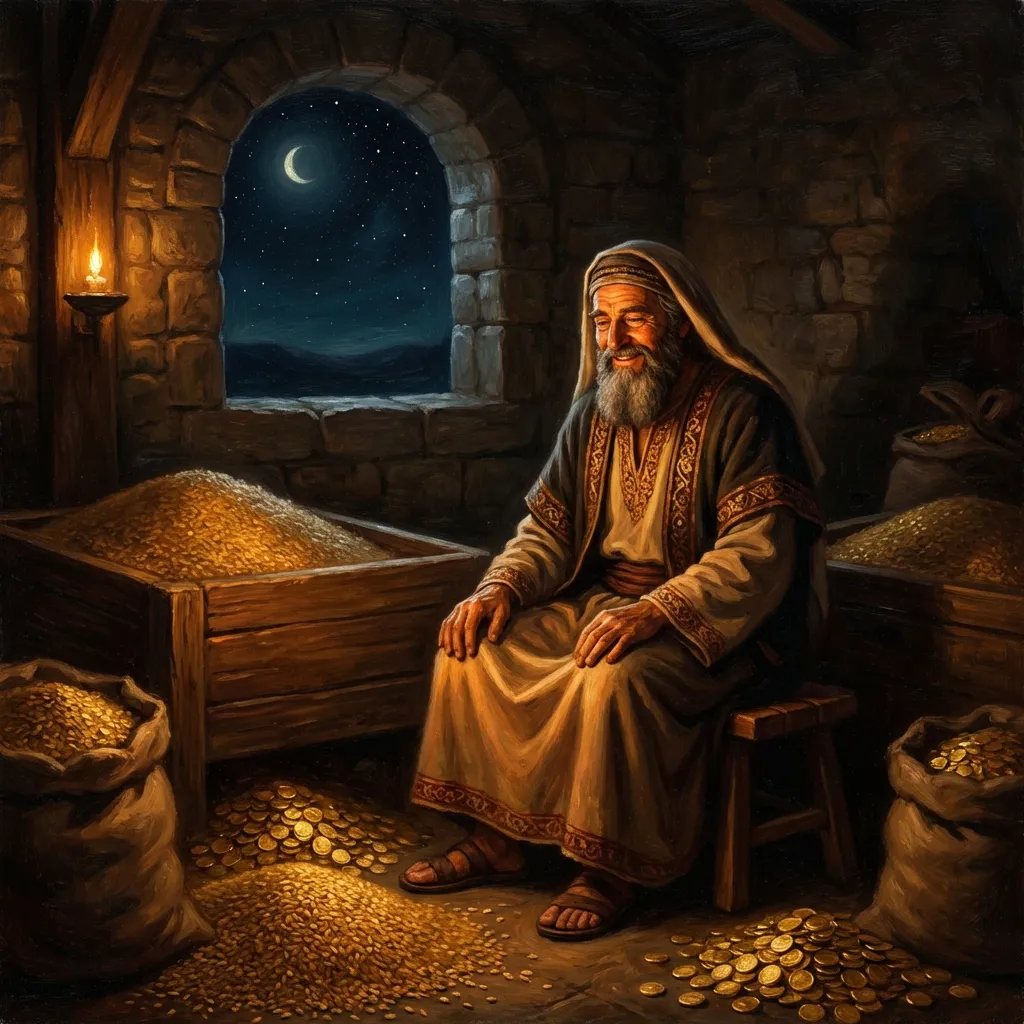
In Luke 12:13-21, Jesus Christ delivers one of His most piercing exposés on the deceitfulness of earthly wealth. Sparked by a petty family grievance over an inheritance, the Parable of the Rich Fool cuts through the superficial glitter of material success to unmask the existential peril of living for temporal security while bankrupt before the Creator.
1. The Disputed Inheritance and Christ's Refusal
The narrative opens in the middle of a bustling crowd where a man abruptly shouts: "Teacher, tell my brother to divide the inheritance with me" (Luke 12:13). In ancient Israel, rabbis frequently arbitrated property distributions governed by Mosaic ordinances (Deuteronomy 21:17). Yet Jesus unequivocally rejected the role of a civil magistrate: "Man, who made me a judge or an arbitrator over you?" Christ discerned that the root issue was not injustice, but the deadly grip of pleonexia—an insatiable craving for more. He immediately warned the multitude: "Watch out! Be on your guard against all kinds of greed; life does not consist in an abundance of possessions" (Luke 12:15).
2. The Bountiful Harvest and the Solitary Monologue
To crystallize His warning, Jesus introduced a prosperous landowner whose fertile estate yielded a superabundant harvest. The man faced a logistical dilemma: his existing barns were inadequate to contain the bounty. Rather than seeking counsel from God or rejoicing that he could now relieve the starving peasants around him, the man withdrew into an egoistic interior monologue: "What shall I do? I have no place to store my crops. Then he said, 'This is what I'll do. I will tear down my barns and build bigger ones, and there I will store my surplus grain. And I'll say to myself, "You have plenty of grain laid up for many years. Take life easy; eat, drink and be merry"'" (Luke 12:17-19). In four brief verses, he repeats 'I' and 'my' eleven times, revealing an isolated soul utterly blind to divine providence.
3. The Illusion of Self-Sufficiency and Physical Food for the Soul
The rich man committed a grave category error when addressing his inner being: "I will say to my soul (psychē)... you have many goods laid up for many years." The human soul, crafted in the divine image, cannot be nourished by wheat, barley, or fermented wine. He mistook economic security for existential peace. By congratulating himself on possessing 'many years,' he presumed upon time—a commodity exclusively held in the sovereign hand of God. His life was structured around self-gratification, comfort, and the absolute elimination of economic vulnerability through hoarding.
4. The Divine Audit: "Tonight Your Soul is Required"
The man's self-congratulatory reverie was violently shattered by the voice of God Almighty: "You fool! This very night your life will be demanded from you. Then who will get what you have prepared for yourself?" (Luke 12:20). The Greek verb for 'demanded' is apaiteō, an accounting term designating the calling in of a loan. God had loaned this man his breath, his intellect, his fertility of soil, and his life energy. At the appointed hour, the divine Creditor summoned the debtor for an unannounced audit. The immense barns remained standing, packed to the rafters, but the owner departed into eternity as a penniless pauper.
5. Rich Toward God: The Eternal Imperative
Jesus sealed the parable with a sweeping verdict: "This is how it will be with whoever stores up things for themselves but is not rich toward God" (Luke 12:21). The sin of the rich fool was not that he was wealthy, nor that his soil produced abundantly. His tragedy lay in his inverted values: he treated the gift as his god and ignored the Giver. True biblical wisdom commands that earthly abundance be invested in kingdom righteousness, benevolence toward the destitute, and trust in the living God. The barns of earth inevitably crumble, but treasures laid up in heaven endure forever.
Biblical Keywords & Theological Roots
Senseless, foolish, lacking spiritual perspective; someone who acts without moral wisdom or eternal foresight.
Covetousness, ruthless greed, an insatiable desire to have more at the expense of spiritual and communal duties.
Storehouse, barn, repository; an earthly silo built to hoard perishable grain while neglecting heavenly riches.
Ancient Near Eastern & Archaeological Context
In first-century Roman-occupied Judea and Galilee, wealth was predominantly agrarian. Landowners accumulated substantial fortunes through wheat, barley, olive oil, and wine. Granaries were commonly constructed as deep underground pits lined with lime plaster or as thick mudbrick storehouses to guard against moisture, rodents, and bandits. Inheritance was governed strictly by Deuteronomy 21:17, where the eldest son received a double portion. Rabbis routinely acted as legal arbiters in estate squabbles, but Jesus explicitly refused to enter mundane civil litigation, exposing instead the lethal spiritual greed (*pleonexia*) driving the dispute.
🔑 Key Spiritual Takeaways
- Life Transcends Possessions: A person's true life does not consist in the abundance of their possessions or temporal achievements.
- The Illusion of Longevity: Presuming upon tomorrow is spiritual folly; human life is a fleeting vapor entirely sustained by divine sovereign breath.
- Hoarding vs Stewardship: God blesses individuals with abundance not to inflate their personal barns, but to be channels of charity to the needy.
- The Sudden Reckoning: Death acts as an impartial auditor that strips away all worldly titles and leaves only spiritual treasures before the Throne.
Support Independent Biblical Research
Did this study bless you? Help support our independent bilingual research and interactive visual Bible tools.
⚡ Fast Facts
- Inheritance Dispute Trigger: Jesus uttered this parable when a listener in the crowd shouted: 'Teacher, tell my brother to divide the inheritance with me' (Luke 12:13).
- Soul Requisition: The Greek word for 'required' (apaiteō, Luke 12:20) is a commercial banking term used for calling in an overdue loan—God abruptly audits the soul.
- Monologue of Self-Absorption: In four brief verses (Luke 12:17-19), the rich man uses first-person pronouns ('I', 'my') no fewer than eleven times, without mentioning God or his neighbors.
- Rich Toward God: The tragic punchline contrasts earthly silos filled with perishable crops against true heavenly equity earned through generosity and faith.
❓ Frequently Asked Questions (FAQs)
Why did God call the rich man a 'fool' when he was simply being prudent?
The Bible does not condemn hard work or agricultural success; God called him a fool because he made three fatal spiritual miscalculations: he assumed his soul could be fed with physical grain, he arrogated absolute control over his future lifespan, and he hoarded divine abundance for self-indulgence rather than being a generous steward toward God and his impoverished neighbors.
What does it mean to be 'rich toward God' according to Christ?
To be rich toward God (Luke 12:21) means investing one's earthly treasures, time, and abilities into eternal realities—such as caring for the poor, advancing God's Kingdom, cultivating Christlike virtues, and relying upon God's providence rather than material wealth as one's ultimate security.
What is the difference between biblical savings and the hoarding of the rich fool?
Scripture commends prudent savings and diligence (Proverbs 6:6-8; 1 Timothy 5:8), but the rich fool's posture was marked by arrogant self-sufficiency, covetous isolation, exclusion of God from his plans, and a refusal to share his windfall harvest with a needy community.