The sprawling encampment of Israel rested at Kadesh-Barnea, a lush desert oasis nestled against the jagged limestone escarpments of the Wilderness of Paran. For over a year, the former Hebrew slaves had journeyed from the blood-stained doorposts of Goshen to the blazing precipices of Mount Sinai, receiving the fiery Law, constructing the golden Tabernacle, and witnessing the glorious descent of the Shekinah cloud. Now, standing at the southern gateway of Canaan, the horizon beckoned. The Promised Land—sworn by unconditional covenant to Abraham, Isaac, and Jacob centuries earlier—lay merely days away. Divine destiny hung in the desert breeze.
At the people's urging, and by divine permission, Moses instituted a strategic reconnaissance mission: "Send men to spy out (tur) the land of Canaan, which I am giving to the children of Israel; from each tribe of their fathers you shall send a man, every one a leader among them" (Numbers 13:2). These twelve men were not green recruits; they were recognized tribal chieftains, men of stature and military renown. Among them stood Caleb, the son of Jephunneh, of the royal tribe of Judah, and Oshea, the son of Nun, of the tribe of Ephraim, whom Moses prophetically renamed Joshua (Yehoshua—"Yahweh is Salvation").
Moses gave them meticulous intelligence directives: penetrate the southern Negev, scale the central Judean hill country, assess the strength and numbers of the indigenous populations, inspect the fortifications of their cities, analyze the fertility of the soil, and bring back tangible specimens of the fruit of the land. "Be of good courage," Moses charged them, "and bring some of the fruit of the land."
The Forty-Day Exploration and the Heavy Vine of Eshcol
For forty grueling days, the twelve chieftains traversed the length of Canaan, trekking over 250 miles northward through the mountain ridges of Hebron, across the fertile plains of Shechem, past the Sea of Galilee, all the way to Lebo-Hamath near Mount Hermon. What they discovered confirmed the breathtaking veracity of God's Word. Canaan was a verdant, sun-kissed paradise—an agricultural wonderland of terraced olive orchards, golden wheat fields, fig groves, and pomegranate orchards fed by mountain springs and seasonal rains.
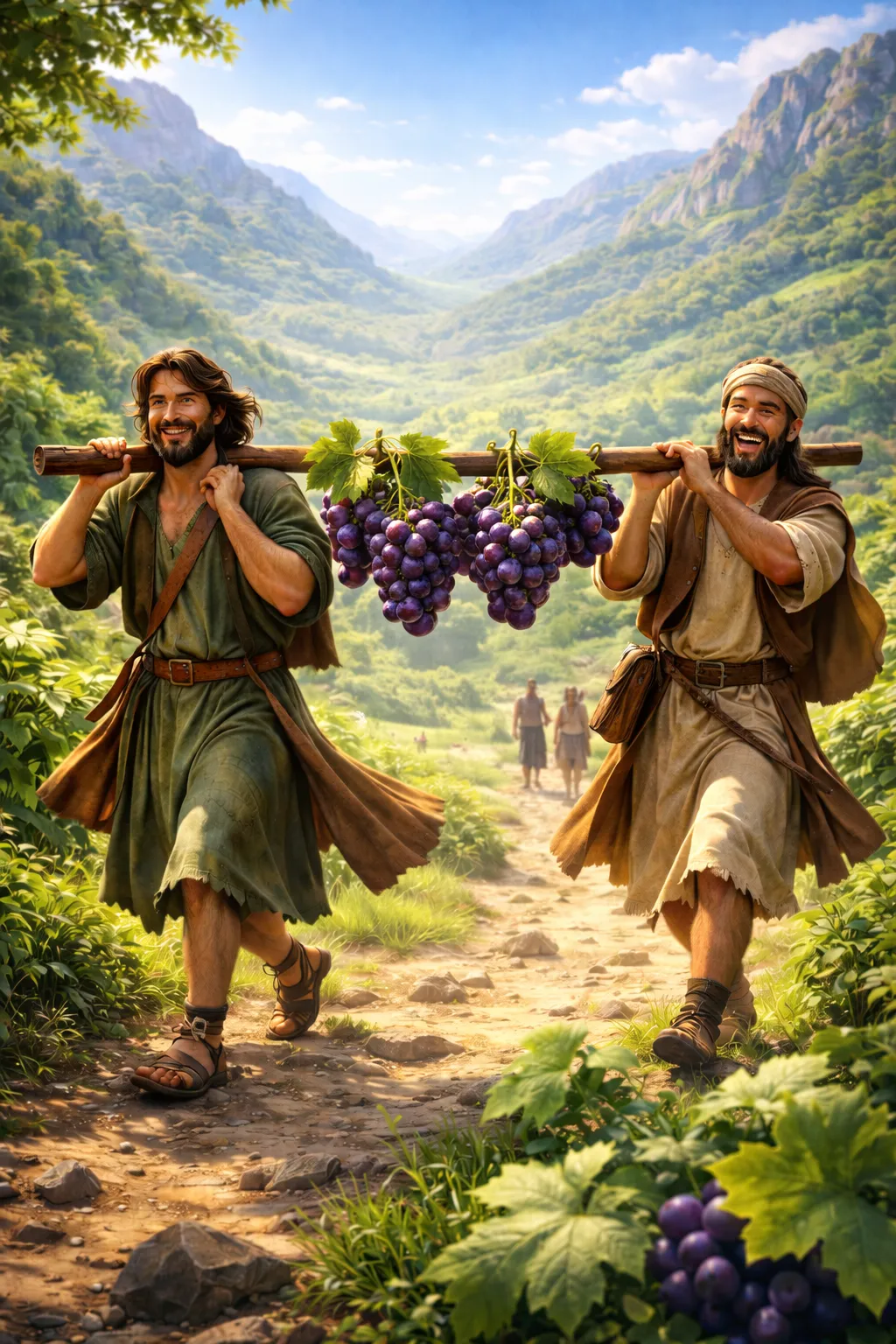
Approaching the Valley of Eshcol near ancient Hebron, the spies encountered viticulture of astonishing proportions. Cutting down a single branch bearing a solitary cluster of grapes (Eshcol), the fruit proved so colossal, dense, and heavy that it could not be carried by a single man without crushing the grapes. Threading a stout pole through the vine, two grown warriors had to hoist the staff upon their shoulders to transport the magnificent purple cluster back to camp, along with sweet pomegranates and fresh figs.
When the dust of their return settled at Kadesh-Barnea, the entire nation gathered in breathless anticipation. Displaying the glistening, heavy cluster of grapes before the elders, the scouts delivered their initial intelligence briefing: "We went to the land where you sent us. It truly flows with milk and honey, and this is its fruit" (Numbers 13:27). The promise of God was vindicated; Canaan was everything Yahweh had declared.

The Lethal "Nevertheless" and the Grasshopper Complex
Then, the fatal pivot occurred. In the very next breath, ten of the chieftains injected a word of toxic, paralyzing unbelief into the bloodstream of the nation: "NEVERTHELESS (Efes ki)... the people who dwell in the land are strong; the cities are fortified and very large; moreover we saw the descendants of Anak there. The Amalekites dwell in the land of the South; the Hittites, the Jebusites, and the Amorites dwell in the mountains; and the Canaanites dwell by the sea and along the banks of the Jordan" (Numbers 13:28-29).
Panic rippled through the multitude like an electric shock. Murmuring gave way to loud weeping. Seeing the camp on the verge of stampede, Caleb stepped forward with fiery, unwavering conviction. Stepping between the terrified multitude and the defeatist spies, Caleb quieted the people before Moses and thundered a battle cry that echoes across the centuries:
"Let us go up at once and take possession, for we are well able to overcome it!" (Numbers 13:30).
Caleb did not deny the reality of the fortified walls or the height of the warriors. But Caleb possessed an entirely different vantage point. He did not evaluate the giants in comparison to his own muscle; he evaluated the giants in comparison to the omnipotent God who had drowned Pharaoh's chariot army in the Red Sea. If Yahweh was with them, the battle was already won.
Yet the ten faithless spies shouted him down, escalating their defeatist propaganda into outright slander: "We are not able to go up against the people, for they are stronger than we!" And they gave the children of Israel a bad report of the land, declaring: "The land through which we have gone as spies is a land that devours its inhabitants, and all the people whom we saw in it are men of great stature. There we saw the giants (the descendants of Anak came from the giants); and we were like grasshoppers (chagavim) in our own sight, and so we were in their sight" (Numbers 13:31-33).
Here was the birth of the Grasshopper Complex—the lethal psychological disease of unbelief. By removing God from the calculation, the ten spies reduced themselves to puny, defenseless insects. Their spiritual cowardice warped their perception; because they felt like grasshoppers in their own sight, they projected that inferiority into the minds of their enemies. Unbelief made the giants look like gods and made God look like a liar.
The Night of Weeping and the Stone-Throwing Mob
That night, the camp of Israel succumbed to complete emotional and spiritual anarchy. Scripture records that "all the congregation lifted up their voices and cried, and the people wept that night" (Numbers 14:1). Tears of self-pity turned into mutinous rage. A chorus of bitter blasphemy rose against Moses and Aaron: "If only we had died in the land of Egypt! Or if only we had died in this wilderness! Why has Yahweh brought us to this land to fall by the sword, that our wives and children should become victims? Would it not be better for us to return to Egypt?"
Then came the ultimate treason: "So they said to one another, 'Let us select a leader and return to Egypt!'" (Numbers 14:4). They were ready to repudiate the Passover, dismantle the Tabernacle, spit upon the blood of the covenant, and march back into the slave pits of Pharaoh.
Moses and Aaron fell on their faces before the entire assembly in agonizing grief. Suddenly, Joshua and Caleb tore their garments in sacred fury, stepping into the center of the howling mob with an impassioned plea:
"The land we passed through to spy out is an exceedingly good land. If Yahweh delights in us, then He will bring us into this land and give it to us, 'a land which flows with milk and honey.' Only do not rebel against Yahweh, nor fear the people of the land, for they are our bread; their protection has departed from them, and Yahweh is with us. Do not fear them!" (Numbers 14:7-9).
Their logic was breathtakingly audacious: the terrifying giants were not insurmountable monsters; they were "our bread"—mere food to be devoured by God's victorious host! Their demonic protective shadow (*tsilam*) had been stripped away by heaven. But the blind, terrified mob would hear none of it. A savage shout arose across the camp: "Stone them with stones!"
The Sudden Glory and the Forty-Year Verdict
Just as the first heavy stones were being lifted to smash the skulls of Joshua, Caleb, and Moses, the Almighty intervened:
"Now the glory of Yahweh appeared in the tabernacle of meeting before all the children of Israel" (Numbers 14:10).
A blinding flash of supernatural luminescence erupted from behind the veil, freezing the murderous mob in their tracks. The voice of God spoke to Moses with terrifying wrath: "How long will these people reject Me? And how long will they not believe Me, with all the signs which I have performed among them? I will strike them with the pestilence and disinherit them, and I will make of you a nation greater and mightier than they."
Once again, Moses stood in the breach. Appealing not to Israel's non-existent righteousness, but to God's holy reputation among the nations and the immutable revelation of His covenant character given at Mount Sinai, Moses prayed:
"Yahweh is slow to anger and abundant in lovingkindness, forgiving iniquity and transgression... Pardon the iniquity of this people, I pray, according to the greatness of Your mercy, just as You have forgiven this people, from Egypt even until now" (Numbers 14:18-19).
God answered with majestic pardon mingled with unbending justice: "I have pardoned, according to your word; but truly, as I live, all the earth shall be filled with the glory of Yahweh!" The covenant was preserved, but the guilty generation would not escape the harvest of their unbelief. God pronounced the sovereign sentence:
"According to the number of the days in which you spied out the land, forty days, for each day you shall bear your guilt one year, namely forty years, and you shall know My rejection. I, Yahweh, have spoken this... In this wilderness they shall be consumed, and there they shall die" (Numbers 14:34-35).
Every single man of war aged twenty years and older who had murmured against the Lord was sentenced to wander in circles until his carcass dropped into the desert sand. Not one of them would set foot in Canaan—save two men. Joshua the son of Nun and Caleb the son of Jephunneh were singled out by God for an eternal inheritance: "Because My servant Caleb has a different spirit (Ruach Achereth) in him and has followed Me fully, I will bring him into the land where he went, and his descendants shall inherit it" (Numbers 14:24).
Judgment fell instantly upon the instigators. The ten spies who brought the evil report were struck dead by a sudden, supernatural plague before the presence of the Lord. The weeping nation then compounded their sin by attempting a presumptuous, unauthorized military assault against the Amalekites in the hill country without the Ark or Moses; they were routed like chaff and slaughtered down to Hormah.
The tragedy of Kadesh-Barnea stands as the supreme biblical warning against unbelief (Hebrews 3:7-19). It demonstrates that faith is not the absence of giants, but the presence of God that dwarfs all giants. While an entire generation wasted their lives marching in circles around the wilderness graves of their own doubts, Caleb and Joshua proved that those who possess a "different spirit"—a spirit that measures every obstacle against the sovereign majesty of Almighty God—will inherit every promise sworn by the Lord.
Biblical Keywords & Theological Roots
To scout, spy out, explore, reconnoiter, or search out thoroughly; used of traversing unfamiliar terrain with strategic military and agricultural assessment.
A cluster, bunch of grapes, or pendant vine fruit; specifically the valley near Hebron where a single grape cluster was so massive it had to be suspended on a pole between two men.
Long-necked ones or giants; a towering, warlike clan descended from Arba inhabiting the hill country of Hebron, striking absolute panic into the faint-hearted spies.
Grasshoppers or locusts; an evocative idiom expressing complete psychological defeat, self-diminution, and perceived insignificance before formidable adversaries.
A different spirit; the supernatural disposition of courageous, wholehearted faith that distinguished Caleb from the cowardly, faithless majority.
Ancient Near Eastern & Archaeological Context
Kadesh-Barnea (*Ein el-Qudeirat*), the largest spring-fed oasis in the northern Sinai/Negev desert, served as the strategic staging ground for Israel's military reconnaissance into southern Canaan. Archaeological excavations across Middle and Late Bronze Age Canaanite sites—such as Tel Hebron, Hazor, and Jericho—confirm that city-states featured cyclopean stone fortifications, massive earthen glacis ramparts, and imposing watchtowers measuring up to thirty feet in height, designed to repel invading armies. The 'Anakim' (*sons of Anak*) were a legendary, tall ethnic group inhabiting the Hebron ridge (*Wadi al-Khalil*), known for intense viticulture where optimal climatic conditions in the limestone terraced hills produced exceptionally massive grape clusters. Confronted by these fortified city-states and elite warrior aristocracies (*chariot-driving maryannu*), the former Hebrew slave population experienced severe psychological collapse.
Practical Discipleship & Spiritual Application
- Shattering the Grasshopper Complex with God's Sovereignty: Ten spies measured the giants against their own puny human strength and concluded defeat was certain. Joshua and Caleb measured the giants against Almighty God and concluded victory was guaranteed. Never evaluate God in light of your problems; evaluate your problems in light of God.
- Beware of the Spiritual Infection of the 'Nevertheless': The ten spies acknowledged that the land flowed with milk and honey, but immediately nullified God's promise with 'Nevertheless, the people are strong...' (Numbers 13:28). Do not allow human 'howevers' to cancel divine certainties in your walk of faith.
- Cultivating a 'Different Spirit' to Stand in the Minority: God commended Caleb because he had 'a different spirit in him and followed Me fully' (Numbers 14:24). True faith is willing to stand in the minority, even when the angry multitude picks up stones to silence you.
- The Tragic Generational Cost of Delayed Obedience: Israel's refusal to step into Canaan at Kadesh-Barnea doomed an entire generation to wander forty years in a circle and die in the wilderness dust. When God opens a door of promise, step through it immediately; presumption tomorrow cannot redeem the disobedience of today.
⚡ Fast Facts
- The twelve spies scouted the land of Canaan for exactly 40 days, traveling approximately 250 miles from the Negev to Lebo-Hamath.
- The cluster of grapes cut from the Valley of Eshcol was so heavy that it had to be suspended on a carrying pole borne between two men.
- Joshua (Oshea) of Ephraim and Caleb of Judah were the only two spies out of twelve who brought back an encouraging, faithful report.
- Because of Israel's rebellion, God sentenced the nation to wander in the wilderness for 40 years—a year for each day the spies explored the land.
❓ Frequently Asked Questions (FAQs)
God did not punish Israel merely for the private opinion of ten scouts; He judged the nation because the entire congregation willingly adopted, amplified, and surrendered to their toxic unbelief. Numbers 14:1-4 records that the entire assembly wept all night, murmured against Moses and Aaron, blasphemed God by claiming He brought them to Canaan to be slaughtered, and actively organized an insurrection to appoint a new captain and return to Egyptian bondage. The ten spies were the spark, but the nation's faithless heart provided the dry tinder. In divine justice, God granted them precisely what their unbelief demanded: 'As you have spoken in My hearing, so I will do to you: the carcasses of you who have complained against Me shall fall in this wilderness' (Numbers 14:28-29).
The 'Grasshopper Complex' is captured in Numbers 13:33: 'We saw the giants there... and we were like grasshoppers in our own sight, and so we were in their sight.' It represents a catastrophic theological blindness wherein believers evaluate external obstacles solely against their frail human abilities, leaving God completely out of the equation. By looking at the towering Anakim rather than the Almighty Lord who split the Red Sea and shattered Pharaoh's empire, Israel diminished themselves into helpless insects. This psychological inferiority paralyzed their faith, turned blessings into terrors, and caused them to view the Promised Land as a graveyard rather than an inheritance.
After God pronounced the forty-year sentence, the people mourned greatly and presumptuously declared: 'Here we are, and we will go up to the place which Yahweh has promised, for we have sinned!' (Numbers 14:40). Moses warned them that this was further rebellion: 'Do not go up, lest you be defeated by your enemies, for Yahweh is not among you.' True repentance yields to divine discipline; presumptuous self-will attempts to force God's hand on human timing. Israel marched up without the Ark of the Covenant and without Moses. Deprived of divine favor, they were routed like chaff by the Amalekites and Canaanites, pursued and beaten down all the way to Hormah.