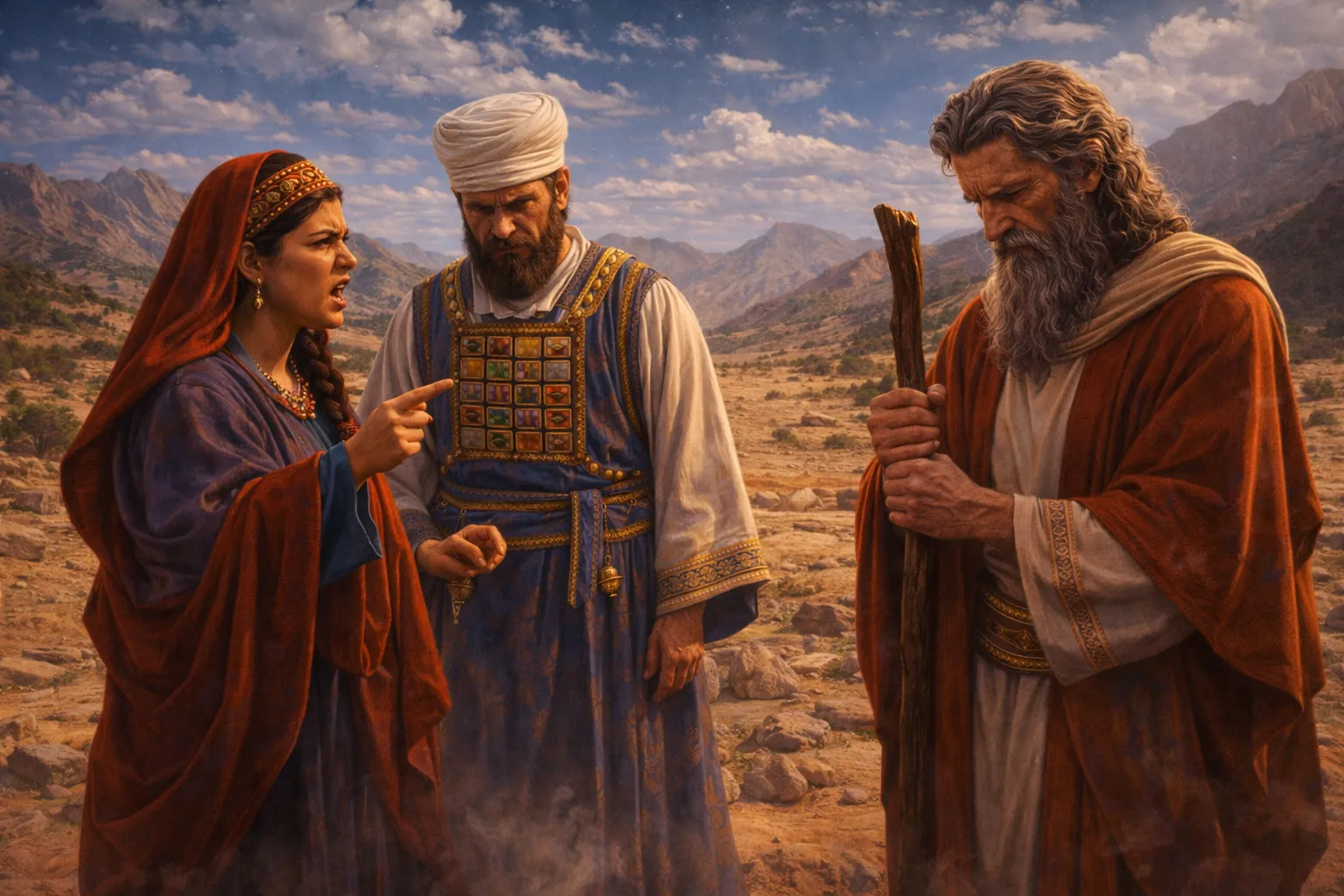
Leaving the blackened slopes of Mount Sinai and traversing the scorching sands of the Wilderness of Paran, the millions of Israel pitched their sprawling tent city at Hazeroth. Only days prior, the camp had been rocked by rebellious complaints at Taberah and the terrifying plague of greed at Kibroth-Hattaavah, where God had mercifully distributed the prophetic Spirit upon seventy elders to bear the crushing weight of leadership alongside Moses. Yet as the dust of national mutiny settled, a far more venomous, intimate treason erupted from the innermost circle of Moses' own household: a sibling rebellion led by Miriam and Aaron.
Miriam was no ordinary woman. She was the venerable prophetess who, eighty years earlier as a brave young maiden, had stood watch among the reeds of the Nile to save infant Moses from Pharaoh's crocodiles (Exodus 2:4-8). She had danced with the tambourine on the shores of the Red Sea, leading the daughters of Israel in anthems of triumph. Aaron was the consecrated High Priest of Yahweh, clothed in golden garments and bearing the names of the twelve tribes upon his breastplate. Together with Moses, they formed the foundational triumvirate of the Exodus: "For I brought you up from the land of Egypt, I redeemed you from the house of bondage; and I sent before you Moses, Aaron, and Miriam" (Micah 6:4).
The Pretext of the Cushite Bride and the Poison of Jealousy
Yet spiritual pedigree is no prophylactic against the corrupting rot of envy. Miriam and Aaron seized upon an intensely personal, cultural pretext to assault Moses' standing: "Then Miriam and Aaron spoke against Moses because of the Cushite woman whom he had married; for he had married a Cushite woman" (Numbers 12:1). Whether this bride was a recent marriage following the death of Zipporah or an insulting reference to Zipporah's desert Midianite lineage, their critique was cloaked in racial, cultural, and domestic prejudice.
However, the Holy Spirit immediately unmasks the true, demonic root beneath their domestic complaint. In the very next breath, their real motive burst forth from bitter lips: "Has Yahweh indeed spoken only through Moses? Has He not spoken through us also?" (Numbers 12:2). This was not about a bride from the Upper Nile; it was about supreme spiritual authority. Watching the seventy elders prophesy under Moses' auspices, Miriam and Aaron felt their exclusive family monopoly on power slipping away. Envy convinced them that their brother had grown too prominent, and they demanded equal footing in the divine council.
To this venomous fraternal attack, Scripture records the astonishing posture of Moses:
"(Now the man Moses was very humble, more than all men who were on the face of the earth.)" (Numbers 12:3).
Moses uttered not a single syllable in self-defense. He did not convene a tribunal, summon his loyal Levites, or remind his siblings of his heroic exploits before Pharaoh. True biblical meekness (anav) is not cowardly weakness; it is explosive power completely harnessed under sovereign divine control. Moses knew that his authority had not been seized by human ambition, but conferred by sovereign grace; therefore, he had no need to defend what God Himself had established. He kept silent and entrusted his soul to the Righteous Judge.
The Thunderous Summons from the Cloud
While Moses held his peace, heaven was incensed. Scripture records four chilling, decisive words: "And Yahweh heard it." Slander whispered behind closed tent flaps echoes like thunder before the celestial throne. Suddenly, without warning, the voice of the Almighty tore through the desert air:
"Suddenly Yahweh said to Moses, Aaron, and Miriam, 'Come out, you three, to the tabernacle of meeting!' So the three came out" (Numbers 12:4).
The summons was immediate, terrifying, and impossible to evade. Trembling with dread, the three siblings walked out into the open courtyard of the sanctuary before the watching eyes of the entire encampment. The pillar of cloud descended in majestic fury, standing at the door of the Tabernacle. From the billowing splendor, God called out: "Aaron and Miriam!" Both stepped forward, separated from Moses, standing exposed before the piercing gaze of their Maker.
Then God delivered an immortal dissertation on the unique stature of Moses:
"Hear now My words: If there is a prophet among you, I, Yahweh, make Myself known to him in a vision; I speak to him in a dream. Not so with My servant Moses; he is faithful in all My house. I speak with him face to face, even plainly, and not in dark sayings; and he sees the form of Yahweh. Why then were you not afraid to speak against My servant Moses?" (Numbers 12:6-8).
God drew a clear, sovereign distinction between ordinary prophetic revelation and Moses' intimate communion. Other prophets received divine truth mediated through enigmatic dreams, obscure riddles, and nocturnal visions that left them physically shattered. But Moses spoke with God "mouth to mouth" (Peh el-Peh)—in crystal-clear, unmediated daylight dialogue, beholding the radiant similitude of the Lord. For Miriam and Aaron to drag this faithful steward down to their own competitive level was an act of breathtaking sacrilege.
The Snow-White Curse of Leprosy
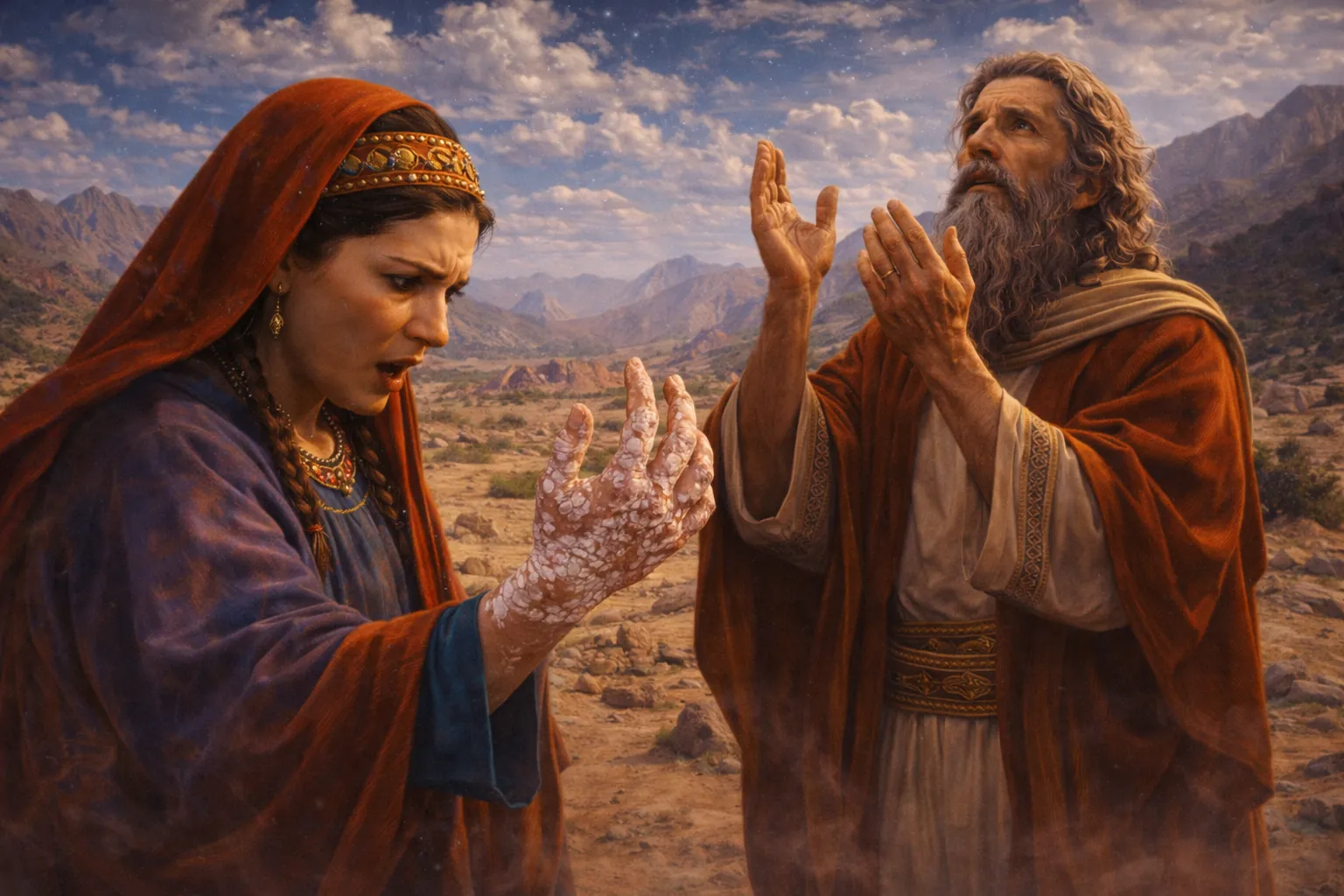
The anger of Yahweh was kindled hot against them, and the divine presence departed. But as the glorious cloud lifted from above the Tabernacle door, Aaron turned to look upon his sister—and froze in horror. Miriam's flesh had suddenly become white as snow, covered from head to toe in the rotting, necrotic scales of virulent leprosy (Tzara'ath)!
The punishment bore terrifying poetic justice. Miriam, who had prided herself on racial and spiritual purity while looking down upon Moses' bride, was now struck with the ultimate ritual defilement—a living corpse whose rotting flesh rendered her unclean and untouchable under the very Law she claimed to represent. Her pride had transformed the revered prophetess into an outcast monstrosity.
Aaron was completely broken. Falling upon his knees before his younger brother, the High Priest cast aside all pretensions of equality, addressing Moses with trembling reverence: "Oh, my lord! Please do not lay this sin upon us, in which we have done foolishly and in which we have sinned! Please do not let her be as one dead, whose flesh is half consumed when he comes out of his mother's womb!" Aaron was forced to recognize that the brother he had slandered was his only hope of salvation.
The Five-Word Cry of Redeeming Mercy
This was Moses' moment of ultimate vindication. A carnal leader would have gloated, reminding Miriam of her biting words or demanding a groveling public apology before lifting a finger. But Moses demonstrated the pure, spotless heart of Christ. Without a second's hesitation, without an ounce of bitterness, Moses cried out to heaven in a desperate, five-word Hebrew intercession:
"El na repha na lah!"
("O God, please heal her, please!" — Numbers 12:13).
It was one of the shortest, yet most powerful prayers in redemptive history. Moses did not ask for judgment; he begged for restoration (rapha). He absorbed the personal insult, transformed it through the alchemy of grace, and stood between his dying sister and the righteous wrath of God.
Yahweh answered Moses' cry, staying the permanent destruction of the leprosy. Yet divine discipline required public acknowledgment of sin. God declared: "If her father had but spit in her face, would she not be shamed seven days? Let her be shut out of the camp seven days, and after that she may be received again."
For seven agonizing days, the proud prophetess of Israel sat quarantined outside the perimeter of the camp, bearing the lonely shame of her rebellion in the dust of the wilderness. And in a profound display of corporate solidarity and sobering reverence, the entire host of Israel—all twelve tribes, nearly two million people—refused to march forward. The entire journey of redemption came to a dead halt until Miriam was cleansed, humbled, and restored.
The rebellion at Hazeroth stands as a perpetual warning across church history against the lethal cancer of spiritual jealousy, gossip, and rebellion against God's anointed servants. It proves that God hears every whisper uttered in secret tents, and that He will jealously guard the honor of His faithful stewards. Above all, it radiates the beauty of biblical meekness in Moses—the servant who refused to avenge himself, pointing forward to the ultimate Prophet, Jesus Christ, who when He was reviled, reviled not again, and who from the bloody wood of Calvary prayed for His executioners: "Father, forgive them, for they know not what they do."
Biblical Keywords & Theological Roots
A Cushite woman, originating from the land of Cush (Nubia/Upper Nile or associated desert Midianite territory); used as a cultural pretext for sibling slander.
Meek, humble, gentle, or completely yielded; describing Moses' profound surrender of personal vindication and lack of retaliatory ego before God.
Mouth to mouth; a Hebrew idiom denoting unmediated, face-to-face, clear direct revelation without riddles, parabolic puzzles, or intermediate dreams.
A virulent, scaly, ritual skin disease or leprosy, rendering the sufferer ceremonially defiled and socially ostracized outside the holy camp.
To heal, restore, cure, or make whole; the root of Moses' passionate five-word intercessory cry: 'El na repha na lah' ('O God, please heal her, please!').
Ancient Near Eastern & Archaeological Context
Ancient Kush (modern Sudan/Nubia), located south of the First Cataract of the Nile, was renowned in Late Bronze Age Egyptian and Levantine records for its distinct African civilization, elite archery corps, and royal gold reserves. Moses' marriage to a Cushite woman (*Kushith*)—either a second wife taken following Zipporah's death or an ethnic appellation referencing Midianite-Cushite desert affinities (Habakkuk 3:7)—served as a xenophobic pretext for Miriam and Aaron to cloak their underlying entitlement. Hazeroth (*Ain Hudra*), characterized by limestone cliffs and isolated freshwater springs in the eastern Sinai peninsula, was an enclosed desert basin where internal social fractures could paralyze military movement. Ancient Near Eastern legal codes enforced strict segregation of individuals displaying communicative skin diseases outside defensive camp walls, making Miriam's public expulsion an agonizing social humiliation for Israel's revered senior prophetess.
Practical Discipleship & Spiritual Application
- Uprooting Spiritual Jealousy and Ministry Envy: Miriam and Aaron used Moses' marriage as a smokescreen to mask their resentment over his supreme authority. Guard your heart against comparing your spiritual giftings or influence with others in ministry.
- Cultivating Authentic Biblical Meekness: Meekness is not weakness; it is strength yielded to God. When slandered by his own siblings, Moses did not retaliate, post defenses, or argue. He stayed silent and allowed God to vindicate his integrity.
- God Hears Every Secret Whispering Slander: Scripture solemnly notes: 'Now Yahweh heard it' (Numbers 12:2). Slander is never private before heaven. Fear the Lord before murmuring against pastoral leadership or fellow believers in secret gossip.
- Interceding Passionately for Those Who Criticize You: The moment Miriam was struck with leprosy, Moses did not feel triumphant vindication. With zero malice or hesitation, he cried out to God for her complete healing. Repay slander with radical, redeeming love.
⚡ Fast Facts
- Miriam was Moses' older sister who had watched over his floating papyrus basket at the Nile riverbank eighty years earlier (Exodus 2:4-8).
- Scripture records that Moses was 'very humble, more than all men who were on the face of the earth' (Numbers 12:3).
- God declared that while He speaks to ordinary prophets through visions and dreams, He speaks to Moses 'face to face' (mouth to mouth) and plainly.
- The entire nation of Israel refused to pack their tents or move forward for seven days until Miriam had completed her quarantine outside the camp.
❓ Frequently Asked Questions (FAQs)
Several biblical and historical factors explain this distinction: First, the Hebrew grammar of Numbers 12:1 employs a feminine singular verb (*va-tedabber* - 'and she spoke'), indicating that Miriam was the primary instigator and agitator of the mutiny, drawing a weaker Aaron into her grievance. Second, Aaron was the consecrated High Priest wearing the holy garments and bearing the sacred anointing oil; had he been struck with leprosy, he would have been instantly defiled, disqualified from the priesthood, and the entire sacrificial system of Israel would have collapsed. Aaron's judgment was psychological and priestly: he was forced to visually inspect his own sister's decaying, leprous flesh and beg Moses for her life, fully acknowledging his own foolish guilt.
Biblical meekness (*anav*) is never weakness, cowardice, or lack of conviction. Moses was a fierce leader capable of grinding golden calves and challenging empires. Rather, meekness in Scripture denotes a total surrender of personal self-defense and retaliatory ego. Moses never fought for his own personal rights or reputation; he fought only for God's glory. When his own family slandered his character and marriage, he uttered not a single word of rebuttal, allowing God alone to serve as his shield and judge.
Although God graciously answered Moses' prayer and halted the permanent ravages of the leprosy, divine justice required that the social and covenant discipline be carried out. God used a vivid cultural analogy: 'If her father had but spit in her face, would she not be shamed seven days?' (Numbers 12:14). Slandering the prophet of God was an act of high treason far graver than filial disrespect. The seven-day exclusion outside the camp served as a public lesson to the entire nation regarding the severity of murmuring against God's appointed leadership.