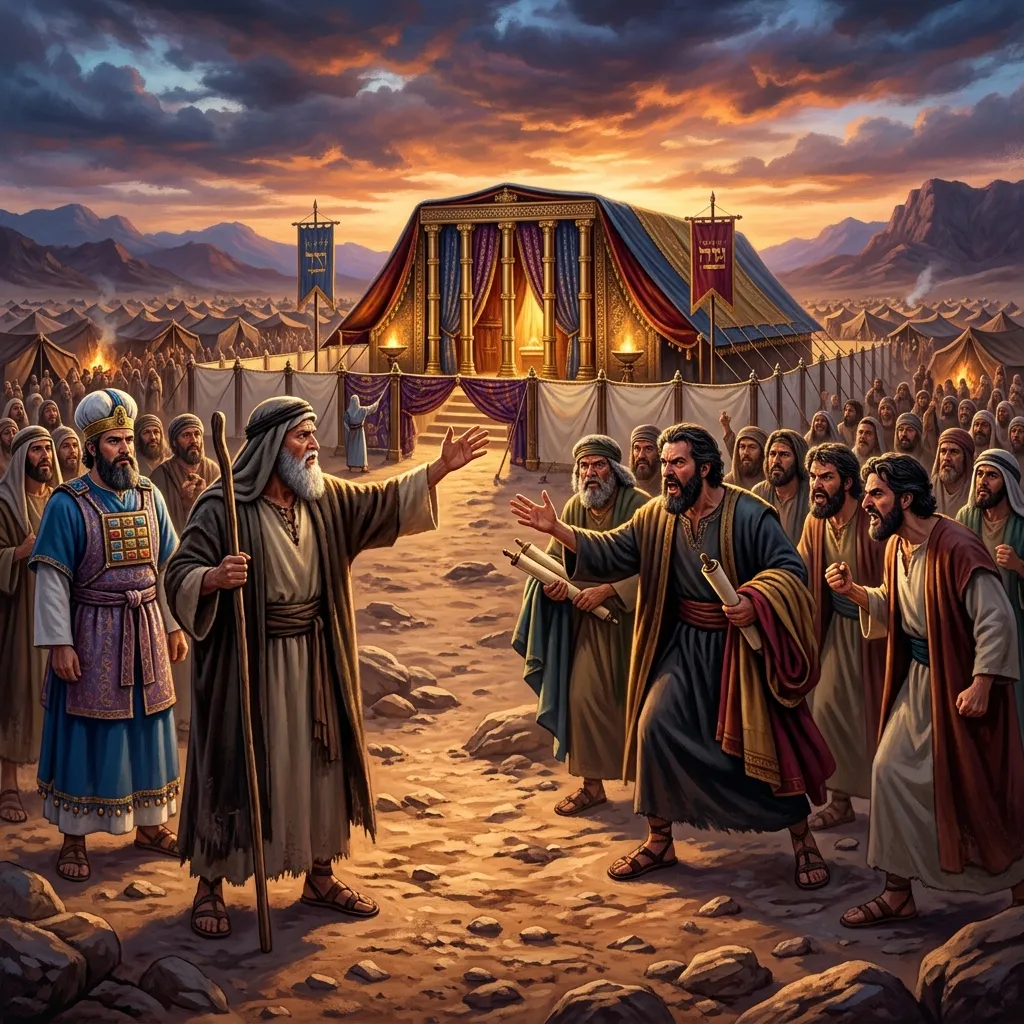
The wilderness of Paran was wrapped in an oppressive, brooding silence. Only weeks prior, at the border oasis of Kadesh-Barnea, the covenant congregation of Israel had committed spiritual treason. Paralyzed by the terrifying report of ten faithless scouts regarding walled Canaanite cities and towering Anakim, the assembly had wept in mutinous despair, demanded the appointment of a new captain to march back into Egyptian bondage, and attempted to stone their faithful leaders. In solemn, agonizing judgment, Yahweh had decreed that not a single member of that unbelieving generation from twenty years old and upward would set foot in the Promised Land. Their carcasses would rot in the sun-scorched desert sands through forty excruciating years of aimless wandering, until a new, circumcised generation arose in faith. The collective mood of the camp was toxic—steeped in grief, aimlessness, and subterranean resentment. And in that fertile soil of national disillusionment, the serpent of rebellion found an ambitious, smooth-tongued champion: Korah, son of Izhar.
Korah was neither a desperate rabble-rouser nor an ignorant slave. He was an aristocrat of the tribe of Levi, belonging to the elite Kohathite clan. While the Gershonites carried the fabric curtains and ropes of the Tabernacle in ox carts, and the Merarites hauled the heavy wooden frames and silver sockets, the Kohathites bore the most sacred treasures upon their own shoulders. When the camp broke, Aaron and his sons first covered the Ark of the Covenant, the golden Menorah, the Table of Showbread, and the Altar of Incense with dyed skins and azure cloths. Only then did the sons of Kohath step forward, lifting the gilded carrying poles to bear the very footstool of the Almighty through the trackless desert. It was an honor of breathtaking spiritual proximity. Yet for Korah, this sacred stewardship had curdled into bitter discontent. Why should Aaron and his direct sons alone enjoy the supreme privilege of the High Priesthood? Why should Aaron wear the breastplate of judgment, enter the Holy of Holies behind the veil on the Day of Atonement, and sprinkle the blood of bulls and goats upon the golden Mercy Seat? Was Korah not equally of Kohath’s noble bloodline? Furthermore, when Moses had organized the tribal administration, he had appointed Elizaphan, the son of Kohath’s youngest brother Uzziel, as the chief prince of the Kohathites, passing over Korah. Smoldering in pride and wounded vanity, Korah began organizing a sophisticated political coup d'état.
Korah did not act alone. He astutely allied himself with Dathan and Abiram, the sons of Eliab, and On the son of Peleth, all noblemen of the tribe of Reuben. Geographically, the camp of Reuben was pitched immediately south of the Tabernacle, directly adjacent to the encampment of the Kohathites. In the quiet darkness of the desert nights, conspiratorial whispers drifted between their tents. The Reubenites nursed their own ancestral grievance. Reuben was the firstborn of the patriarch Jacob, yet due to his ancient sin at Migdal-Eder, his primogeniture had been stripped away and transferred to Joseph and Judah. To the Reubenite nobility, Moses—a younger son of Levi—was an illegitimate dictator who had usurped executive sovereignty over all twelve tribes. Together, Korah and the Reubenite aristocrats orchestrated a formidable confederacy. They recruited two hundred and fifty men of renown: celebrated princes, tribal representatives, and distinguished elders of the sacred congregation. These were not drunken rioters; they were the intellectual, political, and judicial elite of Israel.
The conspiracy erupted with theatrical precision before the entrance of the Tabernacle. Flanked by the two hundred and fifty princes, Korah, Dathan, and Abiram confronted Moses and Aaron in a brazen display of defiance. Korah stepped forward as the populist spokesperson, cloaking his naked lust for supreme ecclesiastical power in the seductive rhetoric of egalitarian democracy. He hurled a thunderous accusation: "You take too much upon yourselves, seeing all the congregation are holy, every one of them, and Yahweh is among them! Why then do you exalt yourselves above the assembly of Yahweh?" (Numbers 16:3). The rhetoric was masterfully deceitful. Korah weaponized the glorious truth spoken by God at Mount Sinai—that Israel was to be a kingdom of priests and a holy nation—to demolish the God-ordained offices of mediator and high priest. By claiming that every individual was already completely holy and possessed equal direct access to the divine, Korah argued that any structural hierarchy, sacrificial boundary, or unique Aaronic priesthood was an oppressive, arrogant imposition.
When Moses heard these words, he did not summon the armed tribal guards of Joshua to strike down the mutineers, nor did he enter into a shouting match to defend his honor. In profound humility and holy terror, Moses fell flat upon his face before the Lord. He knew the terrifying purity of the God who had spoken out of the burning bush and descended upon Sinai in fire and smoke. Rising from the dust, Moses addressed Korah and his faction with prophetic clarity: "Tomorrow morning Yahweh will show who is His, and who is holy, and will cause him to come near to Him; even him whom He chooses He will cause to come near to Him" (Numbers 16:5). Moses then proposed a decisive ritual duel that would settle the controversy once and for all: "Do this: take censers, Korah and all your company; put fire in them and put incense on them before Yahweh tomorrow; and it shall be that the man whom Yahweh chooses shall be the holy one. You take too much upon yourselves, you sons of Levi!"
Turning directly to Korah, Moses exposed the rancid roots of the Levite’s spiritual entitlement: "Hear now, you sons of Levi: Is it a small thing to you that the God of Israel has separated you from the congregation of Israel, to bring you near to Himself, to do the work of the Tabernacle of Yahweh, and to stand before the congregation to serve them? And He has brought you near to Himself, and all your brethren the sons of Levi with you; and are you seeking the priesthood also?" Moses made it unequivocally plain that Korah’s quarrel was not with two mortal men, but with Almighty God: "Therefore you and all your company are gathered together against Yahweh! And what is Aaron, that you complain against him?"
Moses then dispatched a formal summons to Dathan and Abiram, urging them to appear before him to seek reconciliation. But the Reubenite rebels refused with venomous insolence: "We will not come up! Is it a small thing that you have brought us up out of a land flowing with milk and honey, to kill us in the wilderness, that you should keep acting like a prince over us?" (Numbers 16:12–13). Their words were breathtakingly blasphemous. They inverted divine truth, describing the brutal, child-murdering empire of Egypt as a land flowing with milk and honey, while depicting Moses as a deceitful tyrant who had dragged them into the arid wilderness to slaughter them. "Moreover you have not brought us into a land flowing with milk and honey, nor given us inheritance of fields and vineyards. Will you put out the eyes of these men? We will not come up!" Moses was deeply grieved, crying out to Yahweh: "Do not respect their offering! I have not taken one donkey from them, nor have I hurt one of them!"
The following dawn broke with chilling foreboding across the desert plain. At the appointed hour, Korah assembled his entire company before the courtyard gate of the Tabernacle. Each of the two hundred and fifty rebel leaders stood proudly, gripping a shallow bronze censer filled with glowing coals upon which sweet ritual incense smoldered, sending plumes of aromatic white smoke curling into the morning sky. Beside them stood Aaron, bearing his own consecrated censer, while Moses stood steadfast in the presence of the Lord. Korah had not merely assembled his fellow conspirators; he had riled up the entire multitude of Israel, drawing an enormous crowd to witness what they believed would be the humiliation and deposition of Moses. Suddenly, the atmospheric pressure shifted violently. The blinding, unapproachable Shekinah glory of Yahweh flashed forth from within the Tabernacle, illuminating the entire encampment like a supernova of divine majesty.
The voice of Yahweh thundered directly to Moses and Aaron: "Separate yourselves from among this congregation, that I may consume them in a moment!" Once again, true pastoral love conquered personal offense. Instead of rejoicing that their slanderers would be annihilated, Moses and Aaron fell on their faces in desperate intercession: "O God, the God of the spirits of all flesh, shall one man sin, and You be angry with all the congregation?" (Numbers 16:22). God heard the cry of His faithful servants and commanded: "Speak to the congregation, saying, 'Get away from around the tents of Korah, Dathan, and Abiram!'"
Moses rose immediately and walked purposefully toward the residential sector of the camp where Dathan and Abiram resided, followed by the seventy elders of Israel. Approaching the perimeter of their dwellings, Moses shouted a desperate warning to the gathered multitude: "Depart now from the tents of these wicked men! Touch nothing of theirs, lest you be consumed in all their sins!" Terrified by the deadly earnestness in Moses' voice, the crowd surged backward, clearing a wide, empty expanse around the tents. Dathan and Abiram, utterly hardened in their arrogance, stepped out and stood insolently in the open doorways of their tents, surrounded by their wives, their sons, and their little children, sneering at the prophet.
Moses raised his hands toward the heavens and pronounced the most dreadful divine trial recorded in the Pentateuch: "By this you shall know that Yahweh has sent me to do all these works, for I have not done them of my own will. If these men die naturally like all men, or if they are visited by the common fate of all men, then Yahweh has not sent me. But if Yahweh creates a new thing—a Beri'ah—and the earth opens its mouth and swallows them up with all that belongs to them, and they go down alive into Sheol, then you will understand that these men have rejected Yahweh!" (Numbers 16:28–30).
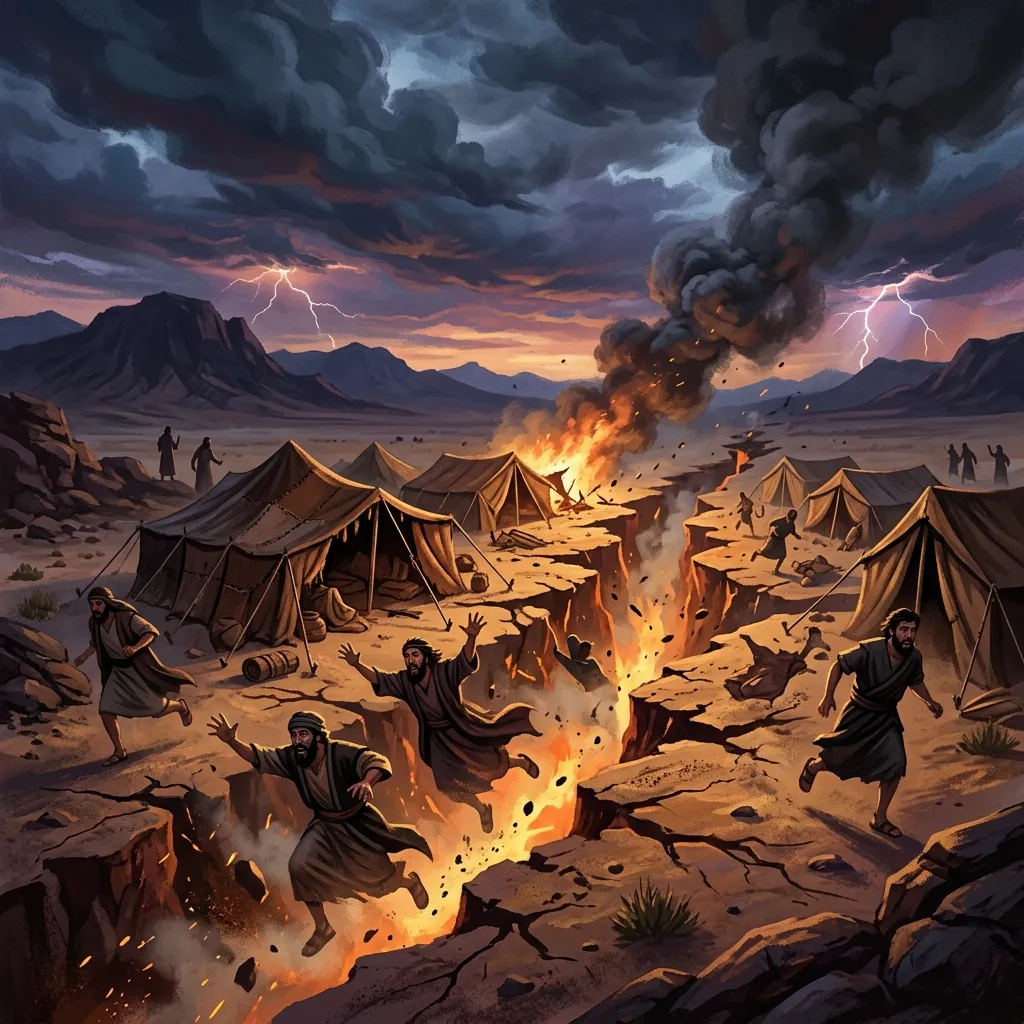
The final syllable had scarcely left Moses' lips when a deafening, subterranean roar tore through the foundations of the desert. The ground trembled with violent seismic fury. Right beneath the feet of Dathan, Abiram, and the dwelling of Korah, the bedrock of the earth split wide open into a yawning, bottomless chasm. Screams of bloodcurdling horror pierced the desert air as the earth literally opened its mouth and swallowed them alive. Down into the black abyss plummeted the rebels, their screaming families, their ornate tents, and all their earthly possessions. Then, with sickening finality, the jagged jaws of the earth slammed shut over them. The ground leveled itself out; they vanished from the midst of the congregation, plunged straight into the silence of Sheol. At the sound of their dying screams, panic swept through the thousands of Israelites watching from the perimeter; shouting, "Lest the earth swallow us up also!", the entire nation fled in wild terror.
Simultaneously, back at the court of the Tabernacle, divine judgment struck with incandescent speed. A supernatural torrent of fire erupted from the presence of Yahweh, consuming the two hundred and fifty princes of Israel who were offering unauthorized incense. In a split second, their proud bodies were incinerated to ash, leaving two hundred and fifty glowing bronze censers clattering upon the blood-stained pavement. Yahweh then commanded Moses to instruct Eleazar, the son of Aaron the high priest, to gather those very censers from the burning embers, scatter the unholy coals far away, and beat the consecrated bronze into broad, hammered plates to overlay the great Brazen Altar. It stood as a permanent, tactile memorial before Israel: never again should any unauthorized person, not of the seed of Aaron, dare to approach the altar of God with strange fire, lest he share the dreadful fate of Korah and his company.
Yet the depravity of human nature is so profound that even this catastrophic demonstration of divine holiness failed to eradicate rebellion. The very next morning, the surviving congregation gathered in mutinous fury against Moses and Aaron, shouting: "You have killed the people of Yahweh!" (Numbers 16:41). Instantly, the cloud covered the Tabernacle and the wrath of God broke out as an invisible, lethal plague sweeping through the camp like wildfire. People began dropping dead by the thousands. Moses cried out to Aaron: "Take a censer and put fire in it from the altar, put incense on it, and take it quickly to the congregation and make atonement for them; for wrath has gone out from Yahweh! The plague has begun!"
Aaron did not hesitate. Forgetting the slander, the treason, and the hatred directed at him, the elderly high priest took burning coals from the altar, cast sweet incense upon them, and sprinted with all his strength into the midst of the collapsing assembly. The smoke of the censer rose between the living and the dead. Standing as a frail, human bulwark between the righteous fury of God and a dying nation, Aaron offered atonement. Where the incense smoke billowed, the angel of death stopped. Fourteen thousand seven hundred people lay dead upon the sand, but through the sacrificial, loving intercession of the high priest whom they had despised, the nation was preserved from utter extermination. The rebellion of Korah remains an eternal beacon of warning across redemptive history: God's holiness cannot be bargained with, His ordained order cannot be subverted, and salvation is found only through the interceding High Priest who stands between the living and the dead.
Biblical Keywords & Theological Roots
Korah, meaning 'baldness', 'frost', or 'ice'; son of Izhar, the Kohathite Levite whose factional entitlement, intellectual arrogance, and populist mutiny brought catastrophic destruction.
'You take too much upon yourselves!' or 'Enough of you!'; an aggressive Hebrew idiomatic expression accusing divine leadership of unwarranted tyranny and self-exaltation.
A newly created thing, a divine novelty, or an unprecedented supernatural phenomenon; from the primordial root *bara* (to create *ex nihilo*), indicating God fashioning an entirely new geological act of judgment.
To swallow up, engulf, devour alive, or submerge entirely; describing the gaping abyss of the fractured earth swallowing the rebels, their tents, and their possessions without a trace.
A bronze firepan, censer, or brazier; shallow ritual vessels used to carry burning charcoal and sweet incense before Yahweh, later beaten into hammered plating for the altar.
Ancient Near Eastern & Archaeological Context
The rebellion of Korah occurred in the strategic wilderness perimeter following the demoralizing defeat at Hormah and the sentencing of Israel to forty years of nomadic wandering. In Ancient Near Eastern clan sociopolitics, tribal genealogies governed strict territorial allotments and cultic responsibilities. Korah belonged to the elite Kohathite clan of Levi, entrusted with the most sacred task of physically transporting the holy ark, altars, and golden vessels of the Tabernacle on their shoulders—yet he coveted the exclusive Aaronic high priesthood. Concurrently, Dathan and Abiram represented the tribe of Reuben, Israel's firstborn son whose primogeniture rights had been historically forfeited, fostering deep-seated resentment against Moses' leadership. Archaeological excavations of Middle and Late Bronze Age Levantine sanctuaries reveal hammered bronze and copper incense shovels (*firepans*) identical to the biblical *machtah*, used in sacred aromatic fumigation ceremonies to establish cultic legitimacy between rival priest-factions.
Practical Discipleship & Spiritual Application
- Guarding Against Insidious Ministerial Jealousy: Korah was already blessed with an extraordinary spiritual calling—bearing the sacred furniture of the Tabernacle. Yet contempt for his assigned boundary and covetousness for Aaron's office destroyed him. Learn to rejoice in your God-given portion rather than envying the public platforms of others.
- Discerning False Egalitarianism and Demagoguery: Korah masked his lust for personal power behind high-sounding spiritual rhetoric: 'All the congregation are holy!' (Numbers 16:3). Beware of ideological rebellion that feigns democratic humility to overthrow divine order and undermine biblical authority.
- The Power of Intercession Standing Between the Living and the Dead: When wrath broke out in a devastating plague against the murmuring assembly, Aaron did not harbor bitterness; he took his censer, sprinted into the midst of the dying multitude, and made atonement (Numbers 16:47–48). True spiritual leaders risk their lives to preserve the very people who slandered them.
- Memorials of Divine Warnings Preserved in Plain Sight: The bronze censers of the 250 incinerated leaders were beaten into broad plates to cover the brazen altar—a perpetual visual reminder that unauthorized approach to God leads to death. Never forget the sobering boundaries of God's holy presence.
⚡ Fast Facts
- Korah was Moses and Aaron's first cousin; his father Izhar and their father Amram were brothers, sons of Kohath (Exodus 6:18-21).
- Exactly 250 prominent princes, members of the sacred council of Israel, joined Korah's mutinous uprising with bronze censers.
- Eleazar the priest gathered the defiled censers of the incinerated rebels and beat them into hammered plating for the brazen altar.
- The devastating plague that struck the murmuring congregation the following morning killed 14,700 people before Aaron's intercession stayed it.
❓ Frequently Asked Questions (FAQs)
Korah operated from a toxic blend of genealogical entitlement, suppressed jealousy, and opportunistic populism. As a grandson of Kohath through Izhar, Korah held elite Levitical standing. However, when tribal leadership positions were assigned, Moses appointed Elizaphan, the son of Kohath's youngest brother Uzziel, to be chief over the Kohathite clan (Numbers 3:30), bypassing Korah. Feeling slighted and passed over, Korah festered in bitterness. Exploiting the nation's widespread depression after being banned from entering Canaan at Kadesh-Barnea, he weaponized egalitarian theological rhetoric—arguing that since the entire covenant nation had heard Yahweh's voice at Sinai, any hierarchical leadership by Moses or exclusive priesthood by Aaron was an act of tyrannical self-exaltation (Numbers 16:3).
Scripture explicitly reveals that Korah's sons did not perish with their rebellious father! Numbers 26:11 states with profound theological clarity: 'Nevertheless, the children of Korah did not die.' Unlike Dathan and Abiram, whose wives, toddlers, and entire households stubbornly stood at the tent doors in unified defiance and were swallowed alive, Korah's sons made a conscious spiritual break from their father's apostasy. Recognizing the lethal error of his rebellion, they submitted to God's holiness. Centuries later, the descendants of Korah became prominent Tabernacle doorkeepers, temple musicians, and the inspired composers of eleven sublime Psalms, including Psalm 42 ('As the deer pants for the water brooks'), Psalm 46 ('God is our refuge and strength'), and Psalm 84 ('How lovely is Your dwelling place').
In the New Testament Epistle of Jude, false teachers and apostates who infiltrate the church are warned: 'Woe to them! For they have gone in the way of Cain, have run greedily in the error of Balaam for profit, and perished in the rebellion of Korah' (Jude 1:11). Korah typifies those who refuse to submit to God's ordained spiritual authority, despising divine order while claiming superior spiritual enlightenment. Just as Korah offered unauthorized fire in brazen presumption and was incinerated, those who distort the Gospel of Jesus Christ and subvert apostolic doctrine bring sudden destruction upon themselves. The beaten bronze plates upon the altar served as an eternal sign that only the God-appointed Mediator—prefiguring Jesus Christ, our great High Priest—can approach the consuming fire of God's holy presence.