The sun crested the eastern desert ridge, bathing the limestone ramparts of Jerusalem in blinding, molten gold. It was the tenth day of the Jewish month of Nisan—the exact day when Mosaic law commanded every Hebrew household to select an unblemished yearling lamb for the Passover sacrifice (Exodus 12:3). Down through the valley of the Jordan, across the Judean hills, and into the crowded gates of the holy city, tens of thousands of white-fleeced lambs were being driven by Galilean shepherds. Yet unknown to the priests inspecting sacrificial animals in the temple courts, the true, uncreated Lamb of God, slain in the councils of eternity before the foundation of the world, was preparing to make His royal, public entrance into Zion.
Departing the hospitable olive terraces of Bethany, Jesus ascended the spine of the Mount of Olives until He reached the stone dwellings of Bethphage ('House of Unripe Figs'). Halting His disciples, the Lord issued a hyper-specific, prophetic command: 'Go into the village opposite you, and immediately you will find a donkey tied, and a colt with her. Loose them and bring them to Me. And if anyone says anything to you, you shall say, “The Lord has need of them,” and immediately he will send them.'
The disciples obeyed, finding the young donkey tethered outside a home near a crossroads, exactly as Christ had foreseen. When the owners asked why they were untying the animal, the simple password—'The Lord has need of it'—opened their hearts without protest. In ancient biblical theology, an animal upon which no human had ever sat, and which had never borne an earthly yoke, was set apart as a sacred vessel reserved exclusively for divine consecration (Numbers 19:2; Deuteronomy 21:3). Jesus was not taking an ordinary ride; He was executing the long-awaited Messianic oracle spoken five hundred years earlier through the prophet Zechariah: 'Rejoice greatly, O daughter of Zion! Shout, O daughter of Jerusalem! Behold, your King is coming to you; He is just and having salvation, lowly and riding on a donkey, a colt, the foal of a donkey' (Zechariah 9:9).
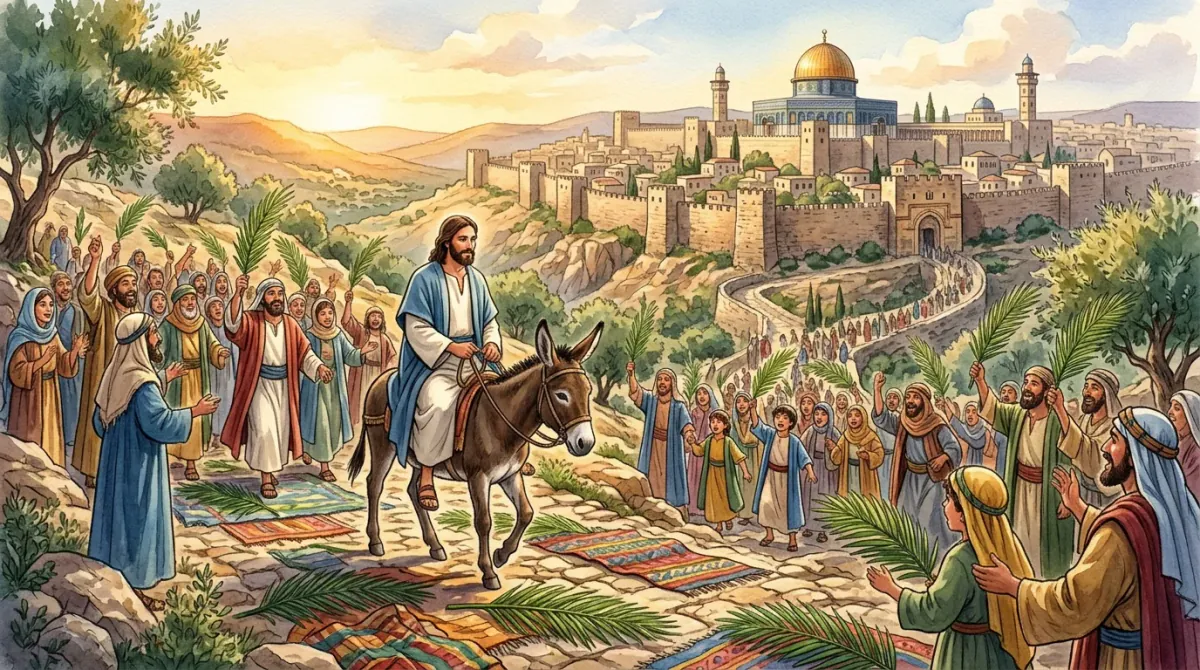
Placing their coarse woolen mantles upon the colt’s back to serve as a royal saddle, the disciples assisted Jesus onto the mount. Instantly, an electrical surge of recognition swept through the massive pilgrim caravan. Thousands of Galileans, diaspora Jews, and locals who had witnessed the resurrection of Lazarus began stripping off their colorful outer garments, laying them across the jagged limestone path to form a royal carpet before the approaching colt—an ancient Near Eastern gesture of absolute monarchical surrender reminiscent of King Jehu’s coronation (2 Kings 9:13). Others climbed high into the flourishing date-palm groves that fringed the eastern slope of the Mount of Olives, severing great, broad green fronds and spreading them along the highway.
As the procession descended the westward switchbacks, the crowd erupted into a rhythmic, antiphonal chorus of thunderous praise. Waving palm branches high against the azure sky, the pilgrims chanted the Great Hallel from Psalm 118:25–26: 'Hosanna to the Son of David! Blessed is He who comes in the name of the Lord! Hosanna in the highest!'
The word Hosanna—derived from the Hebrew petition Hoshiah-na—meant 'Save now, we pray!' For centuries, the subjugated Jewish populace had groaned under the iron fist of foreign empires: Babylon, Persia, Greece, and now imperial Rome. Stationed inside the towering stone turrets of the nearby Antonia Fortress, Roman sentries watched the billowing dust clouds with hands resting upon the hilts of their gladius swords. The crowd believed their Davidic deliverer had finally arrived to crush the Roman legions, overturn the puppet Herodian dynasty, and restore the geopolitical supremacy of Israel. The euphoria was deafening. The disciples walked with puffed chests, believing their moment of worldly triumph had arrived.
Yet as the road rounded a precipitous bend on the Mount of Olives, the entirety of Jerusalem suddenly burst into view across the narrow Kidron Valley. There stood the colossal, gleaming sanctuary of Herod’s Temple—a mountain of polished white limestone overlaid with sheets of hammered gold, flashing like a snow-capped peak in the desert sun. At this breathtaking vista, the royal parade came to a jarring, unexpected halt.
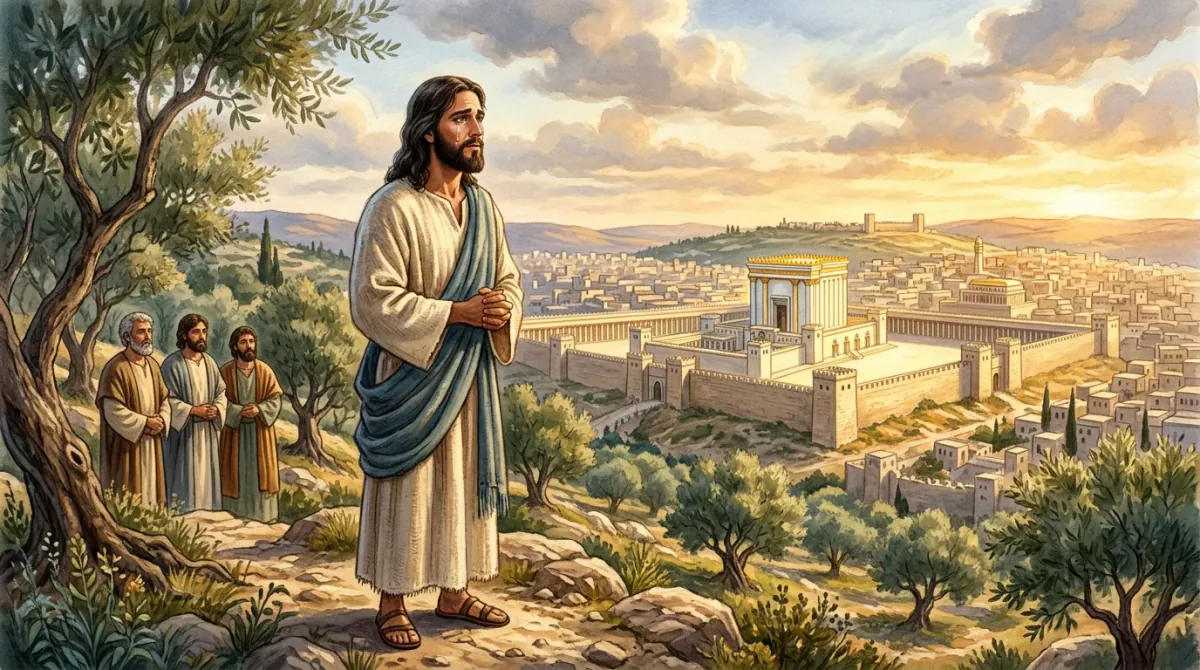
The crowds were cheering, but Jesus was weeping.
The Greek Gospel of Luke does not use the word edakrysen (quiet tears, as at Lazarus’s tomb); it uses the visceral verb eklausen—He sobbed aloud with deep, convulsive, audible agony (Luke 19:41). Tears streamed down the cheeks of the King as His heart fractured over the very people who were singing His praises. Looking past the waving palm branches and the festive banners, Christ saw what human eyes could not see. He saw forty years into the future. He saw the tragic reality of AD 70, when Roman legions under General Titus would surround this beloved city with wooden siege works, starvation would ravage the inhabitants, mothers would weep over dead infants, over one million Jews would be slaughtered by the sword, and the magnificent temple would be incinerated until not one stone was left standing upon another.
Between deep, gasping sobs, the King poured out His prophetic lamentation: 'If you had known, even you, especially in this your day, the things that make for your peace! But now they are hidden from your eyes. For days will come upon you when your enemies will build an embankment around you, surround you and close you in on every side, and level you, and your children within you, to the ground; and they will not leave in you one stone upon another, because you did not know the time of your visitation' (Luke 19:42–44).
Jerusalem was blind. She wanted a military king who rode a snorting war stallion to conquer Caesar; she did not want a Prince of Peace who rode a humble donkey colt to conquer sin. She wanted a political revolution; Christ came to offer a spiritual rebirth. Because she rejected the true foundation of peace, she was sealing her own catastrophic doom.
Furious at the spectacle, several Pharisees pushed their way through the throng and hissed at Jesus: 'Teacher, rebuke Your disciples! Silence this blasphemous shouting before the Romans slaughter us all!' But Jesus turned His tear-stained face upon them and delivered an immortal decree: 'I tell you that if these should hold their peace, the stones would immediately cry out!' If human beings refused to acknowledge the Creator who stepped into His own creation, the very bedrock of Mount Zion would split open and shout His praises.
Riding down through the Kidron ravine, across the stone bridge, and into the Golden Gate of Jerusalem, the entire metropolis was shaken (eseisthē—shaken as by an earthquake). Citizens rushed to their rooftops, leaning over parapets, shouting: 'Who is this?' And the Galilean pilgrims shouted back: 'This is Jesus, the prophet from Nazareth of Galilee!'
Palm Sunday stands as an eternal mirror to the human heart. It challenges us to ask: Do we love Jesus for who He truly is—the suffering Savior who demands our total surrender—or do we only love Him when we think He will fulfill our personal, political, or worldly agendas? The King has entered Zion. He does not come to negotiate with our pride; He comes to reign over our hearts in truth, holiness, and everlasting peace.
Ancient Near Eastern & Archaeological Context
In first-century Roman Judaea, the arrival of Passover was a period of extreme political and military tension. Jerusalem's normal population of roughly 60,000 swelled to over one million as pilgrims flooded the holy city from across the Mediterranean basin. To prevent nationalist insurrections, the Roman Prefect Pontius Pilate routinely marched elite cohorts of Roman legionaries, cavalry, and archers from the coastal capital of Caesarea Maritima up to Jerusalem, staging a thunderous, intimidating military parade through the city's Western Gate. Heavy bronze armor clanked, imperial eagles gleamed in the sun, and war stallions snorted as Rome demonstrated unyielding imperial might.
It was against this imperial backdrop that Jesus orchestrated His anti-imperial counter-procession from the east. Departing Bethany and ascending the eastern ridge of the Mount of Olives to the village of Bethphage ('House of Unripe Figs'), Jesus sent two disciples to acquire an unridden donkey colt. In ancient Near Eastern culture, walking animals bore great theological significance. Under Mosaic law (Deuteronomy 21:3; 1 Samuel 6:7), an animal that had never been ridden or placed under a yoke was consecrated exclusively for sacred ritual use. Furthermore, five centuries earlier, the prophet Zechariah had prophesied: 'Rejoice greatly, O daughter of Zion! Shout, O daughter of Jerusalem! Behold, your King is coming to you; He is just and having salvation, lowly and riding on a donkey, a colt, the foal of a donkey' (Zechariah 9:9).
As Jesus mounted the colt, the massive throng of pilgrims escorting Him recognized the royal coronation script. Spreading garments on the ground was an ancient Near Eastern gesture of royal submission, famously performed for King Jehu in 2 Kings 9:13. Cutting fronds from date-palm trees was an explicit patriotic symbol of Jewish independence dating back to the Maccabean liberation in 141 BC (1 Maccabees 13:51). The crowds perceived that the true King was arriving; yet their nationalistic expectations blinded them to the nature of His kingdom. They wanted a warrior to slaughter the Romans; Christ came as a sacrificial Lamb to die for their sins.
Practical Discipleship & Spiritual Application
- Crowning Christ as Sovereign King: The crowds welcomed Jesus with superficial songs, yet within five days demanded His crucifixion; true discipleship does not offer Christ temporary emotional applause, but yields unconditional, lifelong allegiance to His Lordship.
- The Peace of the Donkey vs. The Pride of the Stallion: The world celebrates aggressive power, intimidation, and ostentatious displays; Christ models the breathtaking majesty of meekness, teaching us that kingdom greatness is demonstrated through humble, sacrificial love.
- Recognizing the Day of Divine Visitation: Jerusalem was destroyed because she failed to perceive the spiritual moment when God drew near; we must remain spiritually alert, ensuring that busyness, tradition, and worldly distractions do not cause us to miss Christ's voice in our lives.
- Sharing the Heartbreak of Jesus Over the Lost: While the multitude rejoiced over political hype, Jesus wept over blind, dying souls; our prayers and evangelism must be fueled not by religious ambition, but by the compassionate tears of the Savior who grieves over broken humanity.
Support Independent Biblical Research
Did this study bless you? Help support our independent bilingual research and interactive visual Bible tools.
⚡ Fast Facts
- Unridden Animal Consecration: In Old Testament law (Numbers 19:2; Deuteronomy 21:3), an animal that had never borne a yoke was sanctified exclusively for sacred divine purposes; Christ rode an unbroken colt that submitted instantly to its Creator
- Prophetic Chronology Precision: In Luke 19:42, Jesus mourned 'if you had known, even you, especially in this your day'; Sir Robert Anderson demonstrated that this exact day concluded Daniel's 69-weeks prophecy (Daniel 9:25) to the very day
- The Palm Branch Symbol: In Greco-Roman and Maccabean antiquity (1 Maccabees 13:51), date-palm fronds symbolized nationalistic military triumph and political liberation; the crowds anticipated an anti-Roman conqueror, but Christ came as the Prince of Peace
- Sobbing Over the Holy City (Flevit Super Illam): Luke 19:41 uses the Greek verb 'eklausen', signifying loud, convulsing, audible weeping; amid roaring cheers, Jesus wept over Jerusalem's impending slaughter in AD 70 under Titus
❓ Frequently Asked Questions (FAQs)
Why did Jesus choose to ride a donkey colt instead of a regal white war horse?
In ancient Near Eastern monarchical tradition, when a king rode a stallion, he came for bloody war, imperial conquest, and judgment; but when a king arrived mounted on a donkey, he came in peace, covenant reconciliation, and sovereign mercy (1 Kings 1:33; Zechariah 9:9). By entering Jerusalem on a humble donkey colt, Jesus deliberately rejected worldly militarism and populist political rebellion. He did not come to topple the Roman Caesar with iron swords, but to conquer sin, Satan, and death through the sacrificial blood of the Cross.
What is the biblical meaning of the crowd shouting 'Hosanna'?
'Hosanna' is an Aramaic transliteration of the Hebrew petition *Hoshiah-na* from Psalm 118:25, literally translating as 'Save now, we pray!' or 'Grant salvation, O Lord!' During the Passover, pilgrims chanted the Great Hallel (Psalms 113–118). By coupling 'Hosanna' with 'Blessed is He who comes in the name of the Lord' and 'Son of David', the crowds were openly crowning Jesus as the Davidic Messiah sent to restore Israel's royal throne.
Why did Jesus weep over Jerusalem in the middle of His triumphant celebration?
While the crowds were ecstatic with transient political euphoria, Jesus looked through the veneer of celebration into eternity. He foresaw that within five days, this same fickle multitude would scream 'Crucify Him! We have no king but Caesar!' Because the nation rejected the Messiah of peace, divine judgment was sealed. Christ prophesied with terrifying precision the Roman siege of AD 70 under Titus, where Roman legions encircled Jerusalem with palisade embankments, starved the inhabitants, slaughtered over one million people, and burned Herod's gleaming temple until not one stone stood upon another.