The brisk, golden light of Monday morning broke over the eastern slopes of the Mount of Olives as Jesus and the Twelve departed their humble lodgings in Bethany. The emotional crescendo of Palm Sunday—with its waving palm fronds and thunderous cries of 'Hosanna!'—had faded into the quiet stillness of dawn. As the little company walked along the winding limestone path climbing toward the city of Jerusalem, an unexpected detail is recorded by the Gospel writers: Jesus was hungry (Matthew 21:18; Mark 11:12). The Creator of heaven and earth, clothed in authentic human flesh, felt the physical pangs of hunger in the early morning chill.
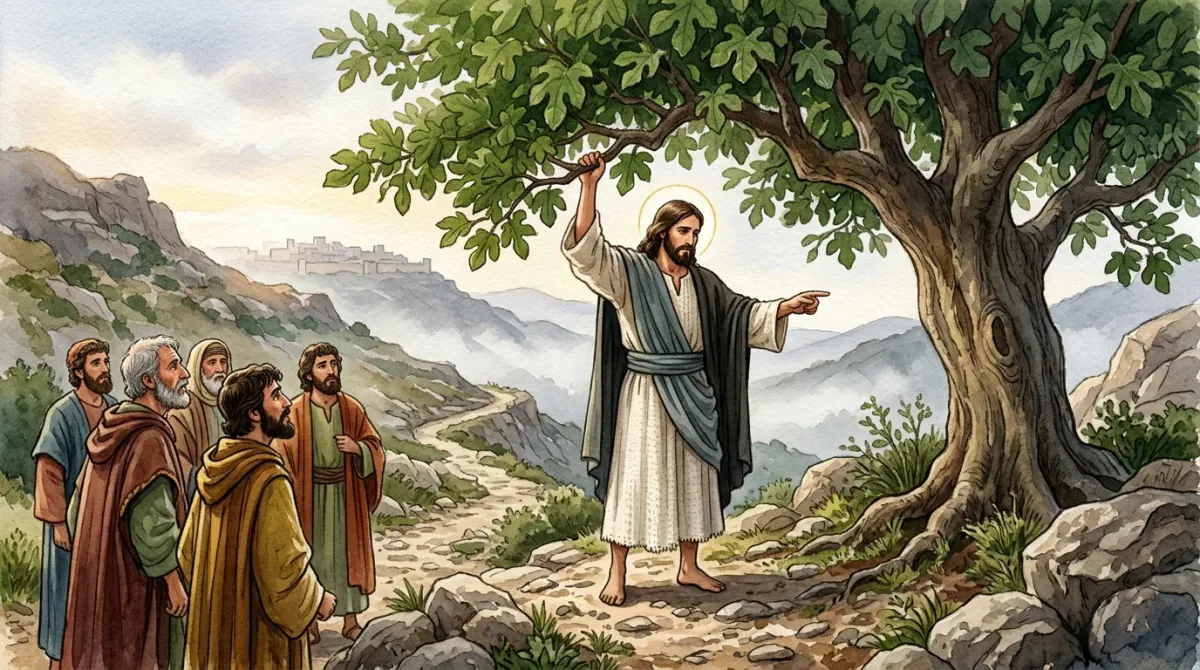
Rounding a bend in the terraced mountainside, Jesus lifted His eyes and spotted a solitary fig tree standing conspicuously against the Judean skyline. It was early April, the season of Passover. Normally, Palestinian fig trees (*Ficus carica*) did not yield their mature, succulent summer harvest (*te'enim*) until late June or August. Yet this particular tree presented an astonishing anomaly: it was covered from root to bough in a luxuriant, flourishing canopy of broad green leaves. In botanical science, the fig tree produces small, edible precursor green buds called *taqsh* before or simultaneously with the emergence of its foliage. For a tree to display such a magnificent, ostentatious mantle of green leaves in early spring was an explicit promise to any hungry traveler: Come, eat! Fruit is hidden beneath my shade!
Approaching the leafy tree, Jesus reached out His hands, parting the thick green foliage to find breakfast. But as His fingers searched the branches, there was nothing. Not a single early bud, not a shriveled winter remnant—nothing but empty, deceptive leaves. The tree was a fraud. It made an arrogant public display of fertility, but possessed zero life-giving fruit.
Fixing His gaze upon the barren branches, Jesus did something that shocked the listening disciples. He did not merely walk away in disappointment; He addressed the tree with judicial, royal authority: 'Let no one eat fruit from you ever again!' Mark adds a crucial, understated note: 'And His disciples heard it.'
Why would the gentle Savior curse an unreasoning tree? Because Jesus was not throwing an emotional tantrum over a missed breakfast; He was staging a prophetic parable in real time. For centuries, Hebrew prophets like Jeremiah, Hosea, and Micah had employed the fig tree as an inspired symbol of Israel's covenant relationship with Yahweh (Jeremiah 8:13; Hosea 9:10). The leafy, barren tree was a living mirror of Jerusalem's religious establishment. It boasted spectacular foliage—the majestic white marble of Herod's temple, ornate priestly vestments, continuous liturgical chants, and rivers of animal blood. But beneath the impressive religious veneer, there was no spiritual fruit: no justice for the oppressed, no compassion for the broken, and no faith in the Messiah of God.
Descending into the Kidron Valley and entering through the gates of Jerusalem, Jesus walked directly into the temple courts to confront the reality that the fig tree had symbolized. What He encountered inside the Court of the Gentiles was an abomination of sacred space.
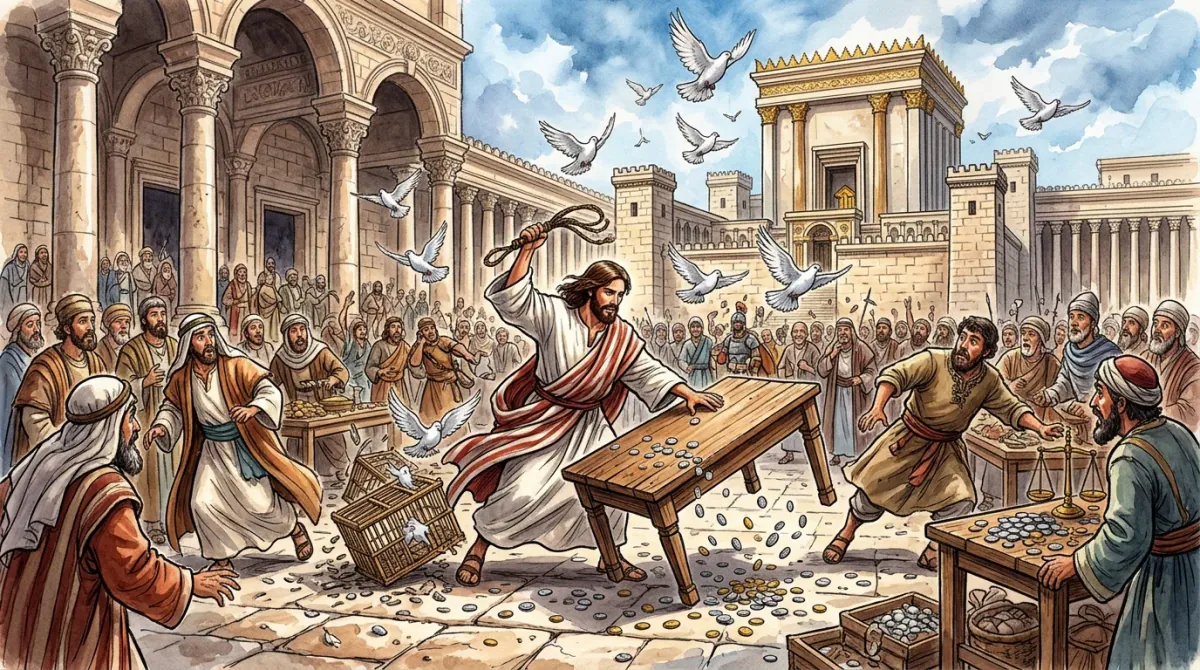
The Court of the Gentiles was the outermost court of the temple, a sprawling fourteen-acre colonnaded plaza designed specifically as the only sanctuary where non-Jewish seekers and God-fearers from the nations could pray and worship the God of Israel. But under the corrupt monopoly of former High Priest Annas and Caiaphas, this holy court had been turned into a deafening, manure-stained livestock exchange known as the 'Bazaars of Annas.' Hundreds of sheep were bleating, oxen were lowing, and cages of white doves were stacked high in the stifling dust.
Worse than the stench was the predatory extortion. Pilgrims traveling from foreign lands could not pay the annual temple half-shekel with Roman or Greek coins because imperial currency bore the idolatrous image of Caesar. Moneychangers seated behind wooden tables (*kollybistai*) charged extortionate exchange fees of up to twelve percent to convert foreign silver into approved Tyrian shekels. Furthermore, temple inspectors routinely rejected the unblemished animals brought by poor pilgrims, forcing them to purchase 'temple-certified' animals at markups of up to a thousand percent. The sacred court of prayer had been transformed into an economic racket that preyed upon the devotion of the poor.
Holy fire ignited within the soul of Christ. Fashioning a whip from coarse cords, Jesus stepped into the center of the bustling plaza. His eyes blazed with the uncreated fury of divine holiness. Grasping the heavy wooden tables of the moneychangers, Christ overturned them with crashing force! Gleaming silver shekels and bronze coins scattered across the polished stone flagstones, rolling into gutters as terrified bankers scrambled in the dirt. Advancing upon the livestock pens, Jesus drove out the sheep and oxen, overturned the benches of those selling doves, and opened the wicker cages, sending flocks of white birds soaring into the morning sky!
Refusing to permit anyone to carry commercial vessels through the temple colonnade, Christ stood like a lion in the Court of the Gentiles. His voice reverberated off the limestone pillars, thundering with ancient prophetic authority: 'Is it not written, “My house shall be called a house of prayer for all nations”? But you have made it a “den of thieves!”'
With two masterstrokes of Scripture, Jesus exposed their hypocrisy. By quoting Isaiah 56:7, He defended the right of Gentile seekers to find a house of prayer. By quoting Jeremiah 7:11, He indicted the corrupt religious elite: they were acting like bandits who rob and plunder the innocent, and then retreat into their sacred limestone cave—the temple—falsely believing God's presence will shield them from divine judgment.
The crowds were astonished at His doctrine, while the chief priests and scribes cowered in fear, plotting how they might destroy Him. As evening shadows lengthened, Jesus and His disciples quietly withdrew from the city, returning once again to Bethany.
The following morning (Tuesday), as they retraced their steps along the mountain path, Simon Peter stopped dead in his tracks, pointing with wide-eyed amazement toward the roadside. 'Rabbi, look!' he gasped. 'The fig tree which You cursed has withered away!'
It was not merely wilting; the tree was withered from the roots up (exērammenēn ek rizōn). In twenty-four hours, the leafy giant had become a brittle, blackened skeleton of dead wood. The taproot of hypocritical religion had been severed.
Looking upon His astonished disciples, Jesus did not gloat over His miracle. Instead, He pivoted their focus toward the limitless authority of the Father: 'Have faith in God. For assuredly, I say to you, whoever says to this mountain, “Be removed and be cast into the sea,” and does not doubt in his heart, but believes that those things he says will be done, he will have whatever he says. Therefore I say to you, whatever things you ask when you pray, believe that you receive them, and you will have them.'
Standing upon the Mount of Olives, pointing toward Mount Zion crowned by the temple, Jesus was declaring that corrupt religious mountains would be cast into the sea of history. But He immediately added a vital, sobering condition: 'And whenever you stand praying, if you have anything against anyone, forgive him, that your Father in heaven may also forgive you your trespasses.'
The withered fig tree and the cleansed temple deliver an urgent message to the modern church. God demands reality, not religious choreography. He seeks fruit, not mere leaves. When we come before Him, let us cleanse our hearts of worldly greed, uproot lingering bitterness through radical forgiveness, and stand in mountain-moving faith before the living God who turns our barrenness into an everlasting harvest of praise.
Ancient Near Eastern & Archaeological Context
Following the emotional upheaval of the Triumphal Entry on Palm Sunday, Jesus and His disciples retired for the night to Bethany. On Monday morning, Christ set out on the two-mile walk back to Jerusalem. The geography between Bethany and Jerusalem passes over the ridge of the Mount of Olives and descends into the Kidron Valley. Along these rocky terraced slopes grew numerous fig orchards (*Ficus carica*). In Palestine, fig trees drop their leaves in winter and sprout new foliage in late March or early April. Before the large leaves expand, the tree typically produces small, edible precursor buds known in Arabic as *taqsh*. While not as luscious as the mature summer figs (*te'enim*), these early buds were eagerly consumed by hungry peasant travelers. A fig tree that boasted a full canopy of broad green leaves in early April was advertising that early fruit was ready for harvest. Finding only leaves was proof of barren deceit.
Upon entering Jerusalem, Jesus proceeded immediately to the Second Temple, an architectural marvel spanning thirty-five acres, reconstructed by Herod the Great with colossal marble porticoes. The outermost perimeter was the vast Court of the Gentiles, encompassing nearly fourteen acres. Separated from the inner Jewish courts by a five-foot stone balustrade (*Soreg*) bearing Greek and Latin inscriptions warning Gentiles of immediate death if they transgressed the boundary, the Court of the Gentiles was the only space on earth where non-Jews could come to pray and seek the God of Abraham.
However, under the corrupt administration of the former High Priest Annas and his son-in-law Caiaphas, this sacred court had been transformed into a commercial market known as the 'Bazaars of Annas' (*Hanuwoth Bene Annas*). Jewish law required every adult male to pay an annual half-shekel temple tax (Exodus 30:13–15). Because Roman coins bore the blasphemous image and title of Caesar as 'divine son of Augustus', they were forbidden inside the temple. Pilgrims were forced to exchange their secular currency for pure Tyrian silver shekels at the moneychangers' tables (*kollybistai*), where brokers charged extortionate exchange fees of up to 12.5%. Furthermore, priests who inspected sacrificial animals systematically disqualified sacrificial lambs and doves brought by poor pilgrims for fabricated defects, forcing worshippers to purchase pre-approved temple animals at inflated prices up to tenfold higher than outside the city. The high priestly family grew unimaginably wealthy on the backs of impoverished worshippers.
Practical Discipleship & Spiritual Application
- Leaves Without Fruit—The Danger of Religious Hypocrisy: Green leaves without fruit deceive hungry souls; God is not impressed by flashy religious activity, church attendance, or pious vocabulary if our private lives are void of love, holiness, humility, and the fruit of the Spirit.
- Guarding the Sacred Space of Prayer: Christ’s holy fury purged the temple so that foreigners could seek God without hindrance; we must examine our hearts and churches, ruthlessly casting out worldly commercialism, pride, and greed that hinder seekers from finding Christ.
- Uprooting Immovable Mountains by Faith: When human systems appear corrupt and insurmountable, Jesus commands us to 'have faith in God'; living faith anchored in the sovereign power of the Almighty can cast mountains of difficulty into the sea.
- The Power of Forgiving Prayer: Jesus connects mountain-moving faith directly with personal forgiveness: 'And whenever you stand praying, if you have anything against anyone, forgive him'; lingering bitterness and unforgiveness clog the spiritual channels of supernatural power.
Support Independent Biblical Research
Did this study bless you? Help support our independent bilingual research and interactive visual Bible tools.
⚡ Fast Facts
- The Botanical Nature of Palestinian Figs: Palestinian fig trees (*Ficus carica*) produce small, edible early green buds called *taqsh* before their broad leaves emerge; an abundance of lush leaves was an explicit botanical guarantee of fruit, making this tree an emblem of hypocrisy
- Prophetic Enactment (Markan Sandwich): Mark deliberately sandwiches the Temple cleansing between the cursing of the fig tree (Mark 11:12–14) and its withering (Mark 11:20–24); the barren leafy tree was a living parable of Israel's ritualistic, hypocritical, and fruitless temple establishment
- The High Priestly Extortion Monopoly: The marketplace in the Court of the Gentiles—known historically as the 'Bazaars of the Sons of Annas'—charged exorbitant exchange rates (up to 12.5%) for Tyrian temple shekels and inflated sacrificial animal prices by up to 1,000%
- Cleansing the Court of the Gentiles: By expelling merchants from the outer court, Jesus defended the sacred right of non-Jewish foreigners (*all nations*) to pray, fulfilling Isaiah 56:7 and tearing down ethnic religious commercialism
❓ Frequently Asked Questions (FAQs)
Why did Jesus curse the fig tree if 'it was not the season for figs'?
Mark’s comment that 'it was not the season for figs' refers to the full harvest season for mature autumn figs (*te'enim*). However, in early spring (April/Passover), edible precursor fruit buds called *taqsh* appear simultaneously with foliage. A tree that displayed full, ostentatious leafy foliage was advertising that early fruit was present. The tree was a botanical fraud: it promised nourishment through its leaves, but delivered nothing. Jesus used it as an enacted prophecy: Jerusalem's temple system boasted magnificent rituals, priestly vestments, and religious ceremonies (leaves), but possessed zero spiritual fruit—no justice, no mercy, and no true faith.
Why was Jesus so angry in the Temple, and did He commit a sin by losing His temper?
Jesus did not exhibit sinful, selfish loss of emotional control; He displayed pure, holy, righteous indignation (*divine zeal*). God’s holiness hates religious oppression. The corrupt high priests had converted the Court of the Gentiles—the only sacred space where non-Jewish foreigners were permitted to seek God—into a noisy, foul-smelling, extortionate livestock market. Jesus was defending the glory of His Father's house and the spiritual access of marginalized Gentiles. Righteous anger against the exploitation of the poor and the desecration of God's worship is an expression of divine love and holy justice.
What is the connection between the withered fig tree and moving mountains through prayer?
When Peter pointed out the next morning that the fig tree had withered from its roots, Jesus redirected their shock toward the infinite power of God: 'Have faith in God... whoever says to this mountain, “Be removed and be cast into the sea,” and does not doubt in his heart... it will be done for him.' In first-century Jewish idiom, 'this mountain' referred literally to the Temple Mount of Mount Zion standing before them. Jesus was prophetically declaring that the corrupt temple mountain would be removed and cast into the sea of history, and that true spiritual power belongs to anyone who prays with pure faith and a forgiving heart.