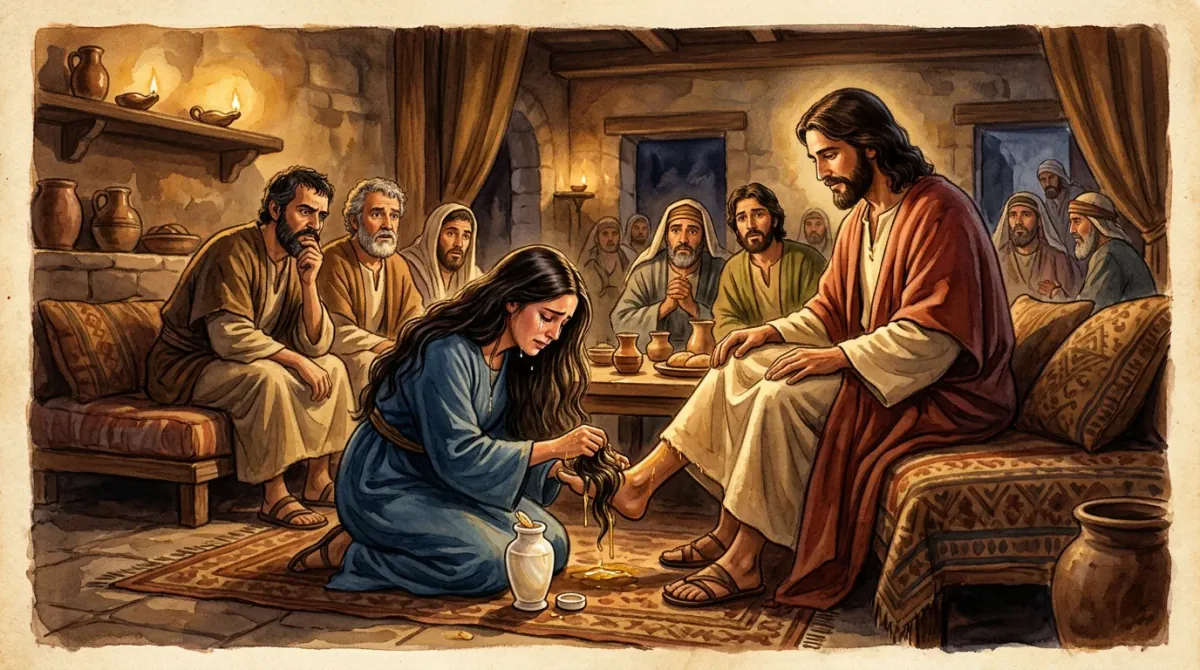
The quiet hillside village of Bethany lay bathed in the cool twilight of a Judean springtime. Situated two miles east of Jerusalem, cloaked behind the eastern ridge of the Mount of Olives, Bethany was an intimate sanctuary where olive terraces stepped down toward the arid wilderness of Judea. It was precisely six days before the Passover—the final, fateful Passover toward which the eternal councils of the Godhead had marched since the foundation of the world. In the festive dining room of Simon the Leper, a man whose rotting flesh had once been miraculously restored by Jesus, the lamps were lit and low tables were laden with bread, figs, roasted meats, and wine. It was a banquet of profound gratitude and unspoken tension. Reclining at the table beside Jesus was Lazarus, the living miracle who had lain four days in the decomposition of a limestone crypt before Christ’s voice shattered the jaws of death. Martha, true to her tireless devotion, was serving with radiant energy, making sure every guest’s cup was filled.
Yet a heavy, solemn atmosphere permeated the laughter and conversation. Outside in the shadows of Jerusalem, the high priests and Pharisees had issued an imperial arrest warrant for Jesus, ordering anyone who knew His whereabouts to betray Him. The cross was no longer a distant theological metaphor; it was an impending, agonizing reality. The disciples, though gathered around the table, were spiritually blind to the hour. They were whispering among themselves about messianic politics, arguing who would sit on the royal thrones of power when Jesus entered Jerusalem. Only one soul in that room had quieted her heart sufficiently to perceive the dark, holy storm approaching. Her name was Mary.
Without announcing her presence, Mary slipped into the banquet hall. In her trembling hands, she cradled an exquisite, translucent vessel carved from pure Egyptian calcite—an alabastron. Within this sealed flask was a Roman pound (nearly twelve ounces) of genuine, unadulterated spikenard (nardos pistikē), extracted from the aromatic roots of alpine herbs gathered in the remote snowpeaks of the Himalayas. Transported thousands of miles over ancient spice routes, this perfume was worth more than three hundred silver denarii. In first-century Judea, a single denarius was the standard daily wage for twelve grueling hours of physical labor. This single flask represented the accumulated wages of an entire year—an irreplaceable family inheritance, a dowry of supreme security that had likely been preserved across generations.
Approaching the reclining form of Jesus, Mary bypassed the social protocol of the day. In ancient Jewish culture, high-ranking guests were honored by having a few drops of scented olive oil poured over their heads. But Mary did not approach Christ as an ordinary guest; she approached Him as the Lord of heaven and earth about to be slain. In an act of irrevocable devotion, Mary did not carefully open the wax seal to dispense a modest measure; she shattered the long, delicate neck of the alabaster flask (syntripsasa to alabastron). With that sharp, snapping sound, all possibility of reclamation vanished. She could never re-cork the bottle; she could never sell the remaining oil. Every single drop belonged irrevocably to Jesus.
First, she poured the golden, fragrant liquid lavishly over His sacred head. Then, moving to the foot of the banquet couch, she knelt upon the stone floor and poured the remaining perfume over His bare, calloused feet. As the precious oil mingled with her flowing tears, Mary did the unthinkable: she untied and loosened her long dark hair, using her tresses to wipe the oil and tears from His feet. In first-century Middle Eastern society, for a woman to publicly unbind her hair in the presence of men was considered a scandalous, disgraceful breach of modesty. But Mary had passed beyond the threshold of human opinion. She took the crowning glory of her womanhood and laid it in the dust beneath the feet of the Lamb of God.
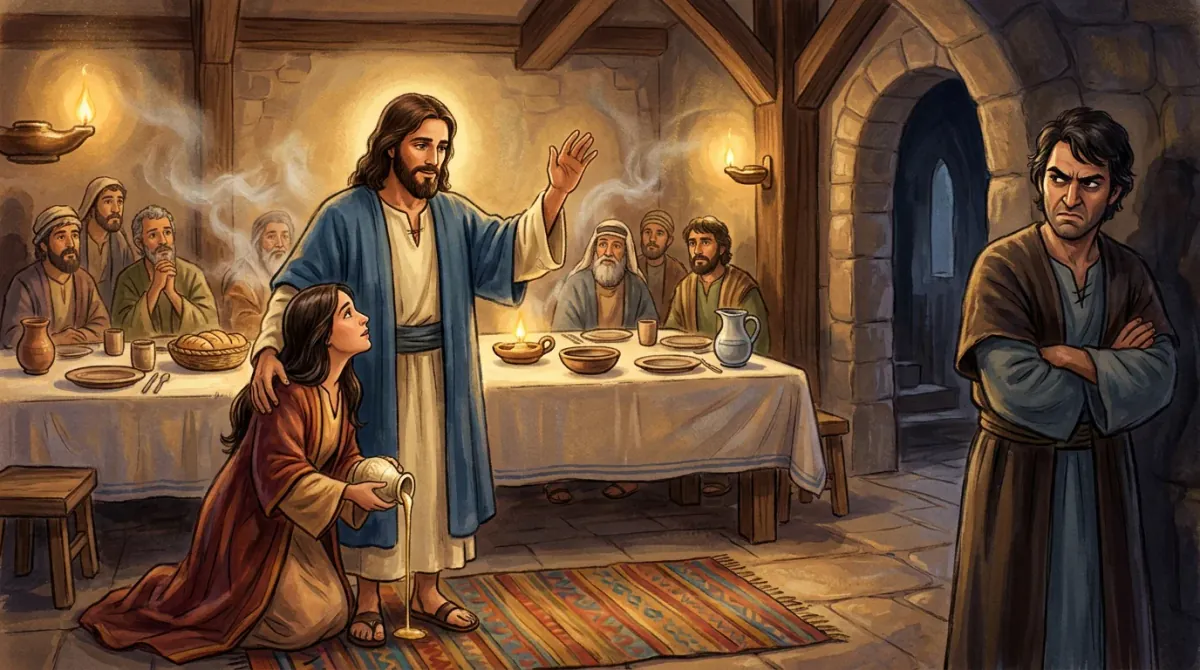
The effect was instantaneous and overwhelming. The Apostle John, writing decades later with vivid sensory memory, recorded: 'And the house was filled with the fragrance of the oil' (hē de oikia eplērōthē ek tēs osmēs tou myrou). The rich, earthy, musky aroma of crushed Himalayan spikenard saturated every corner of the room, clinging to the tapestries, the wooden rafters, the garments of the disciples, and the hair of Mary.
Suddenly, the sacred silence was shattered by a harsh, grating voice dripping with self-righteous indignation. Judas Iscariot, the treasurer of the apostolic band, sneered across the table: 'Why was this fragrant oil not sold for three hundred denarii and given to the poor?'
Judas’s words sounded remarkably pious, reasonable, and charitable. Other disciples, swayed by his pragmatic calculations, began nodding in agreement, murmuring indignantly among themselves: 'What is the point of this waste? This money could have fed dozens of destitute families!' But the Holy Spirit rips away the mask of religious hypocrisy through John's pen: 'This he said, not that he cared for the poor, but because he was a thief, and had the money box; and he used to take what was put into it.' Judas did not love the poor; he loved silver. To a mercenary soul that would soon calculate the value of the Son of God at thirty miserable shekels, Mary’s lavish pouring out of three hundred denarii on Jesus seemed like madness. Carnal minds always view unreserved devotion as 'waste.'
Mary said nothing. She did not defend her expenditure; she did not justify her tears or her loosened hair. She remained kneeling in the perfume at Jesus' feet, allowing her Master to be her vindicator.
And Jesus spoke with thunderous, royal authority. Raising His hand, silencing the grumbling disciples, Christ rebuked them: 'Let her alone; why do you trouble her? She has done a good work for Me.' In the Greek, Jesus calls her deed kalon ergon—a work of moral excellence, transcendent beauty, and spiritual perfection.
Then Jesus unveiled the prophetic depth of Mary’s worship: 'For you have the poor with you always, and whenever you wish you may do them good; but Me you do not have always. She has done what she could. She has come beforehand to anoint My body for burial.' (Proelaben myrisai mou to sōma eis ton entaphiasmon). While the twelve apostles were bickering over earthly thrones and blinded by political ambition, Mary had sat at Jesus' feet, listened to His words, and understood that He was marching toward an altar of sacrifice. She knew the Sanhedrin was circling; she knew the tomb was waiting. And she resolved that her Lord would not go to His death without receiving the royal burial anointing worthy of the King of kings.
Finally, Jesus issued a staggering, prophetic decree that echoes across human history: 'Assuredly, I say to you, wherever this gospel is preached in the whole world, what this woman has done will also be told as a memorial to her.'
Caesars have carved their names into marble arches that crumbled into dust. Herod built colossal fortress palaces that lie in ruins. But the fragrance of Mary’s broken flask remains eternal. Two thousand years later, across every continent, language, and tribe, the story of the woman who broke her alabaster box is proclaimed with awe. Mary taught the Church for all time that nothing poured out on Jesus is ever wasted. When we surrender our costliest treasures, our reputations, and our very lives at the feet of the Crucified King, the fragrance of our worship ascends to the throne of God as a sweet-smelling sacrifice that outlasts the stars.
Ancient Near Eastern & Archaeological Context
Bethany was a humble, secluded agricultural village nestled on the eastern slopes of the Mount of Olives, roughly two miles east of Jerusalem. Its Semitic name, Beit-Anyah, is traditionally translated as 'House of Dates' or 'House of Affliction / Poverty.' Shielded from the political turbulence and urban congestion of Jerusalem by the limestone crest of the Mount of Olives, Bethany served as a peaceful, safe haven for Jesus during His frequent visits to the temple city. It was the cherished home of His closest friends: Martha, Mary, and Lazarus, whom Christ had recently called out of a four-day tomb, causing shockwaves across Judea and cementing the Sanhedrin's determination to execute Him (John 11:47–53).
The banquet described in Mark 14 and John 12 occurred in the residence of a man known as 'Simon the Leper'—presumably a former outcast whom Jesus had miraculously cleansed of leprosy, and who now opened his restored home in lavish gratitude. In first-century Jewish aristocratic banquet culture, guests reclined on low, cushioned couches (*triclinia*) positioned around a central low table, resting on their left elbows with their feet stretched outward toward the perimeter of the room. Servants customarily washed guests' feet with water upon arrival. Pouring perfumed oil on a distinguished guest's head was considered the pinnacle of elite Near Eastern hospitality; anointing feet, however, was unheard of—feet were viewed as spiritually and physically unclean from walking on manure-strewn Roman roads.
The specific ointment brought by Mary was nardos pistikē—pure spikenard derived from the crushed roots of Nardostachys jatamansi, a rare flowering herb found exclusively at alpine elevations of 11,000 to 17,000 feet in the Himalayan mountains of modern-day Nepal, Bhutan, and northern India. Transported overland across Silk Road caravan routes to Syrian Antioch and maritime Mediterranean ports in hermetically sealed Egyptian alabaster flasks, genuine spikenard was one of the most exorbitant luxury commodities of antiquity. A single Roman pound (*litra*, approximately 327 grams) commanded 300 silver denarii. Because an ordinary agricultural or construction laborer in first-century Judaea earned a single denarius for a brutal twelve-hour workday (Matthew 20:2), Mary's flask represented the cumulative wages of an entire year of hard labor—an heirloom representing a family's total financial security.
Practical Discipleship & Spiritual Application
- Extravagant Worship That Shames Calculation: True worship never asks 'What is the minimum required?', but 'How much can I pour out at the feet of my King?'; Mary poured out her family's entire financial security because Christ's infinite worth eclipsed all earthly treasures.
- Breaking the Flask—No Reserved Rights: Mary did not unstop the alabaster flask to save a few drops for herself; she shattered the vessel completely. Biblical surrender means surrendering our lives with no safety nets, no backdoor exit strategies, and no reserved rights.
- Overcoming Religious Cynicism and Mockery: Whenever you step out in radical obedience and sacrificial love for Christ, expect carnal critics—often within religious circles—to label your worship as 'waste'; remember that what the world calls waste, heaven crowns as eternal treasure.
- The Pervasive Fragrance of Christ: When Mary broke the flask, 'the whole house was filled with the fragrance of the oil.' Genuine sacrificial love cannot be hidden; when a believer breaks their pride and surrenders all to Jesus, the fragrance of Christ sweetens their home, church, and community.
Support Independent Biblical Research
Did this study bless you? Help support our independent bilingual research and interactive visual Bible tools.
⚡ Fast Facts
- Astronomical Financial Value: The perfume was 300 denarii of pure Himalayan spikenard (Nardostachys jatamansi), imported in sealed alabaster from northern India, equivalent to an entire year's wages for a working man
- Shattering Social Taboos: In first-century Jewish society, an honorable woman never loosened her hair in public, as it was considered an intimate act; Mary completely discarded human opinion to honor her Lord
- Prophetic Embalming: While the Twelve apostles were arguing over chief seats in the Kingdom, Mary alone spiritually perceived Christ's approaching death and provided His body with royal burial anointing before the Cross
- Eternal Monument of Grace: Jesus declared of Mary: 'Wherever this gospel is preached in the whole world, what this woman has done will also be told as a memorial to her'—the only memorial commanded by Christ in the Gospels
❓ Frequently Asked Questions (FAQs)
Why did Judas Iscariot object so vehemently to Mary's anointing?
Judas cloaked his carnal greed in the pious language of social justice, asking why the oil was not sold for 300 denarii and given to the poor. The Apostle John unmasks his true motive in John 12:6: Judas did not care for the poor, but was a thief who managed the apostolic money box (*glōssokomon*) and routinely stole from collective funds. To a mercenary heart that calculated Christ's worth at thirty pieces of silver, Mary's lavish surrender of 300 denarii on Jesus seemed like an intolerable financial loss. Hypocritical religion always resents unreserved worship because it cannot monetize or control it.
What is the difference between this anointing and the sinful woman in Luke 7?
While superficial similarities exist, they are two historically distinct events separated by geography, time, and theological purpose. The anointing in Luke 7 occurred early in Jesus' Galilean ministry in the house of Simon the Pharisee, performed by an unnamed penitent prostitute seeking forgiveness of sins. The anointing in Bethany (John 12; Mark 14; Matthew 26) occurred in Judea six days before the Passover, performed by Mary—the sister of Martha and Lazarus—not to obtain pardon, but as a prophetic, extravagant act of adoration preparing Christ's sinless body for sacrificial death.
Why did Mary break the alabaster flask instead of merely unstopping it?
Alabaster flasks (*alabastra*) were crafted from fine translucent calcite mined in Egypt, designed with long, slender, hermetically sealed necks to prevent volatile aromatic oils from evaporating. Normally, owners drilled tiny punctures in the wax seal to dispense single drops over decades. By deliberately shattering the neck of the flask (*syntripsasa*), Mary rendered the precious vessel completely unusable for any future purpose. It was an act of total, irrevocable finality: she was declaring that no drop of this perfume would ever touch another human being, and no other love would ever rival Christ in her heart.