Bound in coarse flaxen ropes, His hands wrenched behind His back, Jesus was dragged through the pitch-black olive groves of Gethsemane. The armed Roman legionaries and temple police hurried across the Kidron Valley, their smoking torches hissing in the cold night draft. Re-entering the sleeping city through the Water Gate, they ascended the stepped terrace leading to the palatial mansions of the Upper City. Here, behind high limestone walls and heavily fortified iron gates, lay the sprawling residence of Annas, the former High Priest and patriarch of the Sadducean aristocracy. Though deposed by the Roman authorities nearly two decades earlier, Annas retained absolute mafioso-like control over the Temple commerce, operating the lucrative currency exchange and sacrificial livestock booths known pejoratively as the 'Bazaars of the Sons of Annas.'
It was past two o'clock in the morning. Inside the opulent cedar-paneled reception hall, Annas interrogated the bound Nazarene concerning His disciples and His teaching. Jesus answered with serene, unyielding dignity: 'I spoke openly to the world. I always taught in synagogues and in the temple, where the Jews always meet, and in secret I have said nothing. Why do you ask Me? Ask those who have heard Me what I said to them. Indeed they know what I said.' At these words, one of the temple officers standing by struck Jesus across the face with his open palm (rhapisma), snarling: 'Do You answer the high priest like that?' Jesus looked calmly at the abusive guard: 'If I have spoken evil, bear witness of the evil; but if well, why do you strike Me?' Frustrated by Christ's poise, Annas bound Him again and sent Him across the central courtyard to his son-in-law, Joseph Caiaphas, the reigning High Priest.
The Midnight Sham of the Sanhedrin
The Great Sanhedrin had convened in emergency nocturnal session—a flagrant violation of the Mishnah, which strictly forbade capital trials between sunset and dawn. Seventy-one judges, chief priests, pharisaic elders, and scribes sat in a semicircular tier of cushioned benches. Suborned false witnesses stepped forward one after another, but their fabricated testimonies contradicted each other so egregiously that even the corrupt council could not manufacture a coherent indictment. Some cried out: 'We heard Him say, 'I will destroy this temple made with hands, and in three days I will build another made without hands!'' Yet even on this point, their testimonies failed to agree.
Throughout the barrage of slander, Jesus maintained majestic silence, fulfilling Isaiah's prophecy: 'He was oppressed and He was afflicted, yet He opened not His mouth; as a lamb that is led to the slaughter, and as a sheep before its shearers is silent, so He opened not His mouth.' Losing all composure, Caiaphas sprang from his elevated throne, tore into the center of the hall, and demanded: 'Do You answer nothing? What is it these men testify against You?' Jesus remained motionless and silent. Desperate to force a confession, Caiaphas leveled the most terrifying legal oath in Jewish jurisprudence: 'I put You under oath by the Living God (Exorkizō se kata tou Theou tou zōntos): Tell us if You are the Christ, the Son of God!'
Silence gripped the council chamber. Under Mosaic law, an accused man placed under the oath of God could no longer remain silent. Raising His bruised head, Jesus pierced the High Priest with His gaze: 'I am (Egō Eimi). And I say to you, hereafter you will see the Son of Man sitting at the right hand of the Power, and coming on the clouds of heaven.' In that single sentence, Christ conflated the royal coronation psalm of King David (Psalm 110:1) with the apocalyptic vision of the prophet Daniel (Daniel 7:13–14). He was not merely claiming to be an earthly Davidic king; He was proclaiming Himself the divine, pre-existent Judge of the universe who would one day summon Caiaphas and the entire Sanhedrin before His celestial judgment seat.
Caiaphas recoiled as if struck by lightning. Grasping the neck of his expensive sacerdotal tunic, he ripped it downward with an echoing tear (dierrēxen tous chitōnas autou), screaming: 'He has spoken blasphemy! What further need do we have of witnesses? Look, now you have heard His blasphemy! What do you think?' The council members leapt to their feet in a frenzy of religious hysteria, shouting unanimously: 'He is deserving of death!' Then the veneer of judicial dignity collapsed into savagery. Sanhedrin members and temple guards spat thick saliva into His face. They blindfolded Him, struck Him with fists and heavy wooden rods, and mocked Him: 'Prophesy to us, Christ! Who is the one who struck You?'
The Collapse of Peter by the Charcoal Fire
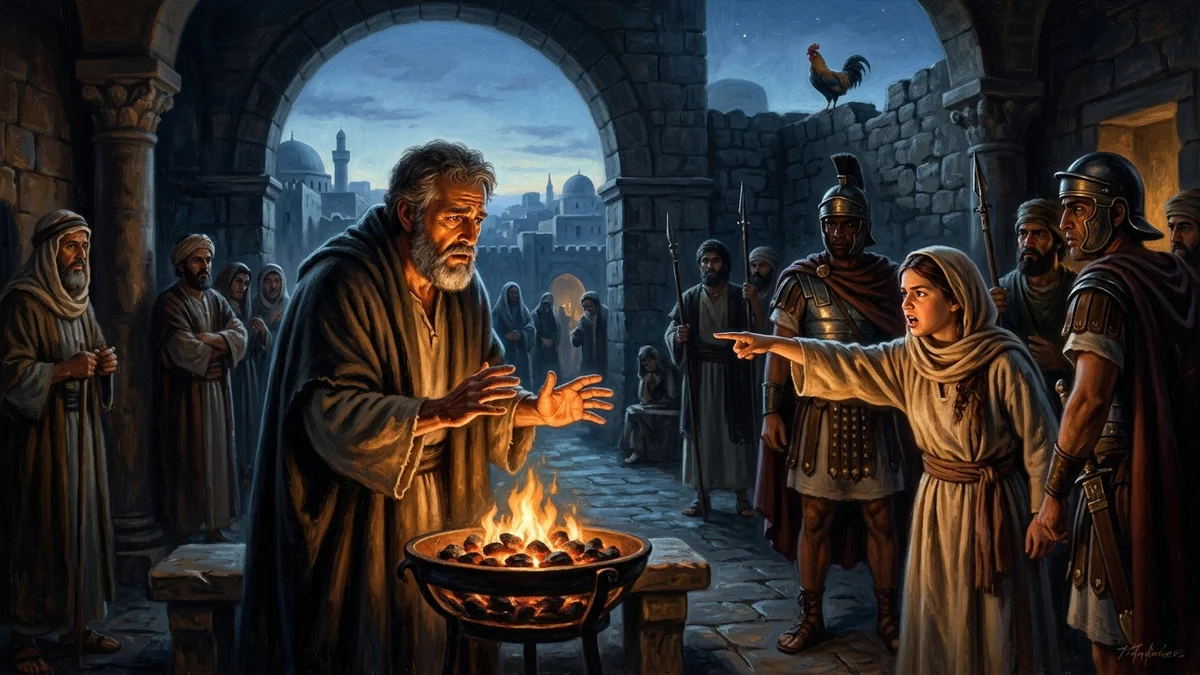
While the Lord of Glory was being battered in the upper council room, a heartbreaking drama was unfolding in the open stone courtyard below. Simon Peter and another disciple (likely John, who was known to the High Priest's household) had gained entrance past the portress. The midnight mountain air was freezing. In the center of the courtyard, temple guards and servants had kindled an iron brazier of burning coals (anthrakia), standing around it and rubbing their hands for warmth. Peter, desperately seeking to blend into the shadows, stepped up to the fire and stretched out his trembling hands.
As the orange flames illuminated his weathered fisherman's face, the young servant girl who kept the door stepped forward, squinting suspiciously. Pointing an accusing finger, she proclaimed loudly to the guards: 'This man was also with Him! You were with Jesus of Nazareth!' Caught entirely off guard, terror seized the fisherman. His boastful vows of martyrdom evaporated into the night. Backing away from the fire, Peter blurted out the first denial: 'Woman, I do not know Him! I do not understand what you are saying!' Slipping out into the darkened gateway, the sharp, solitary crow of a rooster echoed over the city walls—the first warning herald.
Moments later, another servant girl noticed him lingering in the shadows and declared to the bystanders: 'This fellow was also with Jesus of Nazareth!' Cornered and panicked, Peter doubled down on his cowardice, uttering the second denial with a solemn oath (meta horkou): 'I swear by heaven, I do not know the Man!' An hour passed in suffocating dread. Peter remained trapped in the courtyard, unable to leave the Master he loved yet paralyzed by fear of Roman crucifixion. Then, several guards and relatives of Malchus—the man whose ear Peter had sliced off in Gethsemane—surrounded him. One sneered: 'Surely you are one of them; your speech betrays you! You are a Galilean! Did I not see you in the garden with Him?'
Driven into blind, frantic hysteria, Peter began to invoke deadly curses upon himself (katathematizein) and swear: 'I do not know this Man of whom you speak!' Before the final blasphemous word had died on his lips, the silence of the dawn was violently shattered. A rooster perched upon a nearby courtyard parapet threw back its head and crowed the second time—a piercing, clarion trumpet sounding into the morning mist. At that precise, dreadful instant, the door of the upper council room opened. Bound in chains and bruised by punches, Jesus was being led across the balcony. Halting in His tracks, the Lord turned His head and looked directly into Peter's eyes (eneblepsen tō Petrō). It was not a look of rage or contempt; it was a gaze of infinite, tender, sorrowful love. The words of Jesus crashed into Peter's memory like a tidal wave: 'Before the rooster crows twice, you will deny Me three times.' Staggering backward out of the courtyard gates, Simon Peter collapsed into the dark street and wept bitterly (eklausen pikrōs), his arrogant self-righteousness shattered forever.
The Roman Trial Before Pontius Pilate
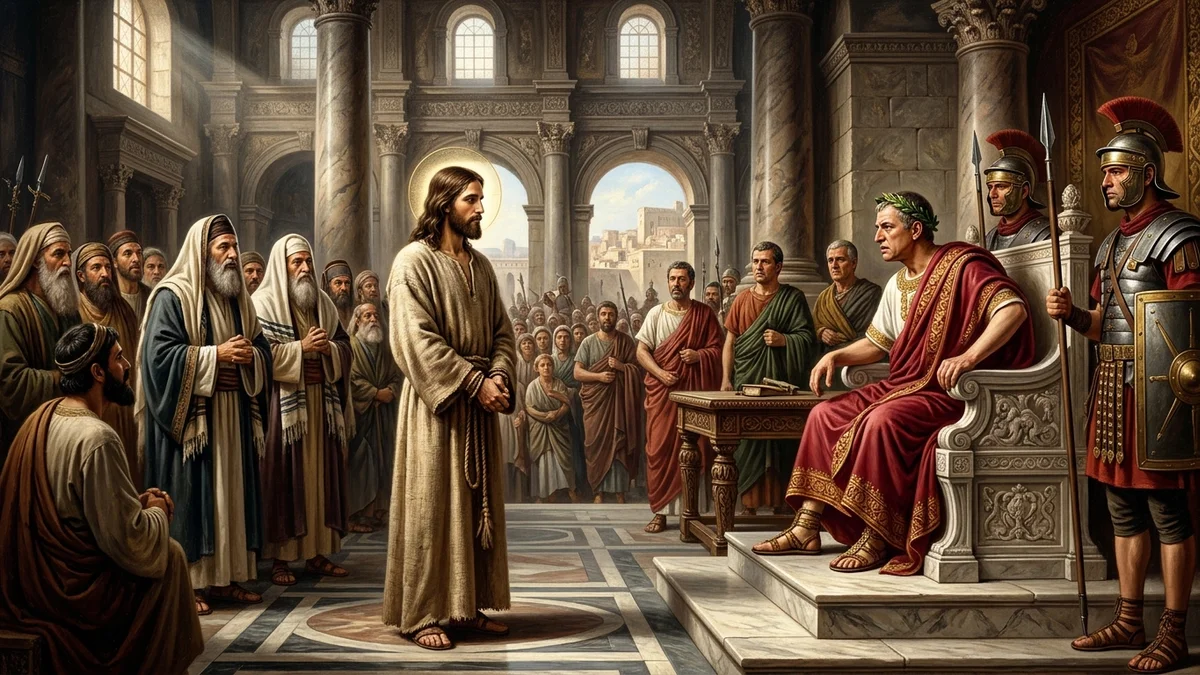
As the first grey streaks of dawn broke over Jerusalem on Friday morning, the Sanhedrin finalized their death sentence in a brief sunrise session, binding Jesus and marching Him across the city to the Praetorium—the Roman headquarters at the Palace of Herod. The Jewish leaders refused to step foot inside the Gentile residence, lest they become ceremonially defiled and disqualified from eating the Passover evening feast. Accommodating their religious scruples, Roman Governor Pontius Pilate walked out onto the elevated stone judgment terrace known as the Pavement (Gabbatha). Looking upon the battered, bound Galilean, Pilate demanded: 'What accusation do you bring against this Man?'
The priests answered arrogantly: 'If He were not an evildoer, we would not have delivered Him up to you!' Pilate shrugged with imperial disdain: 'You take Him and judge Him according to your law.' The priests hissed the real dilemma: 'It is not lawful for us to put anyone to death.' Recognizing that Pilate cared nothing for theological blasphemy, the Sanhedrin shrewdly reformulated their charges into three counts of high treason against Rome: 'We found this fellow perverting the nation, forbidding to pay taxes to Caesar, and claiming that He Himself is Christ, a King!'
Alarmed by the political charge of sedition, Pilate re-entered the inner judgment hall and summoned Jesus privately. Looking upon the serene, silent prisoner, Pilate asked: 'Are You the King of the Jews?' Jesus answered with penetrating depth: 'Are you speaking for yourself about this, or did others tell you this concerning Me?' Pilate snapped: 'Am I a Jew? Your own nation and the chief priests have delivered You to me. What have You done?' Jesus answered with transcendent clarity: 'My kingdom is not of this world. If My kingdom were of this world, My servants would fight, so that I should not be delivered to the Jews; but now My kingdom is not from here.' Pilate pressed: 'Are You a king then?' Jesus answered: 'You say rightly that I am a king. For this cause I was born, and for this cause I have come into the world, that I should bear witness to the truth. Everyone who is of the truth hears My voice.' Pilate uttered his famous cynical sneer—'What is truth?'—and walked back outside to the mob, declaring: 'I find no fault in this Man at all.'
Herod Antipas and the Barabbas Bargain
Enraged by Pilate's verdict, the chief priests shouted that Jesus was stirring up riots all across Galilee. Seizing upon the mention of Galilee, Pilate attempted a jurisdictional dodge: learning Jesus was under the authority of Tetrarch Herod Antipas, who was in Jerusalem for the feast, Pilate remanded the prisoner to Herod's palace. Herod was overjoyed; he had long desired to see Jesus perform a supernatural sign for his royal amusement. But before the decadent, murderous prince who had beheaded John the Baptist, Jesus spoke not a single word. Furious at Christ's silence, Herod and his royal bodyguard treated Him with contempt, mocked Him, dressed Him in a flamboyant, glittering robe (esthēta lampran), and sent Him back to Pilate. On that very day, Luke notes, Pilate and Herod became friends, having previously been enemies.
Back at the Praetorium, Pilate sought a second avenue of escape. It was the governor's custom to grant amnesty to one Jewish prisoner chosen by the crowd during Passover. Pilate brought forward Jesus alongside a notorious, bloodstained terrorist named Barabbas—an insurrectionist who had committed murder in an urban revolt against Rome. Standing on the Pavement, Pilate asked the surging multitude: 'Whom do you want me to release to you? Barabbas, or Jesus who is called Christ?' Pilate was certain that common decency would compel the crowds to choose the gentle prophet over a murderous brigand.
But the chief priests and elders moved aggressively through the packed throng, inciting the mob to demand Barabbas. Suddenly, a roar erupted from thousands of throats: 'Away with this Man, and release to us Barabbas!' Pilate, stunned and unsettled, called out again: 'What then shall I do with Jesus who is called Christ? What shall I do with your King?' The crowd erupted into a demonic, bloodthirsty frenzy: 'Crucify Him! Let Him be crucified!' Pilate shouted back: 'Why, what evil has He done? I have found no reason for death in Him! I will therefore scourge Him and let Him go!' But they shouted all the more violently: 'Crucify Him! Crucify Him!'
The Scourging and 'Ecce Homo'
Hoping to satisfy their lust for blood without committing judicial murder, Pilate ordered Jesus to undergo the horrific Roman scourging (phragellōsis). Stripped bare and tied to a low stone pillar in the barracks courtyard, Jesus was surrounded by a cohort of hardened Roman soldiers. Two executioners wielded the dreaded flagrum—a heavy whip with multiple leather thongs embedded with jagged sheep bones and lead balls. With professional cruelty, they lashed His back, shoulders, chest, and legs. The weighted ends bruised deep into muscle tissue, while the bone fragments tore away skin and flesh, exposing veins, arteries, and the white glistening surface of ribs. His blood soaked the stone floor of the Praetorium.
Untying His lacerated body, the soldiers dragged Him into the garrison hall to indulge in sadistic sport. They threw a faded crimson military cloak across His raw, bleeding shoulders. From a nearby desert bush, they wove a crown of long, rigid thorns (stephanos ex akanthōn) and smashed it down onto His brow, driving sharp spikes deep into His scalp until crimson streams cascaded down His beard. They forced a hollow wooden reed into His right hand as a fake royal scepter. Then, kneeling before Him in mocking worship, they taunted: 'Hail, King of the Jews!' They spat thick saliva into His bruised face, snatched the reed from His hand, and struck Him repeatedly on the head, driving the thorns deeper into His skull.
Watching this horrific spectacle, Pilate believed that the sight of this pulverized, disfigured prophet would shame the Jewish leaders into pity. He walked out onto the stone balcony once more: 'Behold, I am bringing Him out to you, that you may know that I find no fault in Him.' Jesus stepped out onto the Pavement, wearing the crown of thorns and the purple robe, His face covered in blood, spittle, and bruises. Pilate pointed at the Lamb of God and uttered the immortal words: 'Behold the Man!' (Ecce Homo! / Idou ho anthrōpos!).
Instead of pity, the sight of Christ's blood ignited uncontrollable mob madness. The chief priests and officers shrieked: 'Crucify Him! Crucify Him!' Pilate shouted in exasperation: 'You take Him and crucify Him, for I find no fault in Him!' The priests revealed their ultimate religious indictment: 'We have a law, and according to our law He ought to die, because He made Himself the Son of God!' When Pilate heard that title, terror seized his pagan heart. He rushed back into the Praetorium and demanded of Jesus: 'Where are You from?' Jesus gave him no answer. Pilate threatened: 'Are You not speaking to me? Do You not know that I have power to crucify You, and power to release You?' Jesus looked through the trembling governor with sovereign majesty: 'You could have no power at all against Me unless it had been given you from above. Therefore the one who delivered Me to you has the greater sin.'
From that moment, Pilate fought desperately to release Him. But the Jewish authorities played their final, lethal political trump card: 'If you let this Man go, you are not Caesar's friend! Whoever makes himself a king speaks against Caesar!' The mention of Tiberius Caesar terrified Pilate; accusations of treason would mean imperial disgrace, exile, or suicide. Seated upon the judgment seat, Pilate looked at the Jews: 'Shall I crucify your King?' The chief priests uttered the ultimate theological apostasy of Israel's history: 'We have no king but Caesar!' Seeing that a riot was beginning and that he could prevail nothing, Pilate called for a basin of water. Washing his hands before the multitude, he declared: 'I am innocent of the blood of this just Person. You see to it.' And all the people answered: 'His blood be on us and on our children!' Releasing Barabbas the murderer, Pilate handed Jesus over to the centurions to be led away and crucified on the hill of Golgotha.
Ancient Near Eastern & Archaeological Context
In first-century Roman Judaea, legal authority was bifurcated between the local Jewish aristocratic council (the Sanhedrin) and the Roman provincial administration. The Great Sanhedrin, comprising seventy-one elders, chief priests, and scribes presided over by the High Priest, exercised religious jurisdiction but lacked the legal authority to execute capital punishment (ius gladii), which had been revoked by Rome around AD 6. Consequently, religious authorities were forced to stage two separate legal proceedings: first, a religious trial to condemn Jesus of theological blasphemy under Mosaic law (Leviticus 24:16); and second, a secular trial before Roman Prefect Pontius Pilate, reframing the theological charge into civil treason and insurrection against Tiberius Caesar (Luke 23:2). The Jewish trial was conducted in the dead of night within the palatial compound of Annas and his son-in-law Caiaphas in the Upper City of Jerusalem, violating established Jewish jurisprudence on eight counts. At dawn, Jesus was transferred to the Praetorium—either at the Antonia Fortress overlooking the Temple or the opulent Palace of Herod near the Jaffa Gate. Pontius Pilate, serving as Roman prefect from AD 26 to 36, was notoriously ruthless toward Jewish customs, yet recognized that the Sanhedrin was delivering Jesus out of sheer envy (Mark 15:10). Caught between imperial paranoia and fear of a provincial riot that could trigger his recall by Rome, Pilate surrendered justice to expediency.
Practical Discipleship & Spiritual Application
- Uncompromising Truth in the Face of Falsehood: Before corrupt religious courts and Roman imperial power, Jesus refused to flatter or posture politically; He remained majestically silent before lies and spoke boldly under oath, showing that God's kingdom stands solely on absolute truth.
- The Bankrupt Mirage of Self-Reliance: Simon Peter drew a sword against an armed cohort in Gethsemane, yet collapsed before the routine questions of a young servant girl; our worst defeats happen not because circumstances are impossible, but because we trust in our own fragile willpower rather than divine grace.
- The Restoring Gaze of Sovereign Grace: When the rooster crowed and Peter remembered Christ's warning, Jesus turned and looked upon him—not with condemning scorn, but with redeeming love; our bitterest tears of repentance are met with the Savior's unwavering mercy.
- The Tragedy of Moral Cowardice: Pontius Pilate washed his hands in water, publicly acknowledging Jesus' complete innocence while simultaneously delivering Him to execution; true discipleship refuses the cowardly compromise of pleasing human crowds over obeying God.
Support Independent Biblical Research
Did this study bless you? Help support our independent bilingual research and interactive visual Bible tools.
⚡ Fast Facts
- Eight Violations of Sanhedrin Law: Jewish legal jurisprudence (the Mishnah, Sanhedrin IV–V) strictly forbade capital trials at night, trials during festivals, conducting trials outside the Temple Hall of Hewn Stones, and executing a death penalty on the same day as the verdict, rendering the religious trial of Jesus an entirely illegal sham
- The Archaeological Pilate Stone: Discovered in 1961 by Italian archaeologists at the seaside amphitheater of Caesarea Maritima, a limestone inscription bearing the Latin text 'Pontius Pilatus, Praefectus Iudaeae' definitively authenticated the exact historical title and governorship of the biblical figure
- The Double Rooster Crow (Mark 14:72): Mark's Gospel uniquely records Jesus prophesying that the rooster would crow twice; in Roman military timekeeping, the third watch of the night (midnight to 3:00 AM) was formally designated 'gallicinium' ('cockcrowing'), pinpointing the exact hour of Peter's collapse
- The Terrifying Name of Barabbas: In ancient Aramaic, Bar-Abba translates literally as 'Son of the Father' (Bar = son, Abba = father); the crowd was offered a literal choice between a murderous earthly 'Son of the Father' and Jesus Christ, the true, eternal Son of the Heavenly Father
❓ Frequently Asked Questions (FAQs)
Why did High Priest Caiaphas tear his robes when Jesus spoke, and what was the legal significance?
When Jesus openly affirmed that He was the Messiah and added that Caiaphas would see the Son of Man sitting at the right hand of Power and coming on the clouds of heaven (citing Psalm 110:1 and Daniel 7:13–14), He claimed absolute equality with Yahweh. Under Leviticus 21:10, the High Priest was explicitly forbidden to tear his sacerdotal vestments under any circumstances. However, rabbinic tradition later permitted tearing garments upon hearing blasphemy. By rending his linen robes, Caiaphas theatrically signaled to the Sanhedrin that the prisoner had spoken blasphemy from His own lips, forfeiting the need for further witnesses and demanding the death penalty.
What is the spiritual meaning behind Peter weeping bitterly after the rooster crowed?
Peter's bitter weeping (eklausen pikrōs) marked the shattering of self-righteous confidence and the birth of true gospel repentance. Luke 22:61 records that at the very instant the rooster crowed, 'the Lord turned and looked at Peter.' Standing bound and bruised across the courtyard, Christ caught Peter's gaze not with condemnation, but with sorrowful, intercessory love. Unlike Judas, who experienced worldly remorse (metamelomai) that led to suicide, Peter experienced godly sorrow leading to genuine repentance (metanoia). His tears washed away the arrogant pride that relied on human flesh, preparing him to be restored by the risen Christ on the shores of Galilee.
Why did Pilate wash his hands before the mob, and did it absolve him of legal and moral guilt?
Pilate performed the ceremonial Jewish rite of hand-washing (Deuteronomy 21:6–8) in an attempt to pacify his conscience and communicate to the Jewish leaders that he considered Jesus innocent of treason. However, hand-washing was a cowardly political stunt. As the supreme Roman judicial authority in Judaea, Pilate possessed the legal duty to protect an innocent man from mob violence. By knowingly capitulating to blackmail ('If you let this man go, you are not Caesar's friend') and ordering Christ scourged and crucified to preserve his political standing, Pilate bore indelible moral guilt, as confessed in the historic Christian creeds: 'crucified under Pontius Pilate.'