The full Passover moon hung high in the Judean sky like a pale, unblinking eye, casting silver light across the rugged limestone crags of the Mount of Olives. Descending the steep southeastern slope of Jerusalem through the Essene Gate, Jesus led the eleven disciples down into the shadowy gorge of the Kidron Valley. The night air was biting and damp. Beneath their sandals, dry olive leaves crackled in the darkness. As they crossed the shallow bed of the Kidron Brook, the faint, metallic scent of sacrificial blood lingered in the air—the runoff from hundreds of thousands of Passover lambs slaughtered earlier that afternoon at the Temple altar. Now, the true Lamb of God, slain in the divine counsel before the foundation of the world, walked toward His own altar.
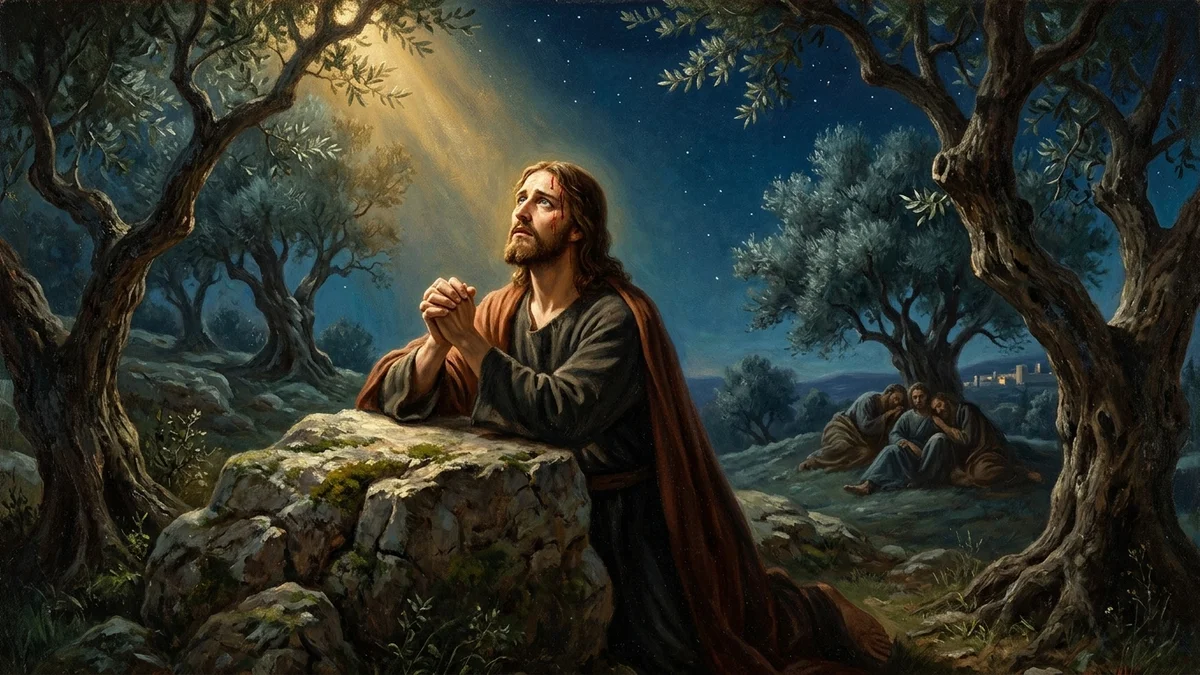
Reaching the eastern bank of the valley, Jesus led them into an enclosed estate known as Gethsemane—an Aramaic name meaning 'the oil press' (Gat-Shemanim). Massive, gnarled olive trees, centuries old with twisted trunks and silvery foliage, cast contorted, groaning shadows under the moonlight. This was a familiar sanctuary; Jesus had retreated here countless times to pray in solitary communion with the Father. But tonight, an atmosphere of suffocating dread permeated the grove. Turning to the weary group, Jesus halted eight of the disciples near the stone entrance: 'Sit here while I go and pray over there.' Then, beckoning His inner circle—Peter, James, and John, the three who had witnessed His dazzling glory on the Mount of Transfiguration—He led them deeper into the labyrinth of twisted trees.
The Onset of the Crushing Horror
As the shadows deepened, a sudden, violent transformation seized the Savior. Matthew records that Jesus 'began to be sorrowful and deeply distressed' (lypeisthai kai adēmonein), while Mark uses an even more terrifying Greek verb: ekthambeisthai—to be gripped with profound, hair-raising horror, stunned awe, and paralyzing grief. The divine weight of what lay ahead fell upon His human soul like the descent of a collapsing mountain. The physical agony of the coming Roman scourging and crucifixion was terrible, yet thousands of martyrs had faced execution with stoic calm. What seized Christ was an infinitely deeper, cosmic terror: the holy, sinless Son of God was about to become the sin-bearer of a rebel universe. The unbroken, eternal fountain of love and communion He had shared with the Father from before time was about to be severed by the judicial curse of Calvary.
Jesus turned to Peter, James, and John, His face ashen and His voice trembling with raw heartbreak: 'My soul is exceedingly sorrowful, even to death. Stay here and watch with Me.' He, who had stilled the roaring tempest with a single word and summoned Lazarus from four days in the tomb, now begged His frail human friends for the comfort of their presence. Moving a stone's throw further into the darkness—perhaps thirty or forty yards—Jesus collapsed to the earth. Luke records that He fell upon His knees, while Matthew states that He fell flat upon His face in the dust, His arms outstretched upon the cold limestone rock.
The Prayer of the Cup and the Bloody Sweat
Out of the dark earth rose the desperate, agonizing cries of the Son of Man. The author of Hebrews later wrote that in the days of His flesh, Christ offered up prayers and supplications with vehement cries and tears to Him who was able to save Him from death (Hebrews 5:7). Crying out in His native Aramaic tongue, He prayed: 'Abba, Father, all things are possible for You. Take this cup away from Me; nevertheless, not what I will, but what You will.' The 'cup' was the terrifying Old Testament metaphor for the wine of God's unmitigated, holy fury against sin (Psalm 75:8; Isaiah 51:17; Jeremiah 25:15). In this cup was distilled the concentrated guilt of every idolatry, murder, betrayal, lust, and rebellion committed by fallen humanity from Adam to the end of time. To drink it meant to plunge into the abyss of divine abandonment, crying 'My God, My God, why have You forsaken Me?'
Rising in exhaustion, Jesus walked back through the trees seeking a word of comfort from His beloved disciples. But instead of vigilant watchmen, He found them curled on the ground under their heavy wool mantles, sound asleep, their eyes weighed down by grief and sorrow. Approaching Simon, Jesus nudged the sleeping fisherman: 'Simon, are you sleeping? Could you not watch with Me one hour? Watch and pray, lest you enter into temptation. The spirit indeed is willing, but the flesh is weak.' Peter stammered in confusion, ashamed and disoriented. Turning away, Christ retreated a second time into the dark solitude of the grove.
Again, He threw Himself upon the rock: 'O My Father, if this cup cannot pass away from Me unless I drink it, Your will be done.' The spiritual battle reached an intensity beyond human comprehension. The medical evangelist Luke records that an angel appeared from heaven, strengthening Him. Yet even with angelic sustenance, His agony (agōnia) grew so excruciating that He prayed more earnestly. Beneath the immense psychological and spiritual pressure, the blood vessels in His subcutaneous sweat glands ruptured. Drops of blood mingled with His profuse sweat, falling like thick, viscous clots (thromboi haimatos) onto the limestone rock and soil of Gethsemane. The physiological phenomenon, known to modern pathology as hematidrosis, signified that Christ was literally dying of a broken heart before a single Roman nail had pierced His flesh.
A second time, Jesus returned to the three disciples, and again found them sleeping, for their eyes were heavy; neither did they know what to answer Him. A third time, the Son of God withdrew to the rock and poured out the exact same prayer. In that third agonizing intercession, the decisive victory of cosmic history was won. The human will of the Son aligned in absolute, unreserved surrender to the eternal will of the Father. The rebellion of Eden, where Adam said 'My will, not Thine,' was forever overturned in Gethsemane, where Christ declared: 'Not My will, but Yours be done.' Rising from the bloody rock, serene and clothed in unshakeable divine majesty, Jesus walked to the sleeping apostles for the final time: 'Are you still sleeping and resting? It is enough! The hour has come; behold, the Son of Man is being betrayed into the hands of sinners. Rise, let us be going. See, My betrayer is at hand!'
The Kiss of Judas and the Blazing Cohort
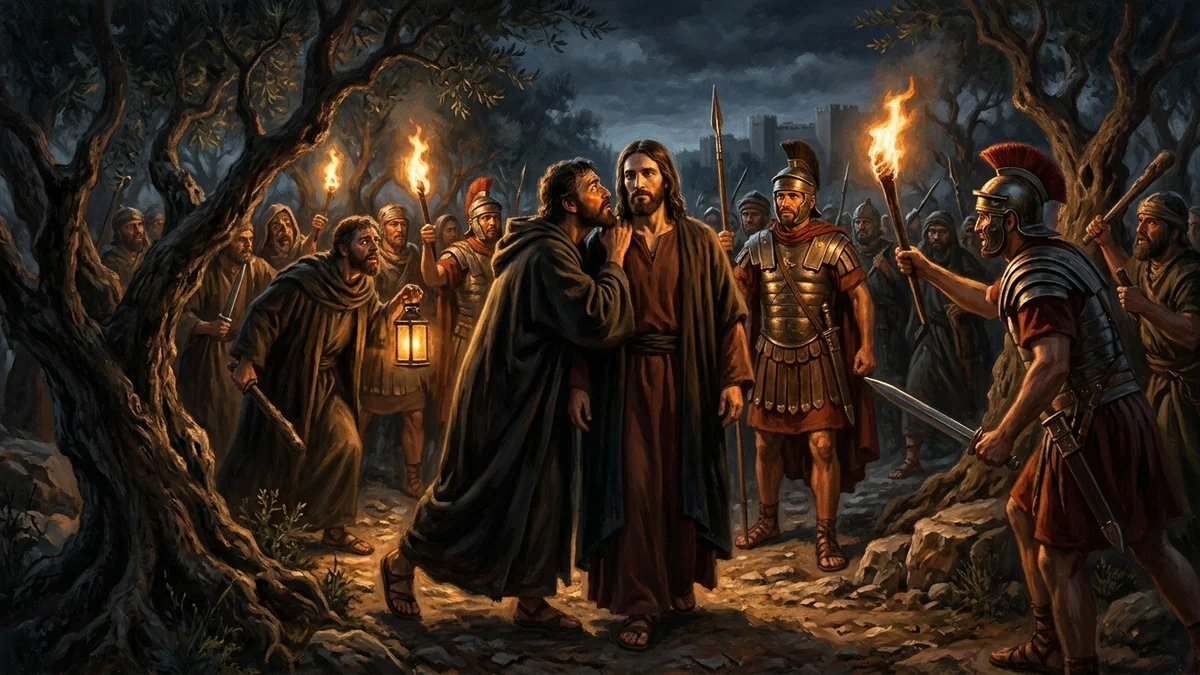
Before the echoes of His voice faded, the tranquil darkness of the Mount of Olives was violently shattered. Down the slope from the Kidron Valley emerged a blazing serpent of fire: hundreds of iron torches, pitch lanterns, and bronze-tipped spears flashing in the night. Leading the vanguard was Judas Iscariot. Behind him marched a full Roman military cohort (speira) dispatched from the Antonia Fortress by Pontius Pilate at the Sanhedrin's request, accompanied by the temple police (hypēretai) armed with heavy wooden clubs and short swords. They had prepared for a bloody midnight ambush, expecting Jesus and His disciples to fight like desperate Galilean zealots.
Judas had given them a prearranged signal: 'Whomever I kiss, He is the One; seize Him and lead Him away safely.' In the flickering torchlight beneath the ancient olive branches, the traitor stepped briskly into the clearing. Bypassing the other disciples, he walked straight up to Jesus. With brazen hypocrisy, Judas looked into the sorrowful eyes of the Master he had sold for thirty pieces of silver and said: 'Greetings, Rabbi!' (Chaire, Hrabbi!). Then, leaning forward, he kissed Him repeatedly and effusively upon the cheek (katephilēsen auton). Jesus did not flinch or strike him down. Looking upon the face of His betrayer, Christ spoke with heartbreaking gentleness: 'Friend, why have you come? Judas, are you betraying the Son of Man with a kiss?'
The Divine Shockwave and the Healing of Malchus
Stepping forward past Judas, Jesus confronted the wall of armed soldiers and temple police. Knowing all things that would come upon Him, He asked calmly: 'Whom do you seek?' The Roman tribune and temple officers answered: 'Jesus of Nazareth.' Jesus uttered two words: 'Egō Eimi'—'I am He.' It was the uncreated, sovereign covenant Name revealed to Moses at the burning bush. At the sound of that voice, a supernatural shockwave exploded through the olive grove. John records the astonishing historical fact: 'Now when He said to them, 'I am He,' they drew back and fell to the ground.' Hundreds of armored Roman legionaries and temple guards collapsed backward onto the rocky terrain, pinned to the earth by the sheer weight of divine glory.
Allowing them to struggle back to their feet, Jesus asked them again with sovereign authority: 'Whom do you seek?' And they said, 'Jesus of Nazareth.' Jesus answered: 'I have told you that I am He. Therefore, if you seek Me, let these go their way'—fulfilling His word that none of those whom the Father gave Him would be lost. Seeing the soldiers advance with ropes and fetters, Simon Peter's fiery Galilean temper exploded. Reaching beneath his outer cloak, Peter drew a concealed short sword (machaira) and swung it with lethal force at the nearest man. The blade missed the skull, slicing clean through the right ear of Malchus, the personal high-ranking servant of High Priest Caiaphas. Blood spurted across the servant's shoulder as he shrieked in agony.
The soldiers drew their weapons, ready to slaughter the disciples where they stood. But Jesus intervened with a thunderous command: 'Put your sword into the sheath! For all who take the sword will perish by the sword. Shall I not drink the cup which My Father has given Me? Or do you think that I cannot now pray to My Father, and He will provide Me with more than twelve legions of angels? How then could the Scriptures be fulfilled, that it must happen thus?' Reaching out His hand, Jesus gently touched the severed, bleeding wound of Malchus; instantly, the flesh and cartilage were miraculously restored to wholeness—the final healing miracle of Christ's earthly ministry, performed on an armed enemy sent to murder Him.
Turning to the chief priests, temple captains, and elders who had accompanied the soldiers, Jesus exposed their cowardice: 'Have you come out, as against a robber, with swords and clubs to take Me? I sat daily with you, teaching in the temple, and you did not seize Me. But this is your hour, and the power of darkness; all this was done that the scriptures of the prophets might be fulfilled.' At those words, the illusion of human bravery collapsed. Terror seized the apostles. Seeing their Master willingly submit to the iron chains of Rome, 'all the disciples forsook Him and fled' into the dark crags of the Mount of Olives. Bound in heavy ropes, Jesus was led away across the Kidron Valley toward the palace of the High Priest, solitary, victorious, and ready to die for the sins of the world.
Ancient Near Eastern & Archaeological Context
Following the Passover celebration, it was Jewish custom to remain within the municipal boundaries of Jerusalem overnight. However, ancient rabbinic law considered the western slopes of the Mount of Olives, directly across the Kidron Valley, as part of the extended liturgical precincts of the holy city. The Garden of Gethsemane was an enclosed agricultural estate containing an ancient olive grove and a subterranean olive oil press (Gat-Shemanim). In first-century Judea, wealthy property owners frequently maintained private walled gardens along the Mount of Olives to escape the stifling congestion of the city. Jesus had visited this private sanctuary so frequently with His disciples that John 18:2 records, 'Judas also, who betrayed Him, knew the place.' The Kidron Valley was historically saturated with grim prophetic symbolism: it was the exact dark gorge through which King David fled weeping and barefoot when betrayed by his trusted advisor Ahithophel (2 Samuel 15:23). Furthermore, during the Passover slaughter, the blood of hundreds of thousands of sacrificial lambs washed from the Temple altar through an underground drainage conduit directly into the Kidron Brook, staining its waters crimson. Crossing this blood-tinged stream in the dead of night, the true Lamb of God walked toward the crushing stones of Gethsemane.
Practical Discipleship & Spiritual Application
- The Ultimate Posture of Surrender: When faced with dark valleys, bitter trials, and overwhelming sorrow, anchor your soul upon the bedrock of Christ's prayer: 'Not My will, but Yours be done'; true faith yields unconditionally to the Father's sovereign wisdom.
- Vigilance in the Midnight Hours: When cosmic spiritual battles are being waged, guard against the creeping lethargy of the flesh; Jesus' warning to Peter echoes across the ages: 'Watch and pray, lest you enter into temptation; the spirit indeed is willing, but the flesh is weak.'
- Renouncing Carnal Weapons for Divine Victory: When Peter slashed off Malchus' ear, Christ commanded him to put away his sword; the Kingdom of God is never established through fleshly anger, violence, or human retaliation, but through spiritual intercession and sacrificial love.
- Comfort in the Solitude of Suffering: In your darkest hours of abandonment and grief, remember that Jesus has trodden the lonely winepress of Gethsemane before you; He who sweat great drops of blood draws near to comfort every broken heart.
Support Independent Biblical Research
Did this study bless you? Help support our independent bilingual research and interactive visual Bible tools.
⚡ Fast Facts
- The Name Gethsemane (*Gat-Shemanim*): In Aramaic and Hebrew, Gethsemane translates literally as 'the oil press'; located at the foot of the Mount of Olives, it was the exact industrial site where massive basalt crushing stones pulverized olives to extract virgin oil, prefiguring Christ being crushed for our iniquities
- Medical Reality of Hematidrosis: Luke the physician specifically documents that Christ's sweat became 'like great drops of blood falling down to the ground' (Luke 22:44); modern clinical science identifies this rare physiological condition as hematidrosis, caused by acute psychological stress rupturing subcutaneous micro-capillaries into the sweat ducts
- The Staggering Roman Cohort (*Speira*): John 18:3 uses the technical military term *speira*, designating a Roman auxiliary cohort stationed at Fortress Antonia (comprising between 400 and 600 heavily armed legionaries), demonstrating the Sanhedrin feared a massive armed insurrection
- The Divine 'I AM' (*Egō Eimi*) Shockwave: When the arresting soldiers demanded Jesus of Nazareth and Christ replied 'I am He' (John 18:6), the sovereign power of the divine Tetragrammaton struck the cohort with such supernatural force that hundreds of armed soldiers fell backward onto the rocky ground
❓ Frequently Asked Questions (FAQs)
What was the terrifying 'cup' that Jesus pleaded with the Father to remove if possible?
Jesus was not shrinking from mere physical pain, torture, or crucifixion; thousands of Roman criminals endured crucifixion without sweating blood. The 'cup' (Hebrew: *kos*) throughout the Old Testament prophetic literature (Psalm 75:8; Isaiah 51:17; Jeremiah 25:15) is the terrifying, unmitigated cup of divine holy wrath against cosmic sin. In Gethsemane, the perfectly holy, sinless Son of God—who had enjoyed unbroken, radiant trinitarian communion with the Father from all eternity—faced the incomprehensible horror of becoming sin for us (2 Cor 5:21), absorbing the full judicial weight of human guilt, and enduring the agonizing curse of divine abandonment on the cross.
Why did Judas choose a kiss as the signal to identify Jesus to the arresting mob?
In first-century Jewish rabbinic tradition, a kiss on the cheek or hand was the customary, reverent greeting given by a disciple to his honored master, symbolizing deep affection, loyalty, and submission. At night in an unlit olive grove, where Jesus and His disciples wore similar coarse Galilean tunics, the Roman soldiers who had never seen Christ closely could easily mistake another disciple for Jesus. Judas deliberately weaponized the highest symbol of covenant intimacy into an instrument of lethal treachery. Mark 14:45 notes that Judas did not merely kiss Him (phileō), but kissed Him fervently and repeatedly (kataphileō), masking his black betrayal behind an ostentatious display of devotion.
Why did Jesus command Peter to put away his sword after cutting off Malchus' ear?
When Peter impulsively drew his short sword (machaira) and slashed off the right ear of Malchus, the High Priest's personal servant, he was attempting to inaugurate an earthly, military revolution. Jesus immediately rebuked Peter with two eternal principles: first, 'All who take the sword will perish by the sword,' declaring that the Kingdom of God cannot be advanced through carnal violence; and second, 'Shall I not drink the cup which My Father has given Me?' Christ revealed that He had at His disposal twelve legions of angels (over 72,000 heavenly warriors), but voluntarily chose the path of the Suffering Servant to fulfill the Scriptures and redeem mankind.