Found in Luke 14:28-30 and paired with the Warring King in verses 31-33, the Parable of the Tower Builder is Christ's relentless warning against superficial discipleship. Turning to massive, cheering crowds who were following Him on the road to Jerusalem, Jesus intentionally winnowed their numbers by confronting them with the absolute, uncompromising cost of cross-bearing allegiance.
1. The Demands of the Cross and the Winnowing of the Crowds
The historical setting was intoxicating: "Large crowds were traveling with Jesus, and turning to them he said: 'If anyone comes to me and does not hate father and mother, wife and children, brothers and sisters—yes, even their own life—such a person cannot be my disciple. And whoever does not carry their cross and follow me cannot be my disciple'" (Luke 14:25-27). Modern church strategists would celebrate surging attendance; Jesus turned around and delivered a message designed to weed out casual spectators. Following Him was not a weekend parade, but an execution march to a cross.
2. The Architecture of the Vineyard Watchtower
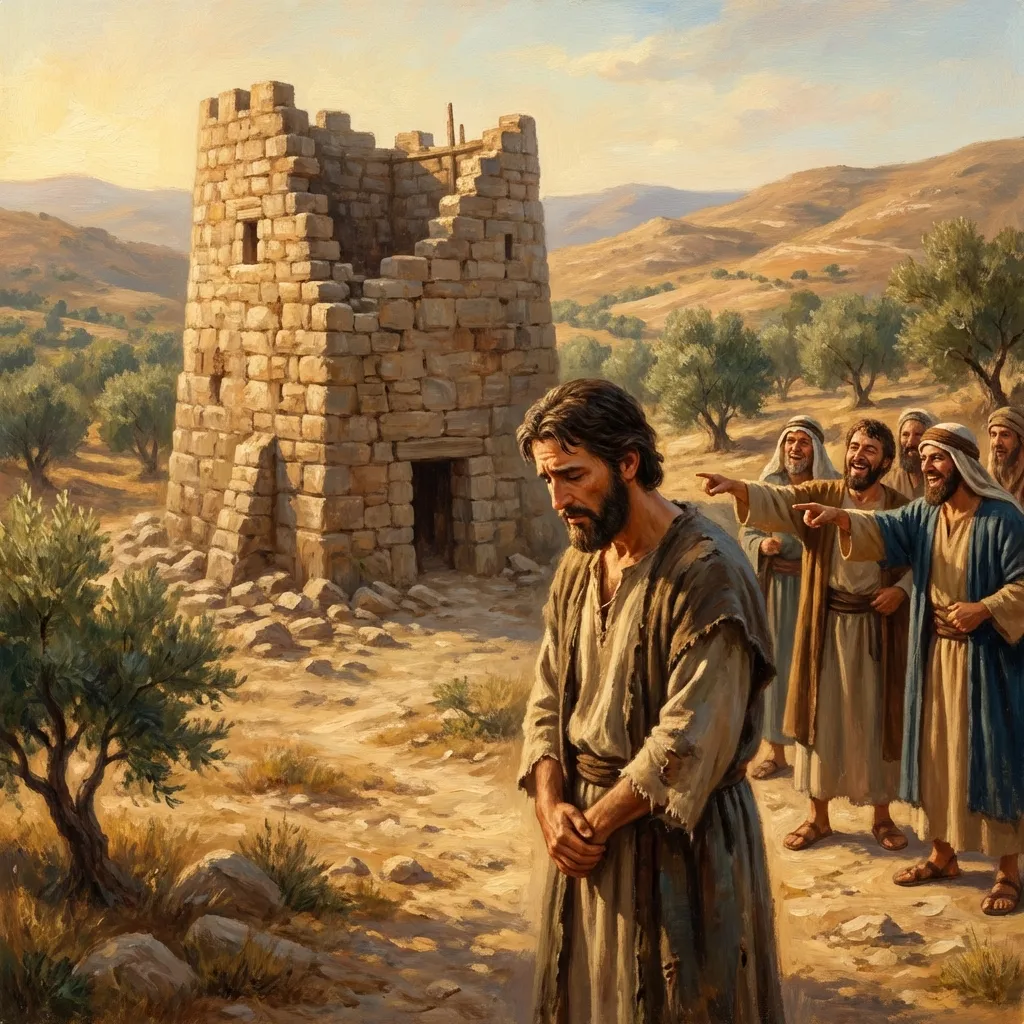
To crystallize His point, Jesus introduced an earthy building project: "Suppose one of you wants to build a tower. Won't you first sit down and estimate the cost to see if you have enough money to complete it?" (Luke 14:28). In ancient Palestine, agricultural towers (*pyrgoi*) built inside vineyards were formidable stone structures. Standing up to thirty feet tall, they guarded valuable grape harvests from thieves and jackals, provided elevated storage for winepress vats, and served as seasonal homes for farm families. Constructing such a fortress demanded quarrying massive limestone blocks, hiring stonecutters, and laying deep bedrock foundations.
3. The Public Mockery of the Unfinished Foundation
Jesus painted the tragic, humiliated outcome of impulsive zeal: "For if you lay the foundation and are not able to finish it, everyone who sees it will ridicule you, saying, 'This person began to build and wasn't able to finish'" (Luke 14:29-30). In Middle Eastern honor-and-shame culture, public ridicule was worse than physical death. An abandoned, weed-choked foundation standing along a major trade route became an enduring monument to the builder's financial stupidity. In the same way, an individual who professes faith in Christ with emotional fanfare, but abandons the walk when persecution, financial loss, or cultural ostracization strikes, becomes a stumbling block and a source of mockery against the Gospel.
4. The Twin Metaphor: The King Assessing Battle Odds
Jesus reinforced the principle with a military analogy: "Or suppose a king is about to go to war against another king. Won't he first sit down and consider whether he is able with ten thousand men to oppose the one coming against him with twenty thousand? If he is not able, he will send a delegation while the other is still a long way off and will ask for terms of peace" (Luke 14:31-32). In this parable, God Almighty is the conquering King advancing against sinful humanity with unyielding holiness. We cannot win a war against omnipotence. The only rational response is to throw down our weapons and sue for peace through total surrender to the Son.
5. Total Renunciation: The True Currency of Discipleship
Christ drove the nail home with His unequivocal summary: "In the same way, those of you who do not give up everything you have cannot be my disciples" (Luke 14:33). Salvation is entirely a free gift of grace, purchased by the precious blood of the Lamb. But receiving that gift means surrendering the deed to our entire life. Jesus does not accept a secondary place in our affections. We cannot negotiate a partial surrender; we must lay down our reputations, our families, our finances, and our very breath at His feet. Those who count the cost and surrender all discover that losing their life for Christ is the only way to find it for all eternity.
Biblical Keywords & Theological Roots
Tower, fortified agricultural watchtower; a multi-story stone fortress protecting valuable vineyards from thieves and beasts.
Cost, expense, price of completion; counting the full financial and existential outlay required before laying the foundation.
Mockery, derision, public ridicule; the humiliating community shame of abandoning an unfinished building project.
Ancient Near Eastern & Archaeological Context
In rural Judea, stone towers (*pyrgoi*) were the most ambitious private building projects undertaken by landowners. Standing 15 to 30 feet tall, they required quarrying thousands of limestone blocks, laying deep bedrock foundations, and hiring skilled masons. Because Judea was an honor-and-shame culture where public reputation was paramount, starting a visible stone tower along a highway and abandoning it mid-construction because funds ran out made the builder the laughingstock of the entire district. Neighbors would point at the unfinished stumps of stone, saying: 'This person began to build and wasn't able to finish.'
🔑 Key Spiritual Takeaways
- Count the Cost Before You Begin: Following Jesus is not an impulsive, emotional hobby; it requires a deliberate, sober calculation of total life commitment.
- Salvation is Free, But Discipleship Costs Everything: Eternal life is a free gift of grace, but following the Master demands the surrender of all competing loyalties.
- The Tragedy of Unfinished Faith: Starting a Christian profession with fanfare only to abandon it when trials strike brings reproach upon the name of Christ.
- Total Renunciation is Required: Discipleship is not negotiating a lease with God; it is unconditionally signing over the deed to our entire life.
Support Independent Biblical Research
Did this study bless you? Help support our independent bilingual research and interactive visual Bible tools.
⚡ Fast Facts
- Shocking Demand to the Multitudes: Jesus delivered this parable in Luke 14:25-33 when 'large crowds were traveling with him,' intentionally winnowing superficial enthusiasts by demanding total allegiance.
- Vineyard Tower Function: Ancient vineyard towers (*pyrgoi*) were expensive, permanent stone edifices serving as surveillance outposts, winepress storage facilities, and family summer lodging during harvest.
- The Twin Parable of the Warring King: Paired immediately with a king marching to battle with 10,000 soldiers against an invading army of 20,000, illustrating total surrender to a superior power.
- The Non-Negotiable Cost: Concluded with Christ's uncompromising summary: 'Those of you who do not give up everything you have cannot be my disciples' (Luke 14:33).
❓ Frequently Asked Questions (FAQs)
Why did Jesus seem to discourage large crowds from following Him in Luke 14?
Jesus was not interested in superficial popularity or manufactured numbers. He knew that cheap, shallow discipleship crumbles under the heat of persecution. He deliberately thinned the crowds to ensure that those who followed Him did so with their eyes wide open to the cross.
What does 'hating father and mother' mean in Luke 14:26?
In Semitic idiom, 'hate' (*miseō*) is a comparative expression denoting loving less by comparison (as in Genesis 29:30-31 where Jacob loved Rachel more than Leah, and Leah was called 'hated'). Our love for and allegiance to Jesus must be so supreme and preeminent that all earthly family ties look like hatred by comparison.
How does the Tower Builder connect to the Warring King in Luke 14:31-33?
Both parables emphasize deliberate pre-calculation: the builder counts the cost of construction; the king counts the cost of war. If you cannot defeat the 20,000 with your 10,000, you send an embassy for peace. In the same way, sinners cannot defeat God Almighty in judgment; our only sane response is unconditional surrender to King Jesus.