Recorded in Luke 14:7-11, the Parable of the Lowest Seat is Christ's surgical assault on human vanity and religious self-promotion. Reclining at a Sabbath dinner surrounded by watching Pharisees, Jesus observed their desperate scramble for social prestige and articulated the universal, unbending law of the Kingdom of God: that self-elevation ends in humiliation, while voluntary lowliness is crowned with divine glory.
1. The Sabbath Dinner and the Scramble for Status
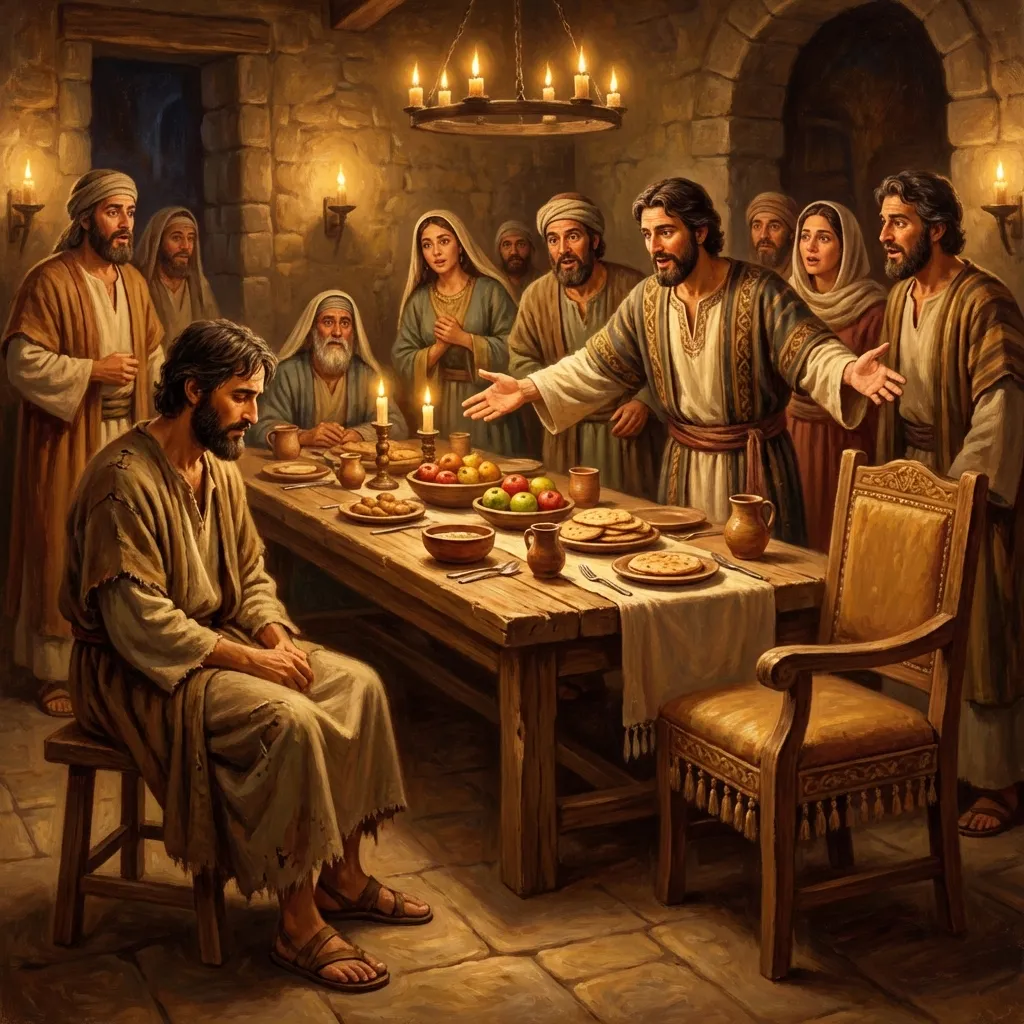
The narrative opens in the tense atmosphere of a prominent Pharisee's home: "When he noticed how the guests picked the places of honor at the table, he told them this parable" (Luke 14:7). Dining in antiquity was an arena of cutthroat status politics. Guests did not merely seek food; they sought social validation. As the dining room doors swung open, men elbowed past each other to recline upon the prominent central couches (prōtoklisia) closest to the distinguished host, advertising their self-assessed importance to the watching city.
2. The Agony of Public Demotion
Jesus exposed the catastrophic risk of self-promotion: "When someone invites you to a wedding feast, do not take the place of honor, for a person more distinguished than you may have been invited. If so, the host who invited both of you will come and say to you, 'Give this person your seat.' Then, humiliated, you will have to take the least important place" (Luke 14:8-9). In a shame-and-honor culture, being publicly tapped on the shoulder by the host and ordered to stand up, walk the entire length of the table with burning cheeks, and slink into the remaining lowest seat was an unbearable social execution. Pride blinds people to their true measure, setting them up for sudden, irreversible disgrace.
3. The Wisdom of the Lowest Seat
Christ commanded a radically counter-intuitive strategy: "But when you are invited, take the lowest place, so that when your host comes, he will say to you, 'Friend, move up to a better place.' Then you will be honored in the presence of all the other guests" (Luke 14:10). Voluntarily selecting the lowest couch—the seat reserved for the youngest or least distinguished—removes all possibility of humiliation. More importantly, it creates space for the host to exercise grace. When the host publicly leads you forward, addressing you as 'friend,' the honor you receive is genuine, untainted by arrogant grasping.
4. The Cosmic Law of Inversion
Jesus concluded by lifting this banquet illustration into an eternal spiritual axiom: "For all those who exalt themselves will be humbled, and those who humble themselves will be exalted" (Luke 14:11). This is not merely good social advice; it is the non-negotiable gravitational law of the spiritual universe. Those who inflate their own reputations, boast of their spiritual credentials, and demand deference will find themselves abased before the throne of God. But those who kneel in the dust, beating their breasts in genuine unworthiness, will be lifted up by sovereign grace.
5. Christ: The True Guest Who Took the Lowest Seat
This parable is ultimately an autobiographical portrait of the Lord Jesus Christ. Possessing the highest seat of cosmic majesty at the right hand of the Father, Jesus did not grasp at His equality with God (Philippians 2:6). He descended into our poverty, took the form of a slave, and chose the lowest seat on earth—the bloody, shameful cross of Golgotha. Because He humbled Himself to the uttermost, God the Father has hyper-exalted Him and given Him the name above every name. When we take the lowest seat, we walk in the footprints of the King of Glory.
Biblical Keywords & Theological Roots
Place of honor, chief seat, first reclining couch at a formal banquet; symbolizing human ambition for prominence.
To humble, bring low, abase; willing self-effacement and voluntary lowliness before God and men.
To exalt, lift high, elevate to honor; the divine elevation bestowed exclusively by God upon the genuinely humble.
Ancient Near Eastern & Archaeological Context
In Greco-Roman and Jewish formal banquets, dining took place in a *triclinium*—a room arranged with three dining couches in a U-shape surrounding a low central table. Guests reclined on their left sides, resting their weight on cushions with their heads toward the table and their feet pointed outward. Every couch had an exact, codified rank of prestige: the *lectus medius* (middle couch) held the host and the guest of supreme honor (*consularis*), while the *lectus imus* (lowest couch) was reserved for minor clients, younger men, or societal dependents. Status anxiety was acute; social climbers frequently rushed into the room to seize the upper couches, only to be publicly commanded by the host to surrender their place to a more distinguished arrival.
🔑 Key Spiritual Takeaways
- Pride Leads to Humiliation: Self-promotion and jockeying for social prestige inevitably invites public embarrassment and divine opposition.
- Voluntary Humility: True humility is not false modesty, but a deliberate choice to take the lowest seat and consider others more significant than oneself.
- Promotion Belongs to God: Honor in the Kingdom cannot be seized; it is bestowed by the Host when He bids the humble to 'move up higher.'
- The Mind of Christ: Jesus Himself modeled the lowest seat by descending from heaven's throne to the shame of the cross, wherefore God highly exalted Him.
Support Independent Biblical Research
Did this study bless you? Help support our independent bilingual research and interactive visual Bible tools.
⚡ Fast Facts
- Sabbath Dinner Observation: Delivered in Luke 14:7-11 as Jesus observed the invited Pharisees aggressively jostling for the places of honor on the banquet couches.
- Echo of Solomon's Wisdom: Directly grounded in Proverbs 25:6-7: 'Do not exalt yourself in the king's presence... it is better for him to say to you, "Come up here," than for him to humiliate you before both nobles and guests.'
- Triclinium Seating Hierarchy: Ancient U-shaped banquet tables had rigid seating protocol: the host reclined at the central couch, the most distinguished guest sat directly to his left or right, and the lowest seat was at the far distal end.
- Cosmic Law of Inversion: Luke 14:11 proclaims the universal spiritual law: 'For all those who exalt themselves will be humbled, and those who humble themselves will be exalted.'
❓ Frequently Asked Questions (FAQs)
Was Jesus merely teaching etiquette and social manners in Luke 14?
No; while using banquet etiquette as an illustration, Jesus was establishing a cosmic theological truth. Luke 14:11 reveals the kingdom law: God actively resists the proud and lavishes grace on the humble (1 Peter 5:5; James 4:6). It addresses our existential standing before God, not table manners.
What is the biblical definition of humility according to this parable?
Humility is not pretending you are worthless; it is freedom from self-absorption. It is the unpretentious willingness to serve without demanding recognition, trusting God alone to orchestrate our elevation in His perfect time.
How did Jesus fulfill the Parable of the Lowest Seat in His own life?
As Philippians 2:5-11 explains, Jesus occupied the ultimate highest seat in the universe, yet emptied Himself, took the form of a bondservant, and chose the lowest place imaginable—a criminal's cross. Therefore, God hyper-exalted Him and gave Him the name above every name.