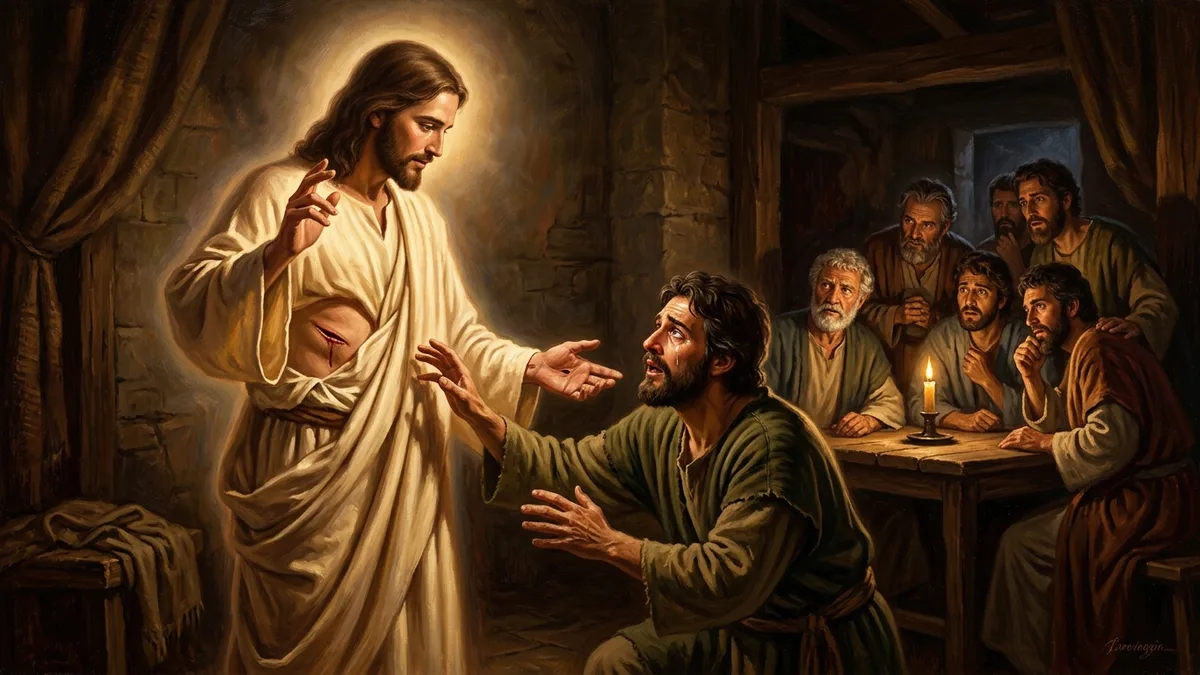
Throughout centuries of superficial preaching, few biblical figures have suffered such unfortunate mischaracterization as Apostle Thomas, known in Greek as Didymos (the Twin). Reduced in popular folklore to the cynical archetype of 'Doubting Thomas', this brave Galilean disciple was, in reality, a man of fierce loyalty, unvarnished honesty, and fearless devotion. When others trembled, Thomas was ready to die with Christ; when others feigned understanding, Thomas asked the hard questions; and when he fell before the Risen Savior, Thomas uttered the crowning, most magnificent confession of the deity of Christ in all the Gospels: "My Lord and my God!"
1. "Let Us Go, That We May Die with Him": The Courage of Thomas (John 11:7–16)
The true character of Thomas is first unveiled not in doubt, but in breathtaking bravery. When news reached Jesus in Perea that His beloved friend Lazarus was mortally sick in Bethany of Judea, Jesus announced: "Let us go to Judea again."
The disciples were paralyzed with fear. Only days earlier, religious leaders in Jerusalem had taken up stones to stone Jesus to death for blasphemy (John 10:31). To return to Judea seemed like a reckless suicide mission. The disciples protested: "Rabbi, lately the Jews sought to stone You, and are You going there again?"
While the others hesitated in terrified paralysis, Thomas stepped forward and rallied the trembling band with words of absolute devotion:
"Then Thomas, who is called the Twin, said to his fellow disciples, 'Let us also go, that we may die with Him.'" (John 11:16)
Thomas was not a sunshine follower. He did not expect earthly triumph or political thrones; he anticipated brutal death. Yet so profound was his personal love for Jesus that he preferred dying with his Master in Judea over living in safety without Him.
2. The Honest Question and the Eternal Highway (John 14:1–6)
During the Last Supper in the Upper Room, Jesus comforted His troubled disciples with the promise of eternity: "In My Father's house are many mansions... And where I go you know, and the way you know."
The other disciples nodded in polite silence, pretending to grasp Christ's mystical vocabulary. But Thomas refused to wear a religious mask. He needed concrete, unvarnished clarity:
"Thomas said to Him, 'Lord, we do not know where You are going, and how can we know the way?'" (John 14:5)
Because Thomas had the intellectual honesty to voice his confusion, Jesus gave humanity the absolute foundation stone of the Christian faith:
"Jesus said to him, 'I am the way, the truth, and the life. No one comes to the Father except through Me.'" (John 14:6)
Every time a believer finds assurance in Christ as the sole mediator between God and man, we are indebted to the honest question of Apostle Thomas.
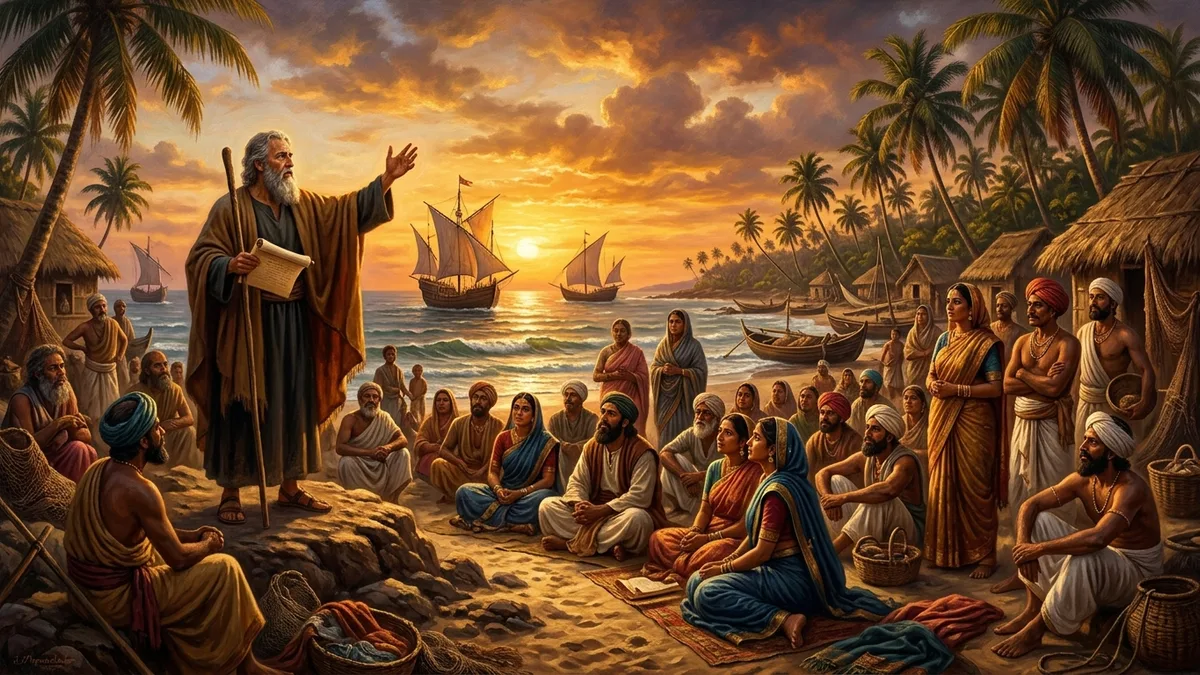 The Apostle of India: An ancient carved stone Persian cross of St. Thomas overlooking the sunrise shores of the Bay of Bengal, commemorating Thomas' mission to the Indian subcontinent.
3. The Upper Room: The Print of the Nails (John 20:19–25)
On resurrection Sunday evening, the risen Jesus appeared to the disciples behind locked doors, showing them His pierced hands and side. But Thomas was absent. Where was he? Shattered by the horror of the crucifixion, Thomas was walking alone in inconsolable grief.
When the ten disciples found him, shouting with exhilaration: "We have seen the Lord!", Thomas could not bear the thought of false hope. He had seen the Roman spear thrust into Jesus' side; he had watched Him die. He uttered his famous demand:
"Unless I see in His hands the print of the nails, and put my finger into the print of the nails, and put my hand into His side, I will not believe." (John 20:25)
Thomas was not asking for anything more than the other apostles had already received. In Luke 24:39, Jesus had told the ten: "Behold My hands and My feet, that it is I Myself. Handle Me and see." Thomas simply demanded the same empirical reality.
4. "My Lord and My God!": The Climax of the Gospels (John 20:26–29)
Eight days later, the disciples were again inside the Upper Room, and Thomas was with them. The doors were shut. Suddenly, Jesus stood in their midst and said: "Peace to you!"
Then, turning His sovereign gaze directly upon Thomas, Jesus repeated the exact words Thomas had spoken in private eight days earlier:
"Reach your finger here, and look at My hands; and reach your hand here, and put it into My side. Do not be unbelieving, but believing." (John 20:27)
Jesus did not denounce Thomas; He lovingly met him at the point of his weakness. Scripture does not record that Thomas ever actually touched the wounds. The sheer physical presence of the living, omniscient Christ was enough. Falling face down upon the stone floor, Thomas cried out the highest theological confession in all biblical literature:
"And Thomas answered and said to Him, 'My Lord and my God!'" (John 20:28)
In the Greek text, it reads: Ho Kyrios mou kai ho Theos mou—explicitly identifying the crucified and risen Jesus as Almighty God Himself. Jesus received this worship, pronouncing a blessing that extends across millennia to you and me: "Thomas, because you have seen Me, you have believed. Blessed are those who have not seen and yet have believed."
5. The Voyage to Ancient India: Planting the Church in Malabar (AD 52)
Following the Day of Pentecost, the apostles divided the known world into mission territories. According to unanimous early church testimony—recorded in the *Acts of Thomas* (c. AD 200), corroborated by Ephrem the Syrian, Gregory of Nazianzus, Jerome, and ancient Indian liturgy—the lot fell to Thomas to carry the Gospel to the remote lands of India.
Boarding a Roman merchant vessel departing from Egypt via the Red Sea, Thomas navigated the monsoon winds across the Arabian Sea, landing at the historic port city of Muziris (Kodungallur) in Kerala in AD 52.
There, Thomas found established Jewish diaspora settlements that had traded spices with King Solomon's fleet centuries earlier. Preaching in their synagogues and along coastal villages, Thomas converted high-caste families, established seven historical church assemblies (the *Ezharappallikal* at Maliankara, Palayoor, Paravur, Kokkamangalam, Niranam, Nilackal, and Kollam), and ordained native priests, founding the vibrant community known through centuries as the **Saint Thomas Christians (Nasranis)**.
6. Martyrdom on St. Thomas Mount, Mylapore (AD 72)
From the western Malabar Coast, Apostle Thomas traversed the rugged Western Ghats mountains to the Coromandel Coast on the eastern shore of India, arriving at the ancient port city of Mylapore (now Chennai, Tamil Nadu).
In Mylapore, Thomas preached the Gospel with supernatural power, performing miracles of healing and turning thousands away from idol worship. Living in a small cave on the rocky hill now known as Little Mount (Chinnamalai), Thomas devoted himself to continuous intercession.
Pagan priests, infuriated by the mass conversions and abandonment of local temples, plotted his assassination. In AD 72, while Apostle Thomas was kneeling in prayer before a stone cross atop the hill (now St. Thomas Mount / Parangimalai), hostile temple priests attacked him from behind, piercing his chest through with a heavy iron spear.
Clutching the stone cross, Thomas prayed for his murderers and committed his spirit into the hands of the Savior he had touched in the Upper Room. His body was reverently buried by weeping Indian disciples in Mylapore, where the magnificent **San Thome Basilica** stands today over his tomb. The brave apostle who had once declared, "Let us go, that we may die with Him," had fulfilled his vow upon the shores of India, sealing his testimony with his life's blood.
Biblical Keywords & Theological Roots
From Aramaic 'Te'oma': a twin; reflecting deep loyalty and intense emotional vulnerability.
Greek translation of Thomas: twin, twofold, duplicate.
My Lord and my God!; the supreme grammatical and theological confession of the absolute deity of Jesus Christ.
The visible mark, imprint, or impression left by a physical blow or strike (specifically the nail-prints of the cross).
Blessed, supremely happy, spiritually fulfilled, favored by God beyond measure.
Ancient Near Eastern & Archaeological Context
Thomas was a Galilean fisherman possessing sharp analytical realism and unwavering devotion. When Jesus embarked on His final journey to Jerusalem, Jewish religious hostility was at fever pitch. While others hesitated, Thomas was willing to face physical execution out of raw love for his Master. Following the Ascension, maritime trade between the Roman Empire and India was flourishing via the monsoon trade winds discovered by Hippalus. Merchant vessels routinely sailed from Myos Hormos on the Red Sea across the Arabian Sea to the Malabar Coast of India (Muziris/Kodungallur). Utilizing these commercial maritime networks, Apostle Thomas embarked on one of the most audacious missionary expeditions in history, bringing the light of Christ to the Indian subcontinent.
Practical Discipleship & Spiritual Application
- Honest Doubt Welcomed by Grace: Jesus did not banish Thomas for needing proof; He condescended to his weakness and invited him to touch His wounds. Christ meets honest seekers in their doubts.
- From Tragedy to Divine Revelation: Thomas' refusal to pretend produced the most triumphant Christological confession in Scripture. Do not settle for superficial faith; seek the living Christ until your heart cries, 'My Lord and my God!'
- The Wounds of Jesus are Our Anchor: The Risen Christ retained His physical scars in His glorified body, proving forever that our redemption was purchased at infinite, tangible cost.
- Apostolic Faith to the Ends of the Earth: Thomas did not stay in comfortable Jerusalem; he sailed across oceans, embraced unfamiliar cultures, and gave his life so that distant nations might hear the Gospel.
Support Independent Biblical Research
Did this study bless you? Help support our independent bilingual research and interactive visual Bible tools.
⚡ Fast Facts
- The Meaning of the Name: 'Thomas' is derived from the Aramaic 'Te'oma', meaning 'Twin'; in Greek he was called 'Didymos'.
- Courage to Die with Jesus: In John 11:16, when the other disciples feared entering hostile Judea where authorities sought to stone Jesus, Thomas boldly declared: 'Let us also go, that we may die with Him!'
- The Supreme Confession: In John 20:28, upon seeing the Risen Christ, Thomas uttered the highest Christological confession in the Gospels: 'My Lord and my God!' (Greek: *Ho Kyrios mou kai ho Theos mou!*).
- Apostle of India: Deeply rooted Indian Christian tradition (attested by Syrian Christians of Kerala and confirmed by Jerome, Gregory of Nazianzus, and Ephrem the Syrian) documents that Thomas landed at Kodungallur (Muziris) in Kerala in AD 52, planted seven churches, and was martyred by a spear at St. Thomas Mount in Chennai in AD 72.
❓ Frequently Asked Questions (FAQs)
The moniker 'Doubting Thomas' unfairly minimizes his extraordinary character. Thomas was deeply loyal, courageous, and committed to absolute empirical truth. When he declared: 'Unless I see in His hands the print of the nails... I will not believe' (John 20:25), he was demanding the exact same sensory confirmation that the other ten disciples had already received the previous week when Jesus showed them His hands and side (John 20:20). Once he encountered the Risen Christ, his faith soared higher than all the others.
In the Upper Room, when Jesus spoke of going to prepare a place and returning, Thomas transparently confessed: 'Lord, we do not know where You are going, and how can we know the way?' (John 14:5). Thomas' honest inquiry prompted Jesus' immortal declaration: 'I am the way, the truth, and the life. No one comes to the Father except through Me' (John 14:6)—the central pillar of Christian salvation.
Abundant historical and archaeological evidence corroborates Thomas' mission to India. The ancient fourth-century *Acts of Thomas* describes his arrival at the court of Indo-Parthian King Gondophares (whose historic existence was confirmed by 19th-century numismatic coin discoveries in northwest India). Church Fathers Ephrem the Syrian, Jerome, and Eusebius cite his Indian ministry. Furthermore, the unbroken living tradition of the St. Thomas Christians (Nasranis) of Kerala and his tomb at San Thome Basilica in Mylapore, Chennai, attest to his apostolic martyrdom in AD 72.