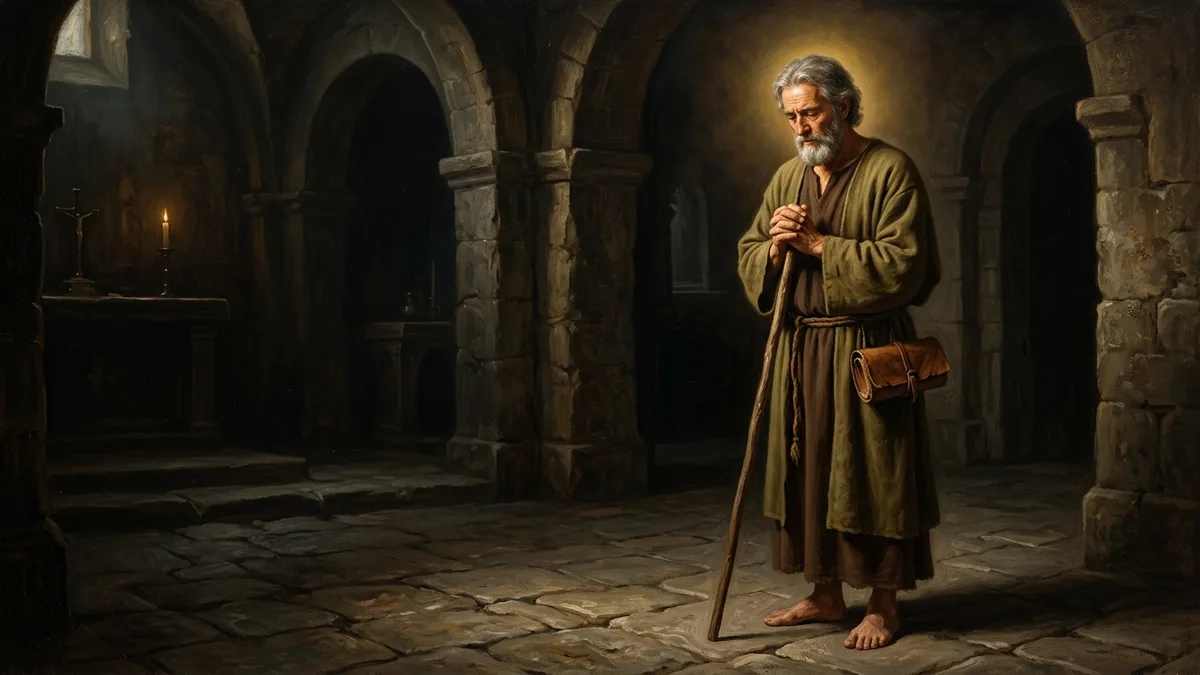
In a world intoxicated with celebrity influence, measurable metrics, and public adulation, the human heart naturally gravitates toward figures of visible prominence. We celebrate the thunderous sermons of Peter, the profound epistles of Paul, and the soaring apocalyptic visions of John. Yet Scripture records that when the Incarnate Son of God spent an entire night in solitary prayer upon a Galilean mountain to select twelve men upon whose shoulders the eternal Church would rest (Luke 6:12–16), He chose an obscure, quiet disciple named James the son of Alphaeus. Known to Christian history as James the Less, his life stands as an eternal monument to the glory of holy obscurity and unheralded faithfulness.
1. The Mystery of the Name: James the Less (Mark 15:40)
In the New Testament, three men bear the Hebrew name Ya'akov (James): James the son of Zebedee (the brother of John), James the Just (the earthly brother of Jesus and leader of the Jerusalem Church), and James the son of Alphaeus.
Mark's Gospel provides the unique historical designation that has adhered to this apostle across millennia:
"There were also women looking on from afar, among whom were Mary Magdalene, Mary the mother of James the less and of Joses, and Salome." (Mark 15:40)
The Greek expression is Iakobos ho mikros, literally translating as "James the Little" or "James the Less." Why was he called this?
- Physical Stature: Some early traditions suggest he was shorter in physical height than the commanding son of Zebedee.
- Age: He was younger in chronological years.
- Public Prominence: He operated without the public thunder, fiery temperament, or high-profile leadership roles occupied by Peter, James, and John.
Yet in the kingdom of God, being "less" is the very prerequisite for spiritual elevation: "He who is least among you all will be great" (Luke 9:48).
2. The Unbroken Record of Faithfulness
Across the four Gospel records, James the son of Alphaeus utters not a single recorded word. We have no recorded dialogue with Christ, no theological question in the Upper Room, no boastful promises, and no recorded blunders.
Yet examine the four canonical lists of the Twelve Apostles:
- Matthew 10:3: "...James the son of Alphaeus, and Lebbaeus, whose surname was Thaddaeus;"
- Mark 3:18: "...James the son of Alphaeus, Thaddaeus, Simon the Cananite;"
- Luke 6:15: "...Matthew and Thomas, James the son of Alphaeus, and Simon called the Zealot;"
- Acts 1:13: "...James the son of Alphaeus and Simon the Zealot, and Judas the son of James."
In every single catalog, across multiple decades of church transmission, James is there. In the third cluster of disciples, his name stands firm at the head. He was present at the miraculous catches of fish, walked the dusty roads of Samaria, listened to the Sermon on the Mount, witnessed the feeding of the multitudes, sat at the table during the Last Supper, and knelt in the Upper Room awaiting the fire of Pentecost.
His was an unbroken, dependable presence. While flashier personalities stumbled or vacillated, James was simply, quietly faithful.
 The Hidden Pillar: Ancient temple colonnades in Jerusalem with the celestial crown of life, symbolizing the quiet, unsung faithfulness of James the Less.
3. A Mother at the Cross: The Heritage of Alphaeus' House
James' steadfastness was nurtured in an atmosphere of extraordinary familial devotion. His mother, Mary the wife of Clopas (Alphaeus), was one of the most remarkable heroines of the early Church.
When the Roman cross was erected on the hill of execution and the majority of male disciples fled for their lives, Mary the mother of James stood unmoving at the foot of the Cross beside Mary of Nazareth and Mary Magdalene (John 19:25). On the third morning, while dawn was still breaking over the olive groves, she was among the holy women carrying costly spices to anoint Jesus' dead body, becoming one of the first human witnesses of the empty tomb.
Furthermore, many scholars noted that Mark 2:14 introduces Matthew as "Levi the son of Alphaeus." If James and Matthew shared the same father Alphaeus, then two biological brothers entered the apostolic company from opposite ends of the social spectrum: Matthew, the wealthy imperial tax collaborator, and James, the quiet, devout traditionalist. In Christ, both found equal sonship and divine assignment.
4. The Bedrock of the Jerusalem Church
Following the Day of Pentecost, early church traditions recorded by Hegesippus (c. AD 150) and preserved in Eusebius' *Ecclesiastical History* indicate that James the son of Alphaeus remained in Judea, laboring diligently alongside the Jerusalem leadership.
While the Apostle Paul carried the Gospel into the Gentile metropolises of Greece and Rome, and Peter traveled to Antioch and Rome, James the Less provided pastoral stability to the thousands of Jewish believers in Jerusalem, navigating the rising tensions between Jewish nationalism, Roman oppression, and temple orthodoxy.
He lived an ascetic, deeply disciplined life of prayer, known among the common people for his integrity, humility, and steadfast compassion toward the impoverished widows and orphans of Judea.
5. The Pinnacle of the Temple and the Fuller's Club
As the political atmosphere in Jerusalem deteriorated toward the Jewish Revolt of AD 66, the religious authorities grew increasingly desperate to suppress the proclamation of Jesus as the risen Messiah.
According to ancient martyrologies recorded by Hegesippus, Clement, and Jerome, James was brought before the Sanhedrin during the Passover festival around AD 62. The scribes and Pharisees demanded that he publicly renounce Jesus from the southeastern pinnacle of the Temple walls overlooking the Kidron Valley, where crowds had assembled.
Instead of renouncing his Master, the quiet apostle raised his voice in thunderous proclamation:
"Why do you ask me concerning Jesus the Son of Man? He sits in heaven at the right hand of the Great Power, and He will come upon the clouds of heaven!"
Enraged by his testimony, the religious rulers rushed upon him, casting him down from the Temple parapet to the stone pavement below. Surviving the catastrophic fall, James struggled onto his knees, lifting his hands toward heaven and praying the prayer of his Lord:
"I beseech You, Lord God and Father, forgive them; for they do not know what they do."
While some began stoning him, a fuller (*knapheus*) among the mob seized the heavy wooden club (*bat*) used to pound damp wool cloth and struck the apostle on the head, fracturing his skull and ushering him into the presence of his King.
James the Less may have been small in the eyes of imperial Rome and obscure in the chronicles of secular history. But in the architecture of eternity, his name is engraved forever upon one of the twelve foundation stones of the New Jerusalem (Revelation 21:14), shining with the unfading splendor of the Lamb.
Biblical Keywords & Theological Roots
James the Little or Less; denoting smallness in physical stature, age, or public profile.
From Aramaic 'Chalphai': changing, exchange, or succession.
Faithful, trustworthy, reliable, unwavering in allegiance through obscurity.
A fuller, cloth-washer, or cloth-dresser who beats wool with heavy wooden mallets.
Unseen, hidden, concealed from public view, unrecognized by the world.
Ancient Near Eastern & Archaeological Context
James the son of Alphaeus was raised in rural Galilee, in a family thoroughly devoted to the God of Israel. His mother Mary was among the dedicated female patrons who followed Jesus from Galilee to Jerusalem, ministering to His physical needs out of their substance (Matthew 27:55–56; Mark 15:40–41). Unlike the prominent cities of Capernaum or Bethsaida, James came from the quiet interior villages of Galilee. In early Christian antiquity, while prominent figures like Peter and Paul attracted widespread literary attention, the majority of the Twelve Apostles labored quietly in Judea, Syria, and Persia without keeping personal diaries. James the Less exemplifies this bedrock foundation of the Church: unsung, uncelebrated by empire chronicles, yet eternally engraved as one of the twelve foundation stones of the New Jerusalem (Revelation 21:14).
Practical Discipleship & Spiritual Application
- Faithfulness in the Shadows: You do not need a spotlight or a stage to be precious to God. The Lord honors the quiet servant who stays at his post without applause.
- God Uses the 'Little' Things: Marked in history as 'the Less', James reminds us that God deliberately chooses the weak, the small, and the overlooked to confound the mighty.
- A Heritage of Maternal Faith: Having a mother who stood faithfully at the cross shaped James' unwavering endurance. Never underestimate the power of a praying, faithful mother.
- Enduring Until the End: James never quit, never complained about being in the background, and never compromised. Run your assigned race with quiet, persevering fidelity.
Support Independent Biblical Research
Did this study bless you? Help support our independent bilingual research and interactive visual Bible tools.
⚡ Fast Facts
- The Meaning of 'The Less': The Greek title 'Iakobos ho mikros' (Mark 15:40) literally translates as 'James the Little' or 'James the Less', denoting either his younger age, shorter physical stature, or his lower public prominence compared to James the son of Zebedee.
- A Godly Mother at the Cross: His mother Mary (Mary of Clopas/Alphaeus) was among the steadfast women who stood at the foot of the Cross and brought spices to the empty tomb on resurrection morning.
- The Unbroken Witness: Though he utters no recorded spoken words in the Gospel narratives, James is faithfully named in every single apostolic catalog (Matthew, Mark, Luke, Acts), demonstrating reliable, continuous attendance.
- Martyred by Fuller's Club: Early church tradition recorded by Hegesippus and Jerome notes that James was cast down from the Temple pinnacle in Jerusalem and beaten to death with a wooden fuller's club (*fuller's bat*) used for washing cloth.
❓ Frequently Asked Questions (FAQs)
The New Testament mentions three prominent men named James: (1) James the Greater, son of Zebedee and brother of John, martyred in Acts 12:2; (2) James the son of Alphaeus ('James the Less'), one of the Twelve Apostles; and (3) James the Just, the half-brother of Jesus, author of the Epistle of James and leader of the Jerusalem Council (Acts 15; Galatians 1:19). While some early Western traditions conflated the latter two, Eastern and modern biblical scholarship clearly distinguish James the son of Alphaeus as a distinct member of the Twelve.
Mark 2:14 introduces Matthew as 'Levi the son of Alphaeus.' Because James is also designated as 'the son of Alphaeus' (Matthew 10:3), some scholars propose that James and Matthew were biological brothers, just as Peter and Andrew, and James and John were brothers. If so, Alphaeus had two sons chosen into the Twelve—one an aristocratic tax collector and the other a quiet, observant disciple.
In a contemporary culture obsessed with celebrity status, viral popularity, and loud public platforms, James the Less represents the vast majority of kingdom servants whose names are rarely praised by men but are written in heaven. His absolute faithfulness without recorded applause proves that God rewards steadfast obedience rather than public visibility.