In the socio-political crucible of first-century Roman-occupied Judea, few individuals were regarded with such visceral disgust as the Jewish tax collectors (*mokhes*). Regarded as traitorous collaborators who lined their pockets by extorting their own impoverished countrymen on behalf of pagan Rome, they were ritually unclean, socially excommunicated, and barred from synagogues. Yet along the bustling commercial highway of Capernaum, Jesus of Nazareth stopped before a customs booth, fixed His gaze upon a wealthy publican named Levi, son of Alphaeus, and spoke two life-altering words: "Follow Me." That publican arose, walked away from his mountains of silver, and picked up a pen to become Apostle Matthew, the inspired chronicler of the King of kings.
1. The Customs Booth on the Via Maris (Matthew 9:9; Luke 5:27–28)
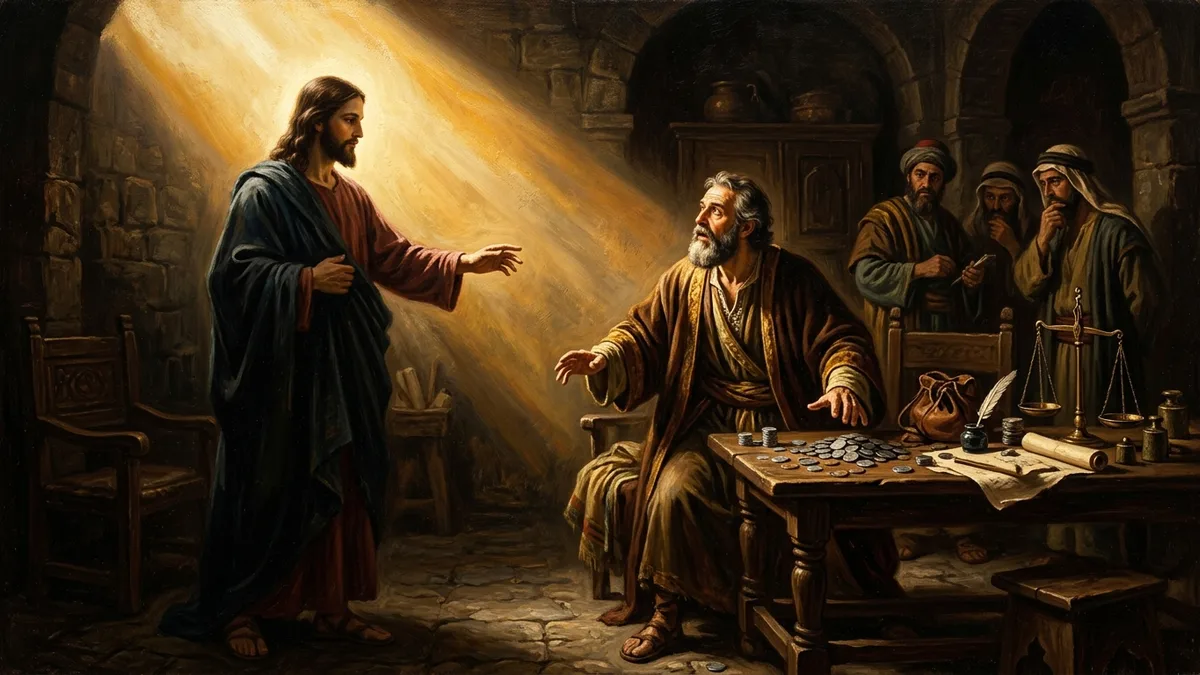
Capernaum was a booming commercial border post. Goods traveling between Damascus and the Mediterranean sea coast passed directly through its gates. As an official tax farmer operating under the authority of Tetrarch Herod Antipas, Levi sat inside his stone toll booth (*telonion*), surrounded by bronze balance scales, iron cash boxes, and official parchment rolls.
His daily routine was marked by hostility and contempt. Pious Pharisees pulled their robes tightly around themselves as they passed to avoid accidental contact with his table. Levi was rich, powerful, and deeply isolated.
Then came the divine interruption:
"As Jesus passed on from there, He saw a man named Matthew sitting at the tax office. And He said to him, 'Follow Me.' So he arose and followed Him." (Matthew 9:9)
Luke's Gospel adds a profound detail: "So he left all, rose up, and followed Him" (Luke 5:28). When Peter and John left their boats, they retained boats to return to if discipleship failed. But when a Roman tax collector abandoned his imperial toll post, his career was terminated forever; another would instantly take his place. Matthew surrendered everything with zero safety nets.
2. The Great Farewell Banquet: Evangelism at the Table (Luke 5:29–32)
Matthew did not slink away into secretive shame. His heart was so flooded with joy and liberation from the crushing weight of guilt that he hosted a massive celebratory banquet in his Capernaum home:
"Then Levi gave him a great feast in his own house. And there were a great number of tax collectors and others who sat down with them." (Luke 5:29)
Matthew leveraged his wealth and social network for one supreme objective: introducing his circle of outcast, morally broken associates to Jesus Christ.
The sight of the holy Rabbi reclining and dining with extortioners and sinners scandalized the scribes and Pharisees. They grumbled bitterly to His disciples: "Why do you eat and drink with tax collectors and sinners?" Jesus answered with the heartbeat of the Gospel:
"Those who are well have no need of a physician, but those who are sick. I have not come to call the righteous, but sinners, to repentance." (Luke 5:31–32)
In Matthew's house, the table became an altar of redemption.
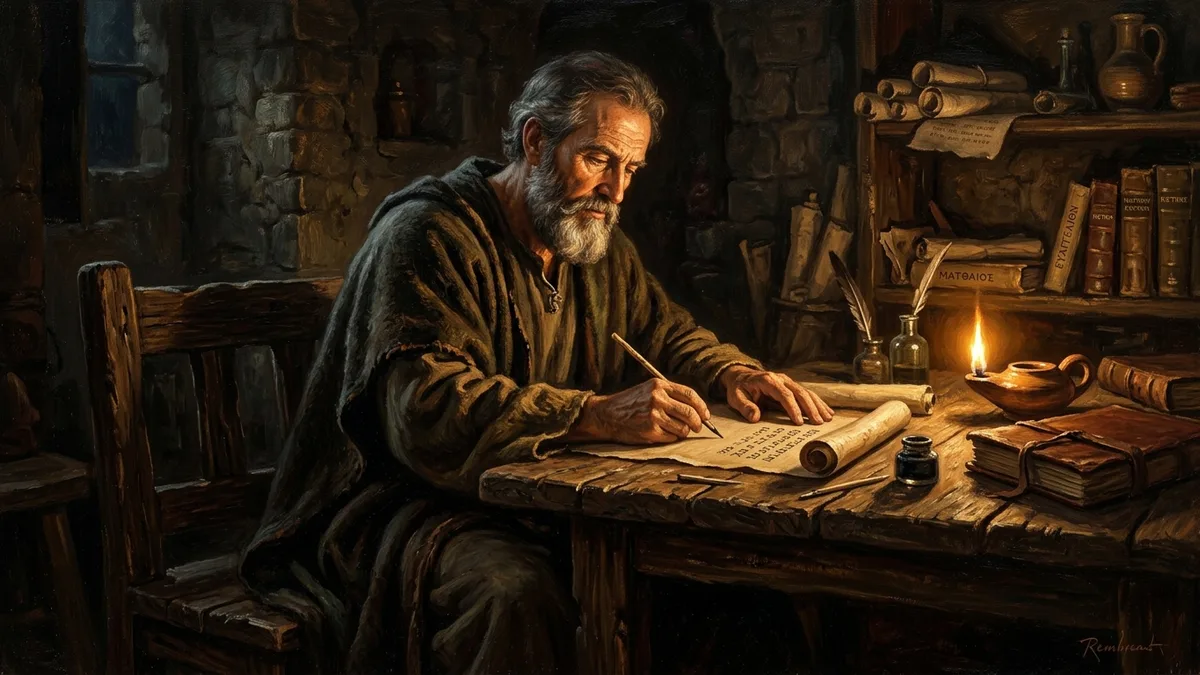 The Scribe of the Kingdom: Apostle Matthew penning the First Gospel by oil lamp, recording how every Old Testament shadow found royal fulfillment in Jesus the Messiah.
3. Sitting Beside Simon the Zealot: The Miracle of Apostolic Unity
When Jesus assembled the Twelve Apostles, He performed a sociological and political miracle that the world had never witnessed. Among the twelve, Jesus placed Matthew the Roman tax collector side by side with Simon the Zealot.
The Zealots were radical Jewish nationalists whose underground insurgency conducted targeted assassinations against Roman soldiers and tax collectors who collaborated with Rome. Under ordinary circumstances, Simon would have slit Matthew's throat in a dark alley as a traitor to Israel.
Yet through the transforming power of Jesus Christ, the insurgent terrorist and the Roman tax collaborator sat at the same table, drank from the same communion cup, and called one another beloved brother. In Christ, all earthly political polarizations melted into kingdom brotherhood.
4. The First Gospel: Proclaiming the Royal Messiah
Matthew possessed unique vocational qualifications that the Holy Spirit sovereignly redeemed. As a senior customs official, Matthew was fluent in Greek and Hebrew, possessed meticulous record-keeping skills, was accustomed to taking rapid shorthand dictation, and understood public administration.
Writing primarily for Jewish readers, Matthew authored the First Canonical Gospel. His Gospel is structured with majestic theological symmetry:
- The Royal Lineage: Commencing with the legal genealogy tracing Jesus through King David and Abraham (Matthew 1).
- The Five Discourses: Structuring Christ's teachings into five monumental discourses (the Sermon on the Mount, the Missionary Charge, the Parables of the Kingdom, the Church Community, and the Olivet Discourse), deliberately mirroring the five books of the Mosaic Torah.
- Fulfilled Prophecy: Citing the Old Testament over sixty times with the signature formula: "Now all this was done that it might be fulfilled which was spoken by the Lord through the prophet."
The man who once calculated taxes on fish now calculated the infinite riches of Christ's kingdom.
5. Apostolic Missionary Journeys and Martyrdom
Following the Day of Pentecost, Matthew labored for approximately fifteen years in Judea, preaching throughout Jerusalem and the surrounding towns. According to Church Father Clement of Alexandria, Matthew lived an austere, disciplined life of prayer and simplicity, subsisting on herbs, roots, and water.
When the persecution of the Church scattered the apostles beyond Judea around AD 48–50, early patristic traditions (attested by Socrates Scholasticus, Ambrose, and Jerome) record that Matthew traveled east into Persia, Parthia, and Media, before journeying southward into Ethiopia.
In Ethiopia, Matthew preached the Gospel in the city of Naddaber, confronting pagan sorcery, establishing churches, and baptizing thousands into Christ. According to ancient martyrologies, King Hirtacus, furious that Matthew protected a consecrated royal virgin named Iphigenia from forced marriage, sent an assassin to the altar while Matthew was leading worship.
While kneeling in prayer before the communion table with hands lifted toward heaven, Matthew was pierced from behind by a spear, sealing his testimony with his blood around AD 60. Levi the tax collector had surrendered his earthly coin box; Apostle Matthew received the crown of life from the King of kings.
Biblical Keywords & Theological Roots
From Hebrew 'Mattityahu': gift of Yahweh, divine endowment of sovereign grace.
A toll-booth, customs office, or tax-collector's station where transit fees were extracted.
A publican, toll-collector, tax contractor; culturally despised as extortioners and ritual outcasts.
To abandon entirely, leave behind permanently, renounce all claims to worldly possessions.
To fill to the brim, fulfill, bring to complete realization prophetic scriptures.
Ancient Near Eastern & Archaeological Context
First-century Capernaum was an economic goldmine situated directly on the border between the tetrarchy of Herod Antipas (Galilee) and Herod Philip (Gaulanitis). All merchant caravans traveling from Damascus to the Mediterranean coast or south toward Egypt traversed the Via Maris, halting at Capernaum's customs booth. As a tax collector licensed under Antipas, Matthew assessed tolls on caravans, dried fish exported from Lake Gennesaret, timber, and agricultural goods. This position required literacy, mathematical fluency in multiple currencies (Tyrian shekels, Roman denarii, Greek drachmas), and proficiency in both Aramaic and Greek commercial shorthand. When Jesus called him, Matthew surrendered this lucrative goldmine in an instant.
Practical Discipleship & Spiritual Application
- No Sinner is Beyond the Reach of Sovereign Grace: If Jesus could transform an extortionist tax collector into an inspired Gospel biographer, there is no sinner too hardened, corrupted, or despised for His grace to redeem.
- Total Surrender of Earthly Security: Fishermen could always return to their boats (as Peter did in John 21), but a tax collector who abandoned his imperial toll booth could never reclaim it. Matthew burned his bridges completely.
- Redeeming Secular Skills for Kingdom Glory: The very pen, ledgers, and literary precision Matthew once used for Roman extortion were consecrated by the Holy Spirit to write the immortal Gospel of the King.
- Open Your Table to the Lost: Matthew did not hide in holy isolation after his conversion; he immediately opened his mansion and wallet to introduce his outcast colleagues to Jesus.
Support Independent Biblical Research
Did this study bless you? Help support our independent bilingual research and interactive visual Bible tools.
⚡ Fast Facts
- The Name Meaning: 'Matthew' derives from the Hebrew 'Mattityahu', meaning 'Gift of Yahweh'; his earlier Semitic name was Levi, son of Alphaeus.
- The Capernaum Customs Post: Matthew operated a toll booth (*telonion*) along the strategic Via Maris trade route under Herod Antipas, levying heavy tariffs on fish, grain, and international merchant caravans.
- The Great Farewell Feast: Upon his conversion, Matthew hosted a lavish banquet in his home, inviting a multitude of fellow tax collectors and outcasts so they could hear Jesus.
- Apostle to the East: Early patristic accounts by Clement of Alexandria and Socrates Scholasticus testify that Matthew ministered in Judea before traveling eastward to Persia, Parthia, and Ethiopia, where he was martyred by the spear.
❓ Frequently Asked Questions (FAQs)
Tax collectors (*mokhes*) were viewed by fellow Jews as treacherous traitors and extortioners. They purchased the right to collect taxes from the oppressive Roman pagan empire (or Herod Antipas), pocketing exorbitant surcharges for personal profit. Jewish society classified them alongside prostitutes and Gentiles, barring them from synagogues and disqualifying them from testifying in rabbinic courts. Jesus calling a tax collector into His inner circle was a staggering social and theological scandal.
While Mark and Luke tactfully use his old name 'Levi' when describing his disreputable profession, Matthew himself, writing his Gospel years later as a revered apostle, humbly and explicitly identifies himself as 'Matthew the tax collector' (Matthew 10:3). He never wanted the Church to forget the pit of sin and greed from which sovereign grace had rescued him.
Matthew was uniquely written for a Jewish audience, demonstrating that Jesus of Nazareth is the direct fulfillment of Old Testament Messianic prophecy. Matthew quotes the Old Testament over sixty times, frequently using the phrase: 'that it might be fulfilled which was spoken by the prophet.' He structures his Gospel around five major instructional discourses (mirroring the five books of Moses) and presents Jesus as the rightful royal King of Israel.