The sun hung high in the white-hot skies of Jerusalem on Tuesday of Passion Week, casting stark, geometric shadows beneath the towering Corinthian colonnades of the Second Temple. It had been an exhausting, bruising day of intellectual combat. For hours, inside the bustling courts, Jesus had endured a relentless barrage of theological ambushes orchestrated by the elite power brokers of Judaea: the Pharisees had tried to ensnare Him with political treason regarding Caesar’s poll tax; the aristocratic Sadducees had mocked Him with absurd scenarios concerning the resurrection; and legalistic scribes had cross-examined Him regarding the primary commandment of the Torah. With peerless divine wisdom, Christ had dismantled every trap, silencing His critics and delivering a scorching public indictment against the scribal aristocracy who 'devour widows’ houses and for a pretense make long prayers' (Mark 12:40).
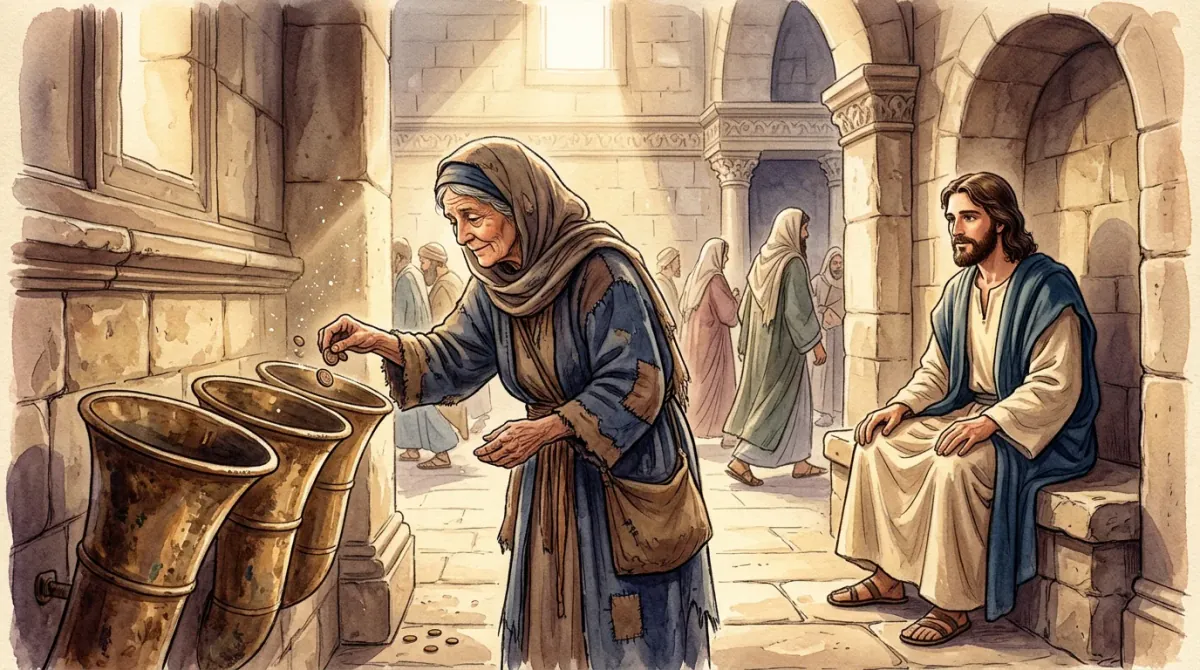
Mentally and physically fatigued by the hypocrisy that swirled through the sacred courts, Jesus walked away from the debate arenas and entered the Court of the Women (*Ezrat Nashim*). Here, beneath the open Judean sky, flanked by soaring limestone porticoes, Christ sat down on a stone bench directly opposite the Temple Treasury (*Gazophylakion*). In this courtyard stood thirteen massive bronze collection chests, famously known in rabbinic literature as the *shofarot* because their collection funnels curved upward like flared ram's horns. Each chest was designated for specific Temple dues: wood, incense, sin offerings, and voluntary freewill gifts.
Resting His back against the warm stone, Jesus did something unexpected: He began watching how the people put money into the treasury (Mark 12:41). The Lord was not passively idling; He was actively inspecting the hearts of the worshippers through the window of their stewardship.
The scene before Him was a bustling theatre of religious showmanship. Passover was only days away, and wealthy landowners, aristocratic merchants, and prominent Sadducean priests were streaming into the court, eager to make a public display of their piety. Dressed in long, flowing robes with elongated blue tassels (*tzitzit*) trailing behind them, wealthy men approached the bronze trumpets. Lifting heavy bags of silver Tyrian shekels, Roman denarii, and gleaming gold staters, they poured their offerings into the flared bronze horns. The coins rattled down the metallic funnels with a deafening, cascading roar that echoed off the high marble columns, turning heads across the courtyard. The donors paused with calculated dignity, soaking in the admiring whispers of the bystanders: 'Look at the generosity of the master! What a pillar of the sanctuary!'
Yet in the divine economy of heaven, this ostentatious display was largely worthless. These men were giving out of their disposable abundance (ek tou perisseuontos). Their lavish gifts did not alter their dinner menus by a single olive; their lifestyle was untouched, their comfort undisturbed, their bank accounts essentially unchanged. They gave what they would never miss.
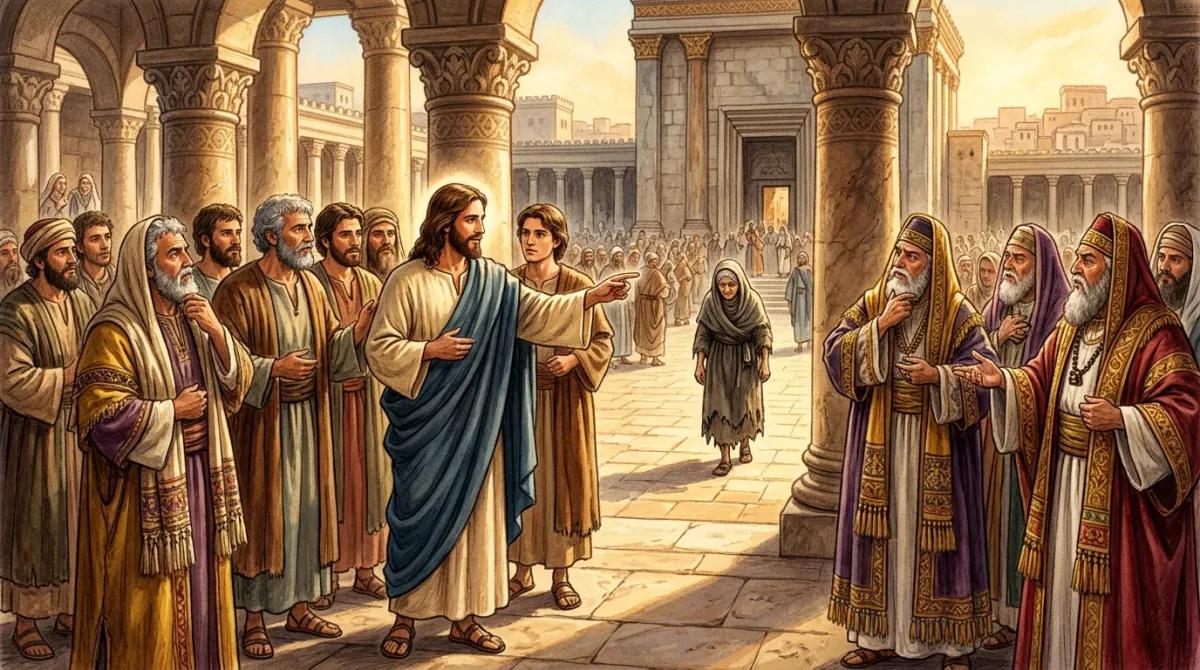
Then, slipping through the fringes of the crowded court, came a figure who seemed to possess no place in this opulent pageant. She was an unnamed widow. In first-century Palestinian society, widowhood was synonymous with acute vulnerability. Having buried her husband, she was stripped of social standing and legal defense. Under Mosaic inheritance customs, family estates passed to sons or male kinsmen, leaving widows dependent on the charity of relatives or the temple poor fund. But as Jesus had just revealed, the corrupt scribes routinely used legal maneuvers to confiscate and 'devour' the homes of such defenseless women. Her sunken cheeks, her threadbare, patched linen mantle, and her timid, downcast eyes testified to a life of agonizing deprivation.
Hesitating before the flared mouth of one of the bronze chests, conscious of the grandees brushing past her in disdain, the widow reached deep into the fold of her worn garment. In her trembling, calloused palm lay two tiny, wafer-thin coins: two lepta (lepta dyo). The Greek word lepton literally means 'the thin one, the peeled one.' Minted decades earlier by the Hasmonean kings, the lepton was the smallest and least valuable copper coin in circulation in the Roman Empire. Together, the two lepta were worth a single Roman quadrans—approximately 1/64th of a laborer's daily denarius. In the commercial markets of Jerusalem, two lepta could not buy a single crust of barley bread. To the temple treasurers, her offering was an irrelevance, an accounting nuisance that was scarcely worth the effort to sweep up.
Stepping forward with quiet reverence, she held her breath and let the two tiny copper flakes slip from her fingers into the bronze horn. There was no clatter, no reverberating chime, no turning of heads. The coins fell with a dull, barely audible clink against the bronze wall, sliding silently into the dark receptacle below. Turning her head, wrapping her thin shawl tightly against the afternoon breeze, the widow slipped away into the crowd, unnoticed by a single human being in that vast court.
Unnoticed by men—but witnessed by the King of Glory.
Leaping to His feet, His heart moved with profound awe and holy tenderness, Jesus called His twelve disciples to gather immediately around Him. Pointing His hand toward the frail, retreating form of the widow as she disappeared through the Beautiful Gate, Christ delivered a monumental, upside-down kingdom proclamation that overturned every financial ledger on earth: 'Assuredly, I say to you that this poor widow has put in more than all those who have given to the treasury; for they all put in out of their abundance, but she out of her poverty put in all that she had, her whole livelihood' (Mark 12:43–44).
The Greek phrase Jesus used for her gift is staggering: holon ton bion autēs—literally, 'her whole life, her entire biological existence.' She did not give ten percent; she did not give fifty percent. She had two coins. She could have reasoned with impeccable logic: 'I will give one coin to God, and keep one coin to buy a crust of bread for tonight.' That would have been a staggering fifty-percent offering! But she refused to divide her trust. With radical, breathless surrender, she cast her very survival into the hands of Yahweh, declaring that the living God was her true husband, her fortress, and her exceeding great reward.
In those two dull copper flakes, Jesus saw the reflection of His own approaching cross. In less than seventy-two hours, Christ would not offer God a surplus donation of convenience; He would pour out His holon ton bion—His very lifeblood, His body broken, His soul emptied to the dregs upon Calvary to redeem a lost world. The widow was the truest disciple in Jerusalem because she alone mirrored the cross of Christ.
Two thousand years later, the golden temple of Herod is gone. The haughty Sadducees are forgotten dust. The massive fortunes poured into the bronze trumpets were melted down by Roman fires in AD 70. But the two mites of the nameless widow still shine like twin stars in the firmament of Scripture. She teaches us that God does not look at the size of our gift, but at the size of our sacrifice. He does not ask how much we put into the plate, but how much we have held back for ourselves. When we place our empty hands and our total lives upon the altar of Christ, heaven counts our poverty as eternal, incorruptible riches.
Ancient Near Eastern & Archaeological Context
On Tuesday of Passion Week, Jesus spent His final public day of ministry teaching inside the precincts of the Second Temple. Following grueling, multi-hour verbal ambushes orchestrated by the Pharisees regarding tribute to Caesar, the Sadducees regarding the resurrection, and the scribes regarding the greatest commandment, Jesus exposed the rapacious greed of the religious elite: 'Beware of the scribes, who desire to go around in long robes, love greetings in the marketplaces, the best seats in the synagogues, and the best places at feasts, who devour widows’ houses, and for a pretense make long prayers. These will receive greater condemnation' (Mark 12:38–40).
Physically fatigued from the relentless hostility, Jesus walked into the Court of the Women (*Ezrat Nashim*), a spacious 200-square-foot open colonnade situated just inside the Beautiful Gate. Jewish women were permitted to proceed no further into the temple complex than this court. Along the perimeter walls of this court stood the Temple Treasury (*Gazophylakion*), consisting of thirteen large bronze collection chests known in rabbinic literature as *shofarot* because their upper necks curved upward like ram's horns. Each chest was inscribed with a specific designation: nine chests collected designated taxes for sacrifices, incense, wood, and gold, while four collected voluntary freewill offerings.
Because the bronze mouths were flared and hollow, when wealthy aristocratic Sadducees and Pharisees tossed in fistfuls of heavy silver Tyrian shekels, Roman denarii, and gold staters, the metallic clatter echoed resoundingly through the stone porticoes. The donors lingered conspicuously, relishing the admiring gazes of the crowds. Into this theatre of ostentatious philanthropy walked an unnamed widow. Widows in first-century Judaea were the most economically defenseless demographic, lacking inheritance rights under Mosaic law and vulnerable to legal predation. Her coins were two *lepta*—the smallest currency minted by Alexander Jannaeus a century earlier, so lightweight that they scarcely produced a sound as they slipped through the bronze horn. Together, they constituted a single *quadrans*—less than 1/64th of a laborer's daily denarius. In the eyes of the temple accountants, her contribution was an utter zero; in the eyes of the King of Glory, it was the greatest gift ever laid upon an altar.
Practical Discipleship & Spiritual Application
- The Currency of Heaven is Sacrifice, Not Surplus: God never measures the value of our giving by the financial figure on the check, but by the proportion of sacrifice it represents; giving that costs us nothing carries little weight in the kingdom of God.
- Invisible to Men, Treasured by Christ: The wealthy donors never noticed the ragged widow, but the eyes of the Lord were fixed intently upon her; never despise small, hidden acts of service, prayer, and generosity done in secret, for your Father who sees in secret will reward you openly.
- Total Dependence on Jehovah Jireh: The widow could have kept one mite for food, but she gave both coins; her radical generosity was not financial recklessness, but a supreme declaration that God alone was her provider, her husband, and her exceeding great reward.
- Rejecting Religious Showmanship: The Pharisees gave to be seen and praised by human spectators; true biblical stewardship seeks no fanfare, no brass trumpet announcements, and no worldly applause, finding complete satisfaction in the approval of Christ alone.
Support Independent Biblical Research
Did this study bless you? Help support our independent bilingual research and interactive visual Bible tools.
⚡ Fast Facts
- The Miniature Lepton Coin: The Greek *lepton* ('peeled, thin') was the smallest copper coin circulating in first-century Palestine, minted by the Hasmonean kings; two lepta equalled one Roman *quadrans*, roughly 1/64th of an average daily wage
- The Shofar-Shaped Treasury Receptacles: The Temple treasury (*gazophylakion*) featured thirteen bronze chests shaped like ram's horns (*shofarot*) with flared tops; heavy coins thrown into them rattled with theatrical resonance, drawing public praise for wealthy donors
- Economic Contrast with Devouring Scribes: Mark deliberately places this narrative immediately after Christ's scorching condemnation of scribes who 'devour widows' houses' (Mark 12:40); the temple establishment exploited the vulnerable, yet God honored the widow's pure sacrifice
- Total Surrender of Livelihood (Holon Ton Bion): Christ declared that she gave her *holon ton bion*—literally her 'entire life' or 'whole subsistence'; while the rich gave disposable discretionary surplus, she consecrated her very survival into God's hands
❓ Frequently Asked Questions (FAQs)
Why did the widow give two mites instead of keeping one for her next meal?
Under Jewish rabbinic tradition, religious authorities strictly prohibited offering less than two lepta at the treasury because a single lepton was considered practically worthless. However, the spiritual magnificence lies in her radical generosity: she possessed two coins. She could have legally and reasonably kept one coin to buy a tiny crust of barley bread to sustain her life for that evening, offering the other fifty percent to God. Instead, with unreserved trust in Yahweh as her ultimate Provider, she surrendered both coins, casting her entire earthly existence upon divine providence.
How did Jesus measure the value of her offering compared to the wealthy?
Human economy calculates the value of a gift by the volume of what is given; divine economy measures the value of a gift by what is retained. The wealthy gave large, impressive sums that cost them nothing in terms of lifestyle, comfort, or security; they gave out of their excess (*ek tou perisseuontos*). The widow gave out of her desperate deficit (*ek tēs hysterēseōs autēs*). While their wallets remained full, her pocket was left entirely empty. In heaven's ledger, sacrificial deficit outweighs complacent surplus every time.
Did Jesus approve of the corrupt Temple taking money from a destitute widow?
Jesus’s observation carries both profound praise for the widow's pure heart and a searing prophetic indictment of the corrupt temple system. Just verses earlier, Jesus condemned the scribes who 'devour widows' houses' (Mark 12:40). The religious hierarchy had turned the house of God into a den of extortion that absorbed the final pennies of starving widows while priests lived in palatial luxury. Jesus praised the widow's breathtaking, unblemished faith in God, but her offering signaled that the corrupt temple system had reached the pinnacle of apostasy and was ripe for destruction.