The sun sank slowly behind the limestone hills of Judea, casting long, bruised shadows across the ancient battlements of Jerusalem. It was Thursday evening, the fourteenth of Nisan. The city was suffocating under the swell of over two million pilgrims who had arrived from Alexandria, Babylon, Rome, and the Syrian frontiers to slaughter their Passover yearlings at the Temple of Herod. The narrow, stepped alleys echoed with the bleating of tens of thousands of spotless lambs, their throats soon to be slit upon the great bronze altar so that their warm blood could be splashed against its base in commemoration of the ancient Exodus. Yet in an upper room situated in the quiet southwestern quarter of the Upper City, far removed from the clamor of the Temple Mount, the true and unblemished Lamb of God was gathering His little flock of twelve for a final, fateful banquet of covenant love.
Simon Peter and John had arrived hours earlier, guided by the uncanny providential sign of a man carrying an earthenware water pitcher—a task almost exclusively reserved for women in Semitic culture. They had secured the roasted lamb, the bitter wild lettuces, the bowl of sweet haroset paste made from crushed figs, raisins, and vinegar symbolizing the mortar of Egyptian brickfields, the stacks of unleavened matzot bread, and the four ritual vessels of red wine mingled with water. As the dusk deepened into pitch blackness, Jesus climbed the exterior stone staircase and entered the spacious, candlelit chamber. The heavy cedar door closed against the hostile world outside, sealing within those stone walls the most momentous evening in human history.
The Disgraceful Dispute and the Girded Basin
According to the rigid dining etiquette of first-century Judea, guests reclining at a formal banquet did not sit upon high chairs; they reclined on low wooden couches arranged in a Roman triclinium—a three-sided horseshoe formation surrounding a low central table. Guests lay upon their left elbows, their heads angled toward the platters, while their dust-caked bare feet stretched outward behind them. Because the limestone pathways of Jerusalem were strewn with dry animal manure, olive oil pressings, and street refuse, hospitality laws dictated that an uninvited household slave wash each arriving guest's feet. But on this night, no slave had been provided. A large stone jar of water and an empty bronze basin sat neglected beside the door.
One by one, the twelve men had slipped off their leather sandals and filed into the room, their feet filthy from the dusty trek from Bethany across the Kidron Valley. Yet not a single apostle moved toward the water pitcher. To bend down and unstrap another man's sandals was deemed so utterly degrading under rabbinic law that even Jewish bondservants were legally exempt from the task; only foreign Gentile captives were forced to perform it. To wash the others would be an admission of inferior status. Instead of offering to serve, their suppressed pride erupted into a bitter, hushed argument. Luke records with searing honesty that a dispute arose among them as to which of them should be accounted the greatest in the coming Messianic kingdom. James and John still nursed secret dreams of the right and left hand seats of global power; Judas stewed in cold financial disillusionment; Peter bristled with defensive bravado.
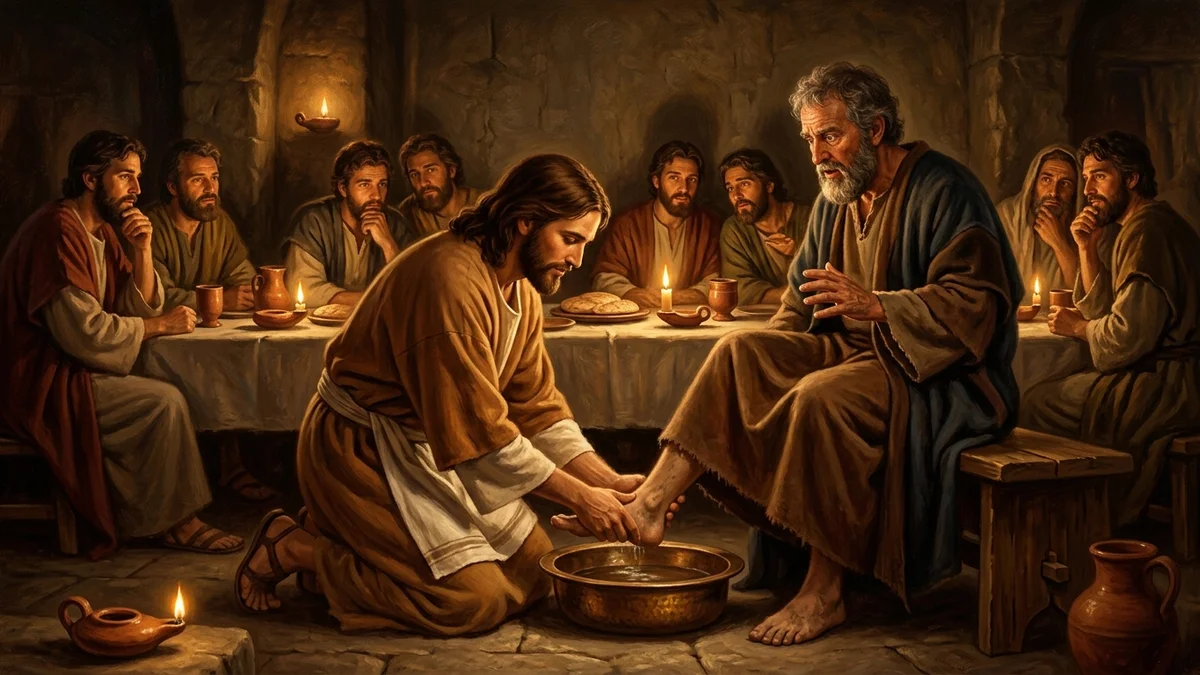
Jesus sat in silence, watching the tragic spectacle of human ambition unravel at the very threshold of His cross. He knew that the Father had given all things into His hands, and that He had come from God and was returning to God. Conscious of His absolute, uncreated sovereignty, Christ rose from the table. The disciples' whispers died away in stunned silence. With slow, deliberate movements, the King of Glory laid aside His seamless outer mantle, stripping down to the basic loincloth of an impoverished slave. He took a long linen apron (lention) and wrapped it securely around His waist. Lifting the heavy stone pitcher, He poured cold water into the bronze basin until it sloshed against the metal rim. Then, stepping behind the reclining men, the Son of the Living God knelt in the dirt at the feet of mortal men.
The Fierce Protest of Simon Peter
A suffocating hush gripped the room. The only sound was the splash of water and the rhythmic scrubbing of calloused, dust-caked toes. Jesus took foot after foot into His holy hands, washing away the grime of the city streets and drying each heel with the rough linen cloth wrapped about His waist. When He moved around the low couch and knelt before Simon Peter, the headstrong fisherman drew his legs back in horror, his face contorted in agony. 'Lord,' Peter blurted out with trembling lips, 'do You wash my feet?' The contrast in the Greek text is staggering: Su mou nipteis tous podas?—'You, the cosmic Messiah, wash the feet of me, a wretched Galilean fisherman?'
Jesus looked up into Peter's fiery eyes with infinite patience: 'What I am doing you do not understand now, but you will know after this.' Yet Peter's pride, cloaked in false humility, could not tolerate the sight of his Master debasing Himself. He struck the couch with his fist: 'You shall never wash my feet—not into eternity!' (ou mē nipsēs tous podas mou eis ton aiōna!). Jesus' countenance grew solemn, piercing through the fisherman's bluster: 'If I do not wash you, you have no part with Me.' Christ's words shattered Peter like a hammer. To have no part with Jesus was spiritual annihilation, exile from the kingdom, separation from the lover of his soul. In characteristic impulsive desperation, Peter swung to the opposite extreme: 'Lord, not my feet only, but also my hands and my head!'
Jesus smiled with tender gentleness, explaining the deep theological mystery of cleansing: 'He who is bathed (louō) needs only to wash his feet (niptō), but is completely clean; and you are clean, but not all of you.' For Jesus knew from the foundation of the world who would betray Him; therefore He said, 'You are not all clean.' Returning to His place at the table and resuming His garments, Jesus gazed intently at the twelve humbled faces: 'Do you know what I have done to you? You call Me Teacher and Lord, and you say well, for so I am. If I then, your Lord and Teacher, have washed your feet, you also ought to wash one another's feet. For I have given you an example, that you should do as I have done to you. A servant is not greater than his master. If you know these things, blessed are you if you do them.'
The Unmasking of the Traitor
As the meal resumed, a dark, heavy pall settled over the Savior's spirit. John writes that Jesus was deeply troubled in His spirit (etarachtē tō pneumati). Looking around the triclinium, His voice cracked with divine sorrow: 'Truly, truly, I say to you, one of you will betray Me.' A wave of collective horror rippled through the twelve. Guilt and self-doubt swept the room. They did not immediately point fingers at Judas; instead, one by one, each man searched his own fragile heart and asked in trembling whispers: 'Lord, is it I? Is it I?' Peter leaned across the couch and signaled frantically to young John, who was reclining immediately to Jesus' right with his head resting near the Master's chest: 'Ask Him who it is of whom He speaks!'
John leaned back against Jesus' breast and whispered quietly: 'Lord, who is it?' Jesus answered in an undertone: 'It is he to whom I shall give a piece of bread when I have dipped it.' Reaching forward toward the common bowl of bitter haroset, Jesus took a morsel of unleavened bread, dipped it, and handed it directly to Judas Iscariot, who was reclining in the position of honor to Christ's left. In ancient Middle Eastern culture, handing the dipped morsel (psōmion) was the highest possible mark of affection and royal favor. Even now, with thirty silver shekels of blood-money burning in Judas' belt, Jesus offered him a final, heartbreaking overture of redeeming love. Judas took the bread, his eyes cold and evasive: 'Rabbi, is it I?' Jesus answered softly: 'You have said it. What you do, do quickly.'
None of the disciples reclining at the table understood what Jesus meant. Because Judas kept the communal money box, some assumed Jesus had instructed him to purchase additional provisions for the week-long feast or give alms to the poor outside the gate. Taking the piece of bread, Judas rose from the couch, cast a final furtive glance at the Master, and slipped out the heavy wooden door into the midnight chill. John closes the scene with four of the most chilling, profound words in all of literature: ēn de nyx—'And it was night.' Outer darkness had claimed the son of perdition.
The Institution of the New Covenant
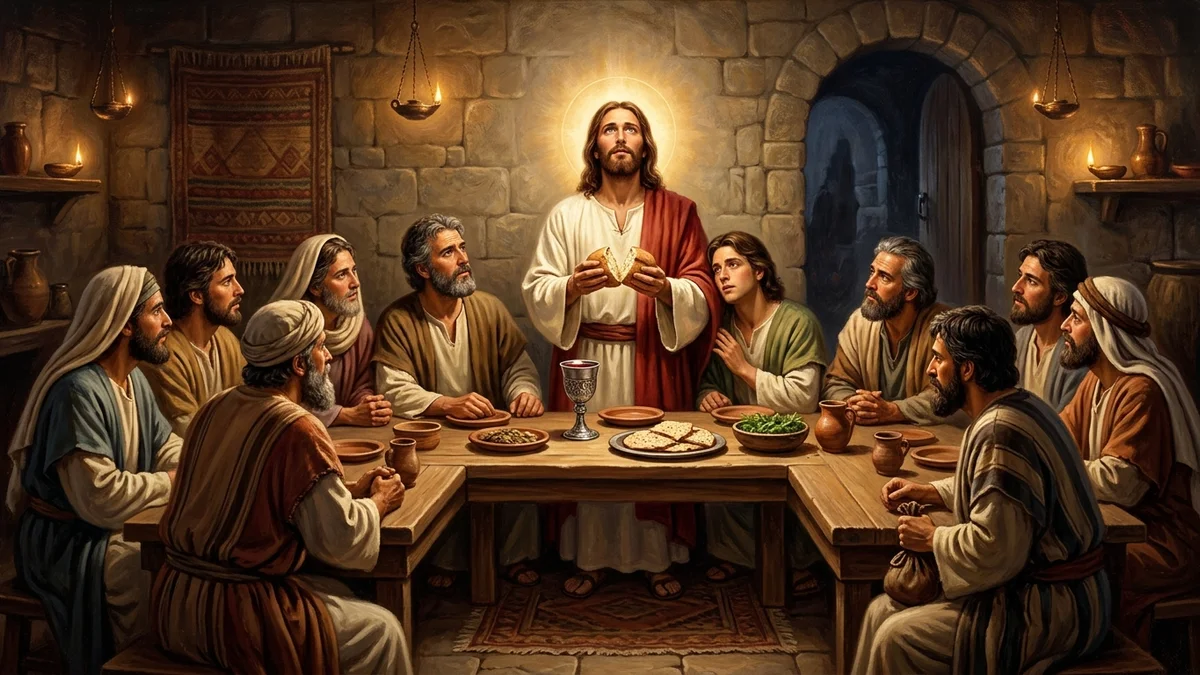
With the dark shadow of the traitor removed, the atmosphere in the Upper Room shifted from tense sorrow into radiant, intimate celestial glory. Jesus turned His full attention to the eleven faithful men who remained. The Passover meal was reaching its third ritual stage. Taking a large, flat round of unleavened bread (matzah)—pierced and striped during the baking process—Jesus lifted it toward heaven. He spoke the traditional Hebrew blessing: 'Barukh attah Adonai Eloheinu, Melekh ha-olam' ('Blessed art Thou, O Lord our God, King of the universe, who bringest forth bread from the earth'). But then, Christ spoke words that shattered fifteen centuries of Jewish liturgical tradition.
Breaking the brittle bread with a sharp, echoing snap, He distributed the warm fragments to the apostles, declaring: 'Take, eat; this is My body which is given for you; do this in remembrance of Me.' The disciples stared at the broken bread in their trembling palms. For generations, the bread had symbolized the bread of affliction eaten in frantic haste on the night of the Exodus. Now, Jesus revealed that His own sinless, holy flesh was the true Manna from heaven, soon to be lacerated by Roman scorpions and nailed to a Roman cross to feed a starving world with eternal life.
Following the supper, Jesus lifted the third ceremonial cup—the sacred 'Cup of Redemption' filled with dark red wine mingled with water. Raising the silver goblet before the lamplight, He offered thanksgiving and handed it to them, saying: 'Drink from it, all of you. For this is My blood of the New Covenant, which is shed for many for the remission of sins. This cup is the New Covenant in My blood; do this, as often as you drink it, in remembrance of Me.' In that incandescent moment, the Mosaic covenant ratified with animal blood at the foot of Sinai was superseded by the eternal covenant ratified by the blood of the Son of God. The physical cup symbolized His life poured out unto death, purchasing an irreversible, everlasting redemption for all who believe.
The Sifting of Peter and the New Commandment
As the meal drew to a close, Jesus looked upon Simon Peter with infinite tenderness and sober prophetic grief: 'Simon, Simon, indeed, Satan has asked for you, that he may sift you as wheat. But I have prayed for you, that your faith should not fail; and when you have returned to Me, strengthen your brethren.' Peter bristled with indignant pride, thumping his chest: 'Lord, I am ready to go with You, both to prison and to death! Even if all are made to stumble because of You, I will never stumble!' Jesus looked through the fisherman's bravado into the chilling reality of the coming hours: 'Truly I tell you, Peter, today, even tonight, before the rooster crows twice, you will deny three times that you even know Me.' Peter protested all the more vehemently: 'Even if I have to die with You, I will not deny You!' And so said all the disciples.
Silencing their protests, Christ bequeathed to them His eternal testament—the Magna Carta of Christian community: 'A new commandment I give to you, that you love one another; as I have loved you, that you also love one another. By this all will know that you are My disciples, if you have love for one another.' Standing up from the table, Jesus led the eleven in chanting the ancient Passover Hallel psalms (Psalms 115 through 118). Their voices resonated in the stone chamber: 'The stone which the builders rejected has become the chief cornerstone... Blessed is He who comes in the name of the Lord!' Singing into the darkness, Jesus led His disciples down the stone stairs, out through the shadowed gates of Jerusalem, and across the moonlit brook of the Kidron toward the blood-stained olive trees of Gethsemane.
Ancient Near Eastern & Archaeological Context
On Thursday of Passion Week (the 14th of Nisan), the city of Jerusalem swelled from its normal population of roughly 50,000 to over two million pilgrims gathering for the Passover feast. Every available roof, guest room, and courtyard was requisitioned. Following Christ's cryptic instructions concerning a man bearing a water jar—an unusual sight in antiquity, as water carrying was typically women's work—Peter and John secured an expansive, furnished second-story room, likely belonging to the family of young John Mark. In Greco-Roman Palestine, affluent homes featured an upper room (hyperōon) insulated from street clamor, equipped with a triclinium: three interconnected couches arranged in a horseshoe shape around a low central serving table. Guests reclined on their left sides, resting their weight on cushions, their heads toward the food and their bare feet stretched backward away from the table. Because unpaved Jerusalem streets were covered in limestone dust, camel dung, and refuse, hospitality codes dictated that a host provide a servant to wash guests' feet upon entry. Yet on this fateful evening, no household slave was provided, and not a single apostle volunteered to perform the humiliating task. Instead, Luke records that an unseemly dispute broke out among the twelve regarding which of them should be regarded as greatest.
Practical Discipleship & Spiritual Application
- The Sacred Posture of Downward Mobility: True spiritual greatness in the kingdom of God is never measured by authority, worldly titles, or power over others, but by the willingness to towel oneself and wash the dirty feet of our brethren; descend into humble, unseen service.
- Continual Cleansing for Daily Walk: While justification in Christ is a once-for-all bath (louō) that makes the believer clean forever, our daily journey through a defiling fallen world requires the constant, confessional washing of our feet (niptō) at the throne of grace.
- Absorbing Betrayal with Radical Grace: Jesus knew Judas was actively selling Him for thirty pieces of silver, yet He washed Judas' feet and handed him the honored morsel of bread; love your enemies and extend compassion even to those who hurt you.
- The High Cost of the New Covenant: Every time we eat the broken bread and drink the fruit of the vine, we proclaim the Lord's death until He comes; live in reverent, holy awe of the precious blood that redeemed you.
Support Independent Biblical Research
Did this study bless you? Help support our independent bilingual research and interactive visual Bible tools.
⚡ Fast Facts
- The Slave's Task Inverted: Under first-century Jewish rabbinic halakha, washing feet was deemed so degrading that even Jewish bondservants could not be compelled to perform it; only Gentile slaves did so, making Jesus' act a cosmic shock to the apostolic hierarchy
- Triclinium Seating Protocol: The Last Supper was held around a low U-shaped table (triclinium); John reclined on Jesus' right leaning against His bosom, while Judas Iscariot occupied the chief seat of honor on Jesus' immediate left
- The Sop (Psōmion) of Grace: Dipping the unleavened bread morsel into the bitter herb sauce (haroset) and handing it directly to Judas was an ancient Semitic token of supreme friendship and royal favor, showing Christ extended love to His betrayer to the final moment
- The Third Cup of Redemption: Jesus instituted the Holy Communion using the Third Cup of the Passover seder—the 'Cup of Blessing' (Kos Berakhah / Kos Ge'ulah)—declaring that His shed blood alone ratifies the eternal New Covenant foretold by Jeremiah 31:31
❓ Frequently Asked Questions (FAQs)
Why did Simon Peter fiercely refuse to let Jesus wash his feet, and what did Christ's response mean?
Peter understood the social humiliation of foot washing and could not bear to see his revered Master and Messiah demean Himself like a common household slave. In Semitic honor culture, allowing a superior to perform menial labor on one's behalf was considered deeply shameful. However, Jesus answered: 'If I do not wash you, you have no part with Me.' Christ revealed a two-dimensional spiritual truth: first, that no soul can enter communion with God without submitting to Christ's cleansing atonement; and second, distinction between the once-for-all bath of justification (louō) and the continual daily cleansing of walk-sanctification (niptō) required as believers journey through a defiling fallen world.
Did Judas Iscariot partake in the bread and wine of the Lord's Supper?
Chronological harmony between the Synoptic Gospels and John indicates that Judas was present for the Passover meal and foot washing, but departed into the night immediately after receiving the dipped morsel (psōmion) in John 13:30. John specifically notes that as soon as Judas took the bread, Satan entered him, and he left immediately ('and it was night'). It was following his departure that Jesus took bread, blessed it, broke it, and instituted the Holy Communion with the remaining eleven faithful apostles, initiating the intimate Farewell Discourse (John 14–17).
How did Jesus transform the ancient Passover into the New Covenant in His blood?
For fifteen hundred years, the Jewish Passover commemorated liberation from Egyptian slavery through the blood of an unblemished yearling lamb smeared upon doorposts. At the Last Supper, Jesus identified Himself as the true, ultimate Passover Lamb (1 Cor 5:7). By taking the unleavened bread (matzah) and declaring 'This is My body which is broken for you,' and taking the cup of wine declaring 'This cup is the new covenant in My blood, which is shed for you,' Christ announced that the Old Covenant shadows were fulfilled. His impending sacrifice on Calvary would purchase eternal redemption, not from earthly pharaohs, but from the universal dominion of sin and death.