In the burning heart of Mount Sinai, amidst a canopy of celestial fire and billowing clouds, God delivered to Moses a mandate that would alter the trajectory of human history: "And let them make Me a sanctuary, that I may dwell among them. According to all that I show you, that is, the pattern of the tabernacle and the pattern of all its furnishings, just so you shall make it" (Exodus 25:8-9). For centuries, pagan deities were housed in static, brooding stone temples—monumental mausoleums designed to terrify worshippers. But the God of Abraham, Isaac, and Jacob revealed Himself as the pilgrim God—a loving Suzerain who desired to pitch His tent in the dust of the wilderness, journeying alongside His redeemed, wandering people.
The construction of this portable sanctuary, the Mishkan, was not financed by imperial taxation or forced slave labor. Instead, Yahweh issued an invitation rooted entirely in grace: "From everyone whose heart moves him you shall receive My offering." What followed was one of the most stunning outbursts of generosity in biblical history. The former slaves opened their travel chests and brought the treasures plundered from Egypt on the night of the Passover—gold bracelets, silver pendants, bronze mirrors, vibrant hanks of blue, purple, and scarlet yarn, finely spun linen, resilient acacia wood, aromatic spices, and precious gemstones. Day after day, men and women flooded the camp with gifts until Moses was compelled to issue a public proclamation commanding the people to stop giving, for the materials gathered were more than sufficient for the work.
The Spirit-Filled Master Craftsmen: Bezalel and Oholiab
To execute the divine architectural blueprint (Tavnith), God did not commission an Egyptian civil engineer or a Phoenician contractor. Instead, Scripture records the first instance in human history of an individual being explicitly "filled with the Spirit of God": Bezalel, the son of Uri, of the tribe of Judah. God declared: "I have filled him with the Spirit of God, in wisdom and understanding, in knowledge and all manner of workmanship, to design artistic works, to work in gold, in silver, in bronze, in cutting jewels for setting, in carving wood, and to work in all manner of workmanship" (Exodus 31:2-5).
Partnering with him was Oholiab of the tribe of Dan, a master weaver and embroiderer. Together, they established a royal vocational guild in the desert. Under the supernatural inspiration of the Holy Spirit, everyday manual labor—chiseling timber, forging precious metals, beating gold leaf, and weaving intricate tapestries—was elevated into high spiritual worship. The Tabernacle demonstrated that holiness is not confined to vocal prayer; it is manifested in mechanical precision, aesthetic beauty, and artistic excellence consecrated to the glory of God.
The Outer Court: The Protocol of Atonement
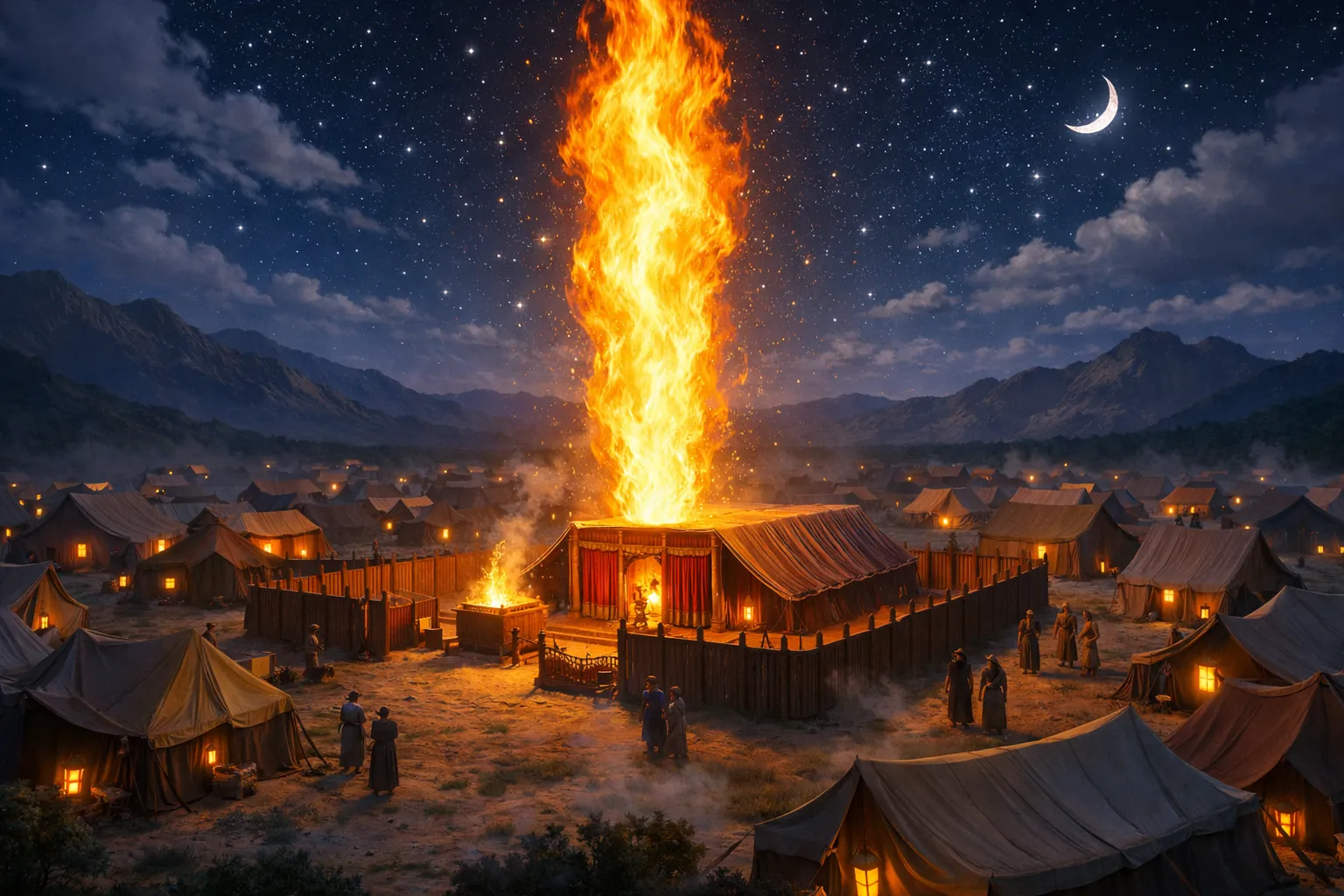
The Tabernacle was organized into three concentric spheres of increasing holiness, providing a visual theology of how fallen sinners can approach a holy God. The entire complex was bounded by the Outer Court—a perimeter of pristine white linen hangings measuring 100 cubits long by 50 cubits wide (approx. 150 ft by 75 ft), held aloft by bronze posts socketed into bronze bases. The white curtains presented an unyielding visual barrier of divine righteousness, declaring that access to God is not casual or universal. There was only one gate, thirty cubits wide, positioned on the east side, woven with glorious blue, purple, and scarlet fabric.
Stepping through the singular gate, the worshipper immediately encountered the Brazen Altar of Burnt Offering—a hollow square of acacia wood overlaid with thick sheets of bronze, equipped with four horns at its corners. Here, day and night, the blood of unblemished yearling lambs, bulls, and goats flowed in perpetual sacrifice, reminding Israel that without the shedding of blood, there is no forgiveness of sins (Hebrews 9:22). Past the altar stood the Bronze Laver—a basin hammered from the polished bronze mirrors donated by the women who ministered at the entrance of the tent. Here, the priests were strictly required to wash their hands and feet before performing holy duties, symbolizing the daily need for moral and spiritual cleansing.
The Holy Place: Sacred Fellowship in Divine Light
Beyond the laver stood the Tent of Meeting itself—a 30-cubit long structure constructed of interlocking acacia boards overlaid with shimmering pure gold, standing upon heavy silver sockets cast from the redemption ransom money of the Israelites (Exodus 30:11-16). The roof was sheltered by four protective layers: an innermost ceiling of fine twined linen embroidered with magnificent winged cherubim in royal blue and crimson, covered by woven goat-hair curtains, durable ram skins dyed red, and a weather-resistant outermost mantle of badger or sea-cow hides.
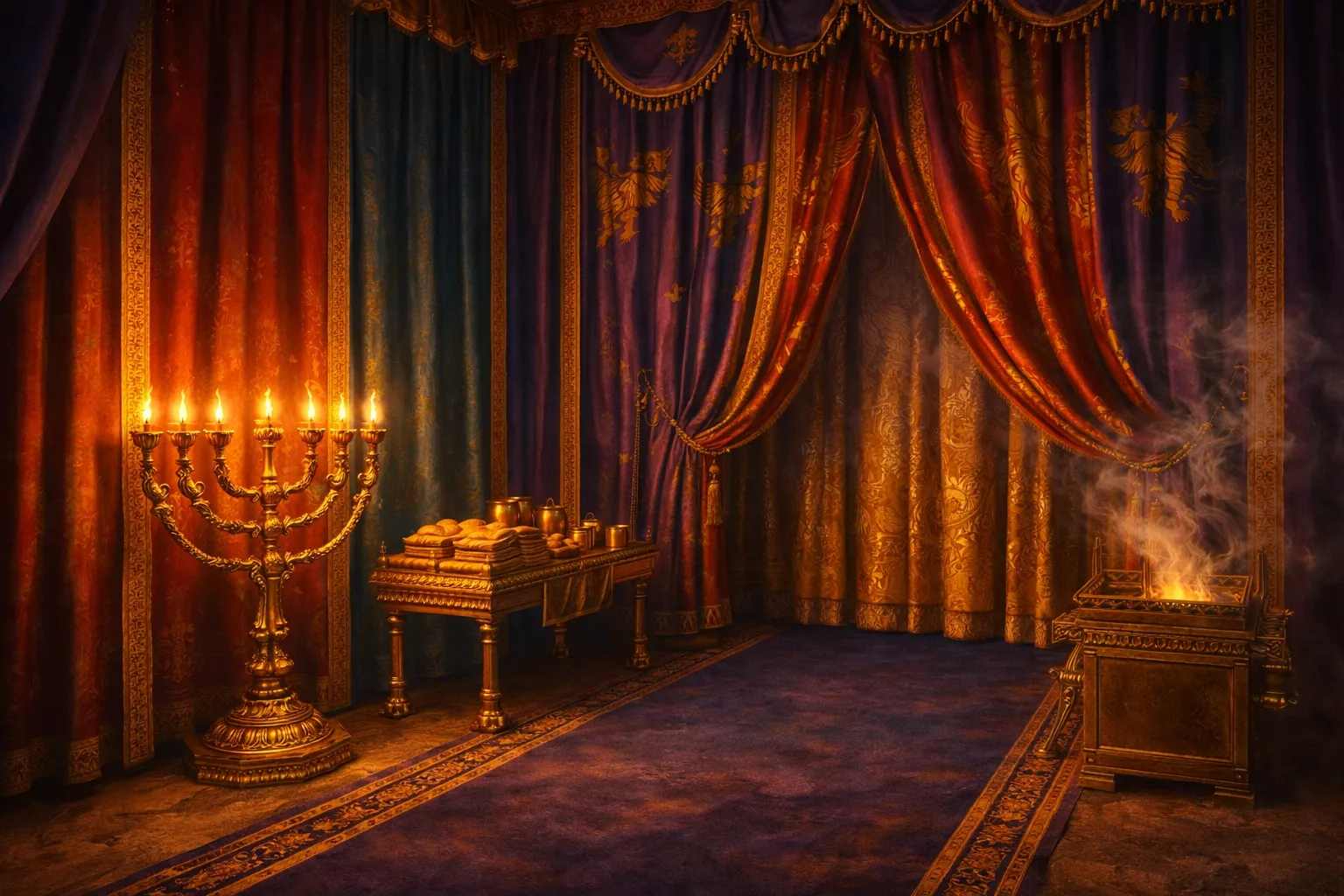
Entering through the embroidered five-pillar screen into the Holy Place, the priest stepped into a world of dazzling golden light. There were no windows; the room was illuminated solely by the Menorah—the sacred seven-branched golden lampstand hammered from a single talent (approx. 75 lbs) of solid pure gold. Decorated with almond blossoms, calyxes, and petals, the Menorah burned with pure beaten olive oil, radiating the uncreated light of the Tree of Life and the perpetual illumination of the Holy Spirit. Directly opposite sat the Table of Showbread—an acacia table overlaid with gold bearing twelve fresh loaves of unleavened bread arranged in two stacks, sprinkled with frankincense, representing God's unbroken covenant fellowship and provision for the twelve tribes. At the far end, immediately before the inner veil, stood the Golden Altar of Incense, where a secret, sacred blend of aromatic gums and frankincense was burned morning and evening, filling the sanctuary with a sweet-smelling cloud symbolizing the perpetual intercession of the saints.
The Holy of Holies and the Ark of the Covenant
Dividing the Holy Place from the innermost sanctuary was the Veil (Parokhet)—a breathtakingly dense tapestry of blue, purple, and scarlet wool interwoven with fine twisted linen, heavily embroidered with cherubim guarding the presence of God as they once guarded Eden. Behind this veil lay the Holy of Holies (Kodesh Ha-Kodashim)—a perfect cube measuring 10 cubits in length, width, and height, completely cloaked in darkness except for the supernatural luminescence of the divine presence.
At the center of this sacred room rested the most revered object in Israel's history: the Ark of the Covenant (Aron Ha-Berith). Crafted of durable acacia wood and overlaid inside and out with pure gold, the chest contained the two stone tablets of the Ten Commandments, the golden pot of manna that never spoiled, and Aaron's miraculous almond rod that budded overnight. Covering the chest was the Kapporeth—the Mercy Seat—beaten out of one solid block of pure gold. Rising seamlessly from its ends were two magnificent cherubim, their wings spread upward overshadowing the cover, their faces turned downward in reverent gaze toward the blood-sprinkled surface.
Here, between the wings of the cherubim, the invisible God promised to meet with Moses face to face. Once every year, on the solemn Day of Atonement (Yom Kippur), the High Priest entered this terrifying sanctuary through the veil, carrying a basin of hot coals from the altar and the warm blood of a sacrificial goat, sprinkling the blood seven times upon and before the Mercy Seat to reconcile a guilty nation to a holy Creator.
The Descent of the Shekinah Glory
On the first day of the first month, in the second year after the Exodus, the construction was complete. Moses systematically erected the silver sockets, raised the golden wooden frames, stretched the four layers of tapestry, placed the Ark behind the veil, lit the lamps of the Menorah, burned sweet incense upon the golden altar, and offered the inaugural sacrifices on the brazen altar. Everything was performed with meticulous, flawless obedience: "According to all that Yahweh had commanded Moses, so he did."
Then, the climax of the Exodus occurred:
"Then the cloud covered the tabernacle of meeting, and the glory of Yahweh filled the tabernacle. And Moses was not able to enter the tabernacle of meeting, because the cloud rested above it, and the glory of Yahweh filled the tabernacle" (Exodus 40:34-35).
The radiant, uncreated light of the Shekinah descended with such suffocating majesty that even Moses—the friend of God who had spoken with Him on the blazing peak of Sinai—could not cross the threshold. The creator of the universe had officially moved into the camp. By day, the pillar of cloud shielded the pilgrim nation from the scorching desert sun; by night, the pillar of fire warmed them in the freezing wilderness frost. Whenever the cloud lifted from above the Tabernacle, Israel packed their golden sanctuary and followed; whenever the cloud rested, they remained encamped. The Tabernacle was the beating heart of Israel—a tangible foretaste of the day when the Word would become flesh and tabernacle among us (John 1:14), inviting every cleansed sinner to dwell in unbroken fellowship with the King of Glory.
Biblical Keywords & Theological Roots
The Tabernacle or sacred dwelling place, derived from the root 'shakan' (to abide or settle down); denoting an earthly sanctuary where the transcendent Creator tabernacles intimately among mortals.
An architectural blueprint, heavenly model, prototype, or exact pattern revealed directly by God on the mount, demanding meticulous structural fidelity.
The Mercy Seat or propitiation cover hammered from solid pure gold, covering the Ark of the Covenant, where sacrificial blood was sprinkled annually on Yom Kippur to cover sin.
The seven-branched golden lampstand fashioned from a single talent of pure hammered gold, designed with almond blossoms, representing the burning Tree of Life and the fullness of the Holy Spirit.
To settle down, permanently abide, reside, or pitch a tent; the linguistic foundation of the 'Shekinah'—the palpable, visible radiant glory presence of God dwelling among His covenant people.
Ancient Near Eastern & Archaeological Context
Archaeological discoveries in Egypt, particularly reliefs depicting the battle camp of Pharaoh Ramesses II at the Battle of Kadesh (c. 1274 BC), reveal that royal military headquarters utilized rectangular, demountable sacred tent structures oriented toward the east, divided into an outer administrative court and an inner sanctum housing the royal standard. God redeemed this known nomadic architecture to establish His own divine Suzerain headquarters among His people. The materials mandated in Exodus—imperishable desert acacia wood (*Acacia raddiana* / *shittim*), Egyptian gold foil repoussé techniques, Phoenician marine snail dye for violet-purple (*tekhelet*) and scarlet kermes scale insect extract (*tola'at shani*)—accurately mirror Late Bronze Age Near Eastern metallurgical and textile technologies.
Practical Discipleship & Spiritual Application
- God's Supreme Desire to Dwell with Humanity: God did not merely deliver Israel from Egypt to set them free; He rescued them so that He might dwell in their very midst (Exodus 29:45). Remember that under the New Covenant, your body is the living temple of the Holy Spirit.
- Joyful and Cheerful Generosity for Kingdom Work: The Tabernacle was not built through taxation, but through freewill offerings from hearts stirred by God. Israel gave so abundantly that Moses had to restrain them from bringing more. Give joyfully of your treasures, talents, and time.
- Honoring Sacred Secular Callings and Craftsmanship: The first person in Scripture said to be 'filled with the Spirit of God' was not a priest or prophet, but Bezalel the builder and artisan (Exodus 31:1-3). Dedicate your professional craft, design, and technical skills as holy worship to God.
- Approaching God Through Atoning Blood and Cleansing Water: No priest could enter the Holy Place without first visiting the Brazen Altar of sacrifice and the Bronze Laver of cleansing. We enter the presence of God solely through the blood of Jesus and the continuous washing of the Word.
⚡ Fast Facts
- The Tabernacle was a portable rectangular sanctuary measuring 30 cubits long by 10 cubits wide (approx. 45 ft by 15 ft).
- Bezalel of Judah and Oholiab of Dan were the two master craftsmen specifically anointed by the Spirit with supernatural artistic wisdom.
- The Ark of the Covenant was made of acacia wood overlaid inside and out with pure gold, containing the Ten Commandments, Aaron's rod, and the golden pot of manna.
- When the Tabernacle was erected on the first day of the second year, the glory of the Lord filled the tent so powerfully that Moses was physically unable to enter.
❓ Frequently Asked Questions (FAQs)
God strictly charged Moses: 'See that you make everything according to the pattern (Tavnith) shown you on the mountain' (Exodus 25:40; Hebrews 8:5) because the earthly Tabernacle was an earthly shadow, scale model, and prophetic microcosm of the true heavenly Sanctuary. Every dimension, material, color, and furnishing possessed typological and Christological significance. Any human alteration would distort the prophetic portrait of Jesus Christ—who is the true Tabernacle (John 1:14), the true Bread of Life, the Light of the World, and our ultimate Mercy Seat.
The veil was an exquisite, thick tapestry of fine twined linen woven with blue, purple, and scarlet yarns, intricately embroidered with cherubim (Exodus 26:31-33). It served as an absolute barrier separating sinful man from the immediate, burning presence of God dwelling above the Mercy Seat. Only the High Priest could pass behind this veil, and only once a year on Yom Kippur with sacrificial blood. When Jesus died on Calvary, this veil was torn in two from top to bottom (Matthew 27:51), proving that Christ's torn flesh opened perpetual, unhindered access into the Holy of Holies for all believers.
The Tabernacle was structured in concentric zones of increasing holiness, access, and precious materials. The Outer Court (enclosed by white linen hangings) utilized bronze for its altar and laver, accessible to common Israelites bringing sacrifices. The Holy Place utilized silver foundations and gold-plated furniture (Menorah, Table of Showbread, Altar of Incense), accessible only to consecrated priests. The Most Holy Place (Holy of Holies) was cubic, wrapped in pure gold, housing the Ark and Mercy Seat, entered exclusively by the High Priest once a year. This visual theology taught that approaching the Holy God requires deep consecration, cleansing, and reverent awe.