The Tabernacle had been erected, consecrated, and bathed in the radiant glory of the indwelling Shekinah. For seven days, Aaron and his four sons—Nadab, Abihu, Eleazar, and Ithamar—remained sequestered at the door of the Tent of Meeting, undergoing the solemn, elaborate ordination ritual commanded by God through Moses. Their hands were filled with sacrificial offerings, their ears, thumbs, and toes touched with the blood of the ram of consecration, and their pristine linen garments sprinkled with the holy anointing oil. It was the birth of Israel's Levitical priesthood—a holy order designed to stand between a righteous God and a fragile, redeemed nation.
On the eighth day, the inaugural public liturgy commenced. Aaron offered the sin offering, the burnt offering, and the peace offerings before the gathered congregation of Israel. Lifting his hands toward the vast multitude, Aaron pronounced the priestly benediction. Then, Moses and Aaron entered the Tent of Meeting, emerged once more, and blessed the people. Suddenly, a collective gasp swept through the camp:
"And the glory of Yahweh appeared to all the people, and fire came out from before Yahweh and consumed the burnt offering and the fat on the altar. When all the people saw it, they shouted and fell on their faces" (Leviticus 9:23-24).
This was the signature of heaven. God had sent uncreated, celestial fire to ignite the Brazen Altar, miraculously accepting their sacrifices. The command regarding this fire was absolute and unequivocal: "A fire shall always be burning on the altar; it shall never go out" (Leviticus 6:13). Every coal used for morning and evening incense was required to be taken exclusively from this divine hearth, connecting every act of worship to the perpetual atonement of the altar.
The Arrogance of Nadab and Abihu
Yet in the very shadow of this breathtaking theophany, unspeakable spiritual tragedy struck. Nadab and Abihu were not ignorant novices. They were Aaron's two eldest sons, the royal heirs to the high priesthood. Only months earlier, they had been chosen alongside Moses, Aaron, and seventy elders to ascend Mount Sinai, where they "saw the God of Israel; and under His feet was something like a pavement of sapphire stone, as clear as the very heavens" (Exodus 24:9-10). They had tasted divine privilege beyond any mortal living.
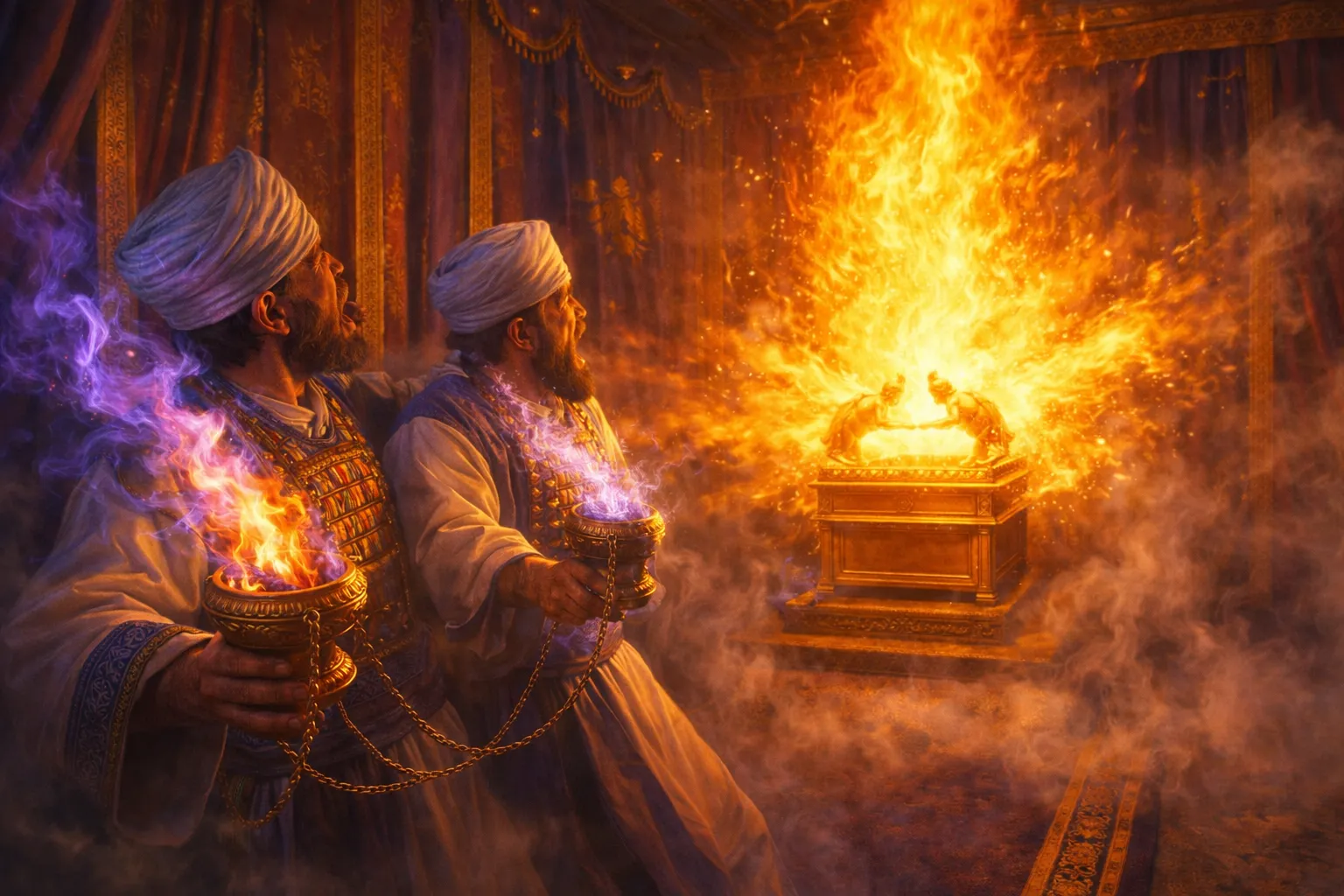
Tragically, spiritual privilege without trembling humility breeds fatal presumption. Intoxicated perhaps by their exalted status—and quite literally impaired by fermented wine, as evidenced by the sudden, solemn divine prohibition against alcohol while ministering that immediately followed (Leviticus 10:8-11)—the two brothers decided to stage their own liturgical innovation. Instead of waiting for Moses' instruction or Aaron's high priestly leadership, each man seized his personal bronze censer (firepan), put fire in it, piled sacred incense upon the embers, and boldly marched toward the sanctuary.
Scripture renders a devastating verdict upon their actions: they "offered strange fire (Esh Zarah) before Yahweh, which He had not commanded them" (Leviticus 10:1). The coals in their censers were 'strange'—alien, profane, illegitimate. They had not scooped them from the sacred embers of the heaven-kindled Brazen Altar; they had gathered them from a common secular hearth, treating the holy as ordinary. Furthermore, they barged unsummoned toward the inner veil, bypassing divine protocol to generate a self-styled, theatrical spiritual experience.
The Flash of Consuming Fire
The reaction of heaven was instantaneous and terrifying. Only moments before, fire had shot forth from Yahweh's presence to graciously consume the sacrificial animal on the altar. Now, that identical supernatural fire flashed once again from the sanctuary:
"So fire went out from Yahweh and devoured them, and they died before Yahweh" (Leviticus 10:2).
It was not a chaotic wildfire, nor an accidental chemical explosion. It was a targeted, laser-like stroke of divine holiness. The devouring flame (akal) flashed through their bodies, instantly extinguishing their life breath without even scorching their clothes! Their consecrated linen tunics, woven girdles, and turbans remained entirely unblemished—an eerie, chilling testimony that God had judged the rebellious spirits within while preserving their holy garments as a silent indictment.
The two young priests lay lifeless upon the sacred floor before the curtain of the sanctuary. The incense smoke still drifted lazily toward the desert sky, but the men who carried it were dead corpses. The celebration of Israel's national ordination had turned in a heartbeat into a funeral of terrifying majesty.
The Golden Standard of God's Holiness and Aaron's Silence
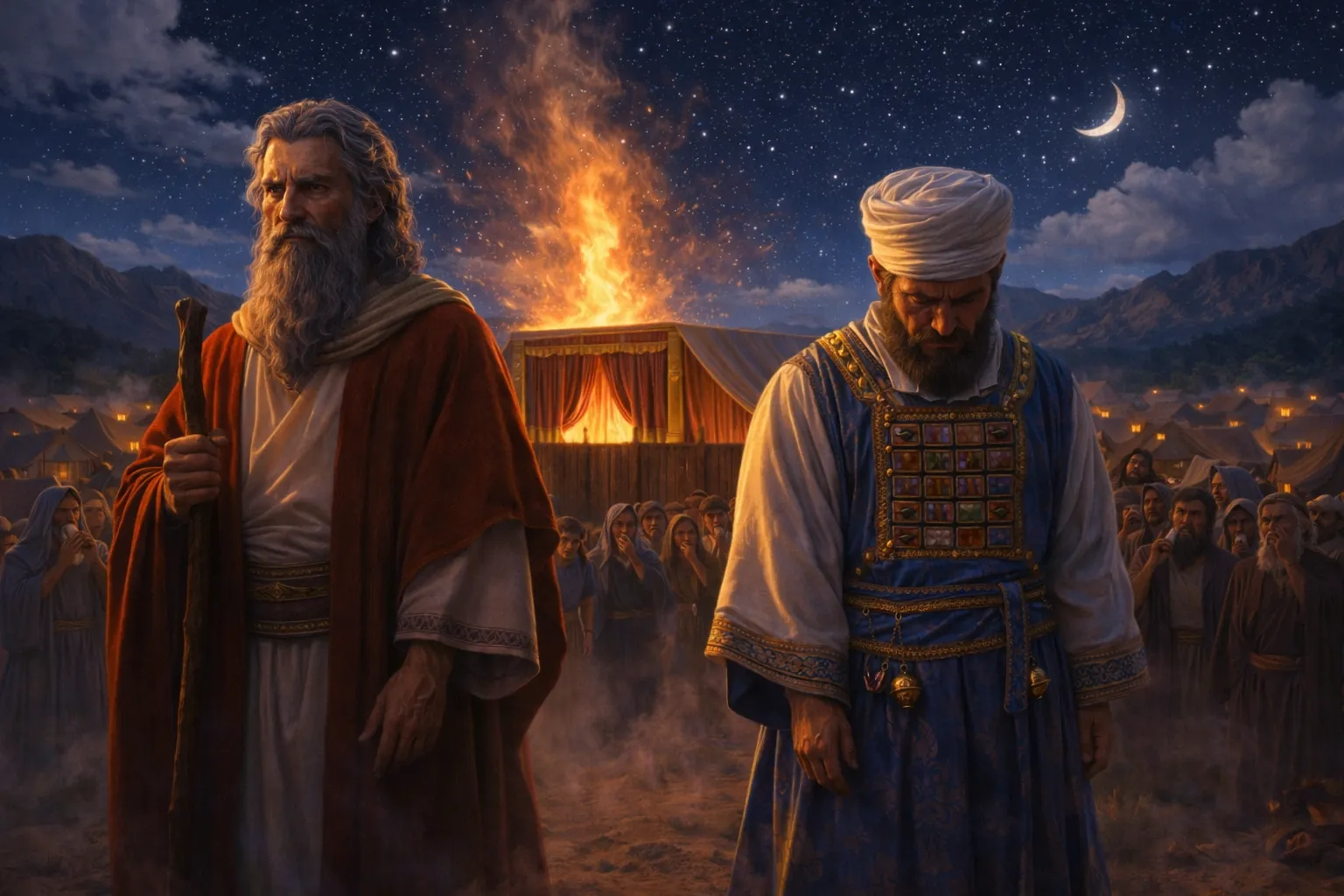
As Aaron stood paralyzed with horror, gazing upon the smoking bodies of his firstborn sons, Moses stepped forward. He did not offer sentimental platitudes or superficial condolences. With grave, prophetic solemnity, Moses uttered the absolute eternal standard of divine worship:
"This is what Yahweh spoke, saying: 'By those who come near Me I must be regarded as holy; and before all the people I must be glorified'" (Leviticus 10:3).
The closer a servant draws to the blazing light of God's presence, the less tolerance exists for carnal compromise. Those who minister in the holy things are not granted casual familiarity; they are entrusted with magnifying the absolute transcendence of the Creator. To treat God's explicit commands as negotiable preferences is to despise His majesty.
Then Scripture records three words of astonishing, heart-wrenching spiritual depth: "And Aaron held his peace" (Vayidom Aharon). Aaron was a father; his heart was undoubtedly ripped in two by unspeakable paternal grief. Yet Aaron was also the High Priest of Yahweh. In that agonizing silence, Aaron bowed his soul before the righteousness of God. He did not scream at the heavens, he did not accuse God of cruelty, nor did he excuse the reckless arrogance of his sons. He accepted the terrifying justice of heaven in mute, worshipful reverence.
The Funeral of Linen and the Eternal Statute
Moses immediately summoned Mishael and Elzaphan, the sons of Aaron's uncle Uzziel, and commanded them: "Come near, carry your brethren from before the sanctuary out of the camp." Clad in ordinary clothes, the cousins gingerly lifted the corpses by their intact linen tunics, carrying the disgraced priests through the silent, trembling rows of tents, dumping them outside the camp into the wilderness.
Turning to Aaron and his two surviving sons, Eleazar and Ithamar, Moses issued an extraordinary, rigorous command: "Do not uncover your heads nor tear your clothes, lest you die, and wrath come upon all the people. But let your brethren, the whole house of Israel, bewail the burning which Yahweh has kindled. You shall not go out from the door of the tabernacle of meeting, lest you die, for the anointing oil of Yahweh is upon you."
The High Priest could not engage in cultural displays of bereavement. The holy anointing oil of God consecrated him for a higher realm; to mourn the judgment of God would be to imply that God had acted unjustly. The nation could weep over the terrifying fire, but Aaron had to remain steadfast at the altar, demonstrating that God's glory surpasses the deepest ties of human flesh and blood. And Aaron, Eleazar, and Ithamar obeyed.
Immediately following this harrowing event, God spoke directly to Aaron—the only time in Leviticus where God addresses Aaron alone without Moses: "Do not drink wine or intoxicating drink, you, nor your sons with you, when you go into the tabernacle of meeting, lest you die. It shall be a statute forever throughout your generations, that you may distinguish between holy and unholy, and between unclean and clean, and that you may teach the children of Israel all the statutes which Yahweh has spoken" (Leviticus 10:9-11).
The tragedy of Nadab and Abihu remains an unyielding warning for every generation of believers. God is not a domesticated mascot to be worshiped according to human cultural whims, emotional thrills, or therapeutic entertainment. He is an all-consuming fire (Hebrews 12:29). While the New Covenant grants us bold, joyful access to the Throne of Grace through the sinless blood of Jesus Christ, that access was purchased at infinite cost. We are called to serve God with reverence and godly fear, never offering the 'strange fire' of our own self-righteous innovations, but approaching Him solely through the holy fire of the Holy Spirit and the finished sacrifice of the Lamb.
Biblical Keywords & Theological Roots
Strange, unauthorized, alien, profane, or illegitimate fire; fire originating from a common or pagan source rather than from the heaven-ignited coals of the Brazen Altar.
To draw near, approach, present oneself, or bring an offering before the holy presence; used technically of priestly access which demands absolute ritual purity and divine authorization.
To be consecrated, sanctified, treated as utterly sacred, or regarded as transcendent; encapsulated in God's decree: 'By those who come near Me I must be regarded as holy.'
To consume, devour, burn up, or eat; used of the terrifying supernatural fire of Yahweh that consumed the rebellious priests in instantaneous judgment.
To be silent, dumbfounded, held in stunned motionless awe, or struck dumb; describing Aaron's solemn submission to divine justice over the corpses of his sons.
Ancient Near Eastern & Archaeological Context
In ancient Near Eastern temple cults, particularly within Mesopotamian, Syrian, and Egyptian traditions, priests routinely manipulated ritual fire and incense to appease unpredictable deities or entice the gods into emotional intimacy. Personal innovation and charismatic performance by ritual practitioners were prized. The Torah instituted a radical polemic against such magical subjectivity: Israel's God was not manipulated by pagan ritualism. Sacred fire had fallen directly from heaven upon the Brazen Altar (Leviticus 9:24) and was legally commanded to be kept perpetually burning (Leviticus 6:12-13). Coals for incense had to be harvested exclusively from this heaven-kindled altar. By introducing alien coals (*esh zarah*)—likely sourced from a common secular domestic hearth—and possibly emboldened by intoxicating fermented wine (indicated by the immediate divine prohibition against alcohol in Leviticus 10:8-9), Nadab and Abihu committed high treason against the transcendent majesty of God.
Practical Discipleship & Spiritual Application
- God Alone Dictates the Terms of Acceptable Worship: Worship is not a venue for human entertainment, theatrical novelty, or carnal creativity. We cannot invent our own methodologies to please God; true worship must be regulated by Spirit and Truth (John 4:24).
- Spiritual Privilege Increases Accountability: Nadab and Abihu had climbed Mount Sinai and seen God's sapphire pavement (Exodus 24:9-10). Yet profound spiritual revelations did not shield them from the consequences of arrogant disobedience. Greater light demands greater consecration.
- Never Substitute Carnal Emotion for the Holy Spirit: Strange fire represents human energy masquerading as divine power. Guard your soul against emotional manipulation, superficial zeal, and unbiblical spiritual practices that mimic true holy revival.
- Silent Reverence Before Righteous Divine Judgments: When Aaron witnessed his sons' deaths, he 'held his peace' (Leviticus 10:3). He refused to charge God foolishly. When God disciplines or allows trials, surrender human complaining to His sovereign righteousness.
⚡ Fast Facts
- Nadab and Abihu were Aaron's two eldest sons, next in line for the High Priesthood of Israel.
- They had previously ascended Mount Sinai with Moses, Aaron, and the 70 elders, eating and drinking before the God of Israel (Exodus 24:9-11).
- The fire consumed their inner life breath, but their priestly linen tunics remained completely unburned (Leviticus 10:5).
- Aaron and his surviving sons, Eleazar and Ithamar, were strictly forbidden from mourning or tearing their garments because the anointing oil of Yahweh was upon them.
❓ Frequently Asked Questions (FAQs)
Scripture describes the fire as 'strange' (Esh Zarah) because it was 'fire which He had not commanded them' (Leviticus 10:1). Several specific liturgical violations occurred: First, the coals were not taken from the sacred Brazen Altar, where the perpetual, heaven-descended fire burned (Leviticus 6:12-13; 16:12), but likely from a common domestic cooking fire. Second, they approached at an unauthorized time, entering presumptuously toward the inner sanctuary behind the veil. Third, each acted independently without Moses' or Aaron's authorization. Fourth, the immediate context of Leviticus 10:8-9 suggests they may have been intoxicated with wine, clouding their judgment and moral discernment.
Leviticus 10:5 records that their cousins 'carried them in their tunics out of the camp, as Moses had said.' This detail underscores that their death was not a natural electrical burn or accidental flammable explosion, but a targeted, supernatural stroke of divine judgment. The consuming fire (*akal*) proceeded directly from the holy presence of Yahweh, striking dead the rebellion within their spirits and extinguishing their life without reducing the fabric of their consecrated garments to ashes. God judged the rebellious heart while leaving the sacred priestly uniform as a solemn witness.
Moses commanded Aaron and his surviving sons: 'Do not uncover your heads nor tear your clothes, lest you die, and wrath come upon all the people' (Leviticus 10:6). As the anointed High Priest, Aaron was the representative of the holy God and the intercessor for the whole nation. To engage in public cultural mourning rituals would signal disagreement with God's righteous judgment, implying that God was unjust in striking down the transgressors. Furthermore, the holy anointing oil of Yahweh was upon him; personal family grief could not supersede his supreme allegiance to the holiness and honor of God.